Sidehill Gouger
Kingdom: Animalia
Location found: North America (with related species found in parts of Europe)
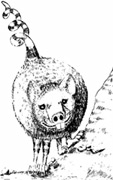
Sidehill gougers are herbivores highly adapted to living on steep hillsides. The legs on one side of their body are longer than the legs on the other, allowing them to stand comfortably on sloped terrain. These creatures come in two varieties: left-handed and right-handed (also known as counter-clockwise and clockwise gougers). The legs of a left-handed gouger are shorter on the left. As a result, it can only travel around a hill counter-clockwise. Right-handed gougers are just the opposite, with legs shorter on the right. They always move clockwise. This business of always moving in the same direction is the source of the gouger's name, because they gouge a path in the side of a hill as they endlessly circle it. If gougers do try to reverse direction, they inevitably topple over.Right-handed and left-handed gougers, it should be noted, are simply different forms of the same species and can breed together. However, their offspring often end up with mismatched legs (a long leg on their front left and a second long leg on their back right, for instance) making it almost impossible for them to move. Such hybrids usually don't survive long.
Beyond the unusual length of the gouger's legs, little is known about the appearance of this creature. Some say it's badger-like. Some say it's goat-like. One observer, a Harry S. Knight of Camp Wood, Arizona, has been quoted as saying: "A Sidehill Gouger is jest a burrowin' buffalo, sized down and growed crooked."
There have been reports of a Gouger sub-species found in the Appalachians that has fur only on the downward-sloping side of its body. The fur on its other side has been worn away by constant rubbing against the side of the hill. The skin of these creatures, being so highly polished and smooth, is sought after by handbag makers.
References to sidehill-type creatures can be found in records dating back hundreds of years. Sir Thomas Browne, writing in the 17th century, recorded a popular belief that British badgers (popularly referred to back then as "brocks") had legs of different lengths: "That a Brock or Badger hath the legs on one side shorter then of the other [which] though an opinion perhaps not very ancient, is yet very general; received not only by Theorists and unexperienced believers, but assented unto by most who have the opportunity to behold and hunt them daily." (Pseudodoxia Epidemica, 1646, Book III, Chapter 5, 'Of the Badger').
In colonial America sidehill-type creatures were referred to as "procks". Evidently a derivative of "brocks". Since then a wide variety of names have been given to these creatures, including: sidehill badger, sidehill winder, sidehill dodger, sidehill wowser, godaphro, and gyascutus. However, sidehill gouger is, by far, the most common name. Other sidehill creatures include the Rackabore, and the French Dahut. There have also been reports from Scotland of a Sidehill Haggis.

Total Comments: 11
Comments
Listed in chronological order. Newest comments at the end.
Page 1 of 1 pages
A sidehill Gouger
walks round a hill, don't turn round!
too late it fell off
Posted by J on Tue Oct 03, 2006 at 07:09 AM
The clockwise vs counter-clockwise nature of the sidehill gouger is frequently misunderstood. Different regions generally have a population of nearly 95% one or the other, and the poor 5% who face the opposite way have a very difficult time finding a mate who they can procreate with, as the majority of gougers they may encounter are facing the wrong way! It takes a very determined sidehill gouger to create "crossbred" offspring! The poor creatures in the minority are known to chase after anything they see in the trail that is facing the "right way."
Posted by John on Wed Jan 24, 2007 at 01:12 PM
That would leed to a situation similar to the Wampahoofus. The two genders faced different ways and they became extinct because they couldnt mate. In this case I think the 5 percent that you talked about would eventually become extinct. The two types are in fact different, but closely related sub-species.
Posted by Thisisnotadrillalienshaveinvadadedtheplanetearth on Mon Apr 02, 2007 at 03:04 AM
'Round the hill he goes
Day in, day out, all he knows
More greens 'round the bend
Posted by hazey in MA on Mon Jun 23, 2008 at 02:37 PM
OHMYGOSH, people have reached a different level of craziness. are you joking?
Posted by paula in CA on Sat Jul 05, 2008 at 04:25 PM
I must say that this is very refreshing. You see as a child my family owned a cottage on Charlotte Lake in Northern Ontario, Canada. My Grandfather was a Police officer with a twisted sense of humor and no idea how to act around children. When it was nap time he would come in our little room and lay down with us to tell stories. His favourite story was of the Sidehill Gouger he tried to convince us that one of these creatures lived in the forest all around the lake and terrorized the inhabitants. He told us that it was a squat pig shaped thing with a cabbage like face, sort of green and rough with bulging red eyes, and of course his favourite meal was misbehaving children. How rediculous it all seems now. However at the time my brother, sister and I were afraid to go to the outhouse alone.
His other favourite story was of the Flying Spokeshave. I'm looking that up next. =)
Posted by Madonna Charlotte in Ontario Canada on Sat Sep 13, 2008 at 07:53 AM
i saw the side hill gouger. it was terrifing. the legs and arms wre different lenghts, the teath were different leanghts one looked like a knife, when it ran it ran in circuls slowly geting bigger because of the different lenghts of the the legs and arms. The ears are huge like floppy bunny ears the fur is dark gray.
Posted by VO in USA on Sun Nov 02, 2008 at 01:19 PM
I read in "The Journal Of Irreproducible Results" some years ago about a study done on these creatures. Turns out the different "directions" (I'd say "handed" but they don't have hands, do they?) of Gougers do tend to live in colonies but where the colonies overlap, there is some interbreeding. Apparently it involves some Kama-Sutra-like positioning above and between boulders. Ah, the power of love! The study revealed that neither "direction" is dominant genetically, and therefore a variety of mixed offspring result from this interbreeding. The researchers referred to "Clockwise" and "Counterclockwise" Gougers (indicating which way they could circle a conical peak). Offspring with diagonally opposed legs were termed "Rockers". As noted above, they don't usually survive long, the exception being that they are very good at clambering over rockfalls, and can do quite well there. Other variants observed had both long legs on the rear, or both on the front. These were termed "Uphill" and "Downhill" respectively, as that is the way they faced to stay level. The "Downhill" ones typically die of drowning (they keep going downhill until they end up in a creek or pond). The "Uphill" ones keep climbing until they either fall to their death from a sheer-faced peak or starve to death at the summit of a less-craggy mountaintop. They don't die too quickly, so you can hear their moaning carried by the winds at night in the mountains.
Posted by Marko in Portland, Oregon on Thu Feb 12, 2009 at 07:01 PM
Sightings of left- and right-handed Sidehill Gougers migrating arm in arm across a plain have been reported, possibly explaining their large range of habitat.
Nothing is more tragic than the look of a mother Sidehill Gouger whose child is of the opposite orientation. They can only meet twice per circuit around the mountain.
Posted by Walter Bender in Newton, MA on Thu May 28, 2009 at 04:56 PM
have never seen anything of the kind, just have read a lot on the topic in different books (download mainly from http://www.picktorrent.com Thanks so much for the depth and understanding at which you covered the topic. it's a useful piece of information not only for me but for many others.I wish I could get to know more about all the unbelievable creatures the nature has in store!
Posted by helen on Tue Jul 28, 2009 at 05:49 AM
Otto Fife, the famous sheriff of Iron County, Utah, reported sightings in southern Utah up to the mid-twentieth century
Posted by David Andersen in Berlin, Germany on Wed Sep 30, 2009 at 10:10 AM
Page 1 of 1 pages
HOAX HAIKU
A sidehill Gouger
walks round a hill, don't turn round!
too late it fell off
(by J)
walks round a hill, don't turn round!
too late it fell off
(by J)