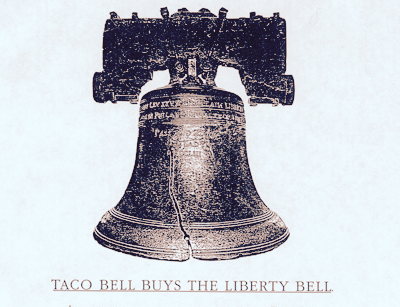
The Top 100 April Fool's Day Hoaxes of All Time

Because of high traffic to this site (and this page) around April 1st, I've had to make this a 'static.html' page, which means you can't see the comments that people have left about these hoaxes over the years (nor can you leave comments). Having the comments up was putting too much of a strain on the server. But return in about a week and they should be back up.
-Alex


#41: Don't Disturb the Squirrels
In 1993 Westdeutsche Rundfunk, a German radio station, announced that officials in Cologne had just passed an unusual new city regulation. Joggers going through the park would be required to pace themselves to go no faster than six mph. Any faster, it was felt, would unnecessarily disturb the squirrels who were in the middle of their mating season.
#42: Canadian Finance Minister Quits to Breed Cows and Ducks
In 2002 a rumor was posted on a Canadian gossip website, Bourque.org, alleging that the finance minister, Paul Martin, was quitting his job in order to breed "prize Charolais cattle and handsome Fawn Runner ducks." Martin, it was said, would be showing his livestock at a local fair in Havelock, a tiny Quebec town boasting a population of only 811. The Bank of Canada was also said to be ready to intervene in case the news rattled the currency markets. Of course, as soon as the word of Martin's retirement began to spread, the markets did get rattled, and the Canadian dollar promptly fell to its lowest level in a month. The currency only recovered once the minister's office denied the rumor. Pierre Bourque, the man behind bourque.org, readily admitted the story had been a hoax. "The ducks," he pointed out, "were the tell-tale sign."
#43: Tasmanian Mock Walrus
In 1984 the Orlando Sentinel featured a story about a creature known as the Tasmanian Mock Walrus (or TMW for short) that many people in Florida were adopting as a pet. The creature was only four inches long, resembled a walrus, purred like a cat, and had the temperament of a hamster. What made it such an ideal pet was that it never had to be bathed, it used a litter box, and it ate cockroaches. In fact, a single TMW could entirely rid a house of its cockroach problem. Reportedly, some TMWs had been smuggled in from Tasmania, and there were efforts being made to breed them, but the local pest-control industry was pressuring the government not to allow them into the country, fearing they would put cockroach exterminators out of business. Dozens of people called the paper trying to find out where they could obtain their own TMW. A picture of the Tasmanian Mock Walrus was included with the article, but what the picture actually showed was a real creature—the Naked Mole Rat. The Tasmanian Mock Walrus was entirely fictitious.
#44: Daylight Savings Contest
In 1984 the Eldorado Daily Journal, based in Illinois, announced a contest to see who could save the most daylight for daylight savings time. The rules of the contest were simple: beginning with the first day of daylight savings time, contestants would be required to save daylight. Whoever succeeded in saving the most daylight would win. Only pure daylight would be allowed—no dawn or twilight light, though light from cloudy days would be allowed. Moonlight was strictly forbidden. Light could be stored in any container. The contest received a huge, nationwide response. The paper's editor was interviewed by correspondents from CBS and NBC and was featured in papers throughout the country.
#45: Retrobreeding the Woolly Mammoth
In 1984 Technology Review published an article titled "Retrobreeding the Woolly Mammoth" that described an effort by Soviet scientists to bring the woolly mammoth species back from extinction. The technique being used was the insertion of DNA from woolly mammoths found frozen in Siberian ice into elephant cells. The cells were then brought to term inside surrogate elephant mothers. The head of the project was said to be Dr. Sverbighooze Yasmilov. The story was widely reported as a factual event.
#46: Hong Kong Powdered Water
In 1982 the South China Morning Post announced that a solution to Hong Kong's water shortage was at hand. Scientists, it said, had found a way to drain the clouds surrounding the island's peak of their water by electrifying them via antennae. The paper warned that this might have a negative impact on surrounding property values, but the government had approved the project nevetheless. Furthermore, more clouds could be attracted to the region by means of a weather satellite positioned over India. And finally, as a back-up, packets of powdered water imported from China would be distributed to all the residents of Hong Kong. A single pint of water added to this powdered water would magically transform into ten pints of drinkable water. Hong Kong's radio shows were flooded with calls all day from people eager to discuss these solutions to the water shortage. Many of the calls were very supportive of the plans, but one woman pointed out that the pumps needed to supply powdered water would be too complicated and expensive.
#47: British Weather Machine
In 1981 the Manchester Guardian reported that scientists at Britain's research labs in Pershore had "developed a machine to control the weather." The article, titled "Britain Rules the Skies," explained that "Britain will gain the immediate benefit of long summers, with rainfall only at night, and the Continent will have whatever Pershore decides to send it." Readers were also assured that Pershore scientists would make sure that it snowed every Christmas in Britain. Accompanying the article was a picture of a scruffy-looking scientists surrounded by scientific equipment. The picture was captioned, "Dr. Chisholm-Downright expresses quiet satisfaction as a computer printout announced sunshine in Pershore and a forthcoming blizzard over Marseilles."
#48: Mount Milton Erupts
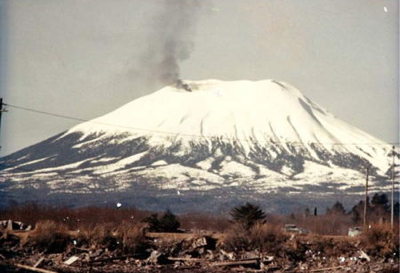
In 1980 the Channel 7 news in Boston ended with a special bulletin announcing that a 635-foot hill in Milton, Massachusetts, known as the Great Blue Hill, had erupted, and that lava and ash were raining down on nearby homes. Footage was shown of lava pouring down a hillside. The announcer explained that the eruption had been triggered by a geological chain reaction set off by the recent eruption of Mount St. Helens in Washington. An audio tape was played of President Carter and the Governor of Massachusetts declaring the eruption to be a "serious situation." At the end of the segment, the reporter held up a sign that read "April Fool." But by that time local authorities had already been flooded with frantic phone calls from Milton residents. One man, believing that his house would soon be engulfed by lava, had carried his sick wife outside in order to escape. The Milton police continued to receive worried phone calls well into the night. Channel 7 was so embarrassed by the panicked reaction that they apologized for the confusion later that night, and the executive producer responsible for the prank was fired.
#49: FatSox
In 2000 the British Daily Mail announced that Esporta Health Clubs had launched a new line of socks designed to help people lose weight. Dubbed "FatSox," these revolutionary socks could actually suck body fat out of sweating feet. The invention promised to "banish fat for ever." The socks employed a patented nylon polymer called FloraAstraTetrazine that had been "previously only applied in the nutrition industry." The American inventor of this polymer was Professor Frank Ellis Elgood. The socks supposedly worked in the following way: as a person's body heat rose and their blood vessels dilated, the socks drew "excess lipid from the body through the sweat." After having sweated out the fat, the wearer could then simply remove the socks and wash them, and the fat, away.
#50: Solar Complexus Americanus
In 1995 the Glasgow Herald described the recent arrival in Britain of a new energy-saving miracle: heat-generating plants. These plants, known by the scientific name Solar Complexus Americanus, were imports from Venezuela. One plant alone, fed by nothing more than three pints of water a day, generated as much heat as a 2kw electric fire. A few of these horticultural wonders placed around a house could entirely eliminate the need for a central-heating system. And when submerged in water, the plants created a constant supply of hot water. The Scandinavian botanist responsible for discovering these hot-air producers was none other than Professor Olaf Lipro (an anagram of April Fool).
Page 1 of 10 pages: 1, 2, 3, 4, 5, 6, 7, 8, 9, 10

Top 10 WORST April Fool's Day Hoaxes Ever

Get the Hoax Museum's Email Newsletter
PRANKPLACE.COM
MERCHANDISE

CLASSIC PRANKS:
Stink Bombs, etc.
Fake Winning Lottery Tickets
Embarrassing Envelopes
Smashed Window Pranks
Two-Headed Quarters


OFFICE PRANKS:
Electric-Shock Staplers
Rude Office Rubber Stamps
Gag Awards
Funny Office Cubicle Signs

CAR PRANKS:
Funny Auto Air-Fresheners
Magnetic Bumper Gags
Funny Bumper Stickers
Rude Fake Parking Tickets
Truck Nutz
Fake Bullet Holes


FART AND TOILET PRANKS:
Fart-Scented Candles
Farting Telephone
Fart Detector (really works)
Untearable Toilet Paper


OTHER STUFF:
Inflatable Deer Head
Obnoxious Garden Gnomes
Trailer Trash Barbie Doll
Funny Inflatable Dolls
Drinking Games & Gifts
Obnoxious Gift Wrap
Funny Posters
MY BOOK
Museum of Hoaxes the Book
A History of Outrageous Pranks and Deceptions

HOAX MUSEUM T-SHIRTS
image