The Top 100 April Fool's Day Hoaxes of All Time
Because of high traffic to this site (and this page) around April 1st, I've had to make this a 'static.html' page, which means you can't see the comments that people have left about these hoaxes over the years (nor can you leave comments). Having the comments up was putting too much of a strain on the server. But return in about a week and they should be back up.
-Alex
#11: UFO Lands in London

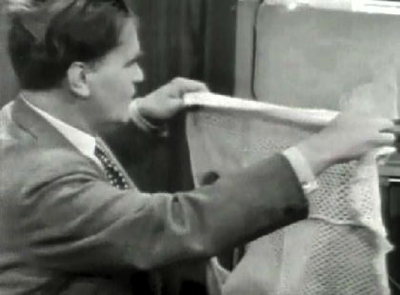
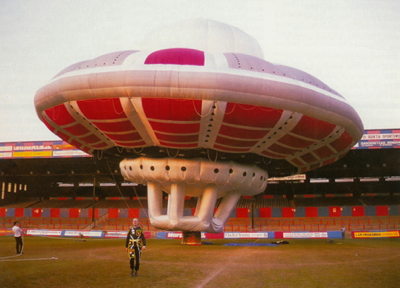
On March 31, 1989 thousands of motorists driving on the highway outside London looked up in the air to see a glowing flying saucer descending on their city. Many of them pulled to the side of the road to watch the bizarre craft float through the air. The saucer finally landed in a field on the outskirts of London where local residents immediately called the police to warn them of an alien invasion. Soon the police arrived on the scene, and one brave officer approached the craft with his truncheon extended before him. When a door in the craft popped open, and a small, silver-suited figure emerged, the policeman ran in the opposite direction. The saucer turned out to be a hot-air balloon that had been specially built to look like a UFO by Richard Branson, the 36-year-old chairman of Virgin Records. The stunt combined his passion for ballooning with his love of pranks. His plan was to land the craft in London's Hyde Park on April 1. Unfortunately, the wind blew him off course, and he was forced to land a day early in the wrong location.
#12: Kremvax
In 1984, back in the Stone Age of the internet, a message was distributed to the members of Usenet (the online messaging community that was one of the first forms the internet took) announcing that the Soviet Union was joining Usenet. This was quite a shock to many, since most assumed that cold war security concerns would have prevented such a link-up. The message purported to come from Konstantin Chernenko (from the address chernenko@kremvax.UUCP) who explained that the Soviet Union wanted to join the network in order to "have a means of having an open discussion forum with the American and European people." The message created a flood of responses. Two weeks later its true author, a European man named Piet Beertema, revealed that it was a hoax. This is believed to be the first hoax on the internet. Six years later, when Moscow really did link up to the internet, it adopted the domain name 'kremvax' in honor of the hoax.
#13: The Predictions of Isaac Bickerstaff
In February 1708 a previously unknown London astrologer named Isaac Bickerstaff published an almanac in which he predicted the death by fever of the famous rival astrologer John Partridge. According to Bickerstaff, Partridge would die on March 29 of that year. Partridge indignantly denied the prediction, but on March 30 Bickerstaff released a pamphlet announcing that he had been correct: Partridge was dead. It took a day for the news to settle in, but soon everyone had heard of the astrologer's demise. On April 1, April Fool's Day, Partridge was woken by a sexton outside his window who wanted to know if there were any orders for his funeral sermon. Then, as Partridge walked down the street, people stared at him as if they were looking at a ghost or stopped to tell him that he looked exactly like someone they knew who was dead. As hard as he tried, Partridge couldn't convince people that he wasn't dead. Bickerstaff, it turned out, was a pseudonym for the great satirist Jonathan Swift. His prognosticatory practical joke upon Partridge worked so well that the astrologer finally was forced to stop publishing his almanacs, because he couldn't shake his reputation as the man whose death had been foretold.
#14: The Eruption of Mount Edgecumbe
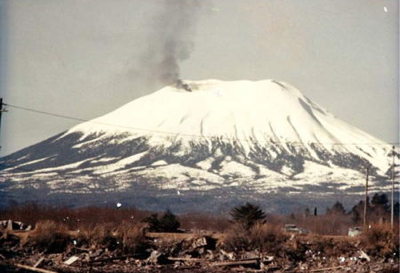
In 1974 residents of Sitka, Alaska were alarmed when the long-dormant volcano neighboring them, Mount Edgecumbe, suddenly began to belch out billows of black smoke. People spilled out of their homes onto the streets to gaze up at the volcano, terrified that it was active again and might soon erupt. Luckily it turned out that man, not nature, was responsible for the smoke. A local practical joker named Porky Bickar had flown hundreds of old tires into the volcano's crater and then lit them on fire, all in a (successful) attempt to fool the city dwellers into believing that the volcano was stirring to life. According to local legend, when Mount St. Helens erupted six years later, a Sitka resident wrote to Bickar to tell him, "This time you've gone too far!"
#15: The Case of the Interfering Brassieres
In 1982 the
Daily Mail reported that a local manufacturer had sold 10,000 "rogue bras" that were causing a unique and unprecedented problem, not to the wearers but to the public at large. Apparently the support wire in these bras had been made out of a kind of copper originally designed for use in fire alarms. When this copper came into contact with nylon and body heat, it produced static electricity which, in turn, was interfering with local television and radio broadcasts. The chief engineer of British Telecom, upon reading the article, immediately ordered that all his female laboratory employees disclose what type of bra they were wearing.
#16: Wisconsin State Capitol Collapses

In 1933 the Madison Capital-Times solemnly announced that the Wisconsin state capitol building lay in ruins following a series of mysterious explosions. The explosions were attributed to "large quantities of gas, generated through many weeks of verbose debate in the Senate and Assembly chambers." Accompanying the article was a picture showing the capitol building collapsing. By modern standards the picture looks slightly phony, but readers in 1933 were fooledand outraged. One reader wrote in declaring that the hoax "was not only tactless and void of humor, but also a hideous jest."
#17: The Sydney Iceberg

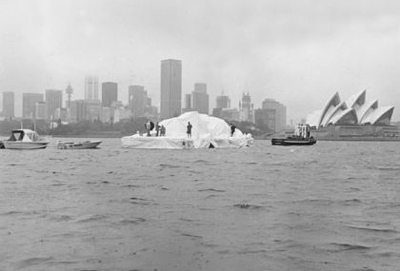
On April 1, 1978 a barge appeared in Sydney Harbor towing a giant iceberg. Sydneysiders were expecting it. Dick Smith, a local adventurer and millionaire businessman (owner of Dick Smith's Foods), had been loudly promoting his scheme to tow an iceberg from Antarctica for quite some time. Now he had apparently succeeded. He said that he was going to carve the berg into small ice cubes, which he would sell to the public for ten cents each. These well-traveled cubes, fresh from the pure waters of Antarctica, were promised to improve the flavor of any drink they cooled. Slowly the iceberg made its way into the harbor. Local radio stations provided excited blow-by-blow coverage of the scene. Only when the berg was well into the harbor was its secret revealed. It started to rain, and the firefighting foam and shaving cream that the berg was really made of washed away, uncovering the white plastic sheets beneath.
#18: The 26-Day Marathon

In 1981 the
Daily Mail ran a story about an unfortunate Japanese long-distance runner, Kimo Nakajimi, who had entered the London Marathon but, on account of a translation error, thought that he had to run for 26 days, not 26 miles. The
Daily Mail reported that Nakajimi was now somewhere out on the roads of England, still running, determined to finish the race. Supposedly various people had spotted him, though they were unable to flag him down. The translation error was attributed to Timothy Bryant, an import director, who said, "I translated the rules and sent them off to him. But I have only been learning Japanese for two years, and I must have made a mistake. He seems to be taking this marathon to be something like the very long races they have over there."
#19: Webnode
In 1999 a press release was issued over Business Wire announcing the creation of a new company called Webnode. This company, according to the release, had been granted a government contract to regulate ownership of 'nodes' on the 'Next Generation Internet.' Each of these nodes (there were said to be over 50 million of them) represented a route that data could travel. The company was licensed to sell each node for $100. Nodes would increase in value depending on how much traffic they routed, and owners would also receive usage fees based on the amount of data that flowed across their section of the internet. Therefore, bidding for the nodes was expected to become quite intense. Offers to buy shares in Webnode soon began pouring in, but they all had to be turned down since the company was just a prank. There really was a Next Generation Internet, but there were no nodes on it. Business Wire didn't find the prank amusing and filed suit against its perpetrators for fraud, breach of contract, defamation, and conspiracy.
#20: 15th Annual New York City April Fool's Day Parade
In 2000 a news release was sent to the media stating that the 15th annual New York City April Fool's Day Parade was scheduled to begin at noon on 59th Street and would proceed down to Fifth Avenue. According to the release, floats in the parade would include a "Beat 'em, Bust 'em, Book 'em" float created by the New York, Los Angeles, and Seattle police departments. This float would portray "themes of brutality, corruption and incompetence." A "Where's Mars?" float, reportedly built at a cost of $10 billion, would portray missed Mars missions. Finally, the "Atlanta Braves Baseball Tribute to Racism" float would feature John Rocker who would be "spewing racial epithets at the crowd." CNN and the Fox affiliate WNYW sent television news crews to cover the parade. They arrived at 59th Street at noon only to discover that there was no sign of a parade, at which point the reporters realized they had been hoaxed. The prank was the handiwork of
Joey Skaggs, an experienced hoaxer. Skaggs had been issuing press releases advertising the nonexistent parade every April Fool's Day since 1986.
Page 1 of 10 pages:
1,
2,
3,
4,
5,
6,
7,
8,
9,
10
Text copyright © 2005 Alex Boese