Status: Urban Legend
One of the many catalogs I receive is the
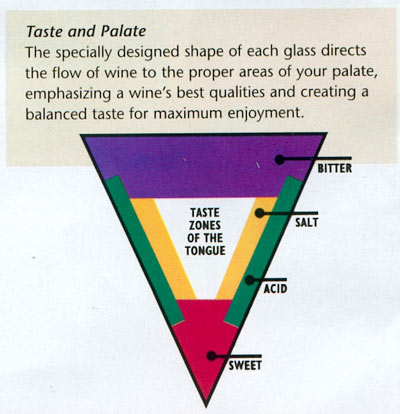
Wine Enthusiast. On the inside cover of the catalog I received last week is a description of Symphony Stemware wine glasses which are supposedly "designed and shaped to enhance the best characteristics of every wine." Accompanying this claim is a map of the tongue with the following caption:
"The specially designed shape of each glass directs the flow of wine to the proper areas of your palate, emphasizing a wine's best qualities and creating a balanced taste for maximum enjoyment."
Symphony isn't the only company to use a tongue map to promote their glasses. Riedel uses the same gimmick in their marketing. The thing is, from what I understand, the tongue map is a completely bogus idea. The tongue is not divided into taste regions. And even if it were, no glass is going to be able to direct flavors to one specific area of the tongue.
An article from the August 2004 issue of
Gourmet magazine ("Shattered Myths" by Daniel Zwerdling... I can't find a link to it), tackled the tongue-map myth at some length and thoroughly debunked it:
"The tongue map? That old saw?" scoffs Linda Bartoshuk when I reach her at her laboratory at the Yale Univerity School of Medicine. Bartoshuk has done landmark studies on how people taste. "No, no. There isn't any 'tongue map.'"
Wait a minute: When you sip Pinot Noir from the correct Riedel glass, won't it maximize the fruit flavors by rushing the wine to the "sweet" zone on the tip of your tongue? When you serve a Chardonnay with too much fruit, won't the correct glass balance the flavors by directing the wine to the "acid" spots near the middle? "Nope," Bartoshuk laughs. "It's wrong." She and other scientists have proved that you can taste salty, sweet, and bitter everywhere on the tongue where there are taste buds. "Your brain doesn't care where taste is coming from in your mouth," Bartoshuk says. "And researchers have known this for thirty years."
The Wikipedia article on
taste buds also debunks the idea of the tongue map:
"Contrary to popular understanding, taste is not experienced on different parts of the tongue. The 'tongue map myth' was based on a mistranslation of a German paper that was written in 1901 by a Harvard psychologist. Though there are small differences in sensation, which can be measured with highly specific instruments, all taste buds can respond to all types of taste."

 One of the many catalogs I receive is the Wine Enthusiast. On the inside cover of the catalog I received last week is a description of Symphony Stemware wine glasses which are supposedly "designed and shaped to enhance the best characteristics of every wine." Accompanying this claim is a map of the tongue with the following caption:


Comments
Of course that was before I started going to private school. (Blame LBUSD, I guess.)
On the Food Network show "Unwrapped" (admittedly not the most scientific of sources), they were explaining why chili peppers are hot. The idiots explanation (the ones I understand best), basically compared taste buds to locks and different tastes to keys, each key or flavor unlocking a specific lock or taste bud. Now, they did not say anything about a "tongue map" or even that specific areas of the tongue were for specific flavors, only what I said above.
They then went to explain that the compound that gives chili's their fire, "capsaicin", was best compared to a lockpick as in that it could fit into all locks (taste buds). This sounds logical enough to me but the last sentence in the article makes me doubt it's validity.
"Though there are small differences in sensation, which can be measured with highly specific instruments, all taste buds can respond to all types of taste."
damnit, if you can't trust the Food Network, who can you trust?
I had to do an assignment on the tongue map for science class, we all had different soltuions(salty, sweet) and swabs and had to measure everybodies ability in class for detection, correlate stats etc.
Come to think of it, we did get meaningful results too. Did we fool ourselves that much just to pass?
More to the topic: I'd love to see better cites about the debunking and the research. What if the debunking isn't reliable? If we just accept that one quote, we're as bad as folks who credulously accept any other info-bite.
Shall we get onto MSG being the 5th taste sense, or just accept that was just an MSG promotion?
Me too, with me its taste dulls a little bit on my right side. It does it with popsicles too.
I hate it.
However, even if it were true that different parts of the tongue are capable of tasting different flavors, that's still a ridiculous argument for a certain shape of wine glass. No matter what kind of glass (or Mason jar or whatever) you drink from, the wine goes all over your mouth and tongue if you're drinking halfway normally. Doesn't it?
More traditional arguments for certain shapes of wine glasses have to do with things like how much air the wine is exposed to, how fast the carbonation escapes (from sparkling wines), how much the drink gets warmed in the hand (commonly used for brandy snifters), etc., not what happens after you get the wine out of the glass and into your mouth.
I prefer jelly glasses, myself.
While waiting for the kids to go to sleep, I found more about the tongue issue, should you be interested. I think it's fascinating.
http://faculty.washington.edu/chudler/news84.html
NEUROSCIENCE FOR KIDS NEWSLETTER by the University of Washington. The Book Reviews section covers the tongue map myth.
http://www.uniklinik-saarland.de/med_fak/physiol1/LDM/chemotopic_1.htm
Collection of References Regarding the Chemotopic Organization of Taste -- summary with many citations.
http://www.aromadictionary.com/articles/tonguemap_article.html
Summary of paper from 1974 with the new info, and how the misunderstanding occurred, with images from the 1901 paper.
Yes, I remember something about this, too. And specifically that if you couldn't smell them, then raw apple, raw potato and raw onion actually all taste the same.
I was also taught that we had different taste receptors around our tongues.
And it ruins one of my favorite jokes too, the one about the cheerleader in biology class who wants to know why semen doesn't taste sweet. 😊
The thing about smell being linked to taste is quite true. That old brain teaser, "If you had to pick one sense to lose, which would you pick?" is a loaded question for that very reason. Most people will pick Smell to lose, reasoning that smell is the sense they rely on the least--not realizing that it's a raw deal, since you would lose about half your sense of Taste along with it.
If you don't believe it, here's an experiment to try: the next time you eat roast beef, hold your nose. The savory flavor of roast beef relies almost entirely on aroma--without the smell, you can hardly detect any flavor at all, just the mass and texture of the meat on your tongue. Honest, it works, try it.
as for holding your nose, the sense of smell will enhance the sense of taste but the lack of smell will not completely remove the taste from an object, so certain bland foods may taste similar if eaten while holding your nose.
John Starrett