Get MOH Blog Posts by Email
Recent Forum Posts
| • | Autism caused by pollution? 06/19/2013 |
| • | Some things are not what they seem. 06/19/2013 |
| • | 15 seconds of fame 06/17/2013 |
| • | Happy Birthday, NEO! 06/17/2013 |
| • | Maybe soon we can sing Happy Birthday to You in public without having to pay for it. 06/15/2013 |
| • | Croakus-Interruptus 06/14/2013 |
| • | HAPPY ANNIVERSARY Neo and Carmen! 06/13/2013 |
| • | I've funded THIS! 06/12/2013 |
| • | German bank employee naps on keyboard, transfers millions 06/12/2013 |
| • | BBC article on Pareidolia 05/31/2013 |
![]() | |
| |
| |
| |
| |
| |
| |
| |
|
Site Map
Blog Categories
Advertising |
Animals |
April Fools Day |
Art |
Bad Excuses |
Birth/Babies |
Body Manipulation |
Books |
Business/Finance |
Celebrations |
Celebrities |
Con Artists |
Conspiracy Theories |
Crop Circles |
Cryptozoology |
Nessie |
Death |
eBay |
Education |
Email Hoaxes |
Entertainment |
Exploration/Travel |
Extraterrestrial Life |
Fashion |
Folklore/Tall Tales |
Food |
Free Energy |
Future/Time |
Gnomes |
Gross |
Hate Crimes/Terror |
Health/Medicine |
History |
Identity/Imposters |
Journalism |
Law/Police/Crime |
Literature/Language |
Magic |
Mass Delusion |
Military |
Miscellaneous |
Music |
Paranormal |
Pareidolia |
Photos/Videos |
Places |
Politics |
Pranks |
Products |
Pseudoscience |
Psychology |
Radio |
Religion |
Scams |
Science |
Sex/Romance |
Social Networking Sites |
Sports |
Technology |
Urban Legends |
Videos |
Websites
Blog Archives
May, 2013 |
April, 2013 |
March, 2013 |
February, 2013 |
January, 2013 |
October, 2012 |
September, 2012 |
August, 2012 |
July, 2012 |
June, 2012 |
May, 2012 |
April, 2012 |
March, 2012 |
February, 2012 |
January, 2012 |
December, 2011 |
November, 2011 |
October, 2011 |
September, 2011 |
August, 2011 |
November, 2010 |
April, 2010 |
January, 2010 |
December, 2009 |
November, 2009 |
October, 2009 |
September, 2009 |
August, 2009 |
July, 2009 |
June, 2009 |
May, 2009 |
April, 2009 |
March, 2009 |
February, 2009 |
January, 2009 |
December, 2008 |
November, 2008 |
October, 2008 |
September, 2008 |
August, 2008 |
July, 2008 |
June, 2008 |
May, 2008 |
April, 2008 |
March, 2008 |
February, 2008 |
January, 2008 |
December, 2007 |
November, 2007 |
October, 2007 |
September, 2007 |
August, 2007 |
July, 2007 |
June, 2007 |
May, 2007 |
April, 2007 |
March, 2007 |
February, 2007 |
January, 2007 |
December, 2006 |
November, 2006 |
October, 2006 |
September, 2006 |
August, 2006 |
July, 2006 |
June, 2006 |
May, 2006 |
April, 2006 |
March, 2006 |
February, 2006 |
January, 2006 |
December, 2005 |
November, 2005 |
October, 2005 |
September, 2005 |
August, 2005 |
July, 2005 |
June, 2005 |
May, 2005 |
April, 2005 |
March, 2005 |
February, 2005 |
January, 2005 |
December, 2004 |
November, 2004 |
October, 2004 |
September, 2004 |
August, 2004 |
July, 2004 |
June, 2004 |
May, 2004 |
April, 2004 |
March, 2004 |
February, 2004 |
January, 2004 |
December, 2003 |
November, 2003 |
October, 2003 |
September, 2003 |
August, 2003 |
July, 2003 |
June, 2003 |
May, 2003 |
January, 2003 |
November, 2002 |
October, 2002 |
September, 2002 |
August, 2002 |
July, 2002 |
Weblog Category
Scams
Scams
I found the following story posted in the March 3, 1944 issue of the Carteret Press (scanned and hosted by the Woodbridge, NJ Public Library):

But I'm having trouble understanding exactly how the scam would have been profitable. First, if the car was a rental, wouldn't it have been easy to find out the identity of the scammer? Unless, of course, he used a fake ID to rent the car. Second, some kind of deposit must have been required by the rental agency. By abandoning the car, the scammer would have lost this deposit. But if he took in more from the victims than he lost on the deposit, I suppose this wouldn't matter.
Perhaps I just answered my own questions!

MOTOR TRIP HOAX
Los Angeles — A new kind of hoax was pulled when four men answered an ad asking for passengers on a trip to Raleigh, N.C. The driver picked them up, collected $50 from each and then stopped at the post office. He went inside and that was the last the passengers saw of him. The car had been rented.
But I'm having trouble understanding exactly how the scam would have been profitable. First, if the car was a rental, wouldn't it have been easy to find out the identity of the scammer? Unless, of course, he used a fake ID to rent the car. Second, some kind of deposit must have been required by the rental agency. By abandoning the car, the scammer would have lost this deposit. But if he took in more from the victims than he lost on the deposit, I suppose this wouldn't matter.
Perhaps I just answered my own questions!

I came across the above complaint in Gleanings in Bee Culture (1896). It seems that a door-to-door salesman was going around selling something he called "Prof. Humbolt's Electric-Light Fluid," which had absolutely nothing to do with electricity or electric lighting. The term "electric" was thrown into just about every product name back then to make products sound more scientific and modern.
As far as I can tell from the description, this "electric-light fluid" was a powder (not a fluid!) that people could add to the kerosene or coal oil in lamps. Supposedly it made the lamps burn brighter, smoke less, and reduced the risk of them exploding. Kind of like those fuel additives that are sold today that are supposed to increase your car's mileage per gallon.
Of course, as the complaint indicates, Prof. Humbolt's electric-light fluid did absolutely nothing, except separate people from their money.
Recently the "202 Market" bar in Roanoke, VA advertised that it was going to be hosting the famous Chippendales dancers. But soon it had to retract its announcement and admit that it had fallen victim to a scam. It had been deceived by a group of frauds posing as the Chippendales Chippenfakes, you might call them. [roanoke.com]
Apparently the Roanoke bar isn't alone in falling for this scam. Kevin Denberg, manager of the real Chippendales, warns that there are a number of fraudulent groups trying to pass themselves off as the Chippendales. The official Chippendales website even has a form that allows fans to report any fakes.
What I find interesting is that if a bar books one of these Chippenfakes, a group of men actually does show up and perform. Denberg insists that they are a "subpar product" when compared to the real deal, but you have to wonder how bad are they? Really bad? Or would most people not notice the difference?
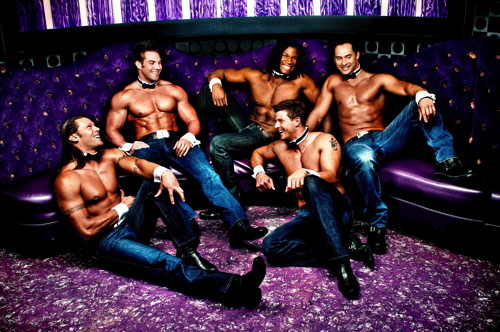
The real Chippendales

The fake Chippendales?
Denberg also reveals that these imposters are usually the same handful of individuals. So perhaps it's a group of ex-Chippendales dancers gone rogue. Or a group of bitter men who tried out for the Chippendales but didn't make the cut.
The good news for Chippendales fans in Roanoke is that the real ones have agreed to stage a performance there in December. The scheduled date is 12/12/12, which, coincidentally, is the day the world ends. So it should be quite a show.

Apparently the Roanoke bar isn't alone in falling for this scam. Kevin Denberg, manager of the real Chippendales, warns that there are a number of fraudulent groups trying to pass themselves off as the Chippendales. The official Chippendales website even has a form that allows fans to report any fakes.
What I find interesting is that if a bar books one of these Chippenfakes, a group of men actually does show up and perform. Denberg insists that they are a "subpar product" when compared to the real deal, but you have to wonder how bad are they? Really bad? Or would most people not notice the difference?

The real Chippendales

The fake Chippendales?
Denberg also reveals that these imposters are usually the same handful of individuals. So perhaps it's a group of ex-Chippendales dancers gone rogue. Or a group of bitter men who tried out for the Chippendales but didn't make the cut.
The good news for Chippendales fans in Roanoke is that the real ones have agreed to stage a performance there in December. The scheduled date is 12/12/12, which, coincidentally, is the day the world ends. So it should be quite a show.

The consumer affairs office of the state of Massachusetts has created a series of phony websites designed to teach people how to avoid online scams. The sites advertise products such as work-at-home deals, weight-loss products, and free trips. If anyone tries to order something from these sites, they're directed to a page identifying it as a scam and telling them how they could have spotted the scam. My favorite one is the "Envelope Elf" site.
The SEC did something similar back in 2002. It created a hoax site for McWhortle Enterprises, Inc. The idea was to teach investors that just because a company has a website, that doesn't mean it's a legitimate business.
The SEC actually registered the domain name mcwhortle.com. The Massachusetts consumer affairs office, however, parked all its hoax sites at the same domain: http://topmassachusettsdeals.com I thi.nk they should have paid the $20 and registered envelope-elf.com.
The SEC did something similar back in 2002. It created a hoax site for McWhortle Enterprises, Inc. The idea was to teach investors that just because a company has a website, that doesn't mean it's a legitimate business.
The SEC actually registered the domain name mcwhortle.com. The Massachusetts consumer affairs office, however, parked all its hoax sites at the same domain: http://topmassachusettsdeals.com I thi.nk they should have paid the $20 and registered envelope-elf.com.
I'm assuming the scammers must stuff the potatoes inside a laptop box. Otherwise I'm not sure how they convince their victims to walk away with a bag of potatoes instead of a laptop.
Manchester police appeal over potato laptop fraud
bbc.co.uk
Police say at least four people have been approached by two men offering to sell them a laptop or iPhone. One man paid up to £1,400 and walked away with a rucksack full of potatoes. Other victims received bottles of soft drinks. Police said the conmen spoke with an Eastern European accent.
bbc.co.uk
Police say at least four people have been approached by two men offering to sell them a laptop or iPhone. One man paid up to £1,400 and walked away with a rucksack full of potatoes. Other victims received bottles of soft drinks. Police said the conmen spoke with an Eastern European accent.
|
Categories: Law/Police/Crime, Scams Posted by Alex on Wed May 16, 2012 |
Comments (0) |
Accipiter already posted about this in the forum, but the story is odd enough that it deserves to be on the front page.
Back in 2007, two teenage twins from North Tyneside, Alexander and Thomas Hunter, began selling a stock newsletter in which they recommended stocks supposedly selected by an AI robot named Marl. Investors could also pay to get advice through a variety of websites run by the twins, daytradingrobot.com, doublingstocks.com, and equitypromoter.com. Or would-be millionaires could get a version of Marl to run on their computer at home. The brothers advertised that "The longer Marl is allowed to run on a computer… The More Advanced He Becomes!"
The reality: Marl didn't exist. It was the twins who were picking the stocks. The home version of Marl simply displayed whatever ticker symbols the brothers told it to. And often they would pick companies that had paid for that honor. Links: Yahoo! Finance, BBC News
The brothers' websites no longer are up, and they were never archived by the wayback machine. But here's a few of their banner ads that I managed to find:

Back in 2007, two teenage twins from North Tyneside, Alexander and Thomas Hunter, began selling a stock newsletter in which they recommended stocks supposedly selected by an AI robot named Marl. Investors could also pay to get advice through a variety of websites run by the twins, daytradingrobot.com, doublingstocks.com, and equitypromoter.com. Or would-be millionaires could get a version of Marl to run on their computer at home. The brothers advertised that "The longer Marl is allowed to run on a computer… The More Advanced He Becomes!"
The reality: Marl didn't exist. It was the twins who were picking the stocks. The home version of Marl simply displayed whatever ticker symbols the brothers told it to. And often they would pick companies that had paid for that honor. Links: Yahoo! Finance, BBC News
The brothers' websites no longer are up, and they were never archived by the wayback machine. But here's a few of their banner ads that I managed to find:


|
Categories: Business/Finance, Scams Posted by Alex on Mon Apr 23, 2012 |
Comments (0) |
It's kinda hard to know who, if anyone, to feel sympathy for here. (Thanks, Bob!)
Lawyer falls for Nigerian e-mail scam, sues Wells Fargo
bizjournals.com
An Edina law firm that lost nearly $400,000 in a Nigerian wire-fraud scam is claiming that Wells Fargo, which handled the fund transfers, should cover its losses. The Star Tribune reports on the lawsuit by Milavetz, Gallop & Milavetz, which three years ago received an e-mail from someone purporting to be a Korean woman who needed the firm's help to collect a settlement... In his suit, Robert Milavetz argues that Wells Fargo & Co. should have recognized the red flags involved.
bizjournals.com
An Edina law firm that lost nearly $400,000 in a Nigerian wire-fraud scam is claiming that Wells Fargo, which handled the fund transfers, should cover its losses. The Star Tribune reports on the lawsuit by Milavetz, Gallop & Milavetz, which three years ago received an e-mail from someone purporting to be a Korean woman who needed the firm's help to collect a settlement... In his suit, Robert Milavetz argues that Wells Fargo & Co. should have recognized the red flags involved.
|
Categories: Law/Police/Crime, Scams Posted by Alex on Wed Apr 11, 2012 |
Comments (0) |
At least 10 people in Vancouver who bought iPad 2s have reported opening up the packaging only to discover it contained a slab of modeling clay, not an iPad. It's an old strategy for thieves to conceal their crime by replacing the item in the box with something of lesser value. Reminds me of the case from 2006 of the Hawaiian boy who opened an iPod box on Christmas Day, only to discover it contained a package of meat. Link: Yahoo!
|
Categories: Law/Police/Crime, Scams, Technology Posted by Alex on Fri Jan 20, 2012 |
Comments (1) |
Over the weekend I received the following letter in the mail from UST Development, Inc.:

I had no idea who this company was, or why I owed them money. Nevertheless, my first reaction was to assume that the invoice must somehow be related to one of the contractors I've had work on my house during the past year -- and that I should therefore probably pay it. But then my more suspicious instincts kicked in, and I decided to google the company.
The first result that popped up was scaminformer.com, on which quite a few people were reporting having received the identical letter -- even though no one had ever heard of this company before, or done any business with them.
This company is evidently hoping that some people will simply pay the phony invoice without bothering to check it out first. And they're probably right.
I noticed that the invoice says: "Thank you for your business. This is not a statement for services rendered but for preventative maintenance."
The company probably hopes that this weasel phrasing provides them with some legal protection. Although I'm sure that the only preventative maintenance that would be achieved by paying them would be to prevent their bank account from getting lower.
I've already filed a complaint with the California Attorney General about the invoice. And, of course, I'm posting about it here to help spread the word.

I had no idea who this company was, or why I owed them money. Nevertheless, my first reaction was to assume that the invoice must somehow be related to one of the contractors I've had work on my house during the past year -- and that I should therefore probably pay it. But then my more suspicious instincts kicked in, and I decided to google the company.
The first result that popped up was scaminformer.com, on which quite a few people were reporting having received the identical letter -- even though no one had ever heard of this company before, or done any business with them.
This company is evidently hoping that some people will simply pay the phony invoice without bothering to check it out first. And they're probably right.
I noticed that the invoice says: "Thank you for your business. This is not a statement for services rendered but for preventative maintenance."
The company probably hopes that this weasel phrasing provides them with some legal protection. Although I'm sure that the only preventative maintenance that would be achieved by paying them would be to prevent their bank account from getting lower.
I've already filed a complaint with the California Attorney General about the invoice. And, of course, I'm posting about it here to help spread the word.
Police are warning that a fake Salvation Army bell ringer is on the loose in Topeka, Kansas:
I never give to the Salvation Army anyway. (Yes, I'm a scrooge). So I'm pretty much immune to this scam.
Related posts:
The "freelance ringer," as Yockey termed the man, had worked for the Salvation Army for the holiday season but began to show up late for his shifts. Then, the day before he was fired, the man placed a Santa hat atop his red kettle and told passersby that the kettle was full and to place money in the hat.
He was then fired.
But on Sunday, when ringers don't work but many of the racks holding the kettles are still out, the man went to the store at S.W. 10th and Topeka and attached a hat to the stand. He then began asking for money.
An astute shopper noticed the man and, knowing the Salvation Army doesn't ring on Sundays, called it in.
He was then fired.
But on Sunday, when ringers don't work but many of the racks holding the kettles are still out, the man went to the store at S.W. 10th and Topeka and attached a hat to the stand. He then began asking for money.
An astute shopper noticed the man and, knowing the Salvation Army doesn't ring on Sundays, called it in.
I never give to the Salvation Army anyway. (Yes, I'm a scrooge). So I'm pretty much immune to this scam.
Related posts:
A new site debuted three days ago: The Con Artist Hall of Infamy. It's tagline is:
As interesting as the site itself is the fact that it's being bankrolled by two billionaires, Warren Hellman and Arthur Rock, who decided that there needed to be a site devoted to offering the big picture on fraudsters and con artists.
Billionaires with an interest in promoting knowledge about the history of deception! In my fantasies someone like that offers to bankroll the Museum of Hoaxes. Unfortunately, in reality the only people who ever contact me with offers of large sums of money are Nigerian bankers.
Finally there is a place to induct the champions of greed and deception.
As interesting as the site itself is the fact that it's being bankrolled by two billionaires, Warren Hellman and Arthur Rock, who decided that there needed to be a site devoted to offering the big picture on fraudsters and con artists.
Billionaires with an interest in promoting knowledge about the history of deception! In my fantasies someone like that offers to bankroll the Museum of Hoaxes. Unfortunately, in reality the only people who ever contact me with offers of large sums of money are Nigerian bankers.