The Museum of Hoaxes
HOME   |   ABOUT   |   FORUM   |   CONTACT   |   PINTEREST   |   FACEBOOK   |   TWITTER   |   RSS
The Top 100
April Fool Hoaxes
Of All Time
April Fool's Day
Gallery
Hoax Photo
Archive

Weblog Category
Nessie
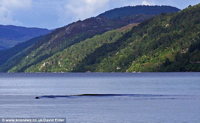
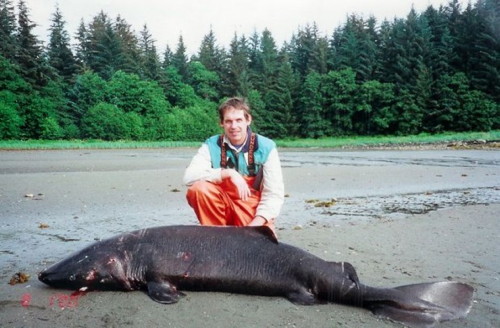
Alaska biologist Bruce Wright, writing in the Alaska Dispatch, offers a new theory to explain Nessie sightings — as well as sightings of 'monsters' in other lakes, such as Alaska's Lake Iliamna. He thinks people may actually have been seeing Pacific Sleeper Sharks. Despite the name, this type of shark is found circumglobally in northern waters and could have made its way into Loch Ness. Wright elaborates:
The idea of sharks possibly using Loch Ness is not new; that's long been one of the hypotheses explaining the Loch Ness Monster. But until now, nobody has suggested sleeper sharks, perhaps because they're secretive and so rarely seen.
Sleeper sharks can exceed 20 feet and weigh upwards of 4 tons. Sleeper sharks probably use rivers and lakes to find food, and there is an abundance of salmon and other fish in Loch Ness and Lake Iliamna.
Sightings are often consistent with descriptions of sleeper sharks in that the monsters' shape and colors usually match that of sleeper sharks. Salmon and lots of other prey species have been found in sleeper sharks' stomachs.

He's planning an expedition to Loch Ness in 2013 to see if he can catch a sleeper shark there on video. Given how many other people have tried and failed (or tried and hoaxed) to get photographic evidence of large marine animals there, he has a difficult task ahead of him.


Bruce Wright posing with a sleeper shark
Categories: Nessie
Posted by Alex on Fri May 11, 2012
Comments (2)
Marcus Atkinson, skipper of a Loch Ness tourist boat, noticed something strange on his sonar fish finder: a long, snake-like object at a depth of 75 ft. (In the image, the green line to the left of the number 25.) So he quickly snapped a picture of the sonar screen with his mobile phone. The picture recently won him bookmaker William Hill's Best Nessie Sighting of The Year Award.


Of course, the scientists have to throw cold water on the excitement of all the Nessie fans. Dr Simon Boxall, of the National Oceanography Centre in Southampton, says:
The image shows a bloom of algae and zooplankton that would exist on what would be a thermocline. Zooplankton live off this algae and reflect sound signals from echo sounders and fish finders very well. They will appear as a linear “blob” on the screen, just like this. This is a monster made of millions of tiny animals and plants and represents the bulk of life in the Loch.

Links: express.co.uk, dailymail.co.uk.
Categories: Cryptozoology, Nessie
Posted by Alex on Mon Apr 23, 2012
Comments (1)
An article by Nick Redfern on mania.com discusses the theory that the Loch Ness Monster (and Bigfoot) may be "phantimals". That is, "the spirits or ghosts of creatures that became extinct thousands of years ago." This theory is promoted by paranormal expert Joshua P. Warren, author of Pet Ghosts, who argues that "the world’s most famous lake-monster, Nessie, might actually represent some form of 'ghostly plesiosaur,' rather than a literal, living animal or colony of animals."

Nice theory. But what I found more interesting was the next part of the article, in which Redfern discusses the research of Jim Marrs, author of PSI Spies, who learned that during some of the U.S. government's experiments with remote viewing (the Stargate Project perhaps?) remote viewers were asked to focus on Nessie and detail what they saw:

Several sessions targeting the famous Loch Ness monster revealed physical traces of the beast – a wake in the water, movement of a large body underwater. Their drawings even resembled a prehistoric plesiosaur, often identified as matching descriptions of Nessie. But when the viewers tried to discover where the object came from or returned to, they hit a dead end. The creature seemed to simply appear and disappear. Considering that reports of human ghosts date back throughout man’s history, the Psi Spies seriously considered the possibility that the Loch Ness monster is nothing less than a dinosaur’s ghost.

And here I went all the way to Loch Ness to see Nessie. I could have just stayed in San Diego and remote viewed her.
Categories: Cryptozoology, Nessie, Paranormal
Posted by Alex on Wed Aug 31, 2011
Comments (8)
Apparently, it's golf balls. From cnn.com:

It seems the simple plastic golf ball is increasingly becoming a major litter problem. The scale of the dilemma was underlined recently in Scotland, where scientists -- who scoured the watery depths in a submarine hoping to discover evidence of the prehistoric Loch Ness monster -- were surprised to find hundreds of thousands of golf balls lining the bed of the loch. It is thought tourists and locals have used the loch as an alternative driving range for many years.

It would be kind of sad if Nessie died choking on a golf ball.
Categories: Cryptozoology, Nessie
Posted by Alex on Tue Nov 10, 2009
Comments (8)
Nessie Hunter Robert Rines died of heart failure yesterday in his Boston home. From Boston.com:

He was 87 and had spent the past 37 years lending his hefty intellectual bona fides to the search for a creature in the waters of Loch Ness.
"It looked like the back of an elephant," he told the Globe in 1997, recalling that moment in 1972 when he looked out the window of a friend's house in Scotland during a tea party and watched the curve of something he couldn't identify repeatedly disturb the water's surface. "I know there was a big unknown thing in that lake. That's why I haven't let go."
Categories: Cryptozoology, Nessie
Posted by Alex on Mon Nov 02, 2009
Comments (3)
According to the Daily Mail, recently released documents from the archives of the British Natural History Museum reveal that in 1987 the Museum struck a deal with the bookmaker William Hill. The Museum agreed that, should the body of the Loch Ness Monster ever be found, the Museum would provide "positive identification." Only if it receives a positive id, will the bookmaker pay out on bets about the creature's existence. (It offers odds of 500/1 on the Loch Ness Monster being found within a year.)

It seems like a pretty good deal for the Museum, since the bookmaker pays them £1,000 per year to maintain the contract.
Categories: Cryptozoology, Nessie
Posted by Alex on Wed Sep 16, 2009
Comments (6)
I missed this while on vacation. A security guard looking at Google Earth in his sparetime found what he believes might be evidence of the Loch Ness monster. Almost everyone else thinks it looks obviously like a boat, except for Loch Ness researcher Adrian Shine who is quoted as saying it looks "really intriguing" and deserves "further study."

Categories: Cryptozoology, Nessie
Posted by Alex on Fri Sep 04, 2009
Comments (4)