The Museum of Hoaxes
HOME   |   ABOUT   |   FORUM   |   CONTACT   |   PINTEREST   |   FACEBOOK   |   TWITTER   |   RSS
The Top 100
April Fool Hoaxes
Of All Time
April Fool's Day
Gallery
Hoax Photo
Archive

Weblog Category
Science
This YouTube video demonstrates a physics trick right out of high-school science -- how to take a glass of water and a glass of whiskey and swap their contents, without using a third glass. It relies on the principle that whiskey is lighter than water and will float on top of it. The funny part is not the video, which is fairly straightforward, but rather the comments left by YouTube viewers, many of whom seem to think the video must have been faked. I guess they weren't paying attention in high-school science. I had a bottle of cheap whiskey on hand (Rebel Yell), so I tried the experiment myself, and I can attest that it definitely works. You just have to make sure not to allow the whiskey and water to mix too quickly, otherwise they'll combine together and you'll end up with two glasses of watered-down whiskey.

Categories: Photos/Videos, Science
Posted by Alex on Thu May 17, 2007
Comments (8)
image One of the stranger rumors I encountered in the course of writing Elephants on Acid was the suggestion that Hillary Clinton participated in a menstrual synchrony study while she was a student at Wellesley College during the 1960s. Stranger still, I haven't been able to disprove this.
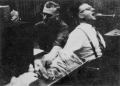
Here are the facts. In 1968, Martha McClintock, while a senior at Wellesley College in Massachusetts, convinced all 135 of her dormmates to participate in a study of the phenomenon of synchronous menstruation. She recorded the date of onset of their menstrual cycles three times during the academic year. Her hypothesis was that their cycles would synchronize as the year progressed, and this is what her data showed. She published an article about her study in a 1971 issue of Nature (1971, 229: 244-245). It remains a highly regarded study.

Hillary Clinton (then Hillary Rodham) was also a senior at Wellesley in 1968. This raises the possibility that she participated in McClintock's study. There were about 400 students in the senior class, which make the odds pretty good that Hillary participated in the study. (A third of the class participated.) The question is: Did the two women (Rodham and McClintock) live in the same dorm?

In her autobiography, Clinton writes, "During my junior and senior years, Johanna Branson and I lived in a large suite overlooking Lake Waban, on the third floor of Davis." McClintock, however, has never revealed what dorm she conducted her study in. I emailed her and asked, thinking that maybe she could say that she didn't conduct the study in Davis, even if she couldn't reveal where she did conduct it. She simply replied, "I cannot answer this question due to privacy regulations."

This leaves open the possibility that Hillary did participate in McClintock's study. I emailed the Clinton campaign, but they never responded to me. My hunch, however, is that she didn't participate in it. It seems like the kind of thing that would be more widely publicized if it were true.

Of course, it doesn't really matter whether she did participate in the study or not. Although if she did, it would be interesting as a piece of biographical trivia. Hillary Clinton herself would seem to be the only person who can confirm or deny the rumor.
Categories: Birth/Babies, Celebrities, Science
Posted by Alex on Wed May 09, 2007
Comments (7)
image Back in the early 1960s Stanley Milgram conducted a famous experiment at Yale University. Volunteers were told that it was designed to test the effect of punishment on learning. Would a person learn a list of word pairs better if they were punished every time they got an answer wrong? The volunteer was instructed to deliver an electric shock to the learner every time one of his answers was wrong. The shocks increased in intensity for every wrong answer. Of course, the experiment wasn't actually about the effect of punishment on learning at all. It was really designed to see how long the volunteers would obey the authority of the researcher. Would they continue to give electric shocks to the learner even when it appeared that doing so would kill the learner? Over sixty percent of them went ahead and gave the shock. They were led to believe that they had killed or seriously injured the learner (who was actually just an actor).

Milgram's experiment is one of the most famous experiments of all time. But it provoked a lot of controversy about whether it was ethical. Often the volunteers were reduced to nervous wrecks as they struggled over whether to continue obeying the researcher, or to refuse to do so. No review board would ever approve such an experiment today.

Mel Slater, a Computer Science researcher at University College London, has announced a possible way around these ethical concerns. He replicated Milgram's experiment using a virtual learner. LiveScience reports:
When the virtual woman gave an incorrect answer, the participants were told to give a virtual 'electric shock' that buzzed to her, increasing the voltage each time she gave an incorrect answer... Over time, she responded with increasing discomfort and protests, eventually demanding the experiment stop. Near the end, her head would slump forward and she became unresponsive... 17 gave all 20 shocks and three gave 19 shocks, 18, 16 and 9 shocks were given by one person each. When volunteers were asked whether they had considered aborting the experiment, nearly half of those who could see and hear the virtual woman indicated they had because of their troubled feelings about what was happening. In addition, their heart rates indicated that participants reacted as though the situation was real.
I don't know. I'm having a hard time buying that a virtual learner could ever substitute for a real, living, breathing learner. However you parse it, thinking you've killed a virtual character is not the same as thinking you've killed a real person. It's like saying Milgram could have used mannequins instead of real people. It just wouldn't have been the same.
Categories: Psychology, Science
Posted by Alex on Thu Dec 21, 2006
Comments (28)
The stardust spacecraft spent seven years collecting outer-space dust in large sheets of aerogel. Now it's back on Earth and researchers have enlisted the help of internet users to find microscopic specks of dust in the aerogel. They taken 1.6 million images of the gel with a scanning microscope and are distributing these to volunteers. Already some people have found signs of life. Unfortunately it's not extraterrestrial life:
On its first day, the website shut down due to heavy traffic. And a few hours after re-opening, it had a stranger problem. In among the speckled grey aerogel pictures appeared photos of weddings, bike riders, sunbathers and more. As the Stardust team put it: "Random images of unknown origin appear in the focus movies. We do not yet understand their origin, but they are not images of the Stardust Interstellar Dust Collector." Amused volunteers speculated about hackers, mischievous team members or problems with the server.
And things get worse, because a lot of the internet volunteers are cheating:
The system randomly checks volunteers' efforts by occasionally throwing in a 'test' photo, where the Stardust team already knows there is or isn't a sign of a dust particle. The volunteer's performance on these gives them a skill rating, which determines how seriously a claim to find a real dust particle is taken. As was quickly documented on the website's forums, however, it is easy to cheat by simply looking carefully at the URL associated with each picture in order to distinguish 'test' pictures from the real ones that have yet to be analysed. Some users have cracked the trick admirably, boosting their skill ratings astronomically in a short period of time.
Categories: Extraterrestrial Life, Science
Posted by Alex on Tue Aug 15, 2006
Comments (11)
Bonsai Contortionist
Hugo Zamoratte is known as 'The Bottle Man' and has the ability to dislocate almost every bone in his body.

Playing Astronauts
The Haughton Mars Project's research and development of ways to survive in space seem like a dream come true for big kids.

Cardboard Office
Mike, a keen prankster, pushed his co-workers too far. It was probably a mistake to then take a few days away from the office.

Lobster Pinches Wallet
A man who lost his wallet during a late-night swim was surprised when it turned up in the claws of a lobster caught by a diver.
Categories: Animals, Entertainment, Pranks, Science, Technology
Posted by Flora on Mon Aug 14, 2006
Comments (12)
I attended an episcopalian high school, which meant that I had to sit through a chapel service every day. Thankfully the services were never fire-and-brimstone stuff. These were Episcopalians, after all. Instead, they were most often like general-interest lectures. But one service in particular has stuck in my mind, during which whoever was giving the service described an unusual experiment involving the relationship between rats and God. I think the experiment might be an interesting addition to my next book, so I'm trying to track down details about it. But so far I've been unsuccessful. So I'm hoping that one of the Museum of Hoaxes readers might know something about it.

The experimenters, so it was said, wanted to test empirically if the universe tends more towards benevolence (good) or malevolence (evil). So they attached two sets of wires to some rats. One wire delivered a painful shock. The other wire triggered a pleasure-center in the rat's brain and made them feel good. The researchers then programmed a computer to randomly activate these wires over a period of time. The activation of the wires was supposed to be totally random, but when the researchers measured which wire got turned on more often, they discovered that it was the pleasure wire. From this they concluded that there must be a benevolent force in the universe (i.e. God) that favors pleasure over pain.

Now, I can see many flaws in the design and conclusions of this experiment. Not least of which is that a benevolent God would never have made the rats suffer by making them endure the experiment in the first place. But that's not the point. The point is that it's a very odd experiment... if it ever really did occur. Or is it just one of those urban legends that circulate through the church community. Anyone know any details?
Categories: Science
Posted by Alex on Sat Aug 05, 2006
Comments (17)
Status: Highly questionable
A company called Aquiess, led by David Miles, claims to have developed technology that can bring rain to drought-ridden areas. Sounds a bit dubious to me, but Miles has managed to convince some farmers in Geelong, Australia that this is the real deal. The farmers have hired him on the agreement that they'll pay him if it rains. So if it doesn't rain, they remain out of luck. And if it does rain, they're going to pay some guy for something that is probably due to natural causes. According to the Aquiess homepage the technology somehow works via blasting weather systems with electromagnetic pulses:
oceanic rainfall is sought from outside the sovereign territory of the Commonwealth of Australia, and drawn into the desired regional target utilizing licensed resonance technology.
Oh, and it can prevent hurricanes too:
weather downgrade capability (W-V) is the aquiess program, involving remote weather observation, algorithms, software and hardware systems utilized to target severe weather patterns via pulses which act to de-intensify those patterns.
Chris Sounness, a climate specialist for the Department of Primary Industries, issued a press release recently blasting the Aquiess weather modification claims, calling them a cruel hoax and saying that:
"Leading climate researchers across Australia confidently state that resonance technology is not based on any peer-reviewed science. The current duping of farmers builds hopes and if it doesn't rain, causes anguish."
But Aquiess seems to have its supporters in the government, such as federal Member for Mallee John Forrest who has stated that:
"Whoever in the department signed that press release should be tarred and feathered... If David Miles is right he'll be a hero. I'm behind him 100 per cent and I've had a gut full."
Personally, I think the farmers would be better off praying for rain like the residents of Lubbock are doing. At least that's free.
Categories: Science
Posted by Alex on Sun Jul 30, 2006
Comments (6)
Status: Prank
Here's a slight variation on the old dihydrogen monoxide prank. The director of the Waterfront Park in Louisville, Ky placed signs around the fountains warning people of dangerously high levels of hydrogen in the water:
It seems authorities, tired of swimmers splashing around in the fountains and leery of the possibility of bacteria developing in the water, were hoping the public would be scared away by the foreboding signs — even though there was nothing amiss. David Karem, executive director of the Waterfront Development Corp., said he had the signs made in the hopes that a lack of understanding of the chemical makeup of water and the association of hydrogen to dangerous weapons such as the hydrogen bomb would keep the fountains people-free... Unfortunately for Karem, the hot summer days and a few good students have him fighting what he knows might be a losing battle.
I figure it's only a matter of time before someone sues him for emotional distress caused by the signs.
Categories: Pranks, Science
Posted by Alex on Thu Jul 20, 2006
Comments (17)
Status: Scholarly debate
Last weekend Philadelphia celebrated the anniversary of Benjamin Franklin's electric kite experiment (in which he flew a kite during a thunderstorm and proved that lightning was a form of electricity). They did so despite the fact that many believe the experiment was a hoax... that it never happened. The Philadelphia Inquirer provides a summary of this debate.

The main proponent of the electric-kite-hoax theory is Tom Tucker, author of Bolt of Fate: Benjamin Franklin and his Electric Kite Hoax. (I noted the publication of his book back in 2003 when it first appeared in print.) Tucker points out that a) "Franklin did not publicize the kite flight until four months later, and then only with a passing mention in the Pennsylvania Gazette"; b) Franklin would have been very stupid to perform such an experiment because it could very easily have killed him; and c) Franklin was a known trickster and a great self-publicist who would not have been above taking credit for something he never did. Defenders of Franklin argue that all of Tucker's evidence is circumstantial. Personally, I'm inclined to believe the hoax theory. I think that Franklin would have been too smart to try such a deadly experiment. But, of course, it's the kind of thing historians can argue about until they're blue in the face. Ultimately there's no definitive evidence to prove that Franklin did or did not perform the experiment.

Update: Since Captain Al pointed out that the kite experiment wouldn't be deadly with some simple safety modifications, let me clarify exactly what Tucker's argument is. Tucker notes that Franklin had been sending the British Royal Society reports about his electricity experiments, but that these reports were being marginalized, mainly because the members of the RS regarded him as an uncouth American. So Tucker suggests that Franklin, frustrated at how he was being treated, sent the RS a report of the deadly electric kite experiment as a joke. It was basically the scientific equivalent of giving them the finger... suggesting that they go fly a kite in a thunderstorm. Franklin knew, and the RS members knew, that doing so could be fatal. But when the report reached France, people there took it seriously. So Franklin, knowing a good PR opportunity when he saw it, played along and began claiming that he really had done the experiment. That's the jist of Tucker's argument.
Categories: History, Science
Posted by Alex on Wed Jun 21, 2006
Comments (26)
Status: Apparently True
Tom Robinson, a mild-mannered professor of Accounting living in Florida, has been identified as a descendant of the fierce Mongol warlord, Genghis Khan. When informed of his ancestor, Robinson expressed admiration for the Mongol leader, but has not yet indicated any plans to begin a campaign of raping and pillaging.

Although it sounds odd, the science behind the claim seems valid enough. It stems from a 2003 genetic study that identified Genghis Khan as the common ancestor of 8 percent of Asian men. A British company, Oxford Ancestors, searched its client database to find more matches with Genghis Khan and identified Tom Robinson as one of his descendants. He is the first man of European or American background to be so identified. Here's how the match was made:
The link is revealed by the Y chromosome, a packet of DNA that determines male sex, which is passed down from father to son. Men who share a Y chromosome are invariably descended from the same man at some point in the past, and the accumulation of mutations can be used to date the common ancestor. Women do not have a Y chromosome, so they cannot be tested in the same way, although millions are likely also to be descended from the warlord.
The Mongolian embassy is going to be holding a reception in Robinson's honor next month. Like I said, the science seems sound enough, but the entire article about this guy reads like an extended advertisement for Oxford Ancestors, which is now inviting the general public (men only) to submit DNA samples to find out if they too are descended from Genghis Khan. It'll cost you only £195.
Categories: History, Science
Posted by Alex on Wed May 31, 2006
Comments (16)
Status: Myth
image According to Wikipedia, the Casimir Effect (which is real) is "a physical force exerted between separate objects, which is due to neither charge, gravity, nor the exchange of particles, but instead is due to resonance of all-pervasive energy fields in the intervening space between the objects." The effect is best observed with things such as parallel plates of metal in a vacuum.

Another example often used to illustrate the effect is that it can be seen operating on ships lying close together in a strong swell because "waves with wavelengths longer than the distance between the ships would be suppressed in the space separating them. This could perhaps pull the ships together."

But Nature.com reports that former NASA scientist Fabrizio Pinto has challenged this notion. The claim about the Casimir Effect acting on ships apparently traces back to a 1996 article by Dutch scientist Sipko Boersma, who came across a statement in an 1836 nautical book warning that "two ships should not be moored too close together because they are attracted one towards the other by a certain force of attraction." Pinto found a copy of this 1836 book and discovered that it was talking about ships moored in a calm sea, not in a strong swell. But Pinto is suspicious even of this claim. Nature reports:
Pinto says he hasn't found any real evidence for the effect, in either sailing or scientific literature. Naval architect Jason Smithwick of Southampton University says he has never heard of such an effect. "I could imagine how it might possibly happen, but it would take a very specific set of circumstances," he told .(JavaScript must be enabled to view this email address). "It's nothing that naval architects have ever worried about." Pinto thinks that the whole tale is symptomatic of physicists' approach to the history of their subject. "Physicists love lore about their own science," he says. "There are other stories that are unfounded historically."
Nature lists a few of these other popular (but false) stories that physicists like to tell, including the claim that Galileo proved objects fall at the same speed by throwing things off the leaning tower of Pisa, or that Newton was inspired to discover the law of gravity after an apple fell on his head.
Categories: Science
Posted by Alex on Sat May 06, 2006
Comments (6)
Status: anti-counterfeit technology
Last year I posted about a group of MIT students who created an Automatic Scientific Paper Generator, capable of creating "random Computer Science research papers, including graphs, figures, and citations." One of the papers created by this program was accepted for presentation at the World Multi-Conference on Systemics, Cybernetics and Informatics. To stop something like this happening again, researchers at the Indiana University School of Informaics have invented an Inauthentic Paper Detector. It's supposed to be able to tell whether a paper has been written by a human or a machine. The researchers write: "The main purpose of this software is to detect whether a technical document conforms to the statistical standards of an expository text... We are trying to detect new, machine written texts that are simply generated not to have any meaning, yet appear to have meaning on the surface."

I tested the Inauthentic Paper Detector by having it analyze the last couple of entries I've written. It told me: "This text had been classified as INAUTHENTIC with a 38.4% chance of being authentic text." I guess this confirms the theory that the real Alex drowned in Loch Ness back in September 2004 and was replaced by replicant Alex. (via New Scientist)
Categories: Identity/Imposters, Science
Posted by Alex on Fri Apr 28, 2006
Comments (15)
Page 5 of 11 pages ‹ First  < 3 4 5 6 7 >  Last ›