Get MOH Blog Posts by Email
Recent Forum Posts
| • | Wow! 05/10/2013 |
| • | Authorities are leaning more toward zero tolerance of teenagers 05/06/2013 |
| • | Lady Light 05/06/2013 |
| • | ET's Visit Earth, aid US Government 05/05/2013 |
| • | Happy Birthday, Robin Bobcat! 05/03/2013 |
| • | Very tiny robot uprising 05/02/2013 |
| • | Return of the living not-really-dead! 05/02/2013 |
| • | A Belated Happy Birthday To Accipiter! 05/01/2013 |
| • | World's Smallest Movie 05/01/2013 |
| • | UFOs now available in blue and yellow 05/01/2013 |
![]() | |
| |
| |
| |
| |
| |
| |
| |
|
Site Map
Blog Categories
Advertising |
Animals |
April Fools Day |
Art |
Bad Excuses |
Birth/Babies |
Body Manipulation |
Books |
Business/Finance |
Celebrations |
Celebrities |
Con Artists |
Conspiracy Theories |
Crop Circles |
Cryptozoology |
Nessie |
Death |
eBay |
Education |
Email Hoaxes |
Entertainment |
Exploration/Travel |
Extraterrestrial Life |
Fashion |
Folklore/Tall Tales |
Food |
Free Energy |
Future/Time |
Gnomes |
Gross |
Hate Crimes/Terror |
Health/Medicine |
History |
Identity/Imposters |
Journalism |
Law/Police/Crime |
Literature/Language |
Magic |
Mass Delusion |
Military |
Miscellaneous |
Music |
Paranormal |
Pareidolia |
Photos/Videos |
Places |
Politics |
Pranks |
Products |
Pseudoscience |
Psychology |
Radio |
Religion |
Scams |
Science |
Sex/Romance |
Social Networking Sites |
Sports |
Technology |
Urban Legends |
Videos |
Websites
Blog Archives
May, 2013 |
April, 2013 |
March, 2013 |
February, 2013 |
January, 2013 |
October, 2012 |
September, 2012 |
August, 2012 |
July, 2012 |
June, 2012 |
May, 2012 |
April, 2012 |
March, 2012 |
February, 2012 |
January, 2012 |
December, 2011 |
November, 2011 |
October, 2011 |
September, 2011 |
August, 2011 |
November, 2010 |
April, 2010 |
January, 2010 |
December, 2009 |
November, 2009 |
October, 2009 |
September, 2009 |
August, 2009 |
July, 2009 |
June, 2009 |
May, 2009 |
April, 2009 |
March, 2009 |
February, 2009 |
January, 2009 |
December, 2008 |
November, 2008 |
October, 2008 |
September, 2008 |
August, 2008 |
July, 2008 |
June, 2008 |
May, 2008 |
April, 2008 |
March, 2008 |
February, 2008 |
January, 2008 |
December, 2007 |
November, 2007 |
October, 2007 |
September, 2007 |
August, 2007 |
July, 2007 |
June, 2007 |
May, 2007 |
April, 2007 |
March, 2007 |
February, 2007 |
January, 2007 |
December, 2006 |
November, 2006 |
October, 2006 |
September, 2006 |
August, 2006 |
July, 2006 |
June, 2006 |
May, 2006 |
April, 2006 |
March, 2006 |
February, 2006 |
January, 2006 |
December, 2005 |
November, 2005 |
October, 2005 |
September, 2005 |
August, 2005 |
July, 2005 |
June, 2005 |
May, 2005 |
April, 2005 |
March, 2005 |
February, 2005 |
January, 2005 |
December, 2004 |
November, 2004 |
October, 2004 |
September, 2004 |
August, 2004 |
July, 2004 |
June, 2004 |
May, 2004 |
April, 2004 |
March, 2004 |
February, 2004 |
January, 2004 |
December, 2003 |
November, 2003 |
October, 2003 |
September, 2003 |
August, 2003 |
July, 2003 |
June, 2003 |
May, 2003 |
January, 2003 |
November, 2002 |
October, 2002 |
September, 2002 |
August, 2002 |
July, 2002 |
Weblog Category
Psychology
Psychology
Writer Lynne McTaggart has been sponsoring a number of "experiments" to promote her book The Intention Experiment, in which she makes the argument (from what I can surmise without actually having read the book) that we can influence the world around us through our intentions. If we want something to happen, we merely intend for it to happen.
Here's a description of the first three experiments:
The first experiment was an enormous success when 400 people sat in a hall in London and intended for a leaf in the University of Arizona to 'glow and glow'. The results were highly significant - so much so that the results can be seen on photographs from special imaging systems.
The second experiment that took place was a web-based trial in which 7,000 people participated. The target this time was stringbean seeds, and again the intention was to make them glow. The results were highly significant in terms of 'glow effect', but too few beans were used to achieve a statistical significance.
The third experiment once again involved a leaf, and so was a web version of the successful experiment in the hall with participants intending in the same space. Computer glitches stopped many from participating, and the results were inconclusive.
This makes me realize that I've been going about gardening all wrong. I've been weeding and watering and fertilizing. Instead, all this time I should have just been intending. Better yet, I should get all the readers of the Museum of Hoaxes to intend for me. If everyone intends for the bare patches in my lawn to disappear, I should have a beautiful lawn in no time. And if everyone would intend for my lawn to glow, that would be pretty cool too. Though it might make my neighbors slightly concerned.
The second experiment that took place was a web-based trial in which 7,000 people participated. The target this time was stringbean seeds, and again the intention was to make them glow. The results were highly significant in terms of 'glow effect', but too few beans were used to achieve a statistical significance.
The third experiment once again involved a leaf, and so was a web version of the successful experiment in the hall with participants intending in the same space. Computer glitches stopped many from participating, and the results were inconclusive.
|
Categories: Psychology, Science Posted by Alex on Wed Jun 06, 2007 |
Comments (22) |
As some people receive Museum updates via RSS feed, or just don't frequent the forum, we have decided to round up some of the most interesting threads each week for all to see.
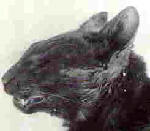
Rabbit-Headed Cat (Smerk)
Two carcasses discovered in 1988 and 1993 are thought to be a new species – rabbit-headed wildcats. These Kellas cats seem to be rare, and investigators are urging landowners and gamekeepers to help them discover more. Sadly, the rabbit-like ears aren’t as impressive as I’d hoped.
Get your free virus now! (Accipiter)
“Is your PC virus-free? Get it infected here!”
409 people decided to click the text advertisement that Finnish IT security expert Didier Stevens had placed on Google’s Adword. Stevens’s experiment was aiming to show that such advertisements could be used with malicious intent. There was, of course, no virus.
June 6, Théopolis World Contact with Aliens (Antoll MA)
On June 6th, the annual gathering to officially ask the alien gods to visit will take place in Théopolis.
Boost Car Remote With Your Skull (Tah)
This video (not suitable for work, due to the type of adverts on the site) demonstrates how, by placing your car remote under your chin and opening your mouth, you can boost the range of the remote. Apparently it uses your oral cavity to amplify the signal. The video doesn’t actually show the remote being used at the same time as showing the car react, so it could be faked. There’s really no way of telling. A couple of forum members have tried it, with mixed results.
Tims Don’t Look Like Bobs (Tah)
A new study reveals that the more a person ‘resembles’ their name, the more likely it is that others will remember it.
Rabbit-Headed Cat (Smerk)Two carcasses discovered in 1988 and 1993 are thought to be a new species – rabbit-headed wildcats. These Kellas cats seem to be rare, and investigators are urging landowners and gamekeepers to help them discover more. Sadly, the rabbit-like ears aren’t as impressive as I’d hoped.
Get your free virus now! (Accipiter)
“Is your PC virus-free? Get it infected here!”
409 people decided to click the text advertisement that Finnish IT security expert Didier Stevens had placed on Google’s Adword. Stevens’s experiment was aiming to show that such advertisements could be used with malicious intent. There was, of course, no virus.
June 6, Théopolis World Contact with Aliens (Antoll MA)
On June 6th, the annual gathering to officially ask the alien gods to visit will take place in Théopolis.
Boost Car Remote With Your Skull (Tah)
This video (not suitable for work, due to the type of adverts on the site) demonstrates how, by placing your car remote under your chin and opening your mouth, you can boost the range of the remote. Apparently it uses your oral cavity to amplify the signal. The video doesn’t actually show the remote being used at the same time as showing the car react, so it could be faked. There’s really no way of telling. A couple of forum members have tried it, with mixed results.
Tims Don’t Look Like Bobs (Tah)
A new study reveals that the more a person ‘resembles’ their name, the more likely it is that others will remember it.
|
Categories: Animals, Extraterrestrial Life, Psychology, Technology Posted by Flora on Fri May 25, 2007 |
Comments (13) |
This trick is quite an interesting little demonstration of misdirection. I shan't say more, so as to not give it away, but keep your eyes peeled - there is more to this than just one trick.
(Thanks, Nettie and David B.)
|
Categories: Entertainment, Photos/Videos, Psychology Posted by Flora on Thu May 10, 2007 |
Comments (17) |
Brits flunk honesty test
A credit-card protection firm, Affinion International, conducted an experiment in which they left items such as mobile phones, key, and wallets in city centres (Birmingham, Bristol, Cardiff, Glasgow, London, and Manchester). All the items were clearly marked with the owner's contact number, but most were never returned. Not surprising.
Obscene messages end graffiti experiment
Officials in Louisville tried to give graffiti artists a legal place to practice their craft, but abandoned the experiment after the concrete walls simply became filled with obscene messages. The walls will now be painted beige... and will doubtless soon be covered with illegal graffiti.
Man from Tooting becomes Hindu Goddess
Steve Cooper was just a run-of-the-mill unemployed guy in his hometown of Tooting, England. But when he moved to India he became known as the reincarnation of Bahucharaji, the patron of Indian eunuchs. I wonder how exactly he came into this new career. That's a story I'd like to know.
Mozart Effect debunked
A study commissioned by the German government has officially debunked the Mozart Effect -- which is the idea that listening to certain kinds of classical music will raise a person's intelligence.
|
Categories: Art, Psychology, Religion Posted by Alex on Tue Apr 17, 2007 |
Comments (5) |
Back in the early 1960s Stanley Milgram conducted a famous experiment at Yale University. Volunteers were told that it was designed to test the effect of punishment on learning. Would a person learn a list of word pairs better if they were punished every time they got an answer wrong? The volunteer was instructed to deliver an electric shock to the learner every time one of his answers was wrong. The shocks increased in intensity for every wrong answer. Of course, the experiment wasn't actually about the effect of punishment on learning at all. It was really designed to see how long the volunteers would obey the authority of the researcher. Would they continue to give electric shocks to the learner even when it appeared that doing so would kill the learner? Over sixty percent of them went ahead and gave the shock. They were led to believe that they had killed or seriously injured the learner (who was actually just an actor).Milgram's experiment is one of the most famous experiments of all time. But it provoked a lot of controversy about whether it was ethical. Often the volunteers were reduced to nervous wrecks as they struggled over whether to continue obeying the researcher, or to refuse to do so. No review board would ever approve such an experiment today.
Mel Slater, a Computer Science researcher at University College London, has announced a possible way around these ethical concerns. He replicated Milgram's experiment using a virtual learner. LiveScience reports:
When the virtual woman gave an incorrect answer, the participants were told to give a virtual 'electric shock' that buzzed to her, increasing the voltage each time she gave an incorrect answer... Over time, she responded with increasing discomfort and protests, eventually demanding the experiment stop. Near the end, her head would slump forward and she became unresponsive... 17 gave all 20 shocks and three gave 19 shocks, 18, 16 and 9 shocks were given by one person each. When volunteers were asked whether they had considered aborting the experiment, nearly half of those who could see and hear the virtual woman indicated they had because of their troubled feelings about what was happening. In addition, their heart rates indicated that participants reacted as though the situation was real.
I don't know. I'm having a hard time buying that a virtual learner could ever substitute for a real, living, breathing learner. However you parse it, thinking you've killed a virtual character is not the same as thinking you've killed a real person. It's like saying Milgram could have used mannequins instead of real people. It just wouldn't have been the same.
|
Categories: Psychology, Science Posted by Alex on Thu Dec 21, 2006 |
Comments (28) |
Yet Another Traveling Gnome
Back in the Spring Allen Snyder's gnome disappeared from his garden. Now he's learned that it's been attending Pittsburgh Steelers' games. Next stop an airplane to somewhere far away. Submitted by Big Gary who notes: "Predicatable, but I thought you'd want to keep your gnome section up-to-date."
Pretends to be mentally ill to get a grope
This is pathetic. William Mucklow has been accused of pretending to be mentally ill so that he can hire nurses to take care of him. He then grabs their breasts as they try to do their job. A pretty elaborate strategy to get a grope.
Jigsaw Prodigy
3-year-old "Mikey" Lorhan can put together "300- to 500-piece puzzles in less than 30 minutes or less -- and sometimes with the pieces flipped over, working blind." If this is real, he evidently has some kind of savant abilities.
Man Shows Back of Head For ObituaryJim Schinneller's death notice in the Sunday paper included a photo of the back of his head. Why? Because "He liked to buck the system. He enjoyed showing people how absurd life was." This would be an even better idea for a high-school yearbook photo, if you could get away with it.
|
Categories: Death, Gnomes, Psychology, Sex/Romance Posted by Alex on Thu Sep 21, 2006 |
Comments (5) |
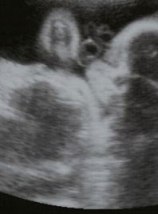
Following hot on the heels of the chocolate Virgin Mary (which, as many people pointed out, looked more like the Maltese Falcon) comes: Jesus as seen on an ultrasound picture. Seven months through her pregnancy, Laura Turner went for a routine ultrasound. She already knew that her son had a cleft lip, and she and her partner had been told there was a possibility of the child having Down's Syndrome. She says that she didn't notice anything particularly odd about the scan until a friend pointed it out once they got home.

'The pregnancy has been fairly difficult so to see a likeness of Jesus in the picture gives me a lot of comfort.
'It's as if someone is watching over Joshua. It's helped make us feel more at ease and although I'm not very religious, seeing the picture does reassure me that things are going to turn out okay and that Joshua will be our little miracle.'
I suppose that, what with the difficult pregnancy, it's a very heartening sign for her.
|
Categories: Birth/Babies, Health/Medicine, Pareidolia, Photos/Videos, Psychology, Religion Posted by Flora on Thu Aug 24, 2006 |
Comments (12) |
Status: Etiquette advice
Miss Manners recently tackled the question of whether it's better to be honest (and unpleasant) or to be fake-nice. A correspondent asked her: How can one deal (correct word?) with nice people, saying "all the right things," without meaning any of it? It's just been driving me crazy as it seems to be occurring more and more.Miss Manners responded that it would be a disaster if people were always brutally honest:
This is not an affliction, Miss Manners assures you. It is a blessing. For the last several decades, people have been saying all the wrong things that they really mean, from "I can't use this" instead of "Thank you" for a present; "Only a moron would think that" instead of "I'm afraid we disagree" in a political discussion and "You've put on a lot of weight" instead of "How nice to see you" on seeing an acquaintance. If they are learning to say the right thing, good for them. In time, they will learn to say it more convincingly.
Along these same lines, in The Post-Truth Era: Dishonesty and Deception in Contemporary Life, Ralph Keyes points out the extent to which being fake-nice is the socially accepted thing to do: How often do we lie and get lied to? All sorts of figures get bandied about. I've seen estimates that range from two hundred times a day to once. One study concluded that we tell thirteen lies a week on the average. Another found that some form of deception occurs in nearly two-thirds of all conversations. If this sounds far-fetched, bear in mind that the most frequent lie of all is "Fine" (in response to the question "How are you?"). This fib is so ubiquitous that deception researcher Bella DePaulo excused subjects from recording it in records they kept of every lie they told in a week's time.
I definitely agree that most of the time it's better to be fake nice. If I ask someone how they're doing, I don't really want to hear about their bad back and ingrown toenail. But on the other hand, I think Miss Manners needs to provide some guidance for those cases in which fake happiness goes too far. For instance, my wife used to have a constantly upbeat co-worker whose favorite expression was "Yayyyyy!" She managed to use that word a couple times every hour: "That's Great! Yayyy!.... Awesome! Yayyyy!" My wife had to listen to this constant stream of peppiness all day. Not to be cynical, but surely there must come a point when it becomes socially acceptable to subject such people to various forms of medieval torture?Related Posts:
March 17, 2006: Fake Smiles May Cause Depression
|
Categories: Psychology Posted by Alex on Sun Jul 23, 2006 |
Comments (23) |
Status: Undetermined
Some of the things I post about aren't the most intelligence-enhancing things in the world. I know that. But what follows is really scraping the bottom of the barrel, so to speak. It's a woman who appeared on the Maury Povich Show who claims to be Pickle-Phobic. The mere sight of pickles sends her into a state of screaming panic. Her fear of pickles is ruining her life. Here's what she has to say: "My name is Mariah, and I hate pickles. I hate everything about... Pickles are destroying my life. People make fun of me. I feel ashamed. I'm actually afraid of them. I think about pickles I just want to throw up and run away. What I hate most about pickles is the shape, the texture of it, the color. Ewww!"
I realize that people can have irrational phobias about things, but a phobia of pickles? She must be joking. No way can this be real. My vote is that she's either making this up completely, or exaggerating it a lot in order to get on TV. And even if she were terrified of pickles, surely it would be easier for her to simply avoid pickles, rather than to try to cure her of the problem.
|
Categories: Photos/Videos, Psychology Posted by Alex on Sun Jul 09, 2006 |
Comments (47) |
Status: Strange experiment
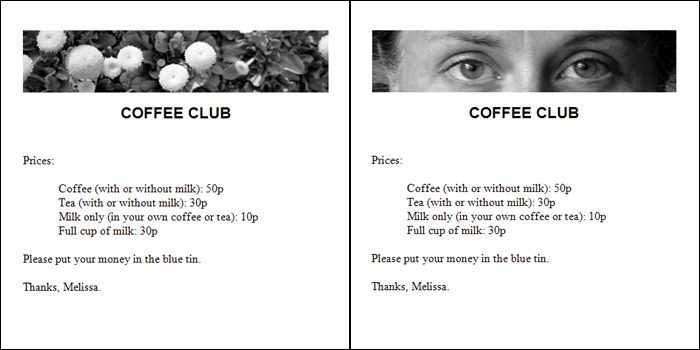
An experiment described in a recent issue of the journal Biology Letters reveals a simple way to make people behave more honestly: display a picture of watching eyes. Melissa Bateson, a biologist at Newcastle University, conducted the experiment on her colleagues, without their knowledge, using the communal coffee pot in the departmental lounge as the set-up. She found that when she placed a picture of a pair of beady eyes above the coffee pot, contributions to the 'honesty box' (the box in which people are supposed to deposit money to pay for the coffee they've drunk) were three times higher than when she displayed a picture of flowers. Bateson explains that: The effect may arise from behavioural traits that developed as early humans formed social groups that bolstered their chances of survival. For social groups to work individuals had to co-operate for the good of the group, rather than act selfishly. "There's an argument that if nobody is watching us it is in our interests to behave selfishly. But when we think we're being watched we should behave better, so people see us as co-operative and behave the same way towards us," Dr Bateson said.

In other words, we behave better if we think we're being watched, even if we're only being watched by fake eyes. It could be named the 'Big Brother Is Watching You' effect.
|
Categories: Psychology Posted by Alex on Wed Jun 28, 2006 |
Comments (6) |
Status: Unusual Research
There's nothing hoaxy about this story. It's just another example of how non-rational people can be... especially investors in the stock market. Two Princeton researchers, Adam Alter and Danny Oppenheimer, have discovered that the ease with which a company's name and its ticker symbol can be pronounced has a strong short-term effect on the performance of its stock. In other words, "a stock with the symbol BAL should outperform one with the symbol BDL in the first few days of trading." "We looked at intervals of a day, a week, six months and a year after IPO," Alter said. "The effect was strongest shortly after IPO. For example, if you started with $1,000 and invested it in companies with the 10 most fluent names, you would earn $333 more than you would have had you invested in the 10 with the least fluent." Alter said the pair of scientists had been careful to address the possibility that other factors were at play in the study. "We thought it was possible that larger companies might both adopt more fluent names and attract greater investment than smaller companies," he said. "But the effect held regardless of company size. We also showed that the effect held when we controlled for the influence of industry, country of origin and other factors."
In Hippo Eats Dwarf I noted a similar effect: that when investors think they've found the next big thing (be it railways, airlines, biotech, dot.coms, or nanotechnology) all stocks whose names seem to have something to do with those fields benefit, whether or not they actually do have something to do with those fields. Thus, in the recent nanotechnology crazy, Nanometrics (ticker symbol: NANO) shot up, even though it makes semiconductor tools and has nothing to do with nanotechnology.|
Categories: Business/Finance, Psychology Posted by Alex on Fri Jun 02, 2006 |
Comments (4) |
Status: Practical joke
I evidently don't spend enough time on LiveJournal, because if I did I would have known about the IQ Challenge sooner. (It was evidently quite popular on LiveJournal.) As it is, I completely missed out on it, and now it's over.What it was (or claimed to be) was an IQ test offered by IQ-Challenge.com. Once you completed the test, it produced a small graphic showing your score that you could post on your site. The joke was that the test gave everyone a high score. But the graphic that you posted on your site would (unbeknownst to you) show a low score. You can imagine the results this produced. Here's one person's description:
a lot of people got really cocky about how they scored on the IQ test. I saw one woman post the results on her blog and beneath the image she wrote something like: “Wow, I scored a 155! [My friend] only scored a 70. I guess I scored so much higher due to life experience and being a good test taker.” But the image said she only scored a 70-something as well.
Someone else’s blog post said, “I’m superior! I always knew I was brilliant!”
Just check out Google blogsearch…there are a ton of posts, mostly on Livejournal, of people proudly showing off their phony IQ scores. A few people even said, “This is a much better and more accurate IQ test than the one at Tickle.com!” Even though you could have guessed any question wrong on the phony test and have scored a 150+.
The weird thing is that I bet those people who believed they scored well on the test will continue to believe they have above-average intelligence, even after finding out that the test results were meaningless. That's just the way the mind works. Someone else’s blog post said, “I’m superior! I always knew I was brilliant!”
Just check out Google blogsearch…there are a ton of posts, mostly on Livejournal, of people proudly showing off their phony IQ scores. A few people even said, “This is a much better and more accurate IQ test than the one at Tickle.com!” Even though you could have guessed any question wrong on the phony test and have scored a 150+.
The test is no longer online, although I think whoever created it should keep it up. It would be like a permanent trap for the gullible.
|
Categories: Psychology Posted by Alex on Tue May 09, 2006 |
Comments (36) |