Get MOH Blog Posts by Email
Recent Forum Posts
| • | Autism caused by pollution? 06/19/2013 |
| • | Some things are not what they seem. 06/19/2013 |
| • | 15 seconds of fame 06/17/2013 |
| • | Happy Birthday, NEO! 06/17/2013 |
| • | Maybe soon we can sing Happy Birthday to You in public without having to pay for it. 06/15/2013 |
| • | Croakus-Interruptus 06/14/2013 |
| • | HAPPY ANNIVERSARY Neo and Carmen! 06/13/2013 |
| • | I've funded THIS! 06/12/2013 |
| • | German bank employee naps on keyboard, transfers millions 06/12/2013 |
| • | BBC article on Pareidolia 05/31/2013 |
![]() | |
| |
| |
| |
| |
| |
| |
| |
|
Site Map
Blog Categories
Advertising |
Animals |
April Fools Day |
Art |
Bad Excuses |
Birth/Babies |
Body Manipulation |
Books |
Business/Finance |
Celebrations |
Celebrities |
Con Artists |
Conspiracy Theories |
Crop Circles |
Cryptozoology |
Nessie |
Death |
eBay |
Education |
Email Hoaxes |
Entertainment |
Exploration/Travel |
Extraterrestrial Life |
Fashion |
Folklore/Tall Tales |
Food |
Free Energy |
Future/Time |
Gnomes |
Gross |
Hate Crimes/Terror |
Health/Medicine |
History |
Identity/Imposters |
Journalism |
Law/Police/Crime |
Literature/Language |
Magic |
Mass Delusion |
Military |
Miscellaneous |
Music |
Paranormal |
Pareidolia |
Photos/Videos |
Places |
Politics |
Pranks |
Products |
Pseudoscience |
Psychology |
Radio |
Religion |
Scams |
Science |
Sex/Romance |
Social Networking Sites |
Sports |
Technology |
Urban Legends |
Videos |
Websites
Blog Archives
May, 2013 |
April, 2013 |
March, 2013 |
February, 2013 |
January, 2013 |
October, 2012 |
September, 2012 |
August, 2012 |
July, 2012 |
June, 2012 |
May, 2012 |
April, 2012 |
March, 2012 |
February, 2012 |
January, 2012 |
December, 2011 |
November, 2011 |
October, 2011 |
September, 2011 |
August, 2011 |
November, 2010 |
April, 2010 |
January, 2010 |
December, 2009 |
November, 2009 |
October, 2009 |
September, 2009 |
August, 2009 |
July, 2009 |
June, 2009 |
May, 2009 |
April, 2009 |
March, 2009 |
February, 2009 |
January, 2009 |
December, 2008 |
November, 2008 |
October, 2008 |
September, 2008 |
August, 2008 |
July, 2008 |
June, 2008 |
May, 2008 |
April, 2008 |
March, 2008 |
February, 2008 |
January, 2008 |
December, 2007 |
November, 2007 |
October, 2007 |
September, 2007 |
August, 2007 |
July, 2007 |
June, 2007 |
May, 2007 |
April, 2007 |
March, 2007 |
February, 2007 |
January, 2007 |
December, 2006 |
November, 2006 |
October, 2006 |
September, 2006 |
August, 2006 |
July, 2006 |
June, 2006 |
May, 2006 |
April, 2006 |
March, 2006 |
February, 2006 |
January, 2006 |
December, 2005 |
November, 2005 |
October, 2005 |
September, 2005 |
August, 2005 |
July, 2005 |
June, 2005 |
May, 2005 |
April, 2005 |
March, 2005 |
February, 2005 |
January, 2005 |
December, 2004 |
November, 2004 |
October, 2004 |
September, 2004 |
August, 2004 |
July, 2004 |
June, 2004 |
May, 2004 |
April, 2004 |
March, 2004 |
February, 2004 |
January, 2004 |
December, 2003 |
November, 2003 |
October, 2003 |
September, 2003 |
August, 2003 |
July, 2003 |
June, 2003 |
May, 2003 |
January, 2003 |
November, 2002 |
October, 2002 |
September, 2002 |
August, 2002 |
July, 2002 |
Weblog Category
Psychology
Psychology
The BBC reports that police in Italy are searching for a thief who hypnotizes checkout staff and orders them to hand over money.
The BBC has a video of the thief in action. It's interesting, because he pulls off his heist in full view of other customers, who are apparently oblivious about what's going on.
This is not a new method of robbery. Back in Oct. 2007 I posted about a thief in New Hampshire who was said to be using hypnosis to rob convenience stores. In that case, the thief was also Indian, which is significant because the art of hypno-robbery seems to have originated in India.
It sounds like a method of robbery that's too good to be true, but I think it is real (i.e. the store clerks aren't secretly in collusion with the criminal. They really do unwittingly hand money over to him). But I don't think the criminal is actually hypnotizing the clerks. They don't go into a trance. Instead, the method takes advantage of a psychological trick -- that if you catch people off guard, they'll often do whatever you tell them to. The British magician Derren Brown demonstrates the principle in a number of his videos. I think you need a combination of a very self-assured thief who projects an air of authority and a highly suggestible victim to get this to work.
In every case, the last thing staff reportedly remember is the thief leaning over and saying: "Look into my eyes", before finding the till empty... A female bank clerk reportedly handed over nearly 800 euros (£630)...
Italian police believe the suspect could be of Indian or North African extraction.
The BBC has a video of the thief in action. It's interesting, because he pulls off his heist in full view of other customers, who are apparently oblivious about what's going on.
This is not a new method of robbery. Back in Oct. 2007 I posted about a thief in New Hampshire who was said to be using hypnosis to rob convenience stores. In that case, the thief was also Indian, which is significant because the art of hypno-robbery seems to have originated in India.
It sounds like a method of robbery that's too good to be true, but I think it is real (i.e. the store clerks aren't secretly in collusion with the criminal. They really do unwittingly hand money over to him). But I don't think the criminal is actually hypnotizing the clerks. They don't go into a trance. Instead, the method takes advantage of a psychological trick -- that if you catch people off guard, they'll often do whatever you tell them to. The British magician Derren Brown demonstrates the principle in a number of his videos. I think you need a combination of a very self-assured thief who projects an air of authority and a highly suggestible victim to get this to work.
|
Categories: Law/Police/Crime, Psychology Posted by Alex on Sun Mar 23, 2008 |
Comments (9) |
Local 6 News in Orlando recently conducted a test to see how quickly people would respond to a crime. They arranged for an undercover police officer to pretend to be a burglar trying to break into cars and homes in plain view of bystanders. The results:
These results aren't surprising. Psychologists have long been aware of the "unresponsive bystander" effect. Witnesses to medical emergencies or crimes often do nothing, either because they assume someone else will do something, or because they fail to correctly interpret the situation.
In Elephants on Acid
I describe an experiment that was conducted at Columbia University in 1968. Subjects were led to believe they were participating in a group discussion over an intercom system, with each participant sitting in a separate cubicle. Suddenly they heard one of the other participants having an epileptic seizure. The seizure was fake, but the subjects couldn't know that, and most of them did nothing to help, because they assumed someone else would help.

most bystanders ignored or just watched the crime -- and some even helped the thieves...
people were ready to help the mystery man break into a car.
A third test had the fake burglar enter a home through a window and then go out the front door. During the staged crime, some golfers gave a friendly wave and a technician ignored the incident.
people were ready to help the mystery man break into a car.
A third test had the fake burglar enter a home through a window and then go out the front door. During the staged crime, some golfers gave a friendly wave and a technician ignored the incident.
These results aren't surprising. Psychologists have long been aware of the "unresponsive bystander" effect. Witnesses to medical emergencies or crimes often do nothing, either because they assume someone else will do something, or because they fail to correctly interpret the situation.
In Elephants on Acid
|
Categories: Law/Police/Crime, Psychology Posted by Alex on Tue Feb 26, 2008 |
Comments (13) |
Tom Bell, in the Agoraphilia blog, asks an interesting question. Why does children's fiction promote credulity as a virtue?
Bell notes an obvious explanation -- that religious and political leaders would like to see young people raised to believe without question. But Bell then suggests an alternative explanation. Maybe it's because children's literature depends upon the suspension of disbelief, and therefore children's authors need to promote gullibility as a virtue.
Looking at the question historically (which, after seven years of grad school is how I tend to approach questions like this), I would say it might have something to do with the sentimentalization of childhood which, in western culture, began to occur during the 18th and 19th centuries. Of course, this just raises the question of why our culture began to sentimentalize childhood. I honestly don't know, but it sure has helped Disney make a lot of money.
Children's fiction employs this trope so often that it fits a formula. A wise character tries to convince the protagonist that something wonderful will happen if only he or she will earnestly believe an improbability. Consider, for instance, how Yoda tells Luke to cast aside all doubt if he wants to levitate his x-wing from the swamps of Dagobah. "Do, or do not. There is no try," Yoda explains. Following the usual script, Luke resists, courting disaster, before he finally embraces faith and wins its rewards.
Bell notes an obvious explanation -- that religious and political leaders would like to see young people raised to believe without question. But Bell then suggests an alternative explanation. Maybe it's because children's literature depends upon the suspension of disbelief, and therefore children's authors need to promote gullibility as a virtue.
Looking at the question historically (which, after seven years of grad school is how I tend to approach questions like this), I would say it might have something to do with the sentimentalization of childhood which, in western culture, began to occur during the 18th and 19th centuries. Of course, this just raises the question of why our culture began to sentimentalize childhood. I honestly don't know, but it sure has helped Disney make a lot of money.
|
Categories: Literature/Language, Psychology Posted by Alex on Wed Feb 20, 2008 |
Comments (27) |
I came across an interesting article, published in the New York Times on June 11, 1950, that discusses a series of experiments examining how likely it is that college students will bluff their way through exams. For instance, when Professor Samuel Fernberger, of the University of Pennsylvania, gave his students their final exam, in one of the questions he asked them to define "psychoterminality." It was a meaningless term, but the students didn't know that. According to the NY Times:
Professors Ernst F. Thelin and Paul C. Scott of the University of Cincinnati conducted the most thorough investigation of bluffing. They gave 147 college students a test that included numerous trick questions. For instance, they asked the students to indicate the authors of nonexistent books or to define made-up words:
Finally the article refers to a study that examined other members of society. An investigator visited bakery shops and asked for "scroofles":
My hunch is that all the figures for the prevalence of bluffing would be even higher today than they were in 1950. But today we'd be more likely to call it bullshitting than bluffing.
Only two students honestly stated they did not know what the term meant. Six left the question blank. But the other twenty-one handed in expositions, ranging from one-half to three pages long, in which they solemnly described it as, among other things, "automatism," "vitalism," "hypnosis" and the "behavior of the lower animals." It was astonishing because, of course, Dr. Fernberger had just coined this mythical word for the occasion.
Professors Ernst F. Thelin and Paul C. Scott of the University of Cincinnati conducted the most thorough investigation of bluffing. They gave 147 college students a test that included numerous trick questions. For instance, they asked the students to indicate the authors of nonexistent books or to define made-up words:
Bluffing was defined by the investigators as "pretending to have greater knowledge than is actually possessed." Some bluffing was done by all students, varying from 5 to 81 per cent. Freshmen bluffed most; seniors least. The average bluffing score of the men (45.8 per cent) was slightly higher than that of the women (43.4 per cent).
Finally the article refers to a study that examined other members of society. An investigator visited bakery shops and asked for "scroofles":
Instead of saying they'd never heard of this mythical product... a surprising number of bakers bluffed they were just out of 'scroofles,' or were not baking 'scroofles' currently because of the lack of demand.
My hunch is that all the figures for the prevalence of bluffing would be even higher today than they were in 1950. But today we'd be more likely to call it bullshitting than bluffing.
|
Categories: Psychology Posted by Alex on Thu Nov 29, 2007 |
Comments (17) |
Researchers from UC Irvine and the University of Padua in Italy have found that doctored photos can alter our perceptions and memories of public events. The researchers showed subjects either an actual or an altered photo of one of two historical events, the 1989 Tiananmen Square protest in Beijing and the 2003 anti-war protest in Rome. The Tiananmen Square photo was altered to include a crowd, and the Rome photo was altered to show riot police and a masked protester. LiveScience reports:When answering questions about the events, the participants had differing recollections of what happened. Those who viewed the altered images of the Rome protest recalled the demonstration as violent and negative and recollected more physical confrontation and property damage than actually occurred. Participants who viewed the doctored photos also said they were less inclined to take part in future protests, according to the study.
Elizabeth Loftus, who designed the study (and whom I write about in Elephants on Acid
Big Gary says, "The Ministry of Truth already knew this."
Incidentally, I'm sure that everyone who came on the 2006 Museum of Hoaxes Trip to Loch Ness remembers when Nessie suddenly appeared right behind our boat. If you don't, here's a picture to jog your memory:
|
Categories: Photos/Videos, Psychology Posted by Alex on Tue Nov 27, 2007 |
Comments (7) |
A New Hampshire convenience store clerk claims that he was robbed. However, the thieves didn't use any weapons or threats. Instead, they used hypnosis and mind control to make the clerk not notice that they were taking more than $1000. First coast news reports:It started with a simple mind game. Think of a wild animal, they say, and we'll write down what's in your mind. but it escalates quickly to very personal information about a former girlfriend, and finally, says Patel, mind control. Even investigators are persuaded.
Patel says that the actual moment of hypnosis occurred when the thieves gave him a piece of paper and asked him to cut it into eleven smaller pieces. The clerk has also said that he'll pay back what was robbed.Apparently this method of robbery has been used before in India (the thieves were Indian, as was the clerk), but I've never heard of it being used before this in America.
|
Categories: Con Artists, Law/Police/Crime, Psychology Posted by Alex on Tue Oct 02, 2007 |
Comments (11) |
Cranky Media Guy forwarded me this article on Ananova.com about a Czech speedway rider who suffered a concussion during a race, was knocked out, and woke up speaking perfect English, with a posh British accent... even though he barely spoke a word of English before. His command of English only lasted for 48 hours, at which point his memory returned, as did his native Czech, and his English disappeared.
CMG is skeptical. He says, "The Foreign Accent Syndrome mentioned in the last paragraph is a real phenomenon but that's very different from a guy who doesn't speak a language suddenly acquiring the ability to speak it, which I can't see could be possible."
But I'm not so sure. The story has been reported in a number of newspapers, and in the version on metro.co.uk, one of the rider's friends is quoted as saying, "Before his crash, his use of the English language was broken, to put it mildly."
Which means that he did know some English. It's very possible he knew more than he realized. Perhaps he woke up dazed, heard people around him speaking English (because the race was in England), and his brain went into English mode. It could happen. However, I'd be interested in knowing just how well he could carry on a conversation in English.
CMG is skeptical. He says, "The Foreign Accent Syndrome mentioned in the last paragraph is a real phenomenon but that's very different from a guy who doesn't speak a language suddenly acquiring the ability to speak it, which I can't see could be possible."
But I'm not so sure. The story has been reported in a number of newspapers, and in the version on metro.co.uk, one of the rider's friends is quoted as saying, "Before his crash, his use of the English language was broken, to put it mildly."
Which means that he did know some English. It's very possible he knew more than he realized. Perhaps he woke up dazed, heard people around him speaking English (because the race was in England), and his brain went into English mode. It could happen. However, I'd be interested in knowing just how well he could carry on a conversation in English.
|
Categories: Literature/Language, Psychology Posted by Alex on Mon Sep 17, 2007 |
Comments (9) |
The Washington Post has a depressing article about the difficulty of myth-busting. Experiments by Norbert Schwarz at the University of Michigan reveal that a few days after telling people a rumor is false, many of those people will have misremembered what they were told and think the rumor is true. The crux of the problem is that:
Other psychologists have found that hearing the same thing again and again from the same source can actually trick the brain into thinking information is more credible, as if the information came from many sources:
So what can myth-busters do? Unfortunately, not much. The only recommended tactic is to debunk rumors by not referring to the original rumor at all, and instead offering a completely different new assertion. For instance:
It's going to make it pretty hard to operate a myth-busting website if one of the rules is that I can't mention the myth I'm debunking. (Thanks, Joe!)
Denials inherently require repeating the bad information, which may be one reason they can paradoxically reinforce it.
Other psychologists have found that hearing the same thing again and again from the same source can actually trick the brain into thinking information is more credible, as if the information came from many sources:
People are not good at keeping track of which information came from credible sources and which came from less trustworthy ones, or even remembering that some information came from the same untrustworthy source over and over again. Even if a person recognizes which sources are credible and which are not, repeated assertions and denials can have the effect of making the information more accessible in memory and thereby making it feel true.
So what can myth-busters do? Unfortunately, not much. The only recommended tactic is to debunk rumors by not referring to the original rumor at all, and instead offering a completely different new assertion. For instance:
Rather than say, as Sen. Mary Landrieu (D-La.) recently did during a marathon congressional debate, that "Saddam Hussein did not attack the United States; Osama bin Laden did," Mayo said it would be better to say something like, "Osama bin Laden was the only person responsible for the Sept. 11 attacks" -- and not mention Hussein at all.
It's going to make it pretty hard to operate a myth-busting website if one of the rules is that I can't mention the myth I'm debunking. (Thanks, Joe!)
|
Categories: Psychology Posted by Alex on Wed Sep 05, 2007 |
Comments (8) |
This has nothing to do with hoaxes, but I thought it was interesting, so I'm posting about it anyway. Also, it reminded me of the Compliment Machine, which I posted about just a few days ago.I received an email from Jennifer Baumeister, who tells me that she's an artist from Berlin working on a project called Comfort XxL, the comforting machine. Here's a description of it:

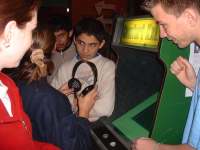
The comforting machine is an art project by the German artist Jennifer Baumeister. She asks people from different origins, age and gender to say comforting words into her camera. Selected clips are accessible through the machine, which looks like an 80s gambling machine. The audience is able to press a button, selecting a woman, man or child and a randomly chosen clip is shown. The user can repeat this procedure indefinitely. Comfort XxL is not only a machine that comforts people, it is also supposed to show how different people comfort in individual ways, the range of 'comforting styles' people have. The experiences and character of the comforter are revealed in every comforting word they say.
Jennifer's website has some examples of clips viewable on the comforting machine. Jennifer is currently in England collecting comforting clips. She's next going to be in Belfast, from the 9th till the 18th of August 2007. So if you live in Belfast and want to say a few comforting words, check out where she's going to be.I think I'm, in general, a pretty bad comforter. My usual tactic is to express puzzlement at why the person is so upset, and then I try to analyze the situation logically. However, I don't think logical analysis is what people seeking comfort are typically looking for.
|
Categories: Art, Psychology Posted by Alex on Wed Aug 01, 2007 |
Comments (5) |
No form of deception is more ubiquitous in modern life than the cheery platitudes we constantly exchange: "How are you?" "Fine!" or "Have a nice day."Washington DC based artist Tom Greaves has created a work of art designed to hold a mirror up to this culture of shallow, saccharine pleasantries. It's the compliment machine -- a red-and-white striped box that sits on a street corner and delivers compliments all day. As pedestrians pass by, it continuously shouts out words of encouragement:
"People are drawn to your positive energy."
"You are always there when needed."
"Your eyes are beautiful."
The Washington Post reports:
Initially, Greaves thought of making some of the compliments subversive, but had a change of heart. "Why not make it completely positive? Everyone deserves to have a compliment paid to them." And so the Compliment Machine has kind words for even the blackest of hearts.
I think there's only one proper response to Greaves' invention: Great idea! Very creative! It's going to spread a lot of positive energy!
|
Categories: Art, Psychology Posted by Alex on Fri Jul 27, 2007 |
Comments (13) |
Many cellphone users are reporting that they often feel their cellphone vibrating, when it's not vibrating at all. The phenomenon is being called Phantom Vibration Syndrome (an allusion, I assume, to Phantom Limb Syndrome, in which amputees feel sensations in their missing limbs).
Psychologists attribute these phantom vibrations to cellphone users' brains becoming over-alert to the sensation of vibration, and therefore experiencing false alarms:
Alejandro Lleras, a sensation and perception professor at the University of Illinois at Urbana-Champaign, adds that learning to detect rings and vibrations is part of a perceptual learning process. "When we learn to respond to a cellphone, we're setting perceptual filters so that we can pick out that (ring or vibration), even under noisy conditions," Lleras says. "As the filter is created, it is imperfect, and false alarms will occur. Random noise is interpreted as a real signal, when in fact, it isn't." Phantom cellphone vibrations also can be explained by neuroplasticity — the brain's ability to form new connections in response to changes in the environment. When cellphone users regularly experience sensations, such as vibrating, their brains become wired to those sensations, Janata says. "Neurological connections that have been used or formed by the sensation of vibrating are easily activated," he says. "They're over-solidified, and similar sensations are incorporated into that template. They become a habit of the brain."
I'm one of the last remaining people on the Planet Earth not to have a cellphone, so thankfully I'm immune to this syndrome.
|
Categories: Psychology, Technology Posted by Alex on Thu Jun 14, 2007 |
Comments (16) |
I was inspired by the news story about the mayor's face in a tree to search out other examples of faces in trees. I knew that stories about faces in trees pop up regularly in the news, but to my knowledge no one had ever collected these stories together in one place. So it seemed like an appropriate thing to waste a couple of hours doing. I posted the results in the hoaxipedia. It's more faces in trees than you can shake a stick at.
|
Categories: Mass Delusion, Pareidolia, Psychology, Religion Posted by Alex on Fri Jun 08, 2007 |
Comments (0) |