Did Idaho Get Its Name As A Result Of A Hoax? —
Status: Undetermined
Following a post about how California got its name,
Boing Boing added an interesting reader comment alleging that Idaho got its name because of a hoax:
"When a name was being selected for new territory, eccentric lobbyist George M. Willing suggested 'Idaho,' which he claimed was a Native American term meaning 'gem of the mountains'. It was later revealed Willing had made up the name himself, and the original Idaho territory was re-named Colorado because of it. Eventually the controversy was forgotten, and modern-day Idaho was given the made-up name when the Idaho Territory was formally created in 1863."
I had never heard this before, so I did a little research. It turns out that Willing did indeed claim to have invented the name Idaho. But whether he did or not is uncertain, since his claim was first published fifteen years after the first appearance of the word. Plus, he was a bit of a self-promoter and not entirely trustworthy. I found the following discussion of the Idaho question in an article by Erl H. Ellis published in
Western Folklore, Oct. 1951:
The first known use of this name was by or before a Congressional committee early in 1860, when the proposal to create a new territory of the Pikes Peak region was before the Congress. In the April 18, 1860 issue of the Rocky Mountain News, Mr. S.W. Beall wrote back to Denver and stated that this name Idaho seemed the most popular suggestion before the committee. On May 10 and 11, 1860, the Congressional Globe mentions the proposals for the Territory of Idaho, and noted that Idaho was an Indian name signifying "Gem of the Mountain." When the territory with Denver as its center was later created, the name Colorado was substituted at the last moment for Idaho. How this name came before the Congress very early in 1860 is unknown. If this was an Indian name known to the miners who flocked to the gold fields in 1859, no mention of the fact was ever made in the newspapers of those days. So perhaps the name was invented by one Dr. George M. Willing; at any rate he claimed to have done so. Willing came to Denver in 1859 from St. Louis and became a candidate for election as delegate to the Congress, despite the lack of any right of the gold miners to have a delegate in Washington. Even though Willing lost the election, he went on to Washington and posed as the properly elected delegate. He claimed that he there invented the name Idaho, it being suggested by the presence of a little girl, Ida. His relation of the matter was published by a friend of his, William O. Stoddard, in the New York Daily Tribune for December 11, 1875...
The Territory of Colorado was actually created February 28, 1861. That was the end of the official interest in the word for the Pikes Peak area. It was after these "Colorado" events that we find the word being used in what became the state of Idaho. In December, 1861, the territorial legislature of Washington created an Idaho County, and it later became a county of the state of Idaho. Joaquin Miller, the "poet of the Sierras," was responsible for several versions of how the word Idaho was first put into that form by him in the winter of 1861-1862. In one of these accounts Miller spells the name "E-dah-hoe" and says that it was an Indian word meaning "the light or diadem on the line of the mountain." A number of historians of the state of Idaho have accepted this story from Miller, but others have noted that the name was well known and used before Miller appeared upon the scene. The Territory of Idaho was created on March 3, 1863, again after the Congress nearly adopted another name, Montana.
Even if Idaho did get its name from a hoax, Des Moines can lay claim to
a funnier name origin. The Peoria indians told the first white settlers that the tribe living in that area (their rivals) was named the Moingoana, which became the root of Des Moines. But it turns out that Moingoana was really the Peoria word for "shitfaces".







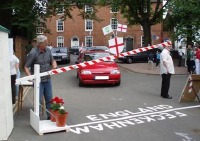 Earlier this spring, while digging up an oak tree, residents of Feckenham (a small British village) discovered an 800-year-old scroll written by King Henry III. The scroll stated that the village should remain independent forever. This prompted the villagers to declare their independence from Britain, set up border-patrol checkpoints around the town, and lower the taxes on beer. The Ottawa Citizen reports:
 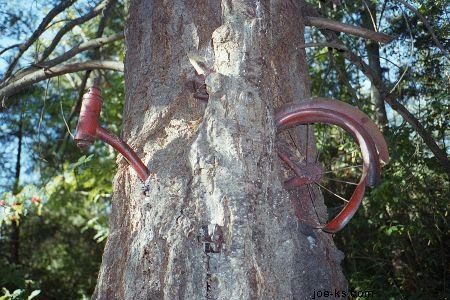 The bicycle-eating tree is probably familiar to most residents of Washington, since it's located on Vashon Island, Washington (and won a 1994 contest to select the most unusual places or events in the Washington-Oregon area), but it's new to me. Apparently someone, decades ago, left their bicycle leaning against the tree, and as the tree kept growing it enveloped the bike and now lifts it seven feet off the ground. I think it's amazing that a) the tree actually grew around the bike instead of pushing it over, and that b) in all that time no one ever moved the bike. The bicycle-eating tree has been featured in Ripley's Believe It Or Not, and also inspired a children's book by Berkeley Breathed, Red Ranger Came Calling. Breathed used to live on Vashon Island. (via CaliforniaTeacherGuy)
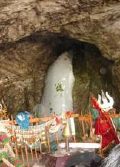 Inside the Amarnath Cave, located in Indian-administered Kashmir, can be found the ice Shiva Linga, one of the holiest objects in the Hindu faith. Basically it's a large, naturally occurring, phallus-shaped ice stalagmite. Hundreds of thousands of Hindus make the pilgrimage to visit it each year, despite a high amount of terrorist activity in that area. (Wikipedia has an entry about it.) But this year the pilgrimage has been marred by allegations that the Shiva Linga has been faked. The BBC reports:
  The residents of Aqueduct Street have an unusual problem. Their lines are going wobbly. Specifically, the double yellow lines on their road. When the city laid down the lines earlier this month, they were straight. But now they've begun to take off in random directions. At first some suspected the work of a prankster, but apparently the truth is much more sinister: The lines are doing this of their own accord!
 Speaking of fake Irish bars, now it's possible to have an instant fake British pub, anywhere you like. It's advertised as "the Worlds first fully functioning Mobile Inflatable Pub." This comes from the same people who brought us the world's first inflatable church. Ideally it should come with a bartender who fakes a British accent.
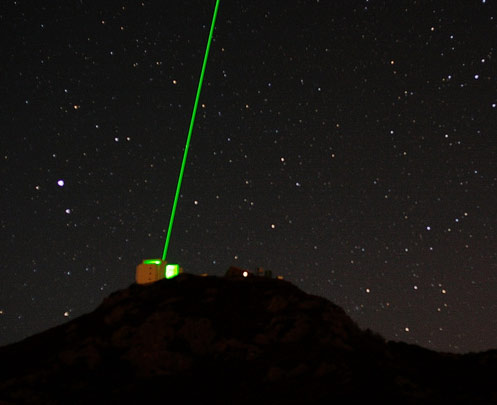 Found on Flickr: a cool picture of a giant laser beaming out of the MMT Telescope, on top of Mt. Hopkins in Arizona. The guy who took it, Filip Pizlo, says it's not photoshopped, and I'm willing to believe him, if only because when I was a grad student at UC San Diego there was a green laser beam similar to this visible in the sky over La Jolla almost every night. I never figured out where it was coming from or what the purpose of it was. It couldn't have been coming from the MMT Telescope in Arizona because that would have been too far away.
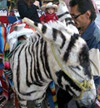 Thanks to Big Gary for sending me this story about Tijuana's fake zebras, which are facing extinction. The Tijuana zebras are donkeys painted to look like zebras. Tourists like to get their picture taken with them. It's a decades-old tradition. The Reuters article explains:
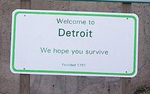 Columnist Tom Greenwood of the Detroit News reports that a sign has been spotted "attached to an authentic Michigan Department of Transportation post on southbound Interstate 75 at the Oakland/Wayne county line." It reads: Welcome to Detroit. We hope you survive.
 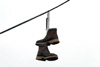 Power company workers in Ballymena (Northern Ireland) were amazed to discover five pairs of shoes hanging from a power line along the road between Larne and Ballymena. Ballymena Today reports:
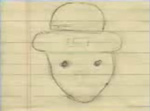 Some residents of Mobile, Alabama are claiming that a leprechaun is loose in their neighborhood. It shows up in the branches of a tree at night. Apparently it can't be photographed, but the thumbnail shows an "amateur sketch" of what people say it looks like. The NBC 15 news broadcast that covered this interesting phenomenon reports that: "eyewitnesses say the leprechaun only comes out at night. If you shine a light in its direction, it suddenly disappears." Make sure that you catch the guy who appears towards the end of the report who has "a special leprechaun flute which has been passed down from thousands of years ago from my great, great grandfather who is Irish."