The Museum of Hoaxes
HOME   |   ABOUT   |   FORUM   |   CONTACT   |   PINTEREST   |   FACEBOOK   |   TWITTER   |   RSS
The Top 100
April Fool Hoaxes
Of All Time
April Fool's Day
Gallery
Hoax Photo
Archive

Weblog Category
Places
Rozel is a small town in the middle of Kansas. Population: 156. It was founded in 1886 — its main reason for existence being that it served as a stop on the Santa Fe railroad line. Throughout its history, it hasn't been in the news much. The one time it did receive national attention was back in 1897 when it supposedly disappeared, swallowed up by a giant sinkhole.

The report of its disappearance went out in November 1897 and appeared in papers nationwide, including the New York Times:
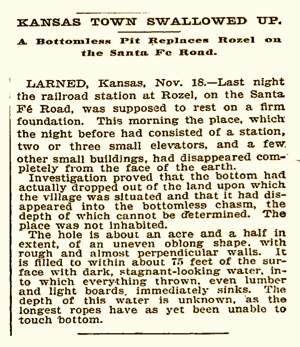
KANSAS TOWN SWALLOWED UP.
A Bottomless Pit Replaces Rozel on the Santa Fe Road

LARNED, Kansas, Nov. 18—Last night the railroad station at Rozel, on the Santa Fe Road, was supposed to rest on a firm foundation. This morning the place, which the night before had consisted of a station, two or three small elevators, and a few other small buildings, had disappeared completely from the face of the earth.

Investigation proved that the bottom had actually dropped out of the land upon which the village was situated and that it had disappeared into the bottomless chasm, the depth of which cannot be determined. The place was not inhabited.

The hole is about an acre and a half in extent, of an uneven oblong shape, with rough and almost perpendicular walls. It is filled to within about 75 feet of the surface with dark, stagnant-looking water, into which everything thrown, even lumber and light boards, immediately sinks. The depth of this water is unknown, as the longest ropes have as yet been unable to touch bottom.

However, the story of the town's disappearance came as a shock to the residents of Rozel, because as far as they could tell, the railroad station and surrounding buildings were all still there, intact.
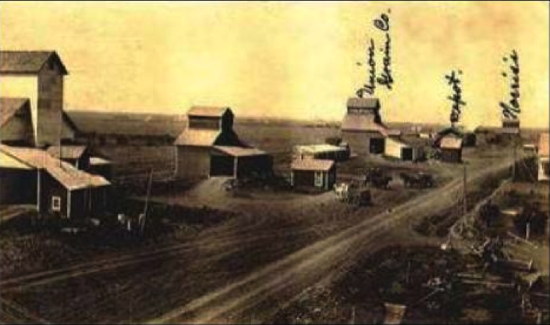

Rozel circa 1900, sinkhole-free

No one is entirely sure who invented the story of the giant sinkhole, but the leading suspect is Dick Beeth, a station agent in Larned, the nearest town.

The story goes that the railroad company had recently decided to move the Rozel train depot elsewhere where it was more needed. So workers had loaded the entire building onto a boxcar and shipped it off. This left a shallow hole in the ground that filled with water when it rained. Locals who saw this hole joked that the depot had been swallowed by a sinkhole.

When Beeth heard this joke, it inspired him to send out a story on the telegraph wire claiming that the entire town had been swallowed by a sinkhole. Local Kansas papers picked up the story and ran it, and then it spread to the national news.
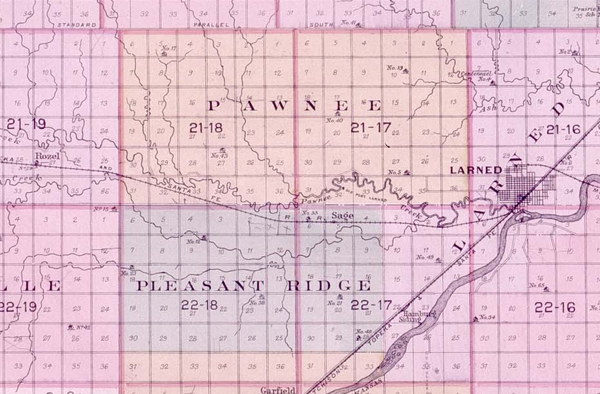

Map showing Rozel (on the far left) and Larned (on the right)

The "Rozel sinkhole" became a running joke in the region. But the fact that the story had been reported as fact in major newspapers continued to fool people for decades. In 1935, Professor Kenneth Landes, an assistant state geologist, wrote a booklet titled Scenic Kansas, in which he included the Rozel sinkhole as one of Kansas's more unusual sights, describing it as being one acre in size. A decade later, the Rozel sinkhole made its way into a Kansas school geography.

The town still remains standing to this day, its size and population not having changed much since 1897.
References:
  • "Hoary Western Kansas Hoax Still Being Accepted As Something True," (Oct 20, 1952), The Hutchinson News-Herald.
  • Richard J. Heggen. (2009). Underground Rivers.

Categories: Journalism, Places
Posted by Alex on Sat Jan 26, 2013
Comments (2)
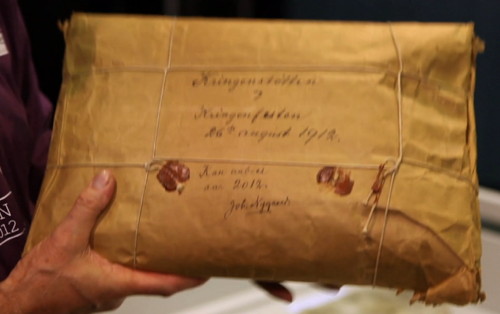
For 100 years, a package marked "May Be Opened in 2012" has been sitting in a museum in Otta, Norway. It was given to the town of Otta by a local resident, Johan Nygaard, back in 1912. There's been enormous speculation about what the package might contain. Money? A diary? Stock certificates?


Finally, last Friday, the 100-year-mark arrived, and the town gathered to open the package. There was a live video feed, so the entire world could share in the excitement. The mayor carefully opened the package, peeked inside... and it turned to contain: "not-too-valuable notebooks, newspaper clippings, community council papers, a letter, small drawing and other bits of paper." In other words, nothing of any value. [time.com].

Some of the newspapers were dated 1914 and 1919, which means someone must have opened the package after 1912 to put them in there. Perhaps they removed whatever was in there and inserted junk in its place.

The affair reminds me the bequest of Francis Douce. When he died in 1834, Douce, who was a wealthy collector, willed a box to the British Museum with instructions that it be opened on January 1, 1900 — in 66 years. The British Museum did wait, as instructed, but when they finally opened the box, it contained nothing but a bunch of worthless papers. According to rumor, there was also a note from Douce in the box explaining that he thought it would be a waste to leave anything of greater value to the philistines at the British Museum.

I wonder if Nygaard had heard of Douce's bequest? He might have read about it in 1900 and decided to do something similar. Probably not. But it's a possibility.
Categories: History, Places
Posted by Alex on Mon Aug 27, 2012
Comments (8)
Bethel, Alaska is a small town. Travel writer Harry Franck, writing in the early 1940s, offered this description of it:
Sidewalk lounging New Yorkers would mistake Bethel at the mouth of the Kuskokwim for the end of the earth. But I found it interesting. For one thing I saw there my first Eskimos, at least in their native habitat. Bethel has a truck, too, and maybe a mile and a half of road... Then there is Bethel's boardwalk, a resounding wooden sidewalk that runs the whole length of the single-row town -- and beyond, vaulting a minor stream by transforming itself into a bridge, reverberating on into what I suppose Bethel calls its suburbs.


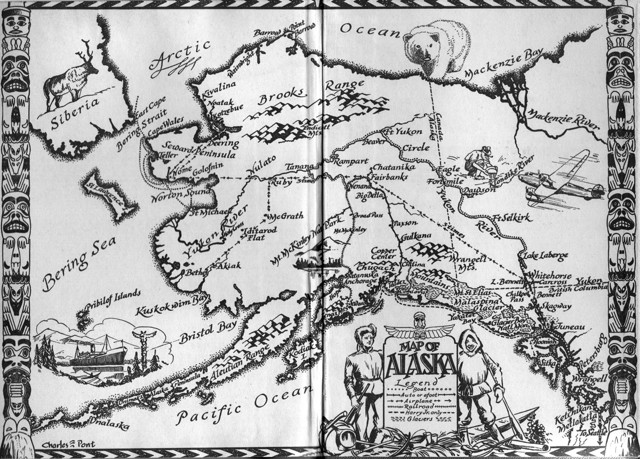
Bethel is on the left-hand side of the map, near Kuskokwim Bay


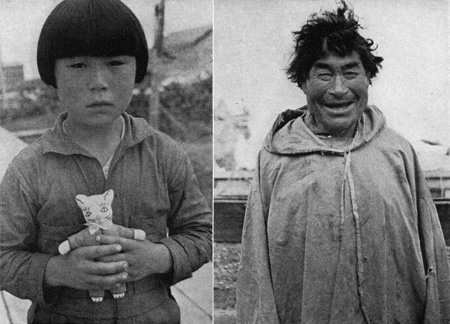
Bethel residents, circa 1940

Bethel isn't much bigger today. It currently has a population of around 6000, many of whom aren't permanent residents. And there are no roads connecting the town to the outside world. You've got to fly, walk, or travel by boat to get there. All of which makes Bethel an unlikely location for what's shaping up to be the most-publicized hoax of 2012.

At the beginning of June, fliers appeared around Bethel announcing that a Taco Bell restaurant would be opening there in time for July 4th. The flier said that positions were available at the restaurant, and listed a phone number for those seeking employment.

Bethel has only one fast-food restaurant, a Subway, so the news that Taco Bell was coming there created enormous excitement. Hundreds of people phoned the contact number -- only to discover they had been taken in by a hoax. The number connected them to a (very annoyed) local resident who wasn't affiliated in any way with Taco Bell.

The fliers turned out to be the result of what local police described as a feud between two Bethel residents. (The names of the two haven't been released... or, at least, I haven't been able to find them.) One of the feuders posted the fliers, listing the other guy's phone number, as a prank. The Anchorage Daily News described it as an "evil hoax."

There was great disappointment in Bethel when everyone realized Taco Bell wasn't opening there. But the story of the taco-loving town made national news, and thereby came to the attention of Taco Bell, whose PR people realized they had a great publicity opportunity on hand.

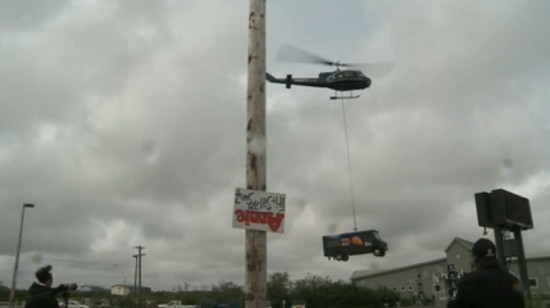
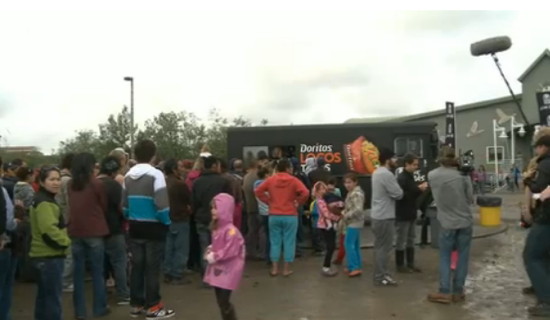
So Taco Bell arranged for a food truck to be flown into Bethel, and on July 2 gave away over 6000 free tacos to the townsfolk. Most people in the town seemed to appreciate the publicity stunt. Though one resident suggested Taco Bell might try adding some Alaskan-themed ingredients, such as moose or cariboo taco, to its menu.


The Taco Bell food truck arrives by air in Bethel


Bethel residents get their tacos

Taco Bell, of course, is no stranger to hoax-themed publicity. See the Taco Liberty Bell hoax of 1996.

Links: kyuk.org, ktuu.com, Washington Post.
Categories: Food, Places
Posted by Alex on Tue Jul 03, 2012
Comments (4)
Apparently it's because the original architects didn't factor in the weight of all the tourists who visit it.

Well, no. Not really. According to the BBC, the real reason is that, "The building's foundations require a steady stream of moisture from the Yamuna River to retain its strength - but the river is slowly drying up." But the headline immediately reminded me of the urban legend of the sinking library.

Categories: Places, Urban Legends
Posted by Alex on Tue Mar 13, 2012
Comments (3)
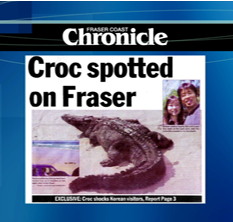
The Telegraph recently listed the beach on Queensland's Fraser Island as among the most dangerous in the world. The reasons: sharks, jellyfish, strong rip currents, deadly spiders, the odd saltwater crocodile, and dingoes. But people around Fraser Island disagree. They don't dispute the presence of the sharks, jellyfish, rip currents, spiders, and dingoes. (Though they don't think dingoes are dangerous). But they do insist there are no crocodiles there, except for one — which is fake.
One of the locals owns a fake, but realistic-looking crocodile that he sometimes puts on the beach. Back in 2006 this crocodile made headlines in the Fraser Coast Chronicle when it scared some Korean tourists. And this seems to be where The Telegraph, five years later, picked up the notion that Fraser Island's beach is croc-infested. Links: Media Watch, Sydney Morning Herald.
Categories: Animals, Places
Posted by Alex on Tue Oct 25, 2011
Comments (4)
Time magazine offers a list of the Top 5 Disney World Urban Legends:
  1. Walt Disney built a special suite for himself in Cinderella's castle at the Magic Kingdom. (Apparently this wasn't true while Disney was alive, though there is a suite there now in which special visitors can stay.)
  2. Cinderella's castle can be disassembled or made to sink into the ground to protect it from natural disasters such as hurricanes.
  3. In the case of a death at a Disney park, no one can be declared dead until their body leaves the park itself.
  4. There's a whole other park beneath the Magic Kingdom. (No, but there are utility corridors beneath it.)
  5. Disney's body was cryogenically frozen and is kept beneath the Pirates of the Caribbean ride at Disney Land.
The list focuses specifically on legends pertaining to the amusement parks, which I guess is why it doesn't include the most persistent Disney urban legend, about the satanic messages hidden in their movies.

But about the last legend — Disney's body being kept frozen beneath the Pirates of the Caribbean ride. While this isn't true, apparently some people have been suspected of dumping cremated human remains at the ride, as posted by Tah in the hoax forum back in 2007.
Categories: Places, Urban Legends
Posted by Alex on Tue Oct 04, 2011
Comments (10)
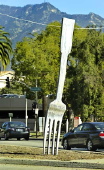
A few days ago a fork appeared in the middle of a Pasadena road. It's located, appropriately, at a fork in the road, where Pasadena and St. John avenues divide. From the Pasadena Star News:

It turns out the fork is an elaborate - and expensive - birthday prank in honor of the 75th birthday of Bob Stane, founder of the Ice House comedy club, who now owns the Coffee Gallery Backstage in Altadena...
The wooden fork, is "expertly carved and painted," to look like metal, Stane said. "It's anchored in 2 1/2-feet of concrete and steel. It's not a public danger - unless someone drives into it."

(Thanks, Bob!)
Categories: Art, Places, Pranks
Posted by Alex on Fri Nov 06, 2009
Comments (6)
From the BBC:

Argleton appears on Google Maps as a small town furnished with amenities, but it does not actually exist, apart from a field and a few trees.
Some people have described the place, nestled between Aughton and Ormskirk, as a "phantom town" that only ever appears on the online search engine.
Google said: "While [most information] is correct there are... errors."
Roy Bayfield from nearby Edge Hill University became so intrigued by the description that he decided to walk there.
He was greeted by a gate, a field and cluster of trees but no houses, businesses, pubs or even a phone box.
"It is strange," Mr Bayfield said, "especially because chiropractors, nurseries and even dating agencies are listed under Argleton.

Hmm. I wonder if it's a copyright trap (or Mountweazel). It reminds me of Agloe, New York. (Thanks, Bob!)
Categories: Places
Posted by Alex on Tue Nov 03, 2009
Comments (3)
A fake seagull perched on a billboard outside the town of Grand Marais, Minnesota recently went missing. Residents suspect it was stolen, and they want it back. So the town has organized a "give us the bird" campaign, in which they're offering a free vacation in Grand Marais in return for information leading to the safe return of the seagull. The best story wins. A strict adherence to the truth, in this case, would seem to be irrelevant. [upi.com]
Categories: Folklore/Tall Tales, Places
Posted by Alex on Thu Sep 10, 2009
Comments (2)
Loch Ness is a finalist in a campaign to name the New 7 Wonders of Nature. Other finalists include the Amazon River, the Grand Canyon, the Great Barrier Reef, and Mount Kilimanjaro.

Loch Ness is very scenic and geologically very interesting, but Willie Cameron of Loch Ness Marketing thinks that the Loch should have a leg-up on the competition because, "None of the other nominees has a legacy we know as the Loch Ness Monster. Whatever it is, it is unexplainable and that is unique."

By that reasoning, shouldn't the North Pole also be a contender, since it's the home of Santa Claus? [Highland News]
Categories: Cryptozoology, Places
Posted by Alex on Thu Jul 16, 2009
Comments (11)
Pranksters in Inverness have made it even more difficult to find Nessie by moving the road signs for Loch Ness so that they point in the wrong direction. The leading suspects are concert-goers attending the RockNess music festival.

But here's the part of the article I found interesting. One resident "likened the alterations to World War II, when the authorities removed signs to prevent German soldiers from navigating their way round the country if they invaded."

I didn't know that had been done during WWII. I can't imagine that a lack of road signs would have significantly slowed down a German invasion. [Press and Journal]
Categories: Places, Pranks
Posted by Alex on Fri Jun 26, 2009
Comments (12)
If you visit Loch Ness, you probably won't see Nessie, but you will see a lot of confused tourists, thanks to confusing road signs that local businesses have been putting up.

For instance, many tourists who are looking for Urquhart Castle wind up in the Loch Ness Monster Visitor Centre because of a large road sign for "Glen Urquhart Castle" that points toward the Visitor Centre. The word "Glen" is in tiny, small letters, and most people probably wouldn't realize that Glen Urquhart Castle is different than Urquhart Castle.

Urquhart Castle is a real castle (and definitely worth seeing). Glen Urquhart Castle is just a wooden building attached to the Loch Ness Monster Visitor Centre.

Link: Inverness Courier.
Categories: Places
Posted by Alex on Fri May 29, 2009
Comments (2)
Page 1 of 13 pages  1 2 3 >  Last ›