The Museum of Hoaxes
HOME   |   ABOUT   |   FORUM   |   CONTACT   |   PINTEREST   |   FACEBOOK   |   TWITTER   |   RSS
The Top 100
April Fool Hoaxes
Of All Time
April Fool's Day
Gallery
Hoax Photo
Archive

Weblog Category
Literature/Language
Status: Hoax
A news report has been doing the rounds concerning a student at UMass Dartmouth who was visited by Department of Homeland Security agents after ordering the official Peking version of Mao Tse-Tung's Little Red Book via interlibrary loan. The student needed the book for a research paper on communism, but apparently the book is on some kind of government watch list, and thus the visit. However, over at Boing Boing, suspicions have been raised that the story is a hoax. Apparently a second version of the story is floating around that places the student at UC Santa Cruz. Also, people find it suspicious that the student is unnamed, and therefore the story is basically hearsay. However, the reporter who wrote the story has responded to queries and is insisting that what he reported is true.
Update: Turns out the student invented the story about being visited by federal agents. Why he made up the story is unclear, but it's speculated that he did it simply to get attention. Details can be read in Aaron Nicodemus's follow-up article in SouthCoastToday.com.
Categories: Law/Police/Crime, Literature/Language
Posted by Alex on Tue Dec 20, 2005
Comments (10)
Status: Patent the A is satire; patented storylines is serious
The Ecchi Patent Company claims to hold a patent on the letter A:

The rights lie with us for all forms of the letter A, including, but not limited to, uppercase, lowercase, accented, Cyrillic, put in a little circle (e-mail users please note), in code, and in any form we may not have thought of already.

Supposedly you need to obtain a license from them in order to use the letter A in any form: "we will soon begin prosecuting people who fail to purchase a license and continue to use the letter A." Of course, this is a joke. Unless you invented the letter A, you wouldn't be able to patent it. The creator of 'patent the A' admits it's a joke on another site he's created.

But in a similar case, Andrew Knight has filed an application to patent a fictional storyline (he says it's the first time anyone has ever sought to patent a storyline), and he doesn't seem to be joking about this. Here's the highly original story Knight seeks to patent:

The fictitious story, which Knight dubs “The Zombie Stare,” tells of an ambitious high school senior, consumed by anticipation of college admission, who prays one night to remain unconscious until receiving his MIT admissions letter. He consciously awakes 30 years later when he finally receives the letter, lost in the mail for so many years, and discovers that, to all external observers, he has lived an apparently normal life. He desperately seeks to regain 30 years’ worth of memories lost as an unconscious philosophical zombie.

Seems to have shades of Rip Van Winkle, to me. Anyway, I truly hope Knight doesn't succeed in his effort (if he is actually serious about it), since if authors are able to patent storylines, it would seem to me to spell the end of literature. Plus, it's often said that there are only three basic storylines: man vs. man, man vs. nature, and man vs. self. So no story is truly original, and therefore shouldn't qualify for a patent.
Categories: Law/Police/Crime, Literature/Language
Posted by Alex on Fri Nov 04, 2005
Comments (14)
Status: Hoax claims victim
image In my Gallery of Hoax Websites (which I created about four years ago, and which has since been superceded by the Hoax Websites category of the weblog), I list the website of Boilerplate, the Victorian Era Robot. The site details the history of a robot named Boilerplate who was supposedly created during the 19th century in order to replace humans in combat. I admit that the site had me going for a while, and that I only realized it was a hoax when I tried to check the bibliographic references, none of which referred to real books. It seems I wasn't the only one to be taken in by Boilerplate. The New York Times reports that comedian Chris Elliott, believing Boilerplate was a nineteenth-hoax (not a modern one), incorporated the robot into his historical novel, The Shroud of the Thwacker. Only when the creator of Boilerplate threatened to sue him for copyright infringement did Elliott realize his mistake. If only Elliott had checked my site, he would have known better.

Categories: Literature/Language, Technology
Posted by Alex on Wed Nov 02, 2005
Comments (4)
Status: Art Fake (i.e. it's not Shakespeare)
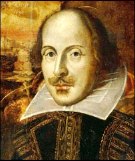
image The National Portrait Gallery has reported that the Grafton portrait, long thought to depict Shakespeare as a young man, doesn't depict him at all. They don't know who the guy in the painting is. The portrait apparently served as the inspiration for the portrayal of Shakespeare in the movie Shakespeare in Love.

So the Grafton portrait will now join the Flower portrait (revealed to be a nineteenth-century fake earlier this year) in the category of "portraits of Shakespeare that don't actually show Shakespeare." My hunch is that all the depictions of Shakespeare are unreliable. We'll never know what he looked like.
Categories: Art, Literature/Language
Posted by Alex on Fri Oct 28, 2005
Comments (10)
Status: Seems to be true
Charles Haberl e-mailed me with a question about the world's longest surname. Here's the main part of his message (it's kind of long):

There's an bit of internet lore circulating around that the Guinness World Record for Longest Name in the world belongs to a Mr. Adolph Blaine Charles David Earl Frederick Gerald Hubert Irvin John Kenneth Lloyd Martin Nero Oliver Paul Quincy Randolph Sherman Thomas Uncas Victor William Xerxes Yancy Wolfeschlegelsteinhausenbergerdorffwelchevoralternwarengewissenschaftschafe rswessenschafewarenwohlgepflegeundsorgfaltigkeitbeschutzenvonangreifeudurch ihrraubgierigfeindewelchevoralternzwolftausendjahresvorandieerscheinenersch einenvanderersteerdemenschderraumschiffgebrauchlichtalsseinursprungvonkraft gestartseinlangefahrthinzwischensternaitigraumaufdersuchenachdiesternwelche gehabtbewohnbarplanetenkreisedrehensichundwohinderneurassevonverstandigmens chlichkeitkonntefortpflanzenundsicherfeuenanlebenslanglichfreudeundruhemitn icheinfurchtvorangreifenvonandererintelligentgeschopfsvonhinzwischenternart Zeus igraum Senior, who was born in Munich in 1904 and lived in Philadelphia for most of his life. Apparently he shortened his name to Wolfeschlegelsteinhausenbergerdorff, and subsequently went by Hubert Blaine Wolfe, but the "Senior" indicates that he passed some form of his name to his son.

Note that misspellings are rife (the Wikipedia entry for his name is "Adolph_Wolfeschlegelsteinhausenberdorf," but within the entry he is identified as "Adolph Wolfeschlegelsteinhausenbergerdorf" - neither of which are correct.

If you poke around, as I have, you'll find that the book in which this bit of information is contained is variously described as "old," "from the 70s", and even "published in 1978." The most amazing thing about this name is the translation of the content after "Wolfe Schlegel Steinhausen-Bergedorf," ("wolf" "mallet" "Steinhausen (a common placename)" and "Bergedorf (a borough of Hamburg)") which translates to

"...who before ages were conscientious shepherds whose sheep were well tended and diligently protected against attackers who by their rapacity were enemies who 12,000 years ago appeared from the stars to the humans by spaceships with light as an origin of power, started a long voyage within starlike space in search for the star which has habitable planets orbiting and whither the new race of reasonable humanity could thrive and enjoy lifelong happiness and tranquility without fear of attack from other intelligent creatures from within starlike space."

On one forum (allsearch.de's AllMystery forum, in German) this is identified as "medieval German" and advanced as possible evidence for the extraterrestrial origins of mankind. I'm more inclined to view it as someone (possibly Mr. Wolfe-Schlegel Steinhausen-Bergerdorff himself)'s idea of a practical joke on the Guinness people.

My question is, does this man actually appear in the Guinness Book of World Records, as the holder of the world's longest name, or is this a bit of unsubstantiated internet trivia? Furthermore, was the text after "Bergerdorff" part of the original Guinness account, or was it subsequently added on? The Guinness website is useless in this regard (it doesn't feature any entry for "longest name") and I don't have a copy of the 1978 Guinness Book of World Records or indeed that for any other year.


Here's my answer: By a very odd coincidence, I own only one edition of the Guinness Book of Records, and it happens to be the 1978 edition. And it does indeed mention Mr. Wolfe. The entry about him states:

The longest name used by anyone is Adolph Blaine Charles David Earl Frederick Gerald Hubert Irvin John Kenneth Lloyd Martin Nero Oliver Paul Quincy Randolph Sherman Thomas Uncas Victor William Xerxes Yancy Wolfeschlegelsteinhausenbergerdorff, Senior, who was born at Bergedorf, near Hamburg, Germany, on 29 Feb. 1904. On printed forms he uses only his eighth and second Christian names and the first 35 letters of his surname. The full version of the name of 590 letters appeared in the 12th edition of The Guinness Book of Records. He now lives in Philadelphia, Pennsylvania, U.S.A., and has shortened his surname to Mr. Wolfe + 585, Senior.

I assume that the 12th edition (which I don't own) gave the full, long version of Mr. Wolfe's name. The other part of Charles's question (was this a practical joke on the Guinness people?) is harder to answer. Mr. Wolfe's birthday (February 29, 1904) seems a bit suspicious, but 1904 was a leap year, so it could be true. For now I suppose we'll have to trust that the Guinness people did their homework and weren't the victims of a hoax.
Categories: Literature/Language
Posted by Alex on Thu Oct 20, 2005
Comments (37)
Status: Not to my knowledge.
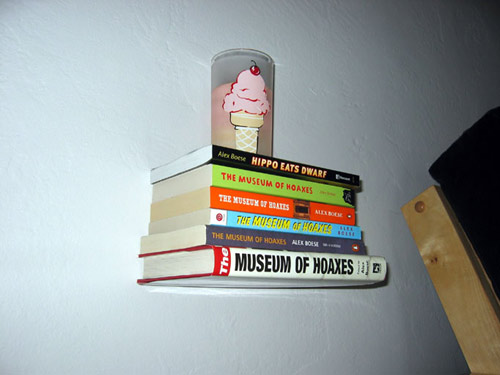
Since my upcoming book is titled Hippo Eats Dwarf, this brief article in The Sun caught my attention:

PANTOS of Snow White And The Seven Dwarfs are being censored — to outlaw the word DWARF. A shocked village drama group sent off for a script and found Dopey and his pals — played by kids — had to be called “gnomes” instead. Ray Lionet, 73, of the Coxheath Players in Kent, said the ban was to avoid offending short people. He said: “It’s madness.”

I never thought the word dwarf was considered to be derogatory. I hope it's not, because it's way too late to change the title of my book. Though when I was considering the title, I kept thinking that no one has ever claimed "Snow White and the Seven Dwarfs" to be offensive, so the word must be okay. Now, that's no longer true. But anyway, wouldn't it have to be less offensive to call a little person a dwarf, than to call them a gnome?
Categories: Literature/Language
Posted by Alex on Mon Oct 17, 2005
Comments (36)
Status: Yes, he's a hoax
image J.T. LeRoy is either a) an extremely shy young man who, at the age of 13, while living a life of abuse and prostitution on the streets, met a psychologist who encouraged him to write down his experiences, which he did, thereby propelling him to literary stardom (now in his mid-twenties, LeRoy has three books, one of which has been made into a movie); or b) a woman in her late-thirties called Laura Albert who, for the past eleven years, has crafted an elaborate hoax to make people believe that LeRoy is a real person.

Stephen Beachy believes that option B is correct, and he lays out the reasons why in an article appearing in the current issue of New York Magazine. His basic argument goes like this: Laura Albert (aka Emily Frasier) is the woman who supposedly took LeRoy in when he was a young teenager. Beachy thinks she didn't take him in. She invented him. For years no one ever saw LeRoy. Blaming shyness, he would only talk on the phone or via email. Beachy suggests that Albert was the one doing the talking. When LeRoy finally did start to make public appearances (in 2001), he would conceal his features with a wig and sunglasses and avoid talking to people. Beachy believes the LeRoy seen in public is an actor hired by Albert. Then there's the odd fact that all of LeRoy's royalty payments go to Albert, or members of her family.

Beachy offers up plenty of other suspicious pieces of evidence, and I'm inclined to think he might be right. The biggest point in favor of LeRoy's reality is simply that it would be pretty outrageous for anyone to devise such an elaborate, and long-lasting, hoax. But then, outrageous is something hoaxers do well.

I suppose with time we'll discover the truth behind this story. My guess is that if LeRoy is a hoax, Albert will try to "kill him off" at some point when it becomes too difficult to continue the deception.

Update, January 4, 2006: Laura Barton has managed to interview JT LeRoy in person, and reports about her experience in the Guardian. She's not at all convinced that the person she interviewed really was LeRoy. She writes:

What strikes me most is the inarticulacy of LeRoy's speech. The delivery is stilted, the distinctive LeRoy vocabulary neutered. And while there is no reason for authors to be verbally articulate, I cannot find the pulse here, nor an intensity that in any way relates to the work of JT LeRoy. He seems distant, not only from our conversation, but from the work and his own argument. Much of what he says is identical to the phrases used by Albert in our telephone conversation, and it is hard to decipher whether this is LeRoy speaking Albert's words, or whether Albert was simply recycling LeRoy's. Whoever this is, sitting so sweetly beside me in the back of the car, I'm not wholly convinced it is the person who wrote the books. I would say two things with some certainty: I think it's a woman, and I think she's a real cutie pie. But whoever she is, our conversation seems cursory, a mahogany finish sprayed onto the solid wood beneath.

Update, January 9, 2006: The New York Times has revealed that the person appearing in public as LeRoy seems to be Savannah Knoop, the half-sister of Geoffrey Knoop (the guy who supposedly helped rescue the teenage LeRoy). I've posted an entry about this new evidence here.

Update, February 6, 2006: Geoffrey Knoop, the partner of Laura Albert, has admitted that Albert wrote all of JT Leroy's books. He also concedes that the face of JT Leroy, whenever Leroy made any public appearances, was his half-sister Savannah Knoop. The New York Times has quoted Geoffrey Knoop as saying: "The jig is up... I do want to apologize to people who were hurt. It got to a level I didn't expect." Knoop also says that he doubts Laura Albert will ever admit to being JT Leroy: ""For her, it's very personal. It's not a hoax. It's a part of her."
Categories: Literature/Language
Posted by Alex on Mon Oct 10, 2005
Comments (39)
The most recent edition of the New Oxford American Dictionary (NOAD) defines esquivalience as "the willful avoidance of one’s official responsibilities." However, esquivalience isn't a real word. It's a copyright trap, placed in the dictionary so that the editors can know when others are stealing their work. This was reported in last week's New Yorker. The editors of NOAD admit that they made up esquivalience: "An editor named Christine Lindberg came up with “esquivalience.” The word has since been spotted on Dictionary.com, which cites Webster’s New Millennium as its source." But, of course, if enough people start to use the word, it could become real. I think the most famous case of fake entries in a dictionary occurred in the 1889 edition of Appleton's Biographical Dictionary. But in that case, the fake entries weren't put there purposefully. (At least, not by the editors.)
Categories: Literature/Language
Posted by Alex on Wed Sep 07, 2005
Comments (2)
A Russian woman, Neonilla Samukhina, claims that the original version of Jonathan Swift's Gulliver's Travels was far racier, containing numerous explicit sex scenes... and she happens to have acquired a manuscript of this early version. She published a Russian translation of it last week.

The book features the hero of 18th century Irish author Jonathan Swift’s famous satire in physical encounters with tiny Lilliputs — who are only 15 centimeters tall — and in Brobdingnag, which is inhabited by 20-meter giants.

No experts seem to be taking her claims very seriously. Obvious signs that it's a hoax are that she refuses to allow anyone to see the manuscript, nor will she allow them to read the English text (she's worried about people reprinting it since Swift's work is no longer copyrighted). University of Ulster Professor Joseph McMinn comments that, "I think this is a clever way of selling an erotic text, by giving it the appearance of ‘serious’ literature, and inventing a mystery story about its origins." Of course, all those high-school kids who are forced to read Gulliver's Travels probably would find the erotic version more interesting.
Categories: Literature/Language, Sex/Romance
Posted by Alex on Mon Aug 22, 2005
Comments (8)
A group of MIT students wrote a computer program capable of creating "random Computer Science research papers, including graphs, figures, and citations." They then used this program to create a paper that they submitted to an academic conference: the World Multi-Conference on Systemics, Cybernetics and Informatics, which sounds like a thrill a minute. The paper was accepted, which isn't really surprising since as the students point out conferences such as this are really 'fake' conferences "with no quality standards, which exist only to make money." The students hope to travel down to the conference (if they're still allowed to attend) and deliver a "completely randomly-generated talk."
Categories: Literature/Language, Science
Posted by Alex on Fri Apr 15, 2005
Comments (5)
Want to be a best-selling author making millions of dollars? Then sign up to be on Book Millionaire and your dreams could become reality!

Here's your chance to finally become America's next Best Selling Author and Reality Show TV Celebrity!  We are scouting for the next group of candidates for America's hottest new reality show. Act now. Picture yourself featured on national television sharing your story, writing, book-to-be or book with millions of people showing you have what it takes to be America's next Best Selling Author and Book Millionaire.

John Ordover brought this to my attention, noting that it looks like a scam, and I have to agree with him. On Book Millionaire's website they claim to be producing a new reality show, but nowhere can I find what studio or network they're working with, or where they're getting their funding from. Plus, they don't even require contestants to be published authors. You only have to have an idea for a book. But how can you become a bestselling author without a book? Maybe they'll help you sell your idea to get a huge advance. Could happen, so it's not impossible that it's legitimate. And maybe they don't list any partners because they haven't sold the idea to any networks yet. I don't know. But right now it looks kind of shady.
Categories: Entertainment, Literature/Language
Posted by Alex on Thu Apr 14, 2005
Comments (16)
image This should appeal to all H.P. Lovecraft fans. It's Springtime in Arkham, a collection of scents inspired by the world of Lovecraft. For only $155 you can buy the entire set, sold together as the 'Gibbering Madness Pack: More eternal evil than you can shake a stick at'. The fact that these are only available from April 1 to June 1 makes it all seem a little like an April Fool's day joke, but I think they're quite real. I'm actually tempted to buy the CTHULHU scent: A creeping, wet, slithering scent, dripping with seaweed, oceanic plants and dark, unfathomable waters.
Categories: Literature/Language, Paranormal
Posted by Alex on Mon Apr 04, 2005
Comments (20)
Page 8 of 12 pages ‹ First  < 6 7 8 9 10 >  Last ›