The Museum of Hoaxes
HOME   |   ABOUT   |   FORUM   |   CONTACT   |   PINTEREST   |   FACEBOOK   |   TWITTER   |   RSS
The Top 100
April Fool Hoaxes
Of All Time
April Fool's Day
Gallery
Hoax Photo
Archive

Weblog Category
Literature/Language
Status: Movie planned about a recent hoax
image Variety reports that the JT Leroy hoax is already heading to the big screen. The Weinstein Company has committed to making a film about Laura Albert's elaborate deception. (Laura Albert was the woman who invented the JT Leroy character.) The time between the hoax being exposed and a movie deal about it being inked seems to have occurred incredibly fast. What is it... a month or two since the hoax was confirmed? The dust has barely settled.

I hope the movie is good. In its favor is that hoaxes seem to translate pretty well to the big screen. Shattered Glass (about the journalistic deceptions of Stephen Glass) was a great movie. And Princess Caraboo, starring Phoebe Cates, (about the Princess Caraboo hoax, obviously) was decent, as a kid's movie. I've read that a movie called The Hoax, starring Richard Gere, about Clifford Irving's fake autobiography of Howard Hughes, is coming out soon. That also sounds good.

In other JT Leroy news, a movie version of one of his (her?) books, The Heart is Deceitful Above All Things, is about to debut. The movie was made under the assumption that the story it told was true. Now that story has been exposed as a lie, prompting a rapid switch in how the movie is marketed. My guess is that most people still have never heard of JT Leroy, so the hoax shouldn't have much impact on the movie.

Related Posts:
October 10, 2005: Is JT Leroy A Hoax?
January 9, 2006: JT Leroy: An Update
February 6, 2006: Knoop Confesses JT Leroy Was a Hoax
Categories: Entertainment, Literature/Language
Posted by Alex on Thu Mar 09, 2006
Comments (6)
Status: True
The internet is full of many unfortunate urls that can be read in two ways. Some of the urls intentionally have double meanings, some don't. For instance, viagrafix.com (via grafix / viagra fix) was an unintentional oversight, but powergenitalia.com (powergen italia / power genitalia) was a deliberate joke, as is penisland.net. Apparently Vietnamese sites are prone to the same problem. For which reason, Vietnamese regulators have rejected the website name http://www.buoi.com.vn The BBC explains:

A website hoping to promote grapefruit in Vietnam has been banned from using the fruit's name because of official fears of a mix-up with a penis.
The Vietnamese for grapefruit, buoi, sounds different from a slang word for penis, but without special accents it looks the same. Vietnamese regulations say website names cannot include "sensitive" words. The site, set up to market a grapefruit wholesaler in Ha Tinh province, was told to find another name. "We have to refuse the website name of http://www.buoi.com.vn because the word for grapefruit, buoi, without a proper tone marking can be misunderstood," Thai Huu Ly, of the Vietnam Internet Network Information Centre, told the AFP agency.
Categories: Literature/Language
Posted by Alex on Thu Feb 16, 2006
Comments (5)
The Comics Should Be Good blog is creating a database of comic book urban legends. I don't recognize all the names and characters referred to, but it makes for interesting reading anyway. Here's a few samples (full explanations for all of these at Comics Should Be Good):

Wolverine's costume was patterned in part on the uniforms of the Michigan Wolverines football team. (False)

Joker was originally killed off in his SECOND appearance! (True)

Wolverine was initially intended to be a genetically mutated wolverine. (True)

Wonder Woman creator William Moulton Marston invented the polygraph test! (False)

Marvel Comics licenses the use of the name "Hulk" to Hulk Hogan. (False, now... but it used to be true)

Marvel HAS to publish a Captain Marvel comic book. (For all intents and purposes, True)

DC had a Superman storyline set during the Holocaust that did not mention the word "Jew" or "Jewish." (True)

Nicolas Cage took his last name from Luke Cage, Hero For Hire. (True, depending on when you talk to Nicolas Cage)
Categories: Literature/Language, Urban Legends
Posted by Alex on Mon Feb 13, 2006
Comments (7)
Status: Final nail in coffin of JT Leroy
Just in case there was anyone who still doubted that JT Leroy was a hoax, the deception has finally been admitted to by an insider, Geoffrey Knoop. Knoop was the partner of Laura Albert, the woman who (it can now definitely be said) wrote all of JT Leroy's books. The face of JT Leroy, whenever Leroy made any public appearances, was Savannah Knoop, Geoffrey's half-sister. Geoffrey Knoop has said: "The jig is up... I do want to apologize to people who were hurt. It got to a level I didn't expect." Knoop also says that he doubts Laura Albert will ever admit to being JT Leroy: "For her, it's very personal. It's not a hoax. It's a part of her."

Previous posts about JT Leroy:
October 10, 2005: Is JT Leroy A Hoax?
January 9, 2006: JT Leroy: An Update
Categories: Identity/Imposters, Literature/Language
Posted by Alex on Tue Feb 07, 2006
Comments (2)
Status: Phony
image Here we go again. Another memoirist has been unmasked as a phony. This time it's Nasdijj, celebrated Native-American author of autobiographical works such as The Blood Runs Like A River Through My Dreams and The Boy and the Dog Are Sleeping. Turns out he ain't Native American, unless by Native American one means white anglo-saxon protestant. His real identity seems to be that of Tim Barrus, who grew up in a middle-class community in Lansing, Michigan. As Barrus, he was a pioneer of gay "leather" erotica, before the gay community got tired of his antics and he disappeared for a few years, only to resurface as Nasdijj. The Native American community has had its doubts about him for quite a while, since he never seemed to have a firm grasp on the nuances of Navajo culture. But he's been fully unmasked by Matthew Fleischer in an article in this week's LA Weekly.
So this month alone we've seen the work of JT LeRoy, James Frey, and now Nasdijj called into question. One common theme is that the work of all three was widely praised for its raw, brutal honesty. Given how artificial and pre-packaged much of our world seems, there's obviously a big demand for things that seem uncommercialized and genuine. But as we're seeing, this demand has provided a perfect opportunity for con artists who can cynically exploit it by serving up fake experience as the real thing. (Thanks to Joe Littrell for forwarding the link.)
Categories: Identity/Imposters, Literature/Language
Posted by Alex on Thu Jan 26, 2006
Comments (5)
Status: True
image Two weeks ago a lot of people were linking to a story about books bound in human skin that can be found in many libraries, including the rare book libraries at Brown and Harvard. This is, apparently, quite true. Often the books are old medical works, with the skin coming from patients or paupers whose bodies were bought for research. The most gruesome book, owned by the Boston Athenaeum, is an 1837 copy of the memoirs of the highwayman George Walton, bound in his own skin.
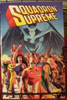
Following on in this vein, Paul Collins has noted that Mark Gruenwald, a writer for Marvel Comics, had his cremated ashes mixed into the printing of a comic book, Squadron Supreme. This is absolutely true. A copy of this "cremain printing" is currently for sale on eBay. The seller notes: "The book is in good shape with a ding on the upper, left corner from falling off a table. I hate to part with Mark, but I'm real tired of telling him to get his ash off the table."

The only other way I can think of to incorporate a human body into a book would be to write it in blood, which I'm sure someone has done. Though maybe I'm not being imaginative enough. Perhaps one could make a book's spine out of human bone, the paper from hair and nails... the possibilities are endless.
Categories: Death, Literature/Language
Posted by Alex on Tue Jan 24, 2006
Comments (15)
Status: It's a kind of magic trick (though it really will hold up your books)
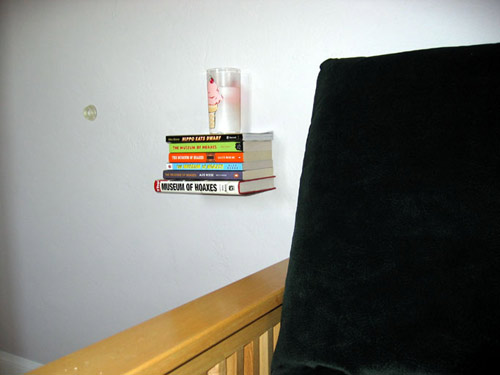
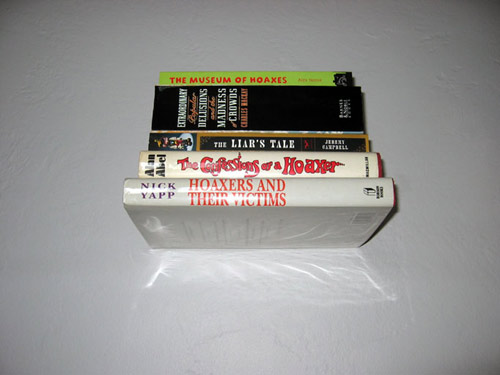
image Linkydinky.com is offering a product called the magicSHELF. Kathy Johnston emailed me to ask: "Is this for real? I can't tell how it works." Unfortunately, I don't yet have a definitive answer. The magicSHELF has stumped me.
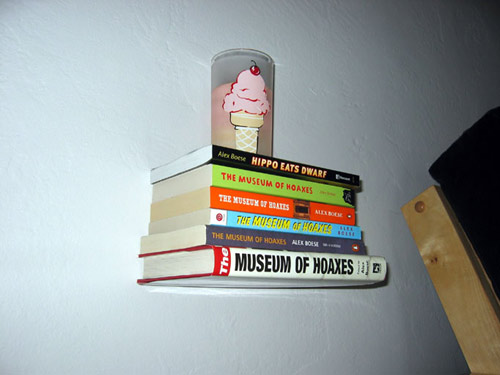
Pictures of the magicSHELF show books floating against a wall as if by magic, with no visible means of support. As the site says, "magicSHELF floats your books in the air, docking to any wall you wish." When I first saw it I figured it had to be a joke. This is linkydinky, after all, the creators of the infamous Lovenstein Institute email. Plus, the pictures of the magicSHELF in action could easily have been photoshopped, and statements such as "How does magicSHELF work? It works like magic!" seem tongue-in-cheek. But then I noticed that they're taking money for these things, which put a dent in my skepticism. After all, if you send them $18, you better get something in return... and not just an empty box. I don't think linkydinky would invite people to send them money for a nonexistent product. So now I'm thinking that the magicSHELF must be real, although I have no explanation for how it works.

Update: Greg Cason ordered a magicSHELF and emailed me the flyer that explains how it works. So what's the secret? Well, now that I know, I think I need to invoke the magician's creed (don't spoil the trick) and stay mum. However, I will say that it is real, and it definitely does work.

Update 2: I received my very own magicshelf in the mail, sent by Uncle Url of linkydinky to help me verify that it is, indeed, real. Perhaps it was just a trick of the light, but I could swear that the package it arrived in was floating, ever so slightly, off the ground. wink

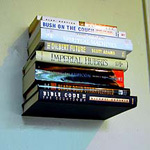
Anyway, it didn't take me long to get it installed. Maybe ten minutes total. You can see the results below.

image image image


When you get the magicSHELF your first thought might be, "This is so simple. Why didn't I think of this?" But, speaking for myself, I had never thought of it before, so I've got to give Uncle Url credit for the idea. And it definitely looks cool to have books magically floating on the wall. It's a surreal effect. You kind of have to blink twice to make sure your eyes aren't playing tricks on you. It really looks like there should be something supporting the books. Great conversation starter. I know I'm going to be showing it off to every guest that comes over.

So how sturdy is it? Well, I wouldn't stack a lot of books on it. Six or seven seems about right. Also, I wouldn't lean on it or let kids hang on it (unless you want a hole in your wall). But if it's by your bedside, it'll support some books and a glass of water, no problem.

If you're handy with making stuff on your own, you could probably jerry-rig something similar to the magicSHELF for less money. (But if you can't imagine how this might be done, then you're probably not handy enough to take on such a project.) However, the challenge would be to find the right parts. When I was at Home Depot this morning, I quickly checked to see how easy it would be to find similar parts. I found a few things that could work, if I had the tools to bend them into the right shape. But I don't have those kind of tools. However, I'm pretty sure that if one were to drive around to a few different hardware stores, you could eventually find something roughly equivalent. But how much effort are you willing to expend? It's a lot easier just to order it from Uncle Url. And it is his idea, after all.

Disclaimer: I don't have any kind of financial arrangement with linkydinky, but I have agreed to let Uncle Url quote me as saying that the magicSHELF is real. In return, whenever he uses my testimonial, he mentions that I have a book coming out soon, Hippo Eats Dwarf. So I do derive some benefit from that.
Categories: Literature/Language, Magic, Technology
Posted by Alex on Thu Jan 19, 2006
Comments (38)
Status: Marking an anniversary in hoax history
The million little biographical lies of James Frey have been getting all the attention in the press this week, but as the Devon Western Morning News reminds us, this month marks the 50th anniversary of the publication of a memoir whose lies were far greater: The Third Eye by T. Lobsang Rampa (aka the Plumber from Plympton). Rampa claimed to have grown up in Tibet (born into a wealthy Tibetan family), to have studied in Lhasa to become a lama, and then to have undergone a mysterious operation to open up the "third eye" in the middle of his forehead. This operation supposedly gave him psychic powers. But in reality, Rampa wasn't a Tibetan monk. He was actually Cyril Henry Hoskins, son of a plumber from Plympton, England. He hadn't even been to Tibet. As the Western Morning News puts it:
it is probable that his globetrotting was mostly restricted to commuting from his home in Plympton to Wadebridge, where he was born and later worked as a clerk and occasional fisherman.

When confronted with the facts about his past, Rampa admitted he had been born Hoskins, but explained that his body had been taken over by Rampa's spirit. Skeptics might say that Rampa/Hoskins was full of it. But happily, thanks to Oprah Winfrey, we now know that it doesn't matter if a memoirist lies about their past, as long as their "underlying message of redemption" is inspiring to readers. By this new standard, I think Rampa just might be off the hook.
Categories: Identity/Imposters, Literature/Language
Posted by Alex on Fri Jan 13, 2006
Comments (5)
Status: Undetermined (but the Smoking Gun presents a convincing argument)
It seems to be quite the week for literary hoaxes. First there were the new revelations in the JT LeRoy case, and now The Smoking Gun is now accusing author James Frey of inventing many of the details in his autobiographical novel, A Million Little Pieces. The book tells the story of Frey's past as a drug-addict and criminal. But the Smoking Gun alleges that, "The 36-year-old author, these documents and interviews show, wholly fabricated or wildly embellished details of his purported criminal career, jail terms, and status as an outlaw 'wanted in three states.'" They concede that the guy was a drug addict and spent time in rehab, but insist that his life has not been as colorful as he's made it out to be. As a police sergeant whom they interview about Frey says: "Seems Mr. Frey has quite an imagination. He thinks he's a bit of a desperado. He's making a bunch of crap up."

I haven't read A Million Little Pieces, and I don't think I will. Confessional novels by former drug addicts going on about how bad they used to be (but how they're now reformed and don't want anyone else to do what they did) always strike me as being annoying, preachy, and a bit full of themselves.
Categories: Literature/Language
Posted by Alex on Tue Jan 10, 2006
Comments (14)
Status: Evidence is mounting that he's a hoax
Last October I posted about the writer JT LeRoy, and the suspicion that he was an elaborate hoax: that his books had actually been written by a woman named Laura Albert, and that the person who appeared in public as LeRoy was an actor. Today the New York Times has revealed more evidence that seems to confirm this theory. The person who has been appearing in public as LeRoy seems to be Savannah Knoop, the half sister of Geoffrey Knoop (who's the guy that supposedly helped rescue the teenage LeRoy). The Times found an image of Savannah Knoop online, and people who have met LeRoy confirm that she is he. Take a look:

image
Savannah Knoop

J.T. LeRoy


The Times also notes that there's "a mounting circumstantial case that Laura Albert is the person who writes as JT Leroy. Pressure to admit the ruse has been building on Ms. Albert since October, when New York magazine published an article that advanced a theory that she was the author of JT Leroy's books." They note that all the money paid to LeRoy appears to go to Albert or her family members. They also note that LeRoy wrote a travel article for the Times about a trip to Disneyland Paris, but (after looking at pictures of Albert) employees at Disneyland have confirmed that the person who was traveling as LeRoy was actually Albert.

So it seems pretty clear that LeRoy is a hoax.

The question is, does it matter? Defenders of LeRoy have been arguing that if people enjoy the books, the identity of the author shouldn't matter. This is a lot like the excuse that P.T. Barnum always offered, that it doesn't matter it people are fooled, as long as they're entertained. Critics are responding that it does matter because readers have been manipulated into caring about someone who doesn't exist. I suspect that the critics are going to win the day in this case, because the phony LeRoy has gone too far and people feel like they've been used. So LeRoy will probably go the way of Milli Vanilli. We'll have to wait to see if readers file a class-action suit against LeRoy.
Categories: Identity/Imposters, Literature/Language
Posted by Alex on Mon Jan 09, 2006
Comments (5)
Status: New word
The American Dialect Society has announced its words of the year for 2005 (links to a pdf file). A number of them are relevant to the study of hoaxes. For instance, the word of the year is Truthiness:

truthiness: the quality of stating concepts or facts one wishes or believes to be true, rather than concepts or facts known to be true.

I suppose the opposite of truthiness would be hoaxiness. A few of the other words of the year include:

flee-ancée: runaway bride Jennifer Wilbanks.
Whizzinator: a trademarked urinating device using a realistic prosthetic penis and synthetic urine in order to pass a drug test.
Bumper Nutz: fake testicles hung from the rear end of a vehicle.


In Hippo Eats Dwarf I have a lot of word definitions like this. I included Whizzinator, but truthiness and flee-ancée are new to me, so they didn't make it in. Nor did bumper nutz, even though I knew what these are. (Prankplace, that company I have affiliate links to, actually sells them.) If there's ever a second edition of the book, I'll put them in. (via The Presurfer)

Update: As quite a few people have now pointed out, Stephen Colbert coined the meaning for "truthiness" used in the ADS's definition.
Categories: Literature/Language
Posted by Alex on Mon Jan 09, 2006
Comments (8)
Status: Publishers hoaxed
Convinced that the publishing industry can no longer recognize quality literature when they see it, the Sunday Times devised an experiment to test their theory. They submitted opening chapters of books by V.S. Naipaul and Stanley Middleton to twenty publishers and agents. The results:

None appears to have recognised them as Booker prizewinners from the 1970s that were lauded as British novel writing at its best. Of the 21 replies, all but one were rejections. Only Barbara Levy, a London literary agent, expressed an interest, and that was for Middleton’s novel. She was unimpressed by Naipaul’s book. She wrote: “We . . . thought it was quite original. In the end though I’m afraid we just weren’t quite enthusiastic enough to be able to offer to take things further.” The rejections for Middleton’s book came from major publishing houses such as Bloomsbury and Time Warner as well as well-known agents such as Christopher Little, who discovered J K Rowling.

This isn't surprising. I don't think many publishers or agents look closely at work from unknown authors. This also isn't the first time an experiment like this has been conducted. The article mentions that Doris Lessing once submitted a novel to her own publisher under a pseudonym, and it was rejected. And back in 2000, a French Magazine called Voici sent a thinly disguised version of L'Institutrice (The Primary School Teacher) by Claire Chazal (who's a celebrity French newswoman) to Plon publishing house. Plon rejected it, which was embarrassing for them since they publish it, and therefore should have recognized it.
Categories: Literature/Language
Posted by Alex on Mon Jan 02, 2006
Comments (7)
Page 7 of 12 pages ‹ First  < 5 6 7 8 9 >  Last ›