The Museum of Hoaxes
HOME   |   ABOUT   |   FORUM   |   CONTACT   |   PINTEREST   |   FACEBOOK   |   TWITTER   |   RSS
The Top 100
April Fool Hoaxes
Of All Time
April Fool's Day
Gallery
Hoax Photo
Archive

Weblog Category
Literature/Language
Tom Bell, in the Agoraphilia blog, asks an interesting question. Why does children's fiction promote credulity as a virtue?

Children's fiction employs this trope so often that it fits a formula. A wise character tries to convince the protagonist that something wonderful will happen if only he or she will earnestly believe an improbability. Consider, for instance, how Yoda tells Luke to cast aside all doubt if he wants to levitate his x-wing from the swamps of Dagobah. "Do, or do not. There is no try," Yoda explains. Following the usual script, Luke resists, courting disaster, before he finally embraces faith and wins its rewards.

Bell notes an obvious explanation -- that religious and political leaders would like to see young people raised to believe without question. But Bell then suggests an alternative explanation. Maybe it's because children's literature depends upon the suspension of disbelief, and therefore children's authors need to promote gullibility as a virtue.

Looking at the question historically (which, after seven years of grad school is how I tend to approach questions like this), I would say it might have something to do with the sentimentalization of childhood which, in western culture, began to occur during the 18th and 19th centuries. Of course, this just raises the question of why our culture began to sentimentalize childhood. I honestly don't know, but it sure has helped Disney make a lot of money.
Categories: Literature/Language, Psychology
Posted by Alex on Wed Feb 20, 2008
Comments (27)
Dave, the forecasting pig
"'Darke County Dave,' a local hog, will opine -- or oswine -- on America's economic outlook on Friday, the Ohio treasurer's office said. In his inaugural outing, Dave will choose between a trough of sugar or one of sawdust to gauge the the economy's future course at the event in Greenville, Ohio, northwest of Dayton." (Thanks, Gary)

How to say "Mr. Rose Apple Nose" in Thai sign language
"Sign language interpreters in Thailand have run afoul of some ruling party supporters by holding their noses to refer to the new prime minister." Big Gary comments: "Here's another of those 'awkward translation' stories, this one apparently true. I didn't know what a 'rose apple' is, so I looked up a description. Frankly, I don't see a resemblance between the pictures of the fruit I could find and the Thai PM. I remember that when Helmut Kohl was Chancellor of Germany, the opposition called him 'The Light Bulb' because his head resembled one. It seemed to me that his real name, which could be translated 'Helmet Cabbage,' was silly enough."

Woman marries five men
"Officials arrested Shauna Keith last week. They said the 27-year-old woman married five men, all members of the military. She is also accused of having five social security numbers."
Categories: Future/Time, Literature/Language, Sex/Romance
Posted by Alex on Fri Feb 01, 2008
Comments (8)
In the article about the Loch Ness Monster in the hoaxipedia, I've posted some Nessie haiku contributed by readers. I'm quite proud of my own contribution:

Lurking in the deep,
centuries old. Addicted
to tourist sushi.

But far more accomplished poets have also been inspired by Nessie. Glasgow's poet laureate, Edwin Morgan, included a poem, "The Loch Ness Monster's Song," in his 1970 collection Twelve Songs. Here it is:

Sssnnnwhufffffl?
Hnwhuffl hhnnwfl hnfl hfl?
Gdroblobblhobngbl gbl gl g g g g glbl.
Drublhaflabhalflubhafgabhhafl fl fl -
gm grawwwww grf grawf awfgm graw gm.
Hovoplodok-doplodovok-plovodokot-doplodokosh?
Splgraw fok fok splgrafthatchgabrlgabrl fok splfok!
Zgra kra gka fok!
Grof grawff gahf?
Gombl mbl bl-
blm plm,
blm plm,
blm plm,
blp.

According to a Rice University webpage, in 1991 the poem was reprinted in 100 Poems on the Underground, and had this explanation appended to it:

"The author explained in conversation that the lonely monster rises from
the loch and looks round for the companions of his youth -- prehistoric
reptiles -- and, finding nobody he knows, he descends again to the depths
after a brief swearing session. This was confirmed by a nine-year-old boy
in a workshop, who said the monster was 'looking for a diplodocus'. When
asked how he knew that, he said, 'It says so.' It does."

Sure enough, if you read the poem closely, you can tell that the monster is looking for a diplodocus, and does then start swearing.
Categories: Cryptozoology, Literature/Language
Posted by Alex on Sat Jan 26, 2008
Comments (8)
Nuclear Reactor in Garage
A 22-year-old man was boasting on an amateur science blog that he had built a mini-nuclear reactor in his garage. His boasts earned him a visit from federal authorities who determined that he didn't actually have a nuclear reactor. But he did have some kind of strange experiment going on that, had it continued, "would have been a cleanup issue." (Thanks, Joe)

Dead Man Cashing Check Scam
"Two men were arrested on Tuesday after pushing a corpse, seated in an office chair, along the sidewalk to a check-cashing store to cash the dead man’s Social Security check." (Thanks, Gary)

Facebook President Hoax
A Facebook application allowed people to pretend to run for "Facebook Worldwide president." A Frency guy got all his friends to vote for him, and when he won told the French media that he was the new president of Facebook. Many members of the French media apparently believed him.

Romance writer accused of plagiarism
Nora Roberts is claiming that fellow romance novelist Cassie Edwards is guilty of plagiarism. It seems that Edwards was lifting passages from old reference works in order to flesh out her historical romances. This actually seems to me like a fairly minor misdemeanor compared to some of the stuff that goes on nowadays. (Thanks, Joe)
Categories: Death, Literature/Language
Posted by Alex on Tue Jan 15, 2008
Comments (2)
The Japan Kanji ability assessment association has selected the Chinese character meaning "fake" as the symbol that best describes Japan in 2007. Xinhuanet.com reports:
The result represented Japanese people's anger over the society's darkness exposed in 2007, including a series of financial scandals involving Cabinet ministers, the Social Insurance Agency's blunder of losing about 50 million pension records and some well-know food companies' forgery of production dates.

My wife was recently thinking of getting a small tattoo, because she's always wanted one, but has never had the courage to get one. So I told her that if she got one, I would too. I was thinking of getting a small jackalope tattooed on my ankle. However, the Chinese symbol for "fake" also sounds cool. But with my luck, I would get the chinese symbol tattoo and later find out that it was actually the symbol for some random phrase such as "stupid American."
Categories: Literature/Language
Posted by Alex on Mon Dec 17, 2007
Comments (2)
Authors love to read reviews of their books, especially positive ones. So, as an author, it's difficult to resist the temptation to periodically check out the Amazon page for your book, to see if readers have posted any new reviews of it. However, in Hippo Eats Dwarf I pointed out the danger of taking such reviews too seriously because so many of them are posted either by friends of the author -- or by rivals. In fact, I actually invited people to post fake reviews of Hippo Eats Dwarf. (You need to go to the early reviews to find the fake ones -- they're obvious when you see them.)

Inviting people to post fake reviews seemed appropriate for Hippo Eats Dwarf, since that book is all about fakery, but it didn't seem to fit for Elephants on Acid. So I never asked anyone to post a review. But when I last checked Elephants on Acid's Amazon product page, I discovered that a fake review had found its way on there anyway. Or rather, a spam review. But the identity of the person posting the spam surprised me. Here's the latest review of Elephants on Acid, posted by "DISINFO CEO":
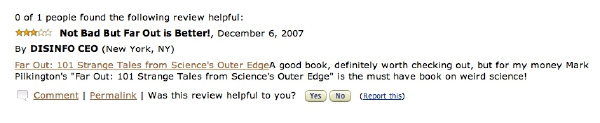


The review follows the tried-and-true formula of comment spam. A meaningless platitude, followed by a plug for the product the spammer is trying to promote, which in this case is a book by Mark Pilkington. But if you check out the page for Pilkington's book, you'll discover that DISINFO CEO has posted a review there as well -- and in that review he pretty much reveals that he's the publisher of Pilkington's book!
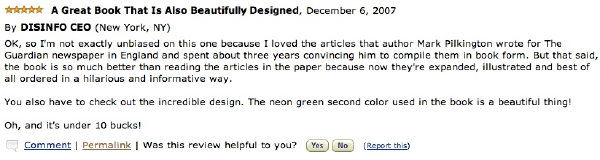


In other words, someone who appears to be the CEO of the Disinformation Company is leaving comment spam on Amazon -- on the page for my book! I've never had any contact with the Disinformation Company, but I am aware of them and had always thought they published some interesting stuff, which is why it really surprised me that THEY, of all companies, would do something that tacky. The irony here is that DISINFO CEO, on his profile page, claims his nickname is "DeathToSpammers".

The possibility that DISINFO CEO is actually someone with no affiliation to the Disinformation Company crossed my mind, but what would be their motive to do this?

I clicked the link to flag DISINFO CEO's review of my book as inappropriate, since I think it's obviously spam. If Amazon agrees, the review may no longer be there by the time you read this.

Update: Amazon has deleted the spammy review. An irony is that I actually thought Pilkington's book sounded really interesting, so I ordered it -- but I ordered it from a used bookstore, so the Disinformation Company won't get any money from the sale. Ha!

Categories: Literature/Language, Miscellaneous
Posted by Alex on Fri Dec 07, 2007
Comments (6)
Qamar Mohammed Malik, a Pakistan-born engineer, submitted his CV to the Amec Group construction company, but was told that the company had no suitable vacancies. He then submitted a similar CV with inferior qualifications, but using a fake Welsh name, Rhyddir Aled Lloyd-Hilbert. This time he was told there was a job vacancy and was offered an interview.

Malik has now filed a lawsuit against the Amec Group, accusing the company of racism. The company defends itself, saying that, ""Mr Lloyd-Hilbert" was contacted for interview with regard to the quality inspector vacancy and not Mr Malik because the former indicated he was about to move to Wales whereas the latter had a Reading address."

Regardless of who's in the right, Malik's experiment represents a variation on what I'm calling the spurious submission hoax. (I made up this term for it, but if anyone can think of a better name, let me know.) Spurious submission hoaxes usually involve the submission of a disguised piece of work (typically the retyped text of a famous work) to a publisher, who inevitably rejects it. The most famous example of such a hoax was when Chuck Ross submitted the manuscript of Casablanca to over 200 movie agents, many of whom rejected it, saying the script needed work.
Categories: Business/Finance, Literature/Language
Posted by Alex on Tue Nov 06, 2007
Comments (7)
The Vancouver Sun reports that linguistics researchers believe that many common surnames began as insults. For instance, centuries ago a guy might have been nicknamed "John the Bastard," and the insulting epithet would become his last name, adhering to all his descendants (until someone eventually changed it):
there is a whole category of names that are believed to have been given to children abandoned to orphanages - including the French name Jette (meaning "thrown out"), the Italian name Esposito (meaning "exposed") and the English name Parrish (meaning someone who was raised at the expense of the community.) ...
Both the English names Nott and Cave probably described someone who was bald.
A Barrett was a fraud, a Mallory someone unlucky and a Purcell a little pig...
Similarly insulting are the German names Armann (poor man), Scheunpflug (avoids the plow) and Schiller (cross-eyed)...
"Shakespeare is probably an obscene name, originally, for a masturbator," said Hanks.

This research is particularly interesting to me, because it helps to explain the source of my last name, "Boese," which means 'angry' or 'evil' in German. (It's spelled Böse in German.) Centuries ago one of my ancestors must have been a real jerk, and my family has been saddled with the name ever since.

This research also helps explain some of the "unfortunate last names" I've occasionally posted about.
Categories: Literature/Language
Posted by Alex on Tue Nov 06, 2007
Comments (18)
The Happy Endings Foundation believes that all children's books should have happy endings. Those that don't should be banned.

The organization was (supposedly) started seven years ago by Adrienne Small after she noticed that her daughter seemed miserable after reading Lemony Snicket's A Series of Unfortunate Events. Mrs. Small plans to rewrite the Lemony Snicket books to give them a happy ending.

Some upcoming events planned by the Happy Endings Foundation include a Halloween "fun and greeting" celebration instead of trick or treating. "Children will be encouraged to knock on someone's door and offer a smlie." Sounds fun. A few days later the foundation will also be hosting a Bad Book Bonfire. Bring along a book with an unhappy ending and watch it go up in flames!

Although the media seems to have accepted the Happy Endings Foundation as real, based on the uncritical articles about it in the press, it definitely isn't real. The biggest clue is the disclaimer that appears on its site:
Most characters appearing in this work are fictitious. Any resemblance to real persons, living, dead, or half dead, is purely coincidental. None of the non-fictitious people, places or things named in this website were harmed during the creation of the site. We're not sure if the Loch Ness monster is fictitious or non-fictitious, you decide.
Internet sleuths have also figured out that the Happy Endings Foundation website is registered to an advertising firm, artscience.net, that lists A Series of Unfortunate Events as one of its clients. In other words, the Happy Endings Foundation is a marketing hoax.
Categories: Advertising, Literature/Language
Posted by Alex on Mon Oct 08, 2007
Comments (1)
Cranky Media Guy forwarded me this article on Ananova.com about a Czech speedway rider who suffered a concussion during a race, was knocked out, and woke up speaking perfect English, with a posh British accent... even though he barely spoke a word of English before. His command of English only lasted for 48 hours, at which point his memory returned, as did his native Czech, and his English disappeared.

CMG is skeptical. He says, "The Foreign Accent Syndrome mentioned in the last paragraph is a real phenomenon but that's very different from a guy who doesn't speak a language suddenly acquiring the ability to speak it, which I can't see could be possible."

But I'm not so sure. The story has been reported in a number of newspapers, and in the version on metro.co.uk, one of the rider's friends is quoted as saying, "Before his crash, his use of the English language was broken, to put it mildly."

Which means that he did know some English. It's very possible he knew more than he realized. Perhaps he woke up dazed, heard people around him speaking English (because the race was in England), and his brain went into English mode. It could happen. However, I'd be interested in knowing just how well he could carry on a conversation in English.
Categories: Literature/Language, Psychology
Posted by Alex on Mon Sep 17, 2007
Comments (9)
In an effort to instill a can-do attitutde in his workers, a Russian mayor has "ordered his bureaucrats to stop using expressions such as 'I don't know' and 'I can't.'"

Seems like a double-plus ungood policy. How should they respond if asked, "Can you say 'I can't'?"

Link: cnews.canoe.ca
Categories: Literature/Language
Posted by Alex on Tue Sep 04, 2007
Comments (5)
At the Edinburgh International Book Festival crime-writer Ian Rankin recently announced that he had some inside intelligence about what fellow Edinburgh resident J.K. Rowling was planning to write next. This announcement was then printed in the Sunday Times:
The Sunday Times newspaper quoted Ian Rankin, a fellow author and neighbor of Rowling's, as saying the creator of the "Harry Potter" books is turning to crime fiction.

"My wife spotted her writing her Edinburgh criminal detective novel," the newspaper, which was available late Saturday, quoted Rankin as telling a reporter at an Edinburgh literary festival.

"It is great that she has not abandoned writing or Edinburgh cafes," said Rankin, who is known for his own police novels set in the historic Scottish city.
The announcement caused a bit of a stir online. But it turns out Rankin was only joking... the joke being, of course, that HE writes Edinburgh criminal detective novels. (If you've never read a Rankin novel, you should. They're good stuff.) Rowling's literary agent commented:
JK Rowling is taking a well-earned break following the English language publication of Harry Potter & the Deathly Hallows and there are no firm plans as yet as to what her next book may be.
I think it would be kind of cool if she did write a crime novel next. (Thanks, Joe)

--And, incidentally, what does one call a person who lives in Edinburgh? An Edinburghian? Flora should know.

Categories: Literature/Language
Posted by Alex on Tue Aug 21, 2007
Comments (14)
Page 4 of 12 pages ‹ First  < 2 3 4 5 6 >  Last ›