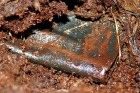
 A guy was out digging in an irish bog recently when, purely by chance, he found a book buried in the mud. Turns out that it could be a book of psalms over 1000 years old. Pat Wallace, director of the National Museum of Ireland, points out that this discovery was highly fortuitous:
 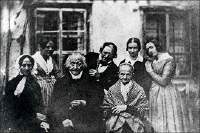 Last week the London Times printed a photo that, so it claimed, was the only known photograph of Mozart's widow (Constanze), taken in 1840 at the home of Swiss composer Max Keller when she was 78 years old. (She's supposedly the woman on the far left.) However, the photo has generated controversy online, where a number of scholars have labeled it a hoax.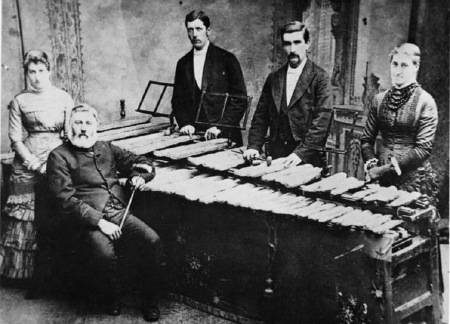
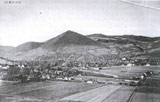 The discovery of massive pyramids in Bosnia was widely reported in the news last month (at which point Beasjt posted about it in the Hoax Forum). The discovery was made by a Bosnian-American businessman named Semir Osmanagic, who has been actively pursuing Chariots-of-the-Gods-style archaeology for the past fifteen years, mostly in Mexico and Central America. (He believes the Mayans were descended from Atlanteans who came from the Pleiades... you can read about it in his book, The World of the Maya, which is online.)
 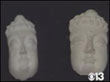 A resident of the town of Colfax (northern California) claims to have found hundreds of ancient Buddha figurines buried in the American River:
 The Raw Feed has linked to a video (in French) in which Belgian archaeologists discuss how they were able to "use computer scans of the grooves in 6,500-year-old pottery to extract sounds -- including talking and laughter -- made by the vibrations of the tools used to make the pottery." The video is fairly good quality and would lead you to believe that it might be real, if it weren't for the premise being pretty farfetched (and not reported anywhere else in the news). Make Magazine reports that the video was created last year as an April Fool's Day hoax, and point out that "This site - 'Poisson d'avril de journal televise', translates to: 'April fools newscast'." (However, I can't find any mention of Poisson d'avril in the site they link to.) Other Make readers point out that the premise (audio extracted from ancient pottery) was ripped off (pun intentional) from a story by Gregory Benford, Time Shards. (Thanks to Schmawy for the link)
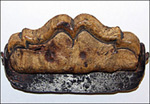 Forty years after stealing a "Sami Fleshscraper" from a Norwegian museum, the contrite thief has mailed the item back. Problem is, the museum has no idea what the object is. From the article on Yahoo News:
 Remember the Black Basketball League? Its teams (including favorites such as the Newark Eagles, Harlem Knights, Baltimore Crabs, West Philly Dancers and Cleveland Ebonies) competed from 1920-40, when they were shut out of the all-white league. Consumers can now honor the memory of this league by buying sportswear emblazoned with the team logos. Of course, if you don't remember this league, it might be because historians insist that it never existed. But Eric Williams, the guy who's selling the black league sportswear, isn't letting that minor fact bother him. He explains that:
  A reporter for Inside Bay Area (I don't know his name... it's not given with the article) recently recounted how his granddaughter told him that the bear on the California flag was originally supposed to be a pear. Back in 1846, Capt. Jedediah Bartlett, leader of a band of rebels fighting against the Mexican authorities in California, supposedly drew up a flag for the future state. He thought a pear, as a symbol of the region's agriculture, would be a fitting symbol. But his instructions were misread and the flagmaker inserted a bear on the flag instead of a pear. The error was never rectified.
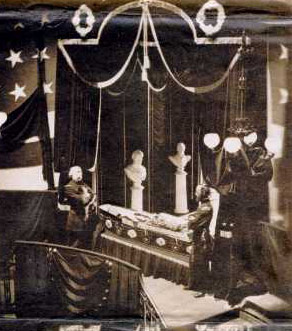 In my hoax photo gallery I display a picture of the body of Abraham Lincoln lying in a casket and explain that the photo is fake because the army didn't allow any photos of Lincoln's body to be taken. But I just received an email from Rich noting that there is one authentic picture of Lincoln's corpse, and he's right. A photographer did manage to snap a shot of the dead Lincoln as he was lying in state in Manhattan's City Hall. Secretary of War Edwin Stanton had the photograph confiscated, and it was supposed to be destroyed. But instead, Stanton kept it, and it was found by historians almost 100 years later. It's the only true Lincoln death photo in existence.
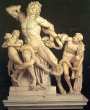 It's already well known that Michelangelo dabbled in art forgery. That's not disputed. For instance, there's his famous forgery of the Sleeping Cupid. However, Lynn Catterson of Columbia University thinks that a much more high-profile forgery should be attributed to him. She believes that Michelangelo forged The Laocoon, which has long been regarded as one of the most important pieces of ancient Greek sculpture in existence. She points out that Michelangelo was present when The Laocoon was unearthed in 1506. She has promised to provide further proof to back up her allegation at a lecture today, as well as in a book she's submitted for publication. (thanks to Jelena for the link)