Pepsi Moonvertising Hoax Fools Thousands in Iran —
On Saturday (June 9) thousands of Iranians stood outside on rooftops looking up at the moon. They were there because of a rumor spread by email, websites, and social networks promising that Pepsi was going to project its logo onto the surface of the moon. The rumor was false. Link: observers.france24.com
Some Iranians got their revenge by drinking Coke. Others created Pepsi-moon parody videos and images.
There's a bit of history to the idea of ads projected onto the moon. Back in 1999, Coca-Cola actually considered the idea of using lasers to project a Coke logo onto the moon. The idea was dreamed up by one of their marketing executives, Steve Koonin. They hired scientists to put the plan into effect, and spent quite a bit of money before abandoning the idea. The problem: It would have required incredibly powerful lasers to do it, and the FAA wouldn't allow the use of such powerful lasers because of the possibility they might interfere with aircraft.
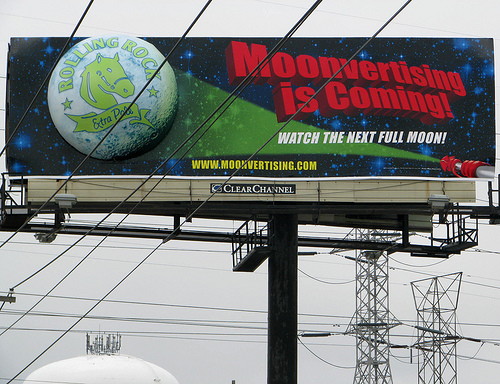
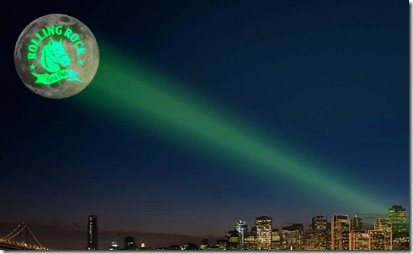
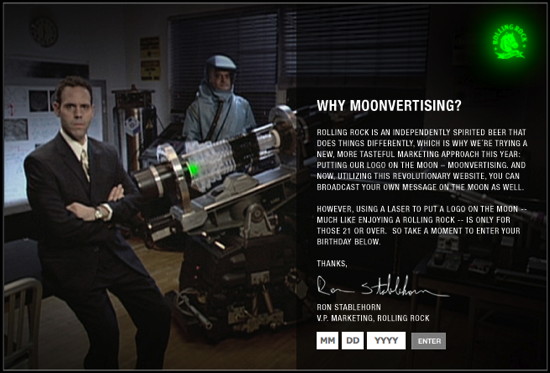
Then, in 2008, Rolling Rock beer ran a hoax campaign claiming that they were going to project the Rolling Rock logo onto the moon during a full moon, on March 21, 2008. They promoted the idea on billboards, in TV ads, and through the website moonvertising.com (which they've since abandoned).
The NY Times ran a brief article about the hoax campaign in which they touched on whether moonvertising would be technically possible:
According to Jim Garvin, the chief scientist at NASA’s Goddard Space Flight Center, moonvertising is possible, if impractical for a number of reasons. While scientists have bounced lasers off the moon, they illuminated an area only about the size of a tennis court. “In order for an advertisement to be seen by people on earth,” Garvin says, “the laser light would need to cover an area about half the land size of Africa,” a challenge because the moon’s surface is dark and fairly nonreflective.
Iran itself also has a history of moon-image hoaxes. Back in November 1978, a rumor swept through Iran alleging that the face of the Ayattullah Khomeini was visible on the moon. This rumor has been analyzed in a paper by Shahla Talebi:
In late November of 1978, as millions of Iranians awaited for the return of Ayattullah Khomeini form exile, a rumor swept the country that his face could be seen in the moon. In great excitement, many gathered on the rooftops to show one another what they “saw.” Although the rumor was officially denied, it had had already acquired millions of legs, and thanks to technology, it soon reached almost every corner of the country. It had taken a life of its own. The emotional ambiance of that particular night of “seeing” was so immensely intense and the claim so unwaveringly firm that those who “could not see” said otherwise.
And let's not forget a similar rumor that spread in America a few years ago, which got thousands of people to stand outside, holding candles, and looking up at the sky. It was following 9/11. The rumor promised that a NASA satellite was going to take a photograph of the entire nation illuminated by candlelight.
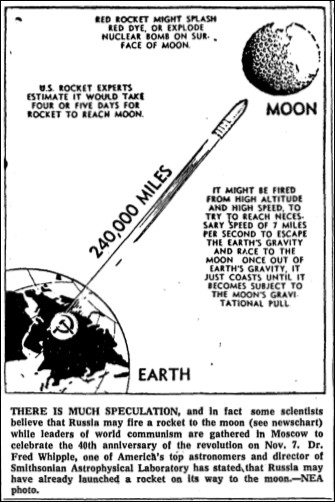
Edit: I just remembered another moon rumor, one which I discuss in Electrified Sheep. Back in 1957, a rumor spread that the Soviets were going to explode a nuclear bomb on the surface of the moon on November 7, and that the flash would be visible on Earth. This date was supposedly chosen both because it was the 40th anniversary of the Bolshevik revolution and because a lunar eclipse was going to occur then, making the flash more visible. This would have been a form of 'moonvertising' on the part of the Soviets. A way for them to display their technological superiority on a canvas visible to the entire world.
There was near hysteria in America as the date approached. When the day arrived, many astronomers trained their telescopes on the moon, waiting for the flash. But it never came. The Soviets probably would have done it, if they could have, but at the time it was beyond their abilities.
There are some intriguing parallels between the 1957 Soviet Nuke rumor and the 2012 Iranian Pepsi-logo rumor. In both cases, people were projecting their fears onto the surface of the moon. In 1957 America, the challenge posed by Soviet power and the spread of communism was the great fear. For Iranians in 2012, American corporate power and global dominance is their great fear.
It would be cool if there really was a tunnel entrance somewhere in the world that looked like this. But this is one of those brought-to-you-by-photoshop images. The original is an image showing a billboard created in March 2007 by the Austrian ad agency Demner, Merlicek & Bergmann for the restaurant chain Oldtimer. (link: adsoftheworld.com)
What's puzzling me is whether the original image is itself photoshopped? Did this Oldtimer billboard ever exist in real life, or is the photo just a concept piece?
I can't find any pictures showing the Oldtimer billboard from a different angle. I can't find any sources that list the specific road where it was placed. Nor can I find news sources from 2007 that discuss the billboard. I also think it's strange that this was an Austrian campaign, and yet the writing is in English.
All of which make me suspect that the original image is a photoshopped concept piece. Though I'm not sure. It could be that I can't find any more info about the ad because all the info is in German.
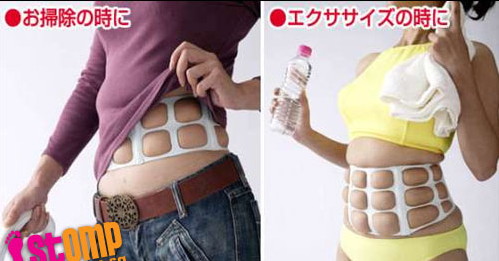
An ad for a product called the "AB-hancer" appeared online back in March 2011 and quickly went viral. The text of the ad made it pretty obvious that this wasn't a real product — specifically where the text says, "Recommended by pseudo-athletes." There's also the fact that the product isn't available for purchase anywhere. Though inevitably a few people seemed to think the AB-hancer was real.
But the mystery is: Where did this ad come from? Who created it? No one seems to know.
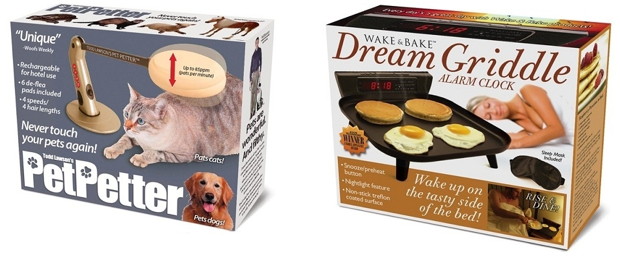
Paul Lucas at infomercial-hell.com theorizes that the image came from an old, out-of-print "prank box." Prank boxes are gag gift boxes that look like they contain ridiculous items such as a "Pet Petter" or a "Wake & Bake Dream Griddle." The gift recipient thinks they got a really stupid gift, until they open the box and find the real gift inside.
This is a good theory. The problem is that there's no evidence an AB-hancer prank box ever existed. If it did, you'd think a picture of it would exist somewhere. So for now the origin of the AB-hancer image remains a mystery.
But although the AB-hancer may not be a real product, there apparently are real products on the market similar to it. Singapore Seen reported the existence of this strange tummy-flattening product, for sale somewhere in Asia.
And if you've got a hairy stomach, you can always create six-pack abs by taking a cue from this guy.
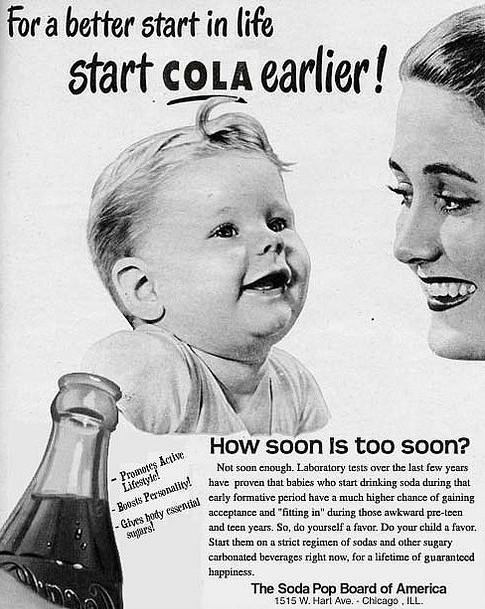
At first glance, this appears to be a vintage ad by the "Soda Pop Board of America" extolling the virtues of drinking cola at an early age. It's been circulating around the internet for quite a while, during which time many sites have angrily responded to the claims made in the ad.
For instance, the Queen Anne Chiropractic Center declared that the ad demonstrates "just how wicked the Mad Men of yesteryear were." The parenting blog babble.com wrote: "We all know that, on occasion, advertisements can offer some fairly crappy advice. Back in the day, though, ads had no shame." And NaturalNews.com offered the ad as evidence that, "Soda companies, much like drug companies, have relentlessly tried to convince parents that forcing their products onto their children is a smart thing to do."
I could go on, but I'll cut to the chase: the ad isn't real. It's just a very successful vintage-ad parody created in 2002 by RJ White, who explains its full provenance on his blog Ice Cream Motor:
About seven or eight years ago, I made this fake ad, exhorting parents to give soda to their babies. It was done on a bored afternoon when J.D. Ryznar asked for someone to make that very specific thing on his livejournal. I whipped it together, posted it to the web, joke over.
THEN. A couple of years later- it started showing up online, in those weird lists that pop up every so often with a "Oh man, ads sure were strange back then, weren't they?" theme. Thing is, those ads are largely real and mine is not and very obviously so.
White links to the original livejournal post that inspired him to create the ad. His ad seems to be currently enjoying a fresh wave of popularity thanks to tumblr and pinterest which are presenting it to new audiences, many of whom (once again) seem to be accepting it at face value as a genuine vintage ad.
F*** The Diet? —
Many people thought this was too weird to be true, but apparently it's real. Multinational mega-corporation Unilever is running an ad campaign in Germany for its "Du Darfst" line of food products that features the English slogan "Fuck the Diet!"
It's kinda like if McDonalds were to unveil "Fuck Eating Healthy" as its new ad slogan.
"Although the current Du Darfst campaign has become a bit of a talking point in Germany -- as effective marketing should -- it is targeted specifically at German consumers and uses language that we do not believe most German consumers find offensive. This is because the term in the campaign is frequently heard on German TV and radio, and is used in newspapers and magazines, and in the context of 'let it be' it is not censored or seen as inappropriate by most German consumers."
Those French beaches look great, because they’re really in Hawaii —
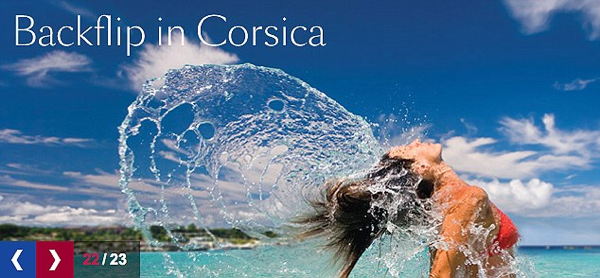
France's tourism agency has been embarrassed after it's been revealed that a whole series of photos it's been using to promote French beaches don't actually show French locations at all. They're stock photos, taken in Hawaii and South Africa, in the background of which the tourism agency sometimes photoshopped sections of French coastline. It seems stupid since France has some great scenery, but the tourism agency was apparently too cheap to hire a photographer to take photos of any of it. (link: Daily Mail)
This is hardly the first time tourism agencies have been caught pulling this trick. In Hippo Eats Dwarf I noted some examples, including a 2003 brochure for Bermuda that showed sunny beaches that were in Hawaii, and a Kentucky tourism brochure that featured a covered bridge actually located in New Hampshire.
Stimulus To Allow Critical Hair Expenses Act —
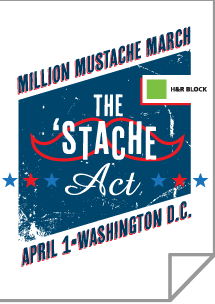
On April 1st of this year, hundreds of thousands of men with mustaches are going to gather in Washington, DC to demand tax equity for Mustached Americans. They're hoping to persuade Congress to adopt the Stimulus To Allow Critical Hair Expenses Act, or STACHE Act. The act would allow Mustached Americans to claim tax deductions for expenses such as:
Mustache and beard trimming instruments, mustache wax and weightless conditioning agents, Facial hair coloring products (for men and women over 43 years of age), bacon, mustache combs and mirrors, DVD collections of "Magnum P.I." and "Smokey & The Bandit," mustache insurance (now required by state law in Alabama, Oregon, Maine, and New Mexico, and Puerto Rico), billy clubs or bodyguards to keep women away as a mustache increases good looks by an estimated 38 percent, little black books and jumbo packages of kielbasa sausage, Burt Reynolds wallet-sized photos.
The organizations behind this mustached march on Washington are the American Mustache Institute (AMUI) and H&R Block.
At first, I assumed the entire thing was an April Fool's Day joke campaign organized by H&R Block. But I now think that the American Mustache Institute was around before H&R Block got involved -- though it's obviously a rather tongue-in-cheek organization.
The Case of the Monster Slipper —
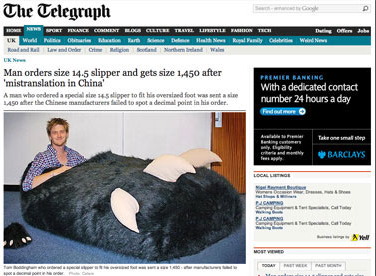
An article recently appeared in various British newspapers telling the story of one Tom Boddingham who ordered a size 14.5 slipper from Monster Slippers. But due to a translation error, the factory in China that makes the slippers sent a size 1450 slipper instead.
Polly Curtis at the Guardian thought the story smelled a bit fishy. And with the help of some people on Twitter, she soon figured out that "Tom Boddingham" coincidentally looked identical to Joseph Jennings, the online retail manager for Monster Slippers. In other words, the entire story was a PR stunt.
The thing about stories like this, which pop up with amazing regularity, is that the debunker actually can't help but publicize the PR hoaxer even more by repeating the story. Which plays into their hand. For instance, I'm now aware of Monster Slippers, and I never would have been if it weren't for the Guardian article. P.T. Barnum was very aware of this phenomenon. He would sometimes purposefully spread rumors debunking his own hoaxes in order to generate renewed media interest.
So you have to wonder, would it be better simply to ignore these PR stunts, and thereby not give the PR people the publicity they're looking for? It's a bit of a dilemma. Though my feeling is that the debunkers should never be blamed for doing their job. (Thanks, Laurie!)
Live Forever Juice —Live Forever Juice is a fake product that was created for educational purposes by FDAImports, a consulting company that specializes in advising companies how to comply with FDA regulations. The idea was to make a food product whose packaging was full of illegal claims, then walk people through why the claims are illegal. (via: The Food Watchdog).
The company handed out samples of Live Forever Juice at a recent trade fair in Baltimore. They also have an accompanying website, liveforeverjuice.com, on which they have some videos that explain what kind of claims companies are legally allowed to make on the packaging of their food products, and what claims they can't make. Of course, all claims have to be "true, adequately substantiated, and not misleading." It's the latter category, misleading claims, that are the most interesting, since companies come up with all kinds of ways to make claims that are technically true, but nevertheless misleading. And the FDA has regulations to try to prevent this.
For instance, labels often declare that the product is a "great source" of a nutrient, such as Vitamin C. But if the label says this, then the food must contain at least 20% of that nutrient's recommended daily intake (RDI). Sometimes labels will use more ambiguous language, such as boasting that the food "contains" a nutrient, which could be technically true even if the food only has a tiny amount of it. But the FDA feels that even this more ambiguous claim implies the food is a good source of the nutrient. So the food still must offer at least 10% of that nutrient's RDI in order to make that claim legally.
FDAImports also created a Live Forever Juice party video that offers a "High-Octane Motivational Video Loop with Unicorns." They caution that you shouldn't watch it if you're prone to seizures.
Twiggy ad ruled misleading —
The UK Advertising Standards Authority has ruled that an advertisement featuring Twiggy is misleading. The ad has Twiggy claiming that "Olay is my secret to brighter-looking eyes." In fact, the brightness of her eyes in the photo is due to digital manipulation. Link: sky.com
Mass: We Pray —Mass: We Pray claims to be a new video game that allows you to simulate going to church, without ever leaving home. Shacknews.com reports receiving a press release from Prayer Works Interactive, the maker of this purported product. An excerpt follows:
Mass: We Pray is the first of many worship-themed games in development for Prayer Works Interactive. Just like with any videogame, families can use a television as a monitor to play. Then, they can use the CROSS, a proprietary, wireless, cross-shaped controller to participate in 24 unique and exhilarating rituals. Make the Sign of the Cross, sprinkle Holy Water, take Collection and even give Holy Communion. Every motion and nuance of a blessing or ritual is detected in three dimensions and replicated on-screen.
Can this be real? As often with claims of a religious nature, Poe's law rears its head. (The real religious stuff is often so crazy that it's indistinguishable from the spoof stuff). But let's review some of the typical signs that a website is a hoax:
The site makes a claim that seems outrageous or absurd.
It advertises a product, but doesn't actually allow you to buy it.
It's registered anonymously, and no business address is provided.
Although you can't buy the main product, you can buy a related t-shirt or mug.
Google ads (or other unrelated ads) are posted to profit from traffic to the site.
An outrageous or absurd claim? Check. You can't buy Mass: We Pray, but the company claims that on Friday, Nov. 20 you'll be able to pre-order it. (Let's wait and see if they hold true to that promise.) The website is also registered anonymously through Domain Discreet, and Prayer Works Interactive offers no business address.
That's three signs of being a hoax. So my guess is that Mass: We Pray is probably fake. But the real test, of course, will be to wait and see if they ever offer this thing for sale.
Below is a video demonstration of the game.
Update: On November 20 Mass: We Pray was revealed to be a hoax. (No surprise there!) The pre-order link, which previously had been dead, became clickable, leading to an ad for the video game Dante's Inferno.
Billboards for Submarines, part 2 —I posted two months ago about underwater billboards that Ivar Haglund supposedly placed at the bottom of Puget Sound back in the 1950s in order to advertise his restaurant to submarines. Some suspected a hoax, and it turns out they were right. From the Seattle Times:
That story about those Ivar's underwater billboards at the bottom of Puget Sound, supposedly anchored in the mid-1950s?...
Fake, fake, fake.
The documents were faked on a computer. The billboard was a wooden prop, says Bob Donegan, president of Ivar's Inc. The only thing real about it was the barnacles stuck to it...
It was a great marketing campaign. Donegan says about $250,000 was spent on the hoax and the follow-up TV and radio ads and real highway billboards. The hoax was reported Oct. 23 in the industry publication Nation's Restaurant News. Donegan says he wasn't to reveal the hoax until after the ad campaign ended this month, but decided to come clean when the industry publication called.
The Case of the Carbolic Smoke Ball —Clive Coleman tells the story for BBC Radio 4 of the Carbolic Smoke Ball Company. It was an 1892 case of fraudulent advertising. The case against them is "seen by some as the birth of modern consumer protection":
The carbolic smoke ball was a peculiar device marketed as a cure for various ailments including influenza. It consisted of a rubber ball, filled with powdered carbolic acid. You squeezed the ball sending a puff of acidic smoke right up a tube inserted into your nose. The idea was that your nose would run and the cold would be flushed out.
The company making the ball advertised it in the Pall Mall Gazette offering a £100 reward to anyone using it correctly who then contracted influenza. They deposited £1,000 in the Alliance Bank in Regent Street to show the money was there.
Billboards for Submarines? —
Around 1954 Ivar Haglund anchored billboards to the bottom of Puget Sound. He said that he thought it would be a good way to advertise his restaurant, Ivar's Chowder, to anyone who happened to be passing by in a submarine. The modern-day Ivar's restaurant chain is now raising the billboards from the sea. Or are they? Some suspect a hoax. From the Seattle Times:
In the past month, the company has had divers bring up three of the billboards — about 7 by 22 feet and made of stainless steel — using a map found in their founder's immense collection of artifacts stored on the top floor of the chain's headquarters at Pier 54.
Included in that collection are Haglund's LP vinyl collection, his rosé wine collection, illustrations, photos and... apparently the actual naval architectural drawings, permit and location map for the billboards.The operative word is "apparently."
"This still could be a hoax. Someone could be doing something," says Bob Donegan, president of Ivar's. "That's why we're being careful on the authentication."
Of course, if it was a hoax, a prime suspect would be the Ivar's chain itself.
Ivar's is promoting the find of the underwater billboards on its Web site, which includes a 2 ½-minute mini-documentary about finding that first billboard Aug. 21 off Alki Beach.
It's also started running 30-second commercials about the billboards during prime time, budgeting more than $100,000 for television ads through mid-October.
The article goes on to say that Seattle historian Paul Dorpat, who's writing a book about Haglund, thinks the billboards are the real deal. (Thanks, Bob!)
Does Farrah Fawcett’s hair spell “SEX” in her famous poster? —In honor of Farrah Fawcett, let's revisit one of the major urban legends of the late 1970s: that the curls of Fawcett's hair, in her famous red-bathing-suit poster, spell out the word "SEX."
This legend arose to explain the incredible popularity of the poster, which sold over 12 million copies (by some accounts). It was always a bit of a mystery why that image in particular became such a focus of popular fixation. After all, there were plenty of other posters of scantily clad attractive young women. The subliminal seduction theory offered a seemingly plausible explanation. The poster was so popular, according to this theory, because the brains of young men were subconsciously perceiving the word "SEX" in her hair, and this triggered desire for the poster.
The word "SEX" is supposed to begin with the curls on her right shoulder that form an S. I can see the S, but I can't see an E-X.
Anyway, I don't think one needs to invoke subliminal seduction to explain the popularity of the poster. The combination of the smile and the nipples makes it an eye-catching image. And once it started to become popular, then the dynamics of group psychology kicked in, turning it into a fad.
Update: Thanks to Joel B1, I think I've now identified where the "EX" is supposed to be. For the benefit of those still unable to see it, I've highlighted the entire word in the relevant section of the image.
Moms Behaving Badly —
A dispute between two young girls escalated into an online fight between the mothers. The mother of one of the girls posted an ad on Craigslist offering sex with men, and listed the phone number of the other girl's mother as the contact. Twenty-two people called the number. The woman has now been charged with aggravated harrassment. [Newsday]
Brain Ads —
Some woman (who doesn't name herself) has realized that for years people have been reading her mind. "TV shows were following my daily thoughts and stores began bringing products I had been wishing for, it finally dawned on me that they were not just teasing me, they were actually getting more viewers and selling more products!" Instead of fighting this condition, she's decided to accept it and profit from it. For which reason, she's now accepting "brain ads." In return for a donation, she will project the telepathic ad of your choice. I'm assuming this is a joke. (Thanks, Bob!)
Ads Disguised as News Columns —Should the LA Times have run an ad designed to look like a regular news column on its front page? (The ad was for an NBC news show Southland.) Critics, who include quite a few of the paper's own staffers, argue that it crossed a line of journalistic integrity. The paper's defenders point out that all newspapers are losing money nowadays, so whether you like it or not, expect to see more ads disguised as news columns in the future. [Editors Weblog]
The Airbrushed Asian —
When Scottish tourism officials first unveiled the promotional poster for next year's Homecoming Scotland campaign (whose purpose is to get people of Scottish descent to visit the homeland), people looked at it and remarked, "You know, not everyone in Scotland is white."
But most people seem to think the change is even worse than the original, calling it "tokenism" and blasting the government tourism agency for having to "think about it after the event."






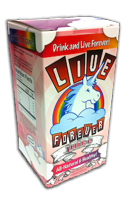 Live Forever Juice is a fake product that was created for educational purposes by FDAImports, a consulting company that specializes in advising companies how to comply with FDA regulations. The idea was to make a food product whose packaging was full of illegal claims, then walk people through why the claims are illegal. (via: The Food Watchdog).

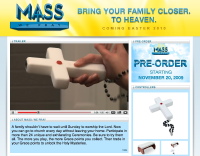 Mass: We Pray claims to be a new video game that allows you to simulate going to church, without ever leaving home. Shacknews.com reports receiving a press release from Prayer Works Interactive, the maker of this purported product. An excerpt follows:
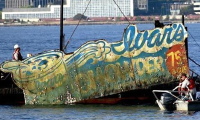 I posted two months ago about underwater billboards that Ivar Haglund supposedly placed at the bottom of Puget Sound back in the 1950s in order to advertise his restaurant to submarines. Some suspected a hoax, and it turns out they were right. From the Seattle Times:
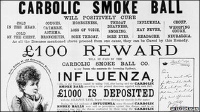 Clive Coleman tells the story for BBC Radio 4 of the Carbolic Smoke Ball Company. It was an 1892 case of fraudulent advertising. The case against them is "seen by some as the birth of modern consumer protection":
 In honor of Farrah Fawcett, let's revisit one of the major urban legends of the late 1970s: that the curls of Fawcett's hair, in her famous red-bathing-suit poster, spell out the word "SEX."
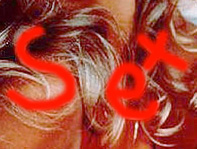 Update: Thanks to Joel B1, I think I've now identified where the "EX" is supposed to be. For the benefit of those still unable to see it, I've highlighted the entire word in the relevant section of the image.
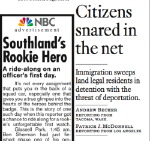 Should the LA Times have run an ad designed to look like a regular news column on its front page? (The ad was for an NBC news show Southland.) Critics, who include quite a few of the paper's own staffers, argue that it crossed a line of journalistic integrity. The paper's defenders point out that all newspapers are losing money nowadays, so whether you like it or not, expect to see more ads disguised as news columns in the future. [Editors Weblog]