About This Page
This page is part of the Museum of Hoaxes' Hoax Photo Archive, a catalog of photo fakery throughout history. Images are categorized by theme, technique of fakery, and time period.
Hoax Museum Archives
The Case of the Moving Pyramids
Status: Fake (digitally altered)
Technique of Fakery: Rotating or Moving Details, Staged Scene.
Date and Time Period: February 1982; (1980-1999)
Themes: Architecture, Magazine Covers, Photojournalism
Technique of Fakery: Rotating or Moving Details, Staged Scene.
Date and Time Period: February 1982; (1980-1999)
Themes: Architecture, Magazine Covers, Photojournalism
During the early 1980s, many magazines and newspapers began to use digital imaging devices to manipulate photographs. The most popular such device was sold by Scitex America. The machines were very expensive, but they allowed images to be altered with far greater ease than darkroom techniques allowed.
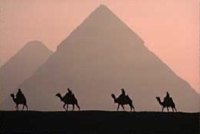
One of the earliest high-profile instances of digital photo alteration appeared on the February 1982 cover of National Geographic (top), which showed a camel train walking in front of the Pyramids of Giza. Readers weren't informed that the pyramids had been moved slightly closer together, in order to fit the vertical format of the cover. No one might have noticed if the photographer, Gordon Gahan, hadn't complained. It then became a source of major controversy. Sheila Reaves, a journalism professor at the University of Wisconsin has speculated that, "The enormity of moving such a large object brought home to people that you can move a shoulder or a smile."
Less remarked upon was that the photo was also staged. The camel train had walked by while Gahan was setting up his equipment. He paid them to walk by again.
Bottom: another shot of the pyramids from the same photo shoot by Gahan. In this photo, the pyramids haven't been moved.
One of the earliest high-profile instances of digital photo alteration appeared on the February 1982 cover of National Geographic (top), which showed a camel train walking in front of the Pyramids of Giza. Readers weren't informed that the pyramids had been moved slightly closer together, in order to fit the vertical format of the cover. No one might have noticed if the photographer, Gordon Gahan, hadn't complained. It then became a source of major controversy. Sheila Reaves, a journalism professor at the University of Wisconsin has speculated that, "The enormity of moving such a large object brought home to people that you can move a shoulder or a smile."
Less remarked upon was that the photo was also staged. The camel train had walked by while Gahan was setting up his equipment. He paid them to walk by again.
Bottom: another shot of the pyramids from the same photo shoot by Gahan. In this photo, the pyramids haven't been moved.
References:
Kiel, Judy. Who Moved My Pyramid? An Overview of Digital Imaging Ethics in Photojournalism. (pdf file)
Use the navigation bar below to view the hoax photo archive one entry at a time, in chronological order.
| Previous photo (older): Yeah Eckerd | Next photo (newer): Sinking Bus |