About This Page
This page is part of the Museum of Hoaxes' Hoax Photo Archive, a catalog of photo fakery throughout history. Images are categorized by theme, technique of fakery, and time period.
Hoax Museum Archives
O.J.‘s Darkened Mug Shot
Status: Fake (altered color)
Technique of Fakery: Color Adjustment.
Date and Time Period: June 27, 1994; (1980-1999)
Themes: Celebrities, Magazine Covers, Photojournalism, Striking a Pose
Technique of Fakery: Color Adjustment.
Date and Time Period: June 27, 1994; (1980-1999)
Themes: Celebrities, Magazine Covers, Photojournalism, Striking a Pose
![]() |
![]() |
Former football star O.J. Simpson was charged with the murder of his ex-wife Nicole Brown Simpson and her friend Ron Goldman. After a widely publicized slow-speed pursuit, Simpson was taken into custody by the police, who then released Simpson's mug shot to the media.
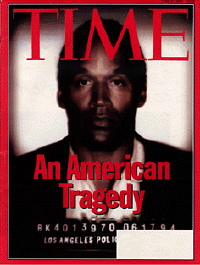
Time magazine decided to use this mug shot on its June 27th cover (top), but first they asked photo-illustrator Matt Mahurin to artistically interpret it. Mahurin darkened the photo and reduced the size of the prisoner ID number. Time managing editor James Gaines offered this description of the resulting cover:
However, many people responded to the cover far less charitably. Critics charged Time with racism, claiming that by darkening Simpson's features the magazine had emphasized his skin color and gave him a more "menacing" appearance. Benjamin Chavis of the N.A.A.C.P. argued that the cover made Simpson seem like "some kind of animal." Journalists suggested that, since the mug shot was a news photo, it should never have been altered at all.
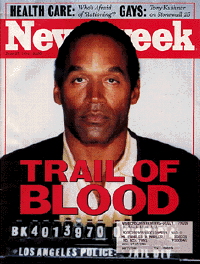
Unfortunately for Time, its rival Newsweek ran the same mug shot on its cover (bottom) that week, without altering it. The two covers appeared side-by-side on newsstands, making Time's decision to darken the photo far more visible. Time later issued an apology to its readers.
Time magazine decided to use this mug shot on its June 27th cover (top), but first they asked photo-illustrator Matt Mahurin to artistically interpret it. Mahurin darkened the photo and reduced the size of the prisoner ID number. Time managing editor James Gaines offered this description of the resulting cover:
The harshness of the mug shot -- the merciless bright light, the stubble on Simpson's face, the cold specificity of the picture -- had been subtly smoothed and shaped into an icon of tragedy. The expression on his face was not merely blank now; it was bottomless.
However, many people responded to the cover far less charitably. Critics charged Time with racism, claiming that by darkening Simpson's features the magazine had emphasized his skin color and gave him a more "menacing" appearance. Benjamin Chavis of the N.A.A.C.P. argued that the cover made Simpson seem like "some kind of animal." Journalists suggested that, since the mug shot was a news photo, it should never have been altered at all.
Unfortunately for Time, its rival Newsweek ran the same mug shot on its cover (bottom) that week, without altering it. The two covers appeared side-by-side on newsstands, making Time's decision to darken the photo far more visible. Time later issued an apology to its readers.
References:
Gaines, J.R. (July 4, 1994). "To Our Readers." Time.
Use the navigation bar below to view the hoax photo archive one entry at a time, in chronological order.
| Previous photo (older): The Disappearing Nipples | Next photo (newer): Tootsie Redressed |