 |  |
| HOME | FORUM | REGISTER | LOGIN | HOAXIPEDIA | TOP 100 APRIL FOOLS | COLLEGE PRANKS | ABOUT THE CURATOR |
| A HISTORY OF HOAXES | HOAX WEBSITES | HOAX PHOTO TESTS | GULLIBILITY TESTS | TALL-TALE CREATURES | CONTACT |
About the Hoax Photo Database
The Hoax Photo Database catalogs examples of photo fakery, from the beginnings of photography up to the present. Included in the database are photos that are "real," but which have been suspected of being fake, as well as images whose veracity remains undetermined. The photos are displayed in chronological order (or reverse-chronological). They're categorized by theme, technique of fakery (if known), and time period. See below for the full list of categories.
Other viewing options
View database as Thumbnail Gallery, reverse-chronological or chronological.
The Hoax Photo Database catalogs examples of photo fakery, from the beginnings of photography up to the present. Included in the database are photos that are "real," but which have been suspected of being fake, as well as images whose veracity remains undetermined. The photos are displayed in chronological order (or reverse-chronological). They're categorized by theme, technique of fakery (if known), and time period. See below for the full list of categories.
Other viewing options
View database as Thumbnail Gallery, reverse-chronological or chronological.
Techniques of Fakery
Numerous techniques of image manipulation are now available to photographers. Instead of trying to list every one, we've narrowed them down to a few broad categories.
Time Periods
Numerous techniques of image manipulation are now available to photographers. Instead of trying to list every one, we've narrowed them down to a few broad categories.
- Added Details
- Deleted Details
- False Caption
- Manipulating Existing Details
- Staged Scene
- Trick Angle
Time Periods
This page has been viewed 0 times.

The Rope Trick
 |
 |
Status: Staged
Date: ca. 1888
Date: ca. 1888
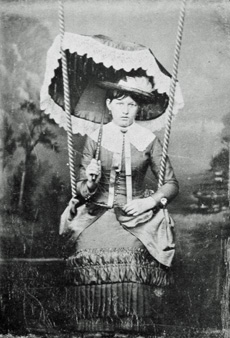
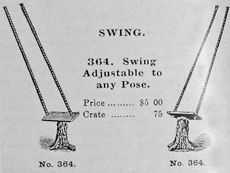
A young lady (top) poses on a swing in a photographer's studio. Except, she isn't really on a swing. Nineteenth-century photographers needed their subjects to remain stationary in order to get the proper focus and exposure. So swinging back and forth was out of the question. The swing was actually a prop available from a catalog (bottom). The ropes remained rigid and were not attached to anything above.
References:
Lothrop, E.S. (July-Sep 1984). The Rope Trick. History of Photography. 8(3): 236.
Lothrop, E.S. (July-Sep 1984). The Rope Trick. History of Photography. 8(3): 236.
The Silent City
Status: False caption
Date: ca. 1889
Date: ca. 1889
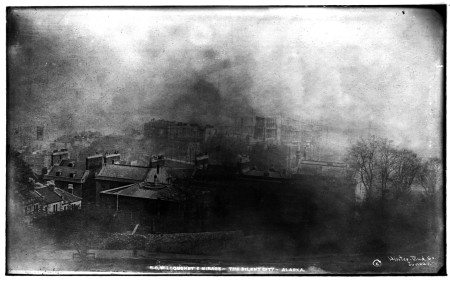
Alaskan prospector Dick Willoughby claimed he snapped this photo in June 1888 while looking out over Muir Glacier in southeastern Alaska. He said that it showed a mirage of a "silent city" that could be seen emerging from the mists. He speculated that the city was actually the reflection of a real city thousands of miles away in Russia.
The photo attracted controversy in 1889 when San Francisco papers acquired copies of it. Photographic experts were skeptical, and Prof. Otto J. Klots, chief astronomer of the Department of the Interior at Ottawa, insisted that "such a thing as the reflections of a city thousands of miles away would be an utter impossibility."
Nevertheless Willoughby managed to sell thousands of copies of the picture and took many people on guided tours to see the mirage. However, when the San Francisco Examiner sent a correspondent to track down the mirage, he couldn't find anything.
The San Francisco Chronicle eventually solved the mystery when an employee of Wells Fargo notified them that he recognized the scene as the skyline of Bristol, England, "the view being from a public park on Brandon Hill. There is a Catholic cathedral there, the main building of which was completed about two centuries ago."
Apparently Willoughby had acquired a blurry photo of Bristol from a stranded English photographer, whose equipment he bought for $10, and he came up with the idea of passing off the photo as an image of a "silent city" mirage. Even after the photo had been debunked, interest in it (and the supposed mirage) continued. In 1890 Willoughby sold the negative to a San Francisco photographer for $500. Willoughby died two years later.
The photo attracted controversy in 1889 when San Francisco papers acquired copies of it. Photographic experts were skeptical, and Prof. Otto J. Klots, chief astronomer of the Department of the Interior at Ottawa, insisted that "such a thing as the reflections of a city thousands of miles away would be an utter impossibility."
Nevertheless Willoughby managed to sell thousands of copies of the picture and took many people on guided tours to see the mirage. However, when the San Francisco Examiner sent a correspondent to track down the mirage, he couldn't find anything.
The San Francisco Chronicle eventually solved the mystery when an employee of Wells Fargo notified them that he recognized the scene as the skyline of Bristol, England, "the view being from a public park on Brandon Hill. There is a Catholic cathedral there, the main building of which was completed about two centuries ago."
Apparently Willoughby had acquired a blurry photo of Bristol from a stranded English photographer, whose equipment he bought for $10, and he came up with the idea of passing off the photo as an image of a "silent city" mirage. Even after the photo had been debunked, interest in it (and the supposed mirage) continued. In 1890 Willoughby sold the negative to a San Francisco photographer for $500. Willoughby died two years later.
References:
• Alaska State Library. Photo Number: PCA 87-2738.
• "The Silent City: An iconoclastic professor says it is a humbug." (Oct 6, 1889.) LA Times.
• "Puzzled by a Photograph." (Jul 21, 1889). The New York Times.
• "Identity of the Silent City." (Oct 20, 1889). The New York Times.
• McKinney, Debra. (Nov 6, 1994). "The Silent City." Anchorage Daily News.
• Alaska State Library. Photo Number: PCA 87-2738.
• "The Silent City: An iconoclastic professor says it is a humbug." (Oct 6, 1889.) LA Times.
• "Puzzled by a Photograph." (Jul 21, 1889). The New York Times.
• "Identity of the Silent City." (Oct 20, 1889). The New York Times.
• McKinney, Debra. (Nov 6, 1994). "The Silent City." Anchorage Daily News.
Mammoth Potato of Loveland
Status:
Date: 1894
Date: 1894
A Man’s Portrait Retouched
Status:
Date: 1895
Date: 1895
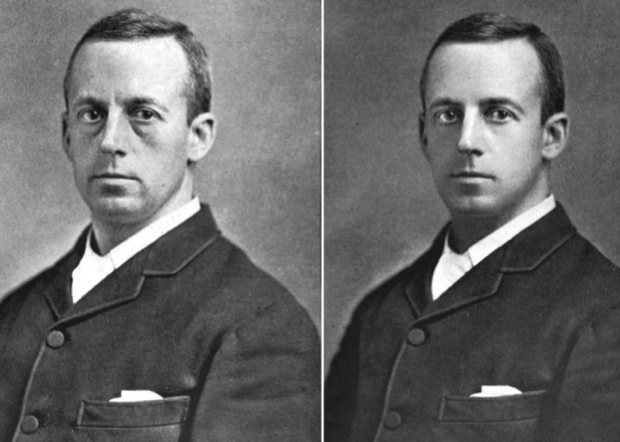
In their 1895 work Photography: Artistic and Scientific, authors Robert Johnson and Arthur Brunel Chatwood offered a defense of retouching portraits (a practice sometimes maligned even back then). They also showed an example of what was possible. They wrote: "In condemning retouching which is only senseless stippling for the direct purpose of making all faces alike, of bringing them all to one standard of smoothness and roundness, we most heartily join. But that judicious retouching is a very great advantage we have no doubt whatever; it is an absolute necessity, in our opinion, in order to obtain the best result, which is admittedly the object of all art.
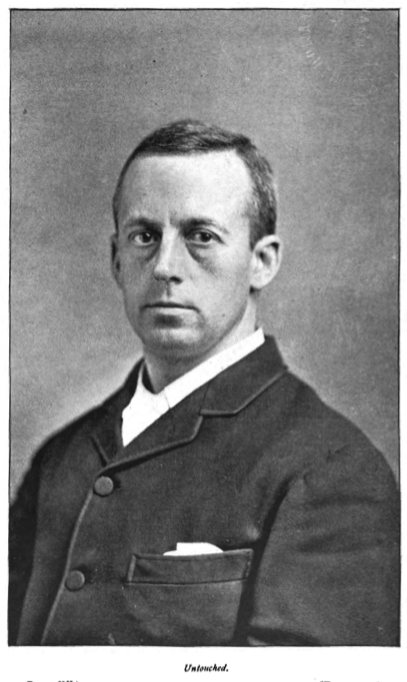
In the accompanying illustration... three different stages of one negative are presented to the reader. The first is a rough proof, nothing in the way of retouching having been done to the negative;
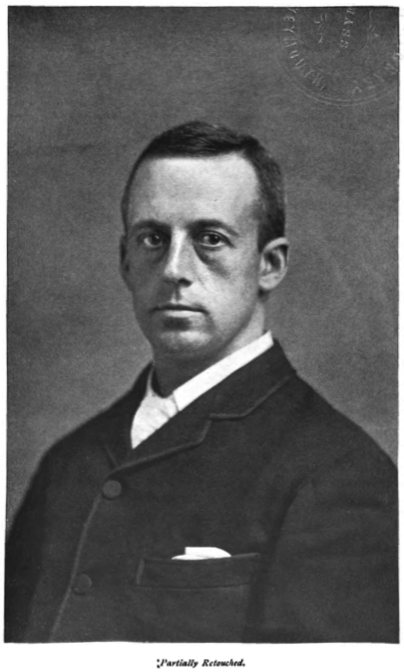
the second is after the knife has been used, and the attention may be drawn to the alterations made, a small patch of light taken from the hair on the outline above the ear, a small patch from the ear itself, the light on the neck caused by the flesh being forced up by the turning of the head (this light on the rough proof is below the outer edge of the jaw); the point of the nose is very slightly scraped, and where the light has caught the muscles round the mouth it has been reduced; the depression between the eyebrows has been altered by scraping the light from one side, and a touch has been taken from the necktie, that is the extent of the scraping.
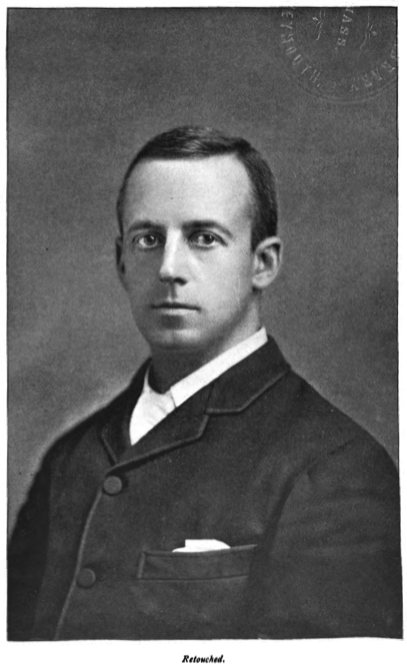
The third illustration shows the retouched picture. It should be mentioned that this negative has been retouched far more than is, as a rule, necessary. The head was posed and lighted with the distinct purpose of needing a great deal of retouching; it is introduced here to show how much can be done without materially altering the shape of a feature or destroying the likeness. If it be closely examine it will be seen that the greatest piece of work has been the addition of light under the eyes. We have omitted to mention another item of scraping, the light on the shaded side of the neck has been reduced; this was a reflected light.
In ordinary portraits of ladies this amount of retouching is expected. In cases of ladies who have been noted for beauty, but whose beauty has somewhat faded, this would be considered a small amount of retouching. One might think that eminent men, whose faces are well known to thousands, would object to so untruthful portrait of themselves going before the public; but it is not so. There seems to be no class, no age, no station in life, no amount of intellectual attainment even, that can divest a man's mind of the idea that he looks younger than he really does; perhaps this is a wise provision of nature, which wilfully blinds us to our own physical, as well as mental, imperfections. Anyhow, the fact remains that scientists, politicans, divines, writers, artists, all are alike in this respect.
References:
- Johnson, R. and Chatwood, A.B. (1895). Photography: Artistic and Scientific. Downey and Co. London. pgs: 133-134
The Sympsychograph
Status: Darkroom effect (satire)
Date: September 1896
Date: September 1896
A curious article appeared in the Sept. 1896 issue of The Popular Science Monthly. It described the discovery of a new form of photography called Sympsychography that allowed invisible brain waves to be made visible on photographic plates — similar to the way in which invisible X rays could produce an image on a photographic plate.
The sympsychographic process, according to the article, had been developed by the members of the Astral Camera Club, who met on April 1. As a test of the concept, seven members of the club had simultaneously concentrated their minds on a photographic plate while thinking of a cat. What emerged was not one man's image of a cat, but rather a joint "impression of ultimate feline reality." The resulting picture (below) was reproduced in the article.
The author of the article noted, "this picture is unmistakably one of a cat. But it is a cat in its real essence, the type cat as distinguished from human impressions of individual cats."

The article might have been dismissed as pseudoscientific nonsense, except that its author was David Starr Jordan, who was not only a highly respected scientist (a leading ichthyologist) but also president of Stanford University.
As such, the article was taken seriously, and accounts of the invention of sympsychography appeared in many newspapers.
However, the article actually was intended to be pseudoscientific nonsense. Jordan had written it as a spoof of the claim that it was possible to photograph mental images — an idea that was, at the time, much in vogue.
Jordan's joke was promptly revealed by the Chicago Daily Tribune, which disclosed that the sympsychographic image of a cat had actually been created by Fernando Sanford, a professor of physics at Stanford, who had fashioned it "out of seven composite views of the college janitor's cat."

The Chicago Tribune - Sep 6, 1896
Despite being revealed as a joke, Jordan's hoax nevertheless succeeded beyond his expectations, as he soon began receiving numerous letters from people who had taken the article at face value. One clergyman confided to Starr that he had prepared six sermons on "the Lesson of the Sympsychograph." Although not all reactions were favorable. Jordan received a letter from one professor who scolded him that his "reputation as a psychologist would not be enhanced by such discoveries." Of course, Jordan was an ichthyologist, not a psychologist.

David Starr Jordan, circa 1891
Jordan later elaborated on the sympsychograph incident in his autobiography, The Days of a Man, published in 1922:
The sympsychographic process, according to the article, had been developed by the members of the Astral Camera Club, who met on April 1. As a test of the concept, seven members of the club had simultaneously concentrated their minds on a photographic plate while thinking of a cat. What emerged was not one man's image of a cat, but rather a joint "impression of ultimate feline reality." The resulting picture (below) was reproduced in the article.
The author of the article noted, "this picture is unmistakably one of a cat. But it is a cat in its real essence, the type cat as distinguished from human impressions of individual cats."
The article might have been dismissed as pseudoscientific nonsense, except that its author was David Starr Jordan, who was not only a highly respected scientist (a leading ichthyologist) but also president of Stanford University.
As such, the article was taken seriously, and accounts of the invention of sympsychography appeared in many newspapers.
However, the article actually was intended to be pseudoscientific nonsense. Jordan had written it as a spoof of the claim that it was possible to photograph mental images — an idea that was, at the time, much in vogue.
Jordan's joke was promptly revealed by the Chicago Daily Tribune, which disclosed that the sympsychographic image of a cat had actually been created by Fernando Sanford, a professor of physics at Stanford, who had fashioned it "out of seven composite views of the college janitor's cat."
The Chicago Tribune - Sep 6, 1896
Despite being revealed as a joke, Jordan's hoax nevertheless succeeded beyond his expectations, as he soon began receiving numerous letters from people who had taken the article at face value. One clergyman confided to Starr that he had prepared six sermons on "the Lesson of the Sympsychograph." Although not all reactions were favorable. Jordan received a letter from one professor who scolded him that his "reputation as a psychologist would not be enhanced by such discoveries." Of course, Jordan was an ichthyologist, not a psychologist.
David Starr Jordan, circa 1891
Jordan later elaborated on the sympsychograph incident in his autobiography, The Days of a Man, published in 1922:
Before leaving for the North I had written what seemed to me a bit of gentle satire directed at certain assertions concerning the supremacy, without intervening agencies, of mind over matter. My article was illustrated by spurious experiments in mental photography, suggested by several 'fakes' then appearing in the current press. In it, by way of ridiculing current claims to the photographing of mental images by turning the camera on the eye, I imagined a sympsychograph ("composite-soul-picture") with a lens of many facets (like a fly's eye) from each of which an electrical connection ran to the eye of every individual in a group of people engaged in framing an "intensive mental image" of a cat. The photograph assumed to have resulted from this process was very striking — a comfortable cat at rest, with various shadowy feline faces in the background. As a matter of fact, Professor Sanford had made for me a composite of several negatives of the pet of Roble Hall.
The satirical nature of my story I had supposed sufficiently clear, especially my proposition similarly to photograph 'the cat's idea of man.' But the scientific minuteness of detail proved to be fatally complete, and a surprising number of people took the thing seriously. One clergyman even went so far as to announce a series of six discourses on 'the Lesson of the Sympsychograph,' while many others welcomed the alleged discovery as verifying what they had long believed, and an eminent professor soberly opined that my reputation as a psychologist would not be enhanced by such discoveries!
The excellent editor of The Popular Science Monthly, William Jay Youmans, was at his wit's end to explain my pleasantry, which he had himself thoroughly understood and enjoyed; he therefore wired me frantically for an authoritative statement of what I was 'driving at.' But I had simply meant to have a quiet laugh at certain absurdities heralded as science. The experience, however, taught me two lessons: first, that very few people ever read a sensational article through to the end, even much beyond pictures and headlines, and second, that with Dr. Holmes, I should never again 'dare to write as funny as I can.'
Text of Jordan's Article
From The Popular Science Monthly (Sept 1896), 597-602.THE SYMPSYCHOGRAPH: A STUDY IN IMPRESSIONIST PHYSICS
By DAVID STARR JORDAN
THE Astral Camera Club of Alcalde was organized in November, 1895, for purposes of scientific research through the medium of photography. The function of the club was the cooperative study of man's latent psychical powers, that these might be made helpful in the conduct of life. No powers granted to man should be neglected or allowed to waste in idleness. Just as the great physical force of electricity remained for centuries hidden, and known only by casual and unimportant manifestations, so the great odic forces within man still are scantily revealed. The method of the club in Alcalde was to be that of the most rigid scientific research. It was to take up, one after another, the discoveries of our eager century as they were made known to the world through the medium of the daily newspaper. To these were to be added those suggestions which alert intuition and psychic practicality would naturally suggest. No hypothesis in science was to be rejected beforehand, and no prejudice was to stand in the way of the reception of any new theory that might contain a living truth.
As soon as the news of the marvelous experiments of Prof. Röntgen had reached Alcalde, the Camera Club began work on the X rays, and on the larger problem of the significance of photography without visible light. They had no difficulty in repeating the usual experiments. They got an outline of the skeleton of a canary, the shadow of an empty pocketbook, the bones of a finger surrounded by a gold ring, and the location of an imbedded shot. Thus those strange rays of light, or odic force, invisible to our eyes, because none of our ancestors ever had a chance to gaze upon them, disclosed the presence of objects which had else lain forever in darkness. In addition to this, the green light of the vacuum tubes provoked that uncanny feeling which always precedes and presages a great discovery in occult science. From this feeling the club was safe in predicting that far greater discoveries were to follow, and that the X rays would not end in mere repetitions of Röntgen's triumphs in "skiography."
In this they were not disappointed. Prof. Inglis Rogers, of London, found that not only could pictures be produced in darkness by means of invisible force, but that the invisible waves sent out through the ether by the mind could also affect a sensitive plate. Just as one sensitive mind at a distance receives an image sent out from the psychic retina of another, so could the same image be concentrated and fixed upon a photographic plate.
Prof. Rogers in a matter-of-fact way looked for a few minutes at a postage stamp, then retired to a dark room, and gazed through the lens of the camera at the sensitive plate. The figure of the post- age stamp was on his mind, and from his mind it passed out through the sensitive ether to the plate made ready to receive it. The result was a photograph of the stamp — small and a little blurred, but showing the undoubted features of the gracious Queen and the words "one penny". Thus was the bridge between psychic power and photographic sensitiveness made once for all. This connection established, there is naturally no limit to the application of the principle.
It thus becomes plain that the invisible rays of Röntgen are not light in the common sense, but akin rather to the brain emanations, or odic forces, which pass from mind to mind without the intervention of forms of gross matter as a medium, and to which gross matter in all its forms is subject.
Nor is this principle new in the philosophy of man. The wise of all ages have held that mind is sovereign over matter. Besides this general law, it has been known to our fathers that in the eye of the dying man is impressed the last scene on which he looked in life. With instruments of precision we may examine that scene, and by skillful photography we should be able to secure and fix it for all time. Whittier foreshadows the broad law on which this rests when he asks :
Do pictures of all the ages live
On Nature's infinite negative,
Whence half in sport, in malice half,
She throws at times, with shudder or laugh,
Phantom and shadow in photograph?
It may be that by means of such negatives History is able to repeat herself. It is not unlikely that among the latent powers which are conferred upon man by the possession of the astral body, are those which will enable him to read the pictures on the infinite negatives of Nature, and by that means to rescue the records of the vanished past.
Following the experiments of Prof. Rogers, other physicists have tried to photograph the psychical images as they are impressed on the retina by the force of imagination. It is evident that such images are distinct from those arising from immediate contact with reality ; but their real nature is the same in essence. When Inglis Rogers was gazing at the stamp he saw only an image on the retina, and in reality it was not on the material cells of the retina itself that the image rested, but it was on the tabula rasa of the mind. It was outward from the mind itself, not from the retina, that this was projected through the sensitive and re- sponsive ether to the sensitive plate of photography, an arrangement of unstable cells which is the triumph of the art of the chemist.
It is therefore not necessary for this experiment that one should gaze at an individual stamp. To think of a stamp will serve as well. Recognizing this fact, Mr. Cameron Lee, another English experimenter, attempted to secure the image of a thought. Placing his own eye in the focus of a lens in absolute darkness, he thought intensely of the face of a certain cat. After a long exposure, necessary on account of the comparative grossness of the photographic materials, a picture was formed. The negative shows a rounded outline evidently that of the enlarged pupil of the eye, and in its center was formed a faint image, which could be mistaken for nothing other than a cat. An account of this experiment was given in the daily press, but its true bearing was first seen at Alcalde.
At the meeting of the Astral Camera Club held in Alcalde on April 1st of this current year, its president, Mr. Asa Marvin, read a paper on these discoveries, calling attention to their astral significance. The supremacy of mind over matter, already indicated in a hundred ways, was thus splendidly illustrated. As a thousand miles of ether may be made to vibrate at the command of the will of the psychical adept, so may the grosser forms of matter be shaken or removed when this subtle and resistless force acts upon it.
The famous legend of Odin and the Golden Mead, as Mr. Mar- vin went on to show, is not a myth, but was probably an actual occurrence. It may be a reality again when Odin's descendants rival their ancestor in that wisdom for which the famous hero so freely gave his right eye. It is not unlikely that the actual Niffelheim, or mist-home, where he exchanged his right eye for wisdom, is to be sought in the Himalayas rather than in Scandinavia. Odin, it will be remembered, after he had gained this wisdom, wished a draught of the golden mead which the giant Suttung kept locked up in his strong house of stone near his castle of Spukheim. Odin had arranged with the giant Bauge, whose hay he had harvested, that he should help him to secure this life-giving drink. And thus, the saga tells us, when they had found the stone castle in which the .mead was hidden, Odin and Bauge sat down all day before the stone wall and gazed steadily upon it. By this means, so the story goes, they bored a small hole through the stone large enough for Odin in the astral form of an angle-worm to pass through, and by this means the mead was gained and the strength of the giants passed over to mortals.
The essence of this story lies in its illustration of the power of mind over matter when its forces are concentrated. By psychic intensity the cohesion of molecules of gross matter may be overcome. It is well known to physicists that these molecules nowhere actually touch each other, nor do they come near doing so. The spaces between them are filled up by ether. Into the interstices of the ether it is easy for the odic force to introduce itself. It is, in fact, unlikely that the gross particles of stone exist at all ; for, as some physicists have shown, these are but eddies or vortex- rings in the ether itself, which is the only material reality.
Mr. Marvin showed very clearly that this supposed legend was not lightly to be set aside as mythology ; or, rather, that it is likely that mythology is the only true history. The same psychic strength and wisdom which have caused Odin to be remembered and revered as a god by our ancestors, was the same psychic force by which he overcame the cohesion of matter. For us all to do this is doubtless only a question of time. Many adepts are already able to do more wonderful things than these. In time the evolu- tion of man will bring these latent powers to light, superseding our common reason with astral intuition as reason has supplanted mere animal instinct.
Having thus shown the broad principles on which studies in the new psycho-physics must rest, Mr. Marvin described a special contrivance or application of these principles to the work of the Camera Club.
He had devised a camera with a lens having curved facets arranged on the plan of the eye of the fly. To each one of the seven facets led an insulated tube provided within by an electric connection, so that electric or odic impulses could be transferred from the brain or retina through the eye of each different observer to the many-faced lens. From the lens these impulses would be converged on a sensitive plate, as the rays of light are gathered together in ordinary photography.
From the members of the Camera Club, seven of those having greatest animal magnetism and greatest power of mental concentration were chosen for the experiment. Connection was made from the eye of these observers to the corresponding parts of the lens; then all were to remain in utter darkness and perfect silence, each person fixing his mind on a cat. They were not to think of any particular cat, but of a cat as represented by the innate idea of the mind or ego itself. This was highly important, for the purpose of Mr. Marvin was not simply to fix by photography an ephemeral recollection, as Mr. Rogers and Mr. Lee had done; it was to bring out the impression of ultimate feline reality. The innate image in the mind was the object desired. One man's thought of a cat would be individual, ephemeral, a recollection of some cat which he had some time seen, and which by the mind's eye would be seen again. From seven ideals, sympathetically combined, the true cat would be developed. This combination is the essence of sympsychography, a term suggested by Prof. Amos Gridley, of Alcalde, as distinct from the ordinary ideography of Rogers and Lee. The personal equation would be measurably eliminated in sympsychography, while the cat of the human innate idea, the astral cat, the cat which "never was on sea or land," but in accordance with which all cats have been brought into incarnation, would be more or less perfectly disclosed.
In accordance with this plan the experiment was tried under the direction of Mr. Asa Martin. By the courtesy of the secretary of the club. Miss Corintha Jones, of Alcalde, we are enabled
to present a copy of the resultant sympsychograph in advance of the publication of the regular bulletin of the society in which the apparatus used is figured in detail (see Plate 10).
It will be noticed that this picture is unmistakably one of a cat. But it is a cat in its real essence, the type cat as distinguished from human impressions of individual cats. This achievement, like the earlier ones of Odin, Röntgen, Rogers, and Lee, opens great vistas for future scientific research. The next experiment will be by similar means to photograph the cat's idea of man.
As might be expected in a first attempt, there is a lack of coordination of the parts. Mr. Gridley, the schoolmaster, had planned his cat on a large scale, a huge cat face with gray radiant whiskers looking directly at the beholder. Most of the others thought of the cat in lateral view or profile. These variant and vagrant individual impressions naturally appeared on the camera before the ether waves were coordinated and the reflex influences came back from all to one, regulating and co-ordinating the thought of the cat. Thus these preliminary impressions are re- corded as ghost pictures in various places about the plate before the ultimate composite view was achieved. The delay in this regard has darkened the center picture, interfering a little with its perfection of definition. This darkening would probably appear in other experiments on account of the long exposure (sixteen minutes) thought necessary for a picture of this kind, in which odic magnetism is made to take the place of light.
On the cat's cheek is a curious black spot or stigma which has not been fully accounted for. From its sharpness of definition it must stand in some relation to each of the seven persons whose thoughts were centered upon it. One suggestion was that this was the blind spot on the retina in each of the sympsychographers. But the blind spot marks the point of entrance of the nerve which goes back to the brain. While it may not have visual power, it is not unlikely that it is a point of special activity in ideography. This suggests that the black stigma may be the yellow spot, or the macula hifea, the point of acute vision, a region on the retina where odic forces would naturally be absent. Mr. Marvin himself inclines to the opinion that a microscopic examination of the negative will show that this stigma has likewise the form of a cat, and that it will be found to be an ideomor- phic germ or centrum where the co-ordinate thought of the cat has first impinged on the plate and from which the image of the cat has concentrically arisen.
Meanwhile the cat of Mr. Thompson, the janitor, who alone could answer this question, lay in the darkness under the warm stove and purred softly.
References:
Jordan, D.S. (Sept 1896). "The Sympsychograph." Popular Science Monthly.
Jordan, D.S. (Sept 1896). "The Sympsychograph." Popular Science Monthly.
A Bear and its Hunters
Status: Staged
Date: ca. 1900
Date: ca. 1900
A bear joins its hunters for a friendly group photo, somewhere in the Utah wilderness.

References:
Sloan, M. (1990). Hoaxes, Humbugs, and Spectacles. Villard Books: p.5.
Sloan, M. (1990). Hoaxes, Humbugs, and Spectacles. Villard Books: p.5.
Pacific Sea Monster

Status: Staged
Date: 1906
Date: 1906
A group of men show off this sea serpent that washed up on the beach at Ballard, Washington. However, the "sea serpent" appears to be the trunk of a tree.
References:
"Sea Serpent #3." Library of Congress Prints and Photographs Archive.
Sloan, M. (1990). Hoaxes, Humbugs, and Spectacles. Villard Books: p.2.
"Sea Serpent #3." Library of Congress Prints and Photographs Archive.
Sloan, M. (1990). Hoaxes, Humbugs, and Spectacles. Villard Books: p.2.
William ‘Dad’ Martin’s Freak Postcards
 |
 |
 |
Status: Composite images
Date: 1909-1910
Date: 1909-1910
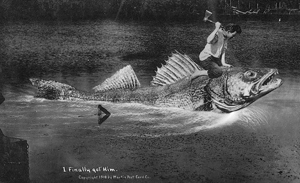
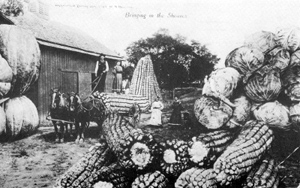
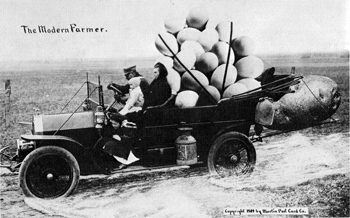
Postcards had been around since 1869, but it wasn't until 1894 that pictures began to be printed on them. The photo postcards were an immediate success. Their popularity inspired photographers to experiment with ways to add more humor to them, and soon they had translated the idiom of the tall tale into visual form, creating tall-tall postcards, also known as "freak" or "trick" postcards.
Oversized crops and animals were a popular theme, especially in the Midwest where farmers got a kick out of sending pictures showing corn as big as trees and cabbages larger than barns to relatives back east. The oversized farm and dairy products evoked the idea of easy abundance at the heart of the American dream. The deeper joke was that these were actually hard years for America's farmers, which gave these cards an edge of dark humor.
William "Dad" Martin of Ottawa, Kansas was one of the masters of the genre and a great innovator in the art of photo fakery. His work was characterized by a fine attention to detail and lifelike effects. Martin's company, the Martin Post Card Company, made him a wealthy man. Fliers for his business read, "This is Dad Martin. He has been arrested for hunting. He is a fool about fishing. But wise on photography."
Martin was particularly good at portraying action in his trick postcards, as can be seen in the top image ("I Finally Got Him"). This set him apart from his peers whose images tended to be static and rather dull.
The middle image, "Bringing in the Sheaves," referred to a well-known hymn:
The bottom image, "The Modern Farmer," is interesting since it shows an automobile. In 1909 cars were still newer than photography itself, and Martin often featured them in his postcards. Today these postcards are particularly sought after by collectors.
Oversized crops and animals were a popular theme, especially in the Midwest where farmers got a kick out of sending pictures showing corn as big as trees and cabbages larger than barns to relatives back east. The oversized farm and dairy products evoked the idea of easy abundance at the heart of the American dream. The deeper joke was that these were actually hard years for America's farmers, which gave these cards an edge of dark humor.
William "Dad" Martin of Ottawa, Kansas was one of the masters of the genre and a great innovator in the art of photo fakery. His work was characterized by a fine attention to detail and lifelike effects. Martin's company, the Martin Post Card Company, made him a wealthy man. Fliers for his business read, "This is Dad Martin. He has been arrested for hunting. He is a fool about fishing. But wise on photography."
Martin was particularly good at portraying action in his trick postcards, as can be seen in the top image ("I Finally Got Him"). This set him apart from his peers whose images tended to be static and rather dull.
The middle image, "Bringing in the Sheaves," referred to a well-known hymn:
Bringing in the sheaves,
Bringing in the sheaves,
We shall come rejoicing,
Bringing in the sheaves.
Bringing in the sheaves,
We shall come rejoicing,
Bringing in the sheaves.
The bottom image, "The Modern Farmer," is interesting since it shows an automobile. In 1909 cars were still newer than photography itself, and Martin often featured them in his postcards. Today these postcards are particularly sought after by collectors.
References:
• Rubin, C.E. & Williams, M. (1990). Larger Than Life: The American Tall-Tale Postcard, 1905-1915. Abbeville Press.
• Welsch, R.L. (1976). Tall-Tale Postcards: A Pictorial History. A.S. Barnes and Company.
• Rubin, C.E. & Williams, M. (1990). Larger Than Life: The American Tall-Tale Postcard, 1905-1915. Abbeville Press.
• Welsch, R.L. (1976). Tall-Tale Postcards: A Pictorial History. A.S. Barnes and Company.
Technique: Composite Images. Time Period: 1900-1919.
Themes: Animals, Fish, Very Large Animals, Humor, Tall-Tale Postcards,.
Themes: Animals, Fish, Very Large Animals, Humor, Tall-Tale Postcards,.
The Melon Party
 |
 |
Status: Fake (composite)
Date: 1911
Date: 1911
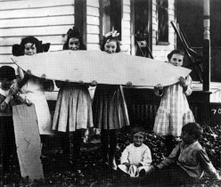
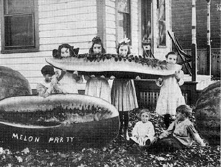
A postcard created by Alfred Stanley Johnson of Waupun, Wisconsin. The top image shows the original, unedited picture which Johnson used to create the trick effect. The children posed, holding wooden props. Johnson then cut and pasted a picture of a watermelon slice into this picture to create the finished postcard (bottom): an illusion of a children's party featuring a giant watermelon.
Tall-tale postcards experienced the peak of their popularity from 1905 to 1915, but cards of this kind are still being created and sent today. And the internet, combined with software that makes it easier than ever to manipulate images, has breathed new life into the genre of tall-tale photography.
Tall-tale postcards experienced the peak of their popularity from 1905 to 1915, but cards of this kind are still being created and sent today. And the internet, combined with software that makes it easier than ever to manipulate images, has breathed new life into the genre of tall-tale photography.
References:
Rubin, C.E. & Williams, M. (1990). Larger Than Life: The American Tall-Tale Postcard, 1905-1915. Abbeville Press: p. 108.
Rubin, C.E. & Williams, M. (1990). Larger Than Life: The American Tall-Tale Postcard, 1905-1915. Abbeville Press: p. 108.
Technique: Composite Images. Time Period: 1900-1919.
Themes: Food, Humor, Tall-Tale Postcards, Plants,.
Themes: Food, Humor, Tall-Tale Postcards, Plants,.
Cat Drinks From a Bottle
Status:
Date: 1911
Date: 1911