On the evening of October 30, 1938, the audience listening to CBS Radio were told they were going to be treated to the music of Ramon Raquello and his orchestra, broadcast live from the Meridian Room at the Park Plaza in New York City. The performance began, but mere minutes into it a reporter from Intercontinental Radio News interrupted to deliver an important announcement. Astronomers had just detected enormous blue flames shooting up from the surface of Mars.

An undated edition of H.G. Wells' story, from Whitman Publishing.
Probably from the 1940s.
The broadcast returned to the music of Ramon Raquello, but soon it was interrupted again with more news. Now a strange meteor had fallen to earth, impacting violently on a farm near Grovers Mill, New Jersey. A reporter was soon on hand to describe the eerie scene around the meteor crater, and the broadcast switched over to continuous coverage of this rapidly unfolding event.
To the dismay of the terrified radio audience, the events around the Grovers Mill meteor crater rapidly escalated from the merely strange to the positively ominous. It turned out that the meteor was not a meteor. It was, in fact, a spaceship, out of which a tentacled creature, presumably a Martian, emerged and blasted the onlookers with a deadly heat-ray.
The Martian sunk back into the crater, but reemerged soon afterwards housed inside a gigantic, three-legged death machine. The Martian quickly disposed of 7,000 armed soldiers surrounding the crater, and then it began marching across the landscape, joined by other Martians. The Martian invaders blasted people and communication lines with their heat-rays, while simultaneously releasing a toxic black gas against which gas masks proved useless.
Mass Panic
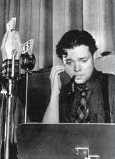
Orson Welles in the CBS studios during the broadcast.
Believing that the nation had been invaded by Martians, many listeners panicked. Some people loaded blankets and supplies in their cars and prepared to flee. One mother in New England reportedly packed her babies and lots of bread into a car, figuring that "if everything is burning, you can't eat money, but you can eat bread." Other people hid in cellars, hoping that the poisonous gas would blow over them. One college senior drove forty-five miles at breakneck speed in a valiant attempt to save his girlfriend.
By the time the night was over, however, almost all of these people had learned that the news broadcast was entirely fictitious. It was simply the weekly broadcast of Orson Welles and the Mercury Theatre. That week, in honor of Halloween, they had decided to stage a highly dramatized and updated version of H.G. Wells' story,
The War of the Worlds.
The broadcast reached a huge audience, demonstrating the enormous reach of radio at that time. Approximately six million people heard it. Out of this number it was long thought that almost one million people panicked. More recent research, however, suggests that the number of people who panicked is probably far lower. In fact, some skeptics contend that the idea that the broadcast touched off a huge national scare is more of a hoax than the broadcast itself, which was never intended to fool anyone. (At four separate points during the broadcast, including the beginning, it was clearly stated that what people were hearing was a play.) The idea that hundreds of thousands of people panicked may have arisen because the media exaggerated the figures in order to dramatize the panic.
Reasons for belief

In this famous photo, New Jersey farmer Bill Dock prepares to fight off the invading Martians. The image was actually posed by a Life Magazine photographer a few days after the panic.
Despite the contention that the panic may not have been as widespread as originally thought, many people undeniably did panic. What might have caused them to believe that the broadcast was real?
First, many people tuned in late and missed the announcement made at the beginning of the broadcast that what followed was merely a staged dramatization. By the time a second disclaimer was made, the most alarming portion of the play had already been broadcast.
Second, the global situation in 1938 provided a context that allowed many to believe such a series of events could be unfolding. Tensions in Europe were rising, and it had been very common during the previous three months for radio broadcasts to be interrupted by reporters delivering ominous news from Europe. Many who panicked later explained they had assumed the Martian invasion was a cleverly disguised German attack.
Most of those who panicked were middle-aged or older. Younger listeners tended not to panic because they recognized Orson Welles's voice as the voice of the hero in the popular radio series,
The Shadow.
Later Panics
The 1938 broadcast was not the only time a dramatized broadcast of H.G. Wells'
War of the Worlds was mistaken for an account of real events. In November 1944 the play caused a similar panic when it was broadcast in Santiago, Chile, and in February 1949 it once again stirred up unrest when it was performed by a radio station in Quito, Ecuador. The situation in Ecuador provoked an angry mob to surround the radio station and burn it to the ground.
How to hear the broadcast
The original 1938 Mercury Theatre broadcast of the War of the Worlds has been archived and can now be heard on the internet at
EarthStation1.com.
War of the Worlds Haiku (Submitted by Hoax Museum visitors)
The night has grown still.
Nothing stirs but that Martian
blasting its heat ray.
(by AB)
|
Tripods fire their beams
Spreading death and destruction
Across the landscape.
(by bobbaxter)
|
You silly people!
Don't you think you'd see a sign
if aliens came?
(by Alia)
|
Aliens shoot, zap and destroy
This is surely the end of time.
But no, it was a ploy.
(by Cuke)
|
Links and References
- Bulgatz, Joseph. Ponzi Schemes, Invaders from Mars and More. 1992.
- Cantril, Hadley. The Invasion from Mars: A Study in the Psychology of Panic, With the Complete Script of the Famous Orson Welles Broadcast. Princeton University Press. 1940.
- Holmsten, Brian and Lubertozzi, Alex (eds.). The Complete War of the Worlds: Mars' Invasion of Earth from H.G. Wells to Orson Welles. Sourcebooks. 2001.



Comments
wasn't it clever of us to bribe Orson Welles to broadcast that we had landed in New Jersey? It distracted everybody's attention, so that we could pull off our landing unnoticed in Massachussetts.
Your secret is safe with me.
http://themintyplum.com/?p=2909