The Voynich manuscript is a mysterious book consisting of approximately 240 pages of hand-written text and crudely drawn illustrations that depict plants, astrological diagrams, and naked women. The text is written in an unknown alphabet that has defied all attempts at translation. It is not certain exactly how old the manuscript is, but it appears to date to around the late fifteenth century. It is named after Wilfrid Voynich, who acquired it in 1912 from the library of Villa Mondragone, a Jesuit college in Frascati, Italy.
History of the Manuscript
The manuscript first came to the attention of modern scholars in 1912 when Wilfrid Voynich discovered it tucked away in the library of Villa Mondragone. He purchased the manuscript and brought it with him back to America.
The history of the manuscript before Voynich found it is unclear. A letter inserted between its pages revealed some of its history. The letter was dated 1665 or 1666 (the writing was unclear) and was addressed to the scholar Athanasius Kircher from Johannes Marcus Marci. Marci explained that the book had once been owned by Emperor Rudolf II, who believed it had been written by the English monk Roger Bacon (1214-1294?). Marci was hoping that Kircher would be able to translate the manuscript, but apparently Kircher was unable to do so.
Upon his return to America, Voynich circulated photostat pages of the manuscript to scholars whom he hoped could help him decode its strange alphabet. Cryptographers rushed to take up the challenge.
Theories about its meaning
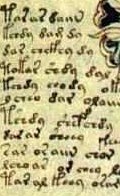
Untranslatable text from the Voynich manuscript
The first to announce a solution to the manuscript's code was William Romaine Newbold in 1921. After microscopically examining the letters of the manuscript, Newbold decided that the letters were not themselves meaningful. The real meaning lay in the individual pen strokes that composed each letter and which, so Newbold claimed, corresponded to an ancient Greek form of shorthand. Newbold's translation, however, now reads more like a work of madness than the work of a rational mind, since what he believed to be individual pen strokes were, in fact, simply cracks in the manuscript's ink caused by age.
In 1943 Joseph Martin Feely, working on the assumption that the manuscript had originally been written by Roger Bacon, attempted to match the frequency of characters in the text to the frequency of characters within Bacon's other writings, and decode it in this way. His effort proved unsuccessful.
In the 1970s, Robert Brumbaugh, using a complicated decoding scheme, decided that the manuscript might be a medieval treatise on the elixir of life.
Since then, a variety of theories about the manuscript have been suggested. In 1978 John Stojko argued that it was an account of a civil war written in an ancient, vowelless form of Ukrainian. In 1987 Leo Levitor theorized it was an ancient prayer-book, offering repetitive meditations on the themes of pain and death. More recently, Jacques Guy has wondered whether it might not represent an ancient attempt to transcribe an east-Asian language, say Chinese or Vietnamese, into alphabetic form.
Theory that it's a hoax
The fact that the text has defied all efforts at translation has led many to believe the writing is actually meaningless and that the book itself was created as a hoax.
Computer scientist Gordon Rugg has argued that a sixteenth-century hoaxer could have created the gibberish text using an encryption tool known as a cardan grille. He argues that the book was created by a sixteenth-century Englishman, Edward Kelley, in order to con Emperor Rudolph II.
Sergio Toresella has suggested the manuscript might be an "alchemical herbal" — that is, a book of nonsense writing that quack doctors used to impress clients. In 1986 Michael Barlow suggested that Voynich himself might have written the manuscript as a hoax, since as an antique book dealer he had the necessary knowledge. However, there is no compelling evidence to indicate this.
To this day the Voynich manuscript continues to resist all efforts at translation. It is thought that the horror writer H.P. Lovecraft might have used the manuscript as the model for the fictional work,
The Necronomicon, which he refers to in many of his stories.
Links and References
- Grossman, Lev. "When Words Fail: The Struggle to Decipher the World's Most Difficult Book," Lingua Franca, 1999.



Comments
The documents actually refer to his creation of these horticultural specimens and also documents his network of suppliers and customers in which his buissness run, in other words the author was a druge dealer and the manuscript is his 'ledger/diary'
The reasoning behind the strange language and format as well as the obviously inept ability to create an acceptable quality of images is a direct result to his sampling of his own specimens.specimens
CRACKED!
Many "tubes" in the Voynich look quite like microscopes.
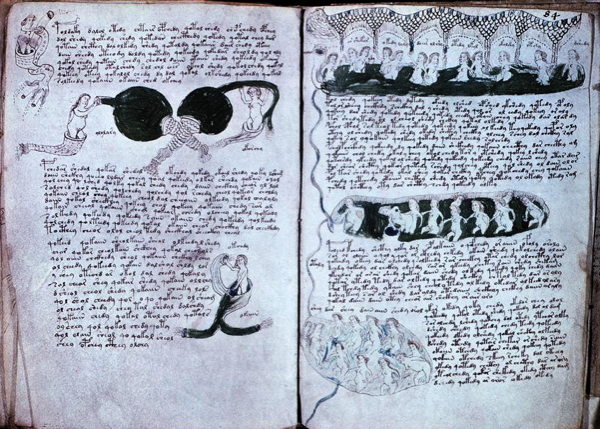
A good portion of the Manuscript revolves around pregnant women. The picture with a circle represents 12 cycles of 24. Every 24 days after a woman’s period ends she should start her period again and when she does not it starts the 12 cycles, at the end of the 12th cycle the baby will be born, 288 days after the last period. The naked ladies in the water and the naked lady in the water represent water births to make the birthing process easier. The pictures of the plants are herbs required for different medication uses throughout the process for pain or to control different parts of the pregnancy period. This section of the book was probably like a mid-wife self help guide written in code due to fear of death if a person was caught with the book due to religious intolerance. This is what I believe from what I have seen.
The book also contains other scientific findings that were made by the books author and also by the second person that finished the book that they passed it down to or that was helping with the discoveries which would explain the two different styles of writing.
I believe that the church realized how important the information in the book was but also believed that to acknowledge it 500 or so years ago would be like admitting that science was not witch craft and that was impossible at that time. Someone in the church saved this book and hid it because they felt it was the right thing to do. I would love to see every page in the book.
My name is Nikolai.
To a question about the key to the Voynich manuscript.
Today, I have to add on this matter following.
The manuscript was written no letters, and signs for the letters of the alphabet of one of the ancient languages. Moreover, in the text there are 2 more levels of encryption to virtually eliminate the possibility of computer-assisted translation, even after replacing the signs letters.
I pick up the key by which the first section I was able to read the following words: hemp, hemp clothing; food, food (sheet of 20 numbering on the Internet); cleaned (intestines), knowledge may wish to drink a sugary drink (nectar), maturation (maturity), to consider, to think (sheet 107); drink; six; flourishing; growing; rich; peas; sweet drink nectar and others. It is only a short word, mark 2-3. To translate words consisting of more than 2.3 characters is necessary to know this ancient language.
If you are interested, I am ready to send more detailed information, including scans of pages indicating the translated words.
Sincerely, Nicholas.
I deciphered the manuscript - a Scandinavian language - see here
http://voynichbook.pp.ua and http://voynichbook.inf.ua
The only verifiable fact; Wilfrid Voynich brought it to light in 1912!
Every-single-word written about it since, is mere speculation. Not one single fact, has ever been officially verified, or proven!
The Carbon14 dating, has ONLY verified the age of the materials used...
Voynich was a dealer in ancient manuscripts, and ancient materials like Velum, ancient inks and manuscript restoration and preservation!
The letter (very conveniently) found with the book, is the only item anywhere purporting to verify the manuscript... Again, no actual facts have been verified or officially recognised!
I think;
The book is a modern production, using ancient materials!
Voynich was perfectly placed to gather the materials, and present such an item!
The distinct lack of verifiable facts suggest nothing else!
Anything else is actual supposition, whichever way you look at it
The initial name of Voynich manuscript is the "Book of Dunstan",
authors - John Dee, Edward Kelly.
Period of writing - 1583 -1588
Language: English (XVI century), modified English (imitation of English of X century)
The description of coding method is published in pre-print depository:
https://arxiv.org/ftp/arxiv/papers/1604/1604.04149.pdf
For the text of last manuscript page decoding (proof of authorship) see pages 56-73 (chapters 10 and 11 of the article). Please appologise my poor English
So... Hoax has been confirmed.