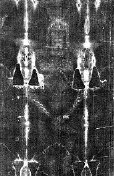
The Shroud of Turin first came to the attention of the public in 1355, when it was exhibited at the Church of St. Mary in Lirey, France. It had been given to the church by a French knight, Geoffroy de Charny, who probably acquired it in Constantinople.
Its supporters claim that this fourteen-foot piece of cloth bearing the image of a naked man was the funeral shroud of Christ. They argue that only supernatural means could have created such an image.
Skeptics dismiss the shroud as a medieval forgery, arguing that: 1) there was a flourishing trade in false relics during the middle ages; 2) a medieval forger could definitely have created such an image (researchers have offered a variety of theories to explain how it might have been done); and 3) the man's body is oddly proportioned (his head is too large), which suggests the image is a painting.
Controversy
Throughout its history, the shroud has been a subject of controversy. Soon after it was discovered, a report to Pope Clement argued that the shroud was merely a painting, and that it was being falsely displayed as a true relic in order to solicit donations to the church. As a consequence, Pope Clement declared the relic a fraud.
In 1453 the shroud was acquired by de Charny's granddaughter who eventually sold it to the Duke of Savoy. The Savoys exhibited it for many decades, claiming that it was the holy shroud that had covered Christ as he lay in the tomb. In 1532 it was almost destroyed in a fire. The shroud still displays burn marks from this incident.
Throughout the twentieth century researchers dueled back and forth over the shroud's authenticity. In 1982 a group calling itself the Shroud of Turin Research Project declared it to be genuine after studying samples lifted from the cloth using tape. However, radiocarbon tests performed later during the 1980s dated the shroud to approximately the fourteenth century, indicating that the relic was a fake. Nevertheless, shroud supporters found many reasons to dispute the radiocarbon testing, and so the debate raged on and likely will for the foreseeable future.
Recent news about the shroud
Aug 22, 2002: The Vatican admitted it had
secretly been allowing a scientist to perform tests on the shroud for the past few months. The scientist was trying to get a more accurate reading of the exact age of the shroud's fibers, following criticism of 1988 tests of the age of the fibers.
Apr 18, 2004: A second face was discovered on the backside of the shroud.
January 31, 2005: New tests suggested that the shroud may be older than previously thought. Tests done in 1988 had apparently (mistakenly) analyzed patches woven into the shroud following the fire in 1532. Raymond Rogers has published a paper in Thermochimica Acta stating that the shroud itself appears to be far older, between 1,300 and 3,000 years old.
March 2005: Nathan Wilson published an article suggesting that the shroud could have easily been created by a medieval forger if the forger painted a figure of a man on a piece of glass, placed the glass over a linen shroud, and left this setup out in the sun for a couple of days. The sun would bleach the linen, but leave behind a photo-negative image of the figure painted on the glass.
Shroud of Turin Haiku (Submitted by Hoax Museum visitors)
Three-dimensional
Image burnt onto old cloth.
Jesus, is that you?
(by AB)
|
|



Comments
Paint it in oil, heat it, and there you have it.
Check facts and update your data.
The Shroud of Turin analyses are a lot more complex than many of the commenters think: https://en.wikipedia.org/wiki/Shroud_of_Turin
If unwashed. The living blood would have completely dried to leave no distinctive marks. It is impossible for dried blood to transfer to cloth in such detail.
If washed. All living blood would have been removed to leave a little post mortem pooled blood consisting of blood and serum. There would be no dirt or vinegar.
The forger has added too many details to correspond with the scriptures of the crucifixion.
1) A local bishop knew the artist and wrote Pope Clement telling him the shroud was a forgery and used in a scam. The Pope declared it fake.
2) The bodily proportions of the figure on the cloth are way off
3) Jews did not bury people in shrouds but the bodies were bound in strips of cloth with a separate cloth to cover the faces
So let me state the obvious for those who blind to the real truth. Keep in mind, I'm not even religious and yet I know more facts about him than 98% of Christians, because I, unlike them, actually do real research.
Fact #1, Jesus was NOT Jewish. He was LEBANESE. That's a fact. He didn't even like Jews. He despised them. Chased them from the temple. Even called them "evil liars, murderers and thieves" [it's right in the Christian book (John 8:44)]. He wasn't born in Jerusalem, or Bethlehem, or even Nazareth. He was born in the district of Phoenicia, of lower Galilee, in LEBANON. (Anyone who knows facts knows he was born in Galilee). So who started the lie that he was a JEW, born in Jerusalem? Take a guess... or just let Jesus himself tell you... "evil LIARS, murderers and thieves." [you'll see a clear pattern of this emerge with research]
He was Lebanese, not Jewish. But if you're trying to convince the world you're a special group of people chosen by God himself, then he can't very well be Lebanese, right? And yet his whole family was from the village of Qana, LEBANON. His grandparents, "Joachim & Hannah Omram," were Lebanese farmers. How many Christians can tell you the name of their lord & saviors grandparents!? Or his last name? ZERO. His father, Joseph, and mother Mary, were actually first cousins [also from Qana, Lebanon] .
But the Vatican knows, as they have the Census. The above is exactly why his native language was ARAMAIC, not HEBREW! And if you're a person with common sense, it's starting to make sense to you.
It's just as silly as stories of a bunch of middle eastern men, all with manes like Luke, John, Paul and Ringo. I can assure you, no one in these areas was named Charles, Johnny, Robert or Todd. And a dark skinned middle eastern man who spoke Aramaic certainly didn't have people around him named Peter, Paul and Mary.. Not unless they were singing "Puff the Magic The Dragon."
You would think at least some of the religious fanatics would be more interested in learning real facts about the one person they claim to love so much that they devote their whole lives away to him, right? Like, say, learning his native language of Aramaic, if not just to see what his words sounded like. For instance, the bible shows Jesus greeted everyone with the repeated phrase "Peace Upon You." Luckily, I happen to know how to say that in Aramaic.
It's actually pronounced, "Asalamualykum" (Ah-Sahla- mu-ahlay-kum). No that's not a typo. It's the standard greeting among Muslims. Have Christians read [Mathew 26:39?] This beloved middle eastern man, who habitually used common Muslim greetings, also happened to pray on his face!
I can go on and on, but I think the point is clear. Whatever people think they know, they're wrong. And when you see things, like alleged super natural shrouds with a picture of what looks like the face of a Lynard Skynaryd band member, there's a good chance it's likely a fraud.
At least Logically speaking (or even thinking.) : /
But really.. are we seriously supposed to be surprised at the notion that someone would actually go to such great lengths, just to manipulate others into believing whatever crazy insanity they do? Have you read the Bible...the one that denounces homosexuality... named after the homosexual King, Queen James...? lol
Monty Python couldn't even make up that type of silliness.