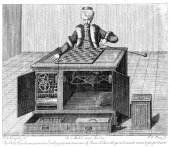
Enlightenment thinkers were fascinated by machines called automata whose sole purpose was to mimic living objects, and they built some amazing examples of them. The frenchman Jacques de Vaucanson built a mechanical duck that quacked, ate food, and defecated just like the real thing. But no automaton was more praised or more famous than the Great Chess Automaton of Baron Wolfgang von Kempelen.
The Great Chess Automaton consisted of a wooden figure dressed in Turkish clothes (and usually referred to as the 'Turk') whose trunk emerged out of a large wooden box filled with gears and wires. When wound up, the figure played chess against human opponents.
But this wasn't a machine that simply mimicked the movements of a man playing chess. The Great Chess Automaton actually moved pieces on its own, planned strategy, and responded to the actions of its opponent. To top it all off, it was an excellent player. It almost always won. In other words, this was not a mere mechanical contraption, such as Vaucanson's duck. This, in the words of its inventor, was an actual 'thinking machine.'
Kempelen, who was a Hungarian nobleman, built the chess automaton in 1769 and toured throughout Europe with it, exhibiting it before audiences filled with royalty and aristocrats. He typically invited audience members to challenge his automaton to a match, and these challengers invariably lost. The automaton even defeated Benjamin Franklin.
In 1790 Kempelen finally dismantled the machine and stored it away. But this was not the end of its career, because in 1805, after Kempelen had died, his family sold the machine to Johann Nepomuk Maelzel, a German university student.
Maelzel reconstructed the automaton and toured with it throughout Europe before bringing it to America in 1826. There it again entertained and fascinated audiences, while regularly beating challengers.
Debate About Its Mechanism
The means by which the automaton operated was a source of constant speculation. Before each show, Kempelen made a point of opening sliding doors on the side of the box to prove that it was occupied only by clockwork gears, and each time the automaton moved the noise of grinding machinery could be heard. Still, most people suspected that there had to be someone hidden in there, somehow. They just couldn't figure out how. Perhaps, they theorized, it was a dwarf. But there were also many who were convinced that the automaton was an actual thinking machine.
While it was touring America, Edgar Allan Poe had a chance to watch it in action, and he wrote an article in which he tried to use strict logic to solve its mystery. He theorized that a man was hidden in the body of the turk itself. He was almost right, but not quite.
The Secret Revealed
The real secret was revealed on February 6, 1837, almost seventy years after the automaton's creation, in a tell-all article published by the
Philadelphia National Gazette Literary Register. Hidden inside the box out of which the body of the Turk emerged (not in the body of the Turk, as Poe thought) was a full-sized man. The identity of the hidden man varied, but Kempelen and Maelzel tried to use chess champions, one of whom wrote the exposé. Among the chess masters who served as the automaton's hidden operator were Johann Allgaier and Aaron Alexandre.
A series of sliding panels and a rolling chair allowed the automaton's operator to hide while the interior of the machine was being displayed. The operator then controlled the Turk by means of a 'pantograph' device that synchronized his arm movements with those of the wooden Turk. Magnetic chess pieces allowed him to know what pieces were being moved on the board above his head.
So the Great Chess Automaton was not sentient after all, but only a hoax. This disclosure proved its undoing. Its mystery snatched away, it was relegated to a warehouse, where a few years later, in 1854, it perished in a fire.




Comments