In the Fall of 1969 a rumor swept around the world alleging that Paul McCartney, singer and bassist for the Beatles, was dead. In fact, that he had died three years ago on November 9, 1966 in a fiery car crash while heading home from the EMI recording studios. Supposedly the surviving band members, fearful of the effect his death might have on their careers, secretly replaced him with a double named William Campbell (an orphan who had won a Paul McCartney lookalike contest in Edinburgh). However, they also planted clues in their later albums to let fans know the truth, that Paul was dead.
Beatles fans, who came to be known as "cluesters," spent countless hours searching for clues hidden in the albums, eventually locating hundreds of them. Numerous articles appeared in magazines pondering the likelihood of Paul's Death. John Chancellor even discussed the issue on the NBC evening news, concluding that "All we can report with certainty is that Paul McCartney is either dead or alive." McCartney only inflamed the rumor by refusing to appear in public to deny it. Finally photographers for
LIFE Magazine tracked the singer down to his Mull of Kintyre country house where he was on vacation and took a photo of him which it ran on its cover, thereby throwing some cold water on the rumor. But not killing it entirely. To this day a few diehard cluesters still persist in their belief that McCartney died in 1966. It is the most persistent and elaborate false death rumor in history.
How the Rumor Got Started
On January 7, 1967 McCartney's Mini Cooper really did crash, and as a result a few newspapers did report he had died. However, McCartney wasn't in the car when it crashed. He was safe at a party in Sussex. The man driving the car (who didn't die either) was Mohammed Hadjij, who allegedly was using the car to transport drugs up to the partyers in Sussex. After this incident, a few scattered rumors of Paul's death and replacement by a double were reportedly overheard at London parties.
But it was two years later, in the American midwest, that the rumor really took hold. Researcher Andru Reeve has traced this midwest origin of the rumor to a song titled "Saint Paul" that received heavy airplay in the midwest in May 1969. The song, penned by Detroit-based Terry Knight, spoke of Paul being in heaven. Knight might have been speaking metaphorically about the imminent breakup of the Beatles, but the lyrics must have suggested the idea of McCartney's death to some fans. Whatever the case, the idea was planted, and the rumor began to spread around college campuses.
The first appearance of the rumor in print occurred on September 17, 1969, in Tim Harper's article for the
Drake Times-Delphic (the student newspaper of Drake University in Des Moines, Iowa) titled "Is Beatle Paul McCartney Dead?" But this article didn't receive much attention at the time. Instead, the real beginning of the Paul-Is-Dead rumor, as a pop-culture phenomenon, dates to October 12, the day Detroit DJ Russ Gibb took a call on-air from Eastern Michigan University student Tom Zarski. Zarski laid out the whole rumor for Gibb and, as proof of its truth, urged him to play "Revolution Number Nine" from the Beatles'
White Album backwards. Gibb obliged and, much to his surprise, could distinctly hear the words "Turn me on, dead man" being spoken repeatedly. Gibb was astounded by what he heard. This was the spark that ignited the fire.
Fred LaBour, a student journalist at the University of Michigan, heard Gibb's broadcast and wrote up an article for the
Michigan Daily outlining the theory and detailing many of the most sensational clues. The article electrified readers, and was soon reprinted in numerous university papers throughout the country. LaBour's article, more than anything else, spread the rumor to a national audience.
The rest was history. The mainstream media, now fully aware of the rumor, latched onto it with a fervor. Planeloads of journalists were dispatched to England to find Paul. For three weeks the musician's supposed death was one of the main topics of conversation in America. It wasn't until
LIFE printed the picture of McCartney on the cover of its November 7 issue that the excitement began to die down.
A Few of the Clues
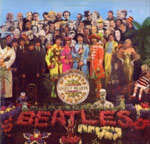
Sgt. Pepper's Lonely Hearts Club Band
1) The foreground scene on the front cover shows a floral arrangement, as if for a funeral. The white flowers on the bottom right either form a left-handed bass guitar (Paul's instrument), or they spell out Paul.
2) "Beatles" is spelled out in red flowers on the cover. But there's an extra letter, an "o" that is mysteriously placed at the end of the name. Perhaps the band was sending a secret message: Be At Leso. Leso was the name of a Greek Island that they had supposedly bought. Were they inviting fans who had figured out the mystery to join them there?
3) A toy Aston Martin convertible can be seen on the lap of a rag doll on the right-hand side of the cover. Paul supposedly died in an Aston Martin.
 4)
4) If you use a mirror to bisect the phrase "LONELY HEARTS" that appears on the drum, the phrase "I ONE IX HE ◊ DIE" can be seen. If "I ONE" is 11, and "IX" is the roman numeral 9, then this might be decoded to mean "11 9 HE DIE" (i.e. November 9, He Die).
 5)
5) A hand is held up behind Paul's head, a raised hand being a mystical symbol of death. (
In some religions, it actually is.) A hand raised behind Paul's head is a recurring clue in many photos of the band.
 6)
6) On the back cover Paul is wearing an arm patch that says "OPD," which is British police jargon for "Officially Pronounced Dead." (
The patch actually reads "OPP," which stands for Ontario Provincial Police. Paul was given the patch while on tour in Canada.)
Magical Mystery Tour
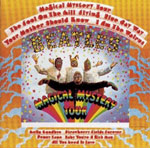 7)
7) If you look at the starry letters of the Beatles name in a mirror, or upside down, they supposedly form a phone number. If you call this number, someone will answer and provide another clue. Or perhaps William Campbell himself will answer. This clue inspired an urban legend alleging that a student dialed the secret phone number and reached someone who quizzed him about Beatles trivia. The student answered all the questions correctly and was then told he had won a trip to Pepperland. He subsequently received a letter instructing him to lick the stamp on the envelope. When he did so, he experienced an LSD trip. While under the influence of the LSD, he jumped out of his dorm room to his death.
8) Paul is wearing a walrus suit on the cover. This is significant because Walrus means Corpse in Greek. (
Actually, it doesn't.)
9) The song "I am the Walrus" is supposedly about Paul's death. The lyrics "Stupid bloody tuesday" refer to the last time Paul was seen alive. And the eggman refers to Humpty Dumpty, who cracked his head open, as did Paul.
10) At the end of Strawberry Fields, the voice of John Lennon can be heard saying "I buried Paul." (
John does say something at the end of the song, but it's not "I buried Paul." He says "cranberry sauce.")
The White Album
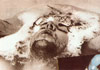 11)
11) One of the images on the poster inside the album shows Paul soaking in a tub of water. Many people have commented that it kind of looks like Paul's decapitated head floating in blood.
12) The song "Glass Onion" contains the lyric "looking through a glass onion." The DJ Russ Gibb claims that "glass onion" was old british slang for the handle of a casket, because in the nineteenth century caskets had round glass handles that looked like glass onions. Paul is looking through a glass onion because he's in a casket.
13) If you play the song "Revolution 9" backwards, you will hear the words "Turn me on, dead man" being spoken. (
It's true, you will... or, at least, you'll hear a phrase that sounds a lot like "Turn me on, dead man.")
Abbey Road
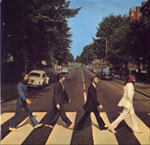
14) On the cover John, Ringo, Paul, and George are walking across a zebra crossing. Fans argue that this represents a funeral procession. John (in white) is the priest, Ringo (in black) is the undertaker, Paul (barefoot... because people are supposedly buried barefoot in Italy) is the corpse, and George (in jeans) is the gravedigger. It's also believed to be significant that Paul is out of step with the others, and that he's holding a cigarette in his right hand (because the original Paul was left-handed). Finally, it's said that this picture was taken at the site where Paul crashed his car on November 8, and that the Beatles are shown walking out of a cemetery which is located on the left side of the street. (
In reality, there's no cemetery there.)
15) Also on the cover, a white volkswagen can be seen parked in the background. Its license plate reads "28 IF." This could mean that Paul would have been 28 if he were alive. (
He actually would have been 27.) This Volkswagen was tracked down years later and sold at auction in 1986 for over $4000.
Was It a Rumor or a Deliberate Hoax?
Most people can agree that Paul McCartney didn't actually die in 1966, but the question remains: was the rumor of his death a deliberate hoax? Were some clues purposefully placed in the albums? Was an elaborate hoax engineered either by Capitol Records or by the Beatles themselves?
Both Capitol Records and the Beatles definitely had a financial motive to devise such a scheme. The Paul-Is-Dead rumor led to massive sales of all the Beatles' albums. People were actually buying multiple copies of the albums in order to play them backwards to listen for hidden messages. But Capitol denies having started the rumor, and it does seem farfetched to think that record executives would have been imaginative enough to dream up and pull off such a hoax. Although it is undeniable that once the rumor took hold, Capitol didn't do much to discourage it.
More suspicion is usually focused on the Beatles themselves because they had the creativity to pull off such a thing, and were well-known for their mischievous sense of humor. And intriguingly, one piece of evidence does link the Beatles to the start of the rumor. The Terry Knight song "Saint Paul" that got the whole ball rolling was published by none other than MacLen Music, McCartney and Lennon's publishing company created in 1963 to publish their own music. Why would MacLen publish this one non-Lennon/McCartney work? All of Knight's other songs were published by Storybook Music. Perhaps it's because Lennon or McCartney suggested that Knight write it. Andru Reeve writes:
"The enigma of a virtually-unknown musician's original song being published by the Beatles may be a greater mystery than the "Paul-Is-Dead" rumor itself. Would its inclusion in the Beatles' catalog (and its recent and mysterious disappearance) have something to do with Terry Knight's visit to Apple in early 1969? Was the song instigated by none other than Paul McCartney himself?"
However, even if one of the Beatles did prompt Knight to write Saint Paul, it's hard to imagine they could have predicted this song would in turn have inspired the most widely circulated death-hoax rumor in history.
Actually, if there is one hoaxer at the heart of this mystery, it's the college student Fred LaBour. His article in the
Michigan Daily was the main vehicle for the dissemination of the rumor. But he freely admits that he invented many parts of the rumor, such as the claim that a Scottish orphan named William Campbell replaced McCartney. LaBour stated in an interview: "I made the guy up. It was originally going to be 'Glenn Campbell,' with two Ns and then I said 'that's too close, nobody'll buy that,' so I made it William Campbell."
One final question remains. If McCartney didn't die on November 9, 1966, what was he doing on that day? It turns out that he was on vacation with his girlfriend Jane Asher. From November 6 through the 19th they were travelling through France and Kenya. But November 9 is a significant Beatles date for another reason. It was the day that John Lennon first met Yoko Ono. So metaphorically it could be seen as the date that the Beatles, as a group, began to die.
Paul is Dead Haiku (Submitted by Hoax Museum visitors)
So many fake clues
The three, the hand, the flowers
Paul is so not dead
(by Kathleen)
|
Paul is a dead man
You can see it everywhere
Why don't they beleive?
(by Jacob)
|
They were four, now three
Untimely death, who can say
Turn me on dead man.
(by mcmickey)
|
|
Links and References
- Andru J. Reeve. Turn Me On, Dead Man: The Beatles and the "Paul-Is-Dead" Hoax. AuthorHouse. 2004.
- R. Gary Patterson. The Walrus Was Paul: The Great Beatle Death Clues. Simon & Schuster. 1996.





Comments
http://blog.wfmu.org/freeform/2011/10/well-all-be-magick-supermen-the-paul-is-dead-videos-of-iamaphoney.html
Back when the news first came on that Paul was, supposedly, dead, I didn't know what to think! I was only 15. Since then, I've studied about it quite a bit and I think it's absurd that anyone thinks that there has been a man who has worn extensive make-up to make him look like Paul, has played and sung like him, written songs, etc..
Paul gave interviews years later & was asked about this, & he always denied that he'd been behind the hoax, but come on now - we just don't believe your denial Paul.
Remember the car accident Mark Hamill had between Star Wars, and Empire... Look at how much he changed.
Clues:
4 provably planted items called clues, no matter why. The 4: text reference, 1967 February Beatles Monthly (ostensibly=disclaimer), 2 "OPD" clues, 1967 (made from an OPP patch) -- one well known, where P. becomes D. on slight cylinder (upper arm, impossible) & 1 nearly unknown (fully frontal OPD), both from versions of Sgt P gatefold on album -- & 1995 (after 1969 brouhaha) "Free as a Bird" video: death head Paul, as if leafy reflection, on back of 1960s police van. (Camera pans on stationary window, reflection, van, but no blur on reflection, optically impossible to be natural). & The other thematic clues = grisly, clever, sad.
Date:
Clue date, even if didn't die = Sept 11 (1966) not Nov 9. Clue date comes from the front of the Sgt Pepper album, on the drumskin (use a mirror image 1/2way thru central text "Lonely Hearts"). Reads "I ONE IX ^ HE DIE" or 11 9 He die, which would mean 11th day, 9th month He die, for UK, Canada, etc. numbered dating. When USA got the rumour (late 1969), the US assumed 11th month, 9th day. -- & On 1-year anniv., Mag Myst Tour movie started filming, w/ lots of PID clue & on 2nd anniv., John Lennon recorded "Glass Onion", which pleaded (or seemed to) to "listen to me" & stated there were clues & Walrus image meant Paul in the clues.
Alibis & circumstance & reason:
Didn't play instruments on film (played air guitar, so to speak) for 1.5 years after Sept. 1966: leaves room for right-hander to learn good left-handed bass for public appearances. If Paulie died by accident or murder, cover-up would include intelligence circles and loyalty to helping the band continue without noticeable interruption. It would be too long to discuss people around the issue here, such as family, friends, etc., but not impossible.
Death:
For anyone who doesn't see a difference in pre-/post-Sept. 1966 Paul images, arguments from forensic imaging aren't likely to *feel* like arguments, but: Careful assessment of the distance between eyes, to forehead width, to chin distance, to under-nose distance, etc., show radically different enough measurements, to be another person. Also, the ears differ, in ways incommensurable with mere foreshortening (perspective) difference. He also wore false ears at least 9 times, in film&video; (not an absolute proof like the others here, but is required if surgery and natural ear difference were being covered up). Voice prints suggest (professional: Dr. Henry Truby, and amateur: modern computer programs) the voices differ between 1966/after in songs, but no-one has done a study of morphing they did, or what or how that would affect the voice print harmonics, or done a study of the speaking voices.
Further sources: some pages at http://plasticmacca.blogspot.com and the page (being rewritten at present, but more complete in one page) http://youcanknowsometimes.blogspot.com
Lee Harvey Oswald alone killed JFK.
Bush did not know about 9/11 in advance.
The world is wonderfully fascinating enough, you don’t have to resort to make believe.
It's also in a portion of the mix, buried in reverb where heard on headphones would give that impression both to the performer and the listener.
Sgt Peppers, Day in the life:
"He blew his mind out in car he hadn't noticed that the lights had changed, a crowd of people stood and stared , they'd seen his face before but nobody was really sure if he was from the House of Lords."
Paul had been recently Knighted, was told to me.
The Walrus was Gaelic symbol of death, not Greek as said in this article.
From MMT: Glass Onion
"You know the Walrus and me man? We're as close as can be man. Well here's another clue for you all. The walrus was Paul. Looking through the bent back tulips to see how the other half lives, trying to make a dove tail joint? Looking through a Glass Onion."
The glass onion was explained to me as another gaelic/celtic term describing how the dead could see through the ground out of their graves.
Many photos with the band except paul facing backwards and also paul dressed in white with the others in black.
I'm pretty sure McCartney is alive. Friend of mine in his band currently. I've never liked Wings or any of his solo stuff and his new material is bloody terrible.
I generally agree with the poster named "Dick Starkey" above. But reserve the right on this single issue.
Sir Paul bass playing comment(though musicians disagree, note the exact points raised here at a radio show Feb 2012: http://radiofetzer.blogspot.ca/2014/02/nick-kollerstrom-clare-kuehn.html?showComment=1393616948882#c2883361151462694647 -- a worthwhile radio show to hear is there, too, and on the same site for Jan 2014 and Jan 2012 as well):
kjaze Feb 28, 2014 at 11:43 AM
First, I've been a bass player for over twenty years. Paul impressed me in the early days with the complexity of the bass parts that he wrote and played. Even more impressively, he hit the part harmonies while playing and rarely looking at his hands. Inexplicably, in performance videos after "Rain", Paul looks at his hands as often as a less-skilled player like myself would. During the rooftop concert, he plays nothing difficult while singing; and still looks at his hands now and then. Actually his playing then wasn't terribly interesting. I'm a fan, but I have to be honest about that.
Secondly, Ringo declares himself the last living Beatle in a dailymail.uk article. Even the most lackadaisical Beatles historian knows that JPM co-founded The Beatles, long before Ringo joined them as "...a setup affair" [as Sir Paul made the mistake or clue of saying once about himself, which, if he's Paul, is not true]. Is Ringo just having a joke, or just letting some truth out in a deliberately casual context? I would think the latter. Especially after watching the Letterman [Sept 2009] interview. Anyone can recognize an "oh shit" moment if they care to.
-----
To realize something MAY be going on with Paul vs Sir Paul -- start with Sir George Martin's COAT OF ARMS, 2004. Remember: it's for his family forever. If this is related to a mere hoax from a money ploy or cruelty from John (unfair to John anyway), this would be forever for his family.
Next comment will contain the coat of arms info.
To realize something MAY be going on with Paul vs Sir Paul -- one place to start is near the end of the story of the Beatles' circle of people, with Sir George Martin's COAT OF ARMS, 2004. Remember: it's for his family forever. If this is related to a mere hoax from a money ploy or cruelty from John (unfair to John anyway), this would be forever for his family.
http://www.colbycosh.com/mt/2007/08/heraldic_brain_baffler.html
Sir George Martin CBE was The Beatles' producer, arranger, mentor, signed them to EMI, worked on majority of songs.
The centre of his heraldic design is a car-tread which 'squashes' the 4th original 'beetle', but also includes the new bandmate.
3 beetles ("stag beetles") -- 3 remaining in 2004 as Martin pointed out, but that leaves out John, which is impossible for Martin to intend, unless it's a partial meaning
tire-track-like white design with a squished edge and tread lines (car crash implication)
5 lines (5 total Beatles & 5 lines for music notation).
If 3 beetles was for the "living Beatles" at the time 2004, which Martin tried to say, that leaves out John. Forever. No way.
So:
it is, and it isn't.
White squash tire tread (double meaning: white car and squash).
3 REMAINING ORIGINAL Beatles & 3 Beatles when created in 2004.
And 5 marks (tire tread lines, also like musical lines, of course) for all 5.
White *(Beetle VW white: Abbey Road & other images & movies). Smush edge. (White car=what killed him and he was a Beatle?)
If they'd told, crest wouldn't have show this; could have 5 beetles.
So it's actually honour, not outrage to show such a thing & it's clever, forever recognizing and immortalizing the event, plus the multiple ways the band existed, Martin's favourite group.
It existed as 4 (3 and the place/1 manner of death for the 4th), it existed as 3 at the time of his crest and after the death, and existed as 5 in reality totally.
Nov. 9 in USA is Sept. 11 in UK numbered dating. The drum-skin clue would be UK dating.
Time to get the new bandmate and some initial plastic surgery in Kenya.
Note: John did an accurate drawing of Paul dead, privately. -- (See mentioned info below.)
General info on the case and a bit about the drawing: http://radiofetzer.blogspot.com/2014/02/nick-kollerstrom-clare-kuehn.html (Feb 2014 radio show -- right-click green name for show download or click to play)
Clues & John's ACCURATE DRAWING OF PAUL DEAD discussed in detail: http://radiofetzer.blogspot.com/2014/01/clare-kuehn.html (Jan 2014 radio show)
Context (intelligence coverup aspect) for the death of Paul and some info on the case details:
radiofetzer.blogspot.com/2012/01/clare-kuehn.html
Images/ Info/ John's actual drawing with deep analysis of them and the forensics issues: youcanknowsometimes.blogspot.com (Dec 2013 page link: click at right)
"paul ... died ... car ... crash ... wednesday ... night"
before the song builds to its final abrupt end.
Something no-one seems to have considered ; if Paul had died, why didn't the other Beatles show signs of distress or grieving ? Their close friend and colleague had presumably just been suddenly killed, and yet none of them seemed shocked at all ? Also presumably, their professional and social schedule / engagements weren't affected at all either. No events abruptly cancelled due to this sudden "tragedy" ? Strange, eh ?
Even more unlikely that there's any credibility to this story, when you consider that they went into the recording studio the very NEXT MONTH ( December 1966 ) to start work on Sgt. Peppers. Now would they really feel up to doing that if they were supposedly mourning Paul ? And the "replacement" Paul just happened to be talented enough to contribute significantly to what would become their most famous landmark album ? And how would the "new" Paul have had time to rehearse with and integrate seamlessly, into the band ?
Not even taking into account the highly implausible likelihood that he would be a left handed bass player ! How common are left handed bass players, by the way ? AND, remember - who also just happens to be an almost exact physical clone of Paul as well ? And not only that, but to have to find someone with ALL these qualities at very SHORT NOTICE ? Come on, it's all too ridiculously fanciful to believe !!!
If you go to page 7, the textual story begins. If you go to page 8, it's a photo of people sitting at a table. However, if you put that picture up and look at it from a distance, you can very clearly see a skull with the attached skeleton behind it - as though you are looking in a casket.
"Nothing is real" is sung as the camera focuses on Faul's face not to mention yes the height and yeah oh, the different face!
If Paul is dead and some guy who just happened to look like him, sound like him, write like him, play instruments like him, remember and discuss the years before the death with such vivid and factual references, etc. was just hanging around like a piece of beef in a meat locker waiting to be called on stage, well if that really happened why can't we keep everything else as quiet as this?
And lastly, when John and George died and all that money was available for a reunion, where were their William Campbells?
Ridiculous if you believe this crap
Even the so called photographic "evidence" is ridiculous. If you can't see that the photographs are of the same bloke just taken at different angles with differen lighting then you really need to get your eyes tested.
If he died, what happened to his body? It's against the law to conceal a death in the UK.
There is a picture of the so called replacement who is so obviously a picture of the real McCartney just made up to look like somebody else. It's just a joke.
Also, the article is incorrect to state that the "rumour" of Paul's death began in "the Fall of1969". It was already current in November 1966.
LMW and 28IF: I just figured out that Linda McCartney was 28 years old at the time abbey road was released (in fact, it was released 2 days later). Linda McCartney Weeps and 28IF when she was almost exactly 28 at the time? Coincidence? Idk I just figured it out
Not enough people were getting the joke.
Feeble People, it is absolutely true, the Beatles did indeed create the hoax that Paul was Dead. Paul is not dead but the clues were there as though he was. Not sure if it was a reaction to the rumor, or if the rumor was caused by the clues, but the clues were intentional. What is more amazing about this story is that there are those who do not believe that there are any such clues. But Glass Onion has one that John says intentionally was a clue.
And, when Let it Be, the album, came out, I hated it. All that dang wall of sound that murder boy put on it later. When "Let it Be, Naked" came out, which is Let it be with the wall of sound taken out, I loved the album.
There's one piece of evidence that I've never seen anyone claiming that this is all a hoax address: the change in height. There were lots of photos taken during the early concert days--including 1966--showing that Paul was clearly about the same height as John and George. Then all of a sudden in 1967 onwards, any pics of them standing together (including the Sgt Pepper album cover) show Paul clearly being a few inches taller than John and George. How in the world do you explain this? Did he suddenly have a growth spurt in his mid-20s??
My original thinking was also that it's implausible, given that the 'imposter' would have to be a great bass player. But then again, he wouldn't, given that at the height of their live touring success in 1966--something they seemed to be perfectly comfortable with and truly enjoy doing--they inexplicably stopped touring--coincidentally the same time that Paul supposedly died. And in the videos that followed afterwards, isn't Paul generally playing piano rather than bass. Why would that be, given what an awesome and incredibly innovative/original bassist he had demonstrated himself to already be? Anyone could have been playing bass on the studio... Even the fact that he was all of a sudden playing so much piano seems perhaps fishy. In the Shea Stadium concert (1965?), I seem to remember it was John who took a keyboard solo. And someone else pointed out that in the Get Back rooftop session, Paul's bass playing seems way more basic than it had been in earlier videos, and he's often looking at his hands while playing (something a more experienced bass player wouldn't do and which Paul didn't do in earlier concerts). I have to go back now and watch that footage...
But regardless of my conjecture about bass vs. piano playing, the one part I really have trouble explaining is how in the world he could have had a growth spurt of 3 inches or so from 1966-1967, already in his mid-20s. Can any of those saying "this is all rubbish" provide an explanation?
All this was well known at the time
This is all rubbish.
Rubbish is rubbish.
No explanation needed.
A tip of the cap on my head to those who are wearing their hat as a seating aid.
And the "number 9" clip backwards? Paraeidolia, or as the Bible puts it "seek and ye shall find"; if you expect strongly enough to hear something, then you will, regardless of whether or not it's actually there. I hear that clip as "turn me o-" trailing off into indistinct mumbling.
I think the reason why the Beatles never denied (nor affirmed) rumours including this one is because, if you deny a rumour, then you feed it; it's best to let it collapse under its own weight.
So, in summary, Paul did a hot dose of Acid, had the classic bad death trip, saw himself as having come back or "reborn" or whatever went on inside his head for days and weeks afterwards and ..... there you have it. Paul prior to that date when he did the "hit" was not the same Paul anymore.
After a period of time, some people never get over the experience. Paul was in fact the "Deadman" . As far as what followed , well, yes it was a unique little game that only something as big as the Beatles could pull off.
And they did pull it off. To this day. As mentioned, it's the same period in which John got into Yoko. That's sort of a "last nail in the coffin", if you catch my salty sea air drift! The bigger question is - and it's probably a legal issue - is why Paul himself has ever been willing to admit to what he experienced and what little hoax was pulled off. Are there legal problems with the true admission? It's OK Paul, if there are legal things attached to telling the truth. But for fans my age (late 50's to late 60's) it would be a great final laugh. And a feeling of the "Coming Together" of kindred spirits. Over Him. smiley face!!
http://i.dailymail.co.uk/i/pix/2015/05/20/19/28E68A2100000578-3089854-image-a-35_1432145270522.jpg
http://cdn.images.express.co.uk/img/dynamic/galleries/x701/60726.jpg
Questions rather ya...
Who stands to benefit from the events of Semptember 11th, 1966(Early morning Sept. 12) being a "Hoax"?
Where is the body of the man who died in said car crash?
Why did The Band stop playing live suddenly after this "hoax"?
Would Brian Epstien and the surviving members of the band benefit financially by replacing Paul with William Shears Campbell?
Why does the "new Paul" stand higher in stature than the actual Paul?
Why is his Jaw line and chin noticeably different?
Why a rooftop performance complete with the ability to escape by simply calling the police on yourself and allowing them to shut it down?
Have you ever really watched the rooftop performance attentively paying direct attention to the looks on Ringo, George and Johns faces? William Shears Campbell's expression is a stark contrast.
Did anyone ever notice that Paul was a delightful, Jovial and pleasant guy while Shears is a dick?
Why was Brian having such a hard time sleeping that it necessitated those pills that ultimately killed him? Could he not live the lie anymore and the guilt was eating him up to the point where he could not sleep and he subconsciously wanted out of the whole thing by ANY means?
You decide,.,. Todaloo
To add another cog in the wheel, listen to the band Klaatu. You will be amazed.
http://www.dailymail.co.uk/sciencetech/article-6006311/Sir-Paul-McCartney-misremembers-writing-Beatles-track-Life.html
Here's another 'oh shit' moment from Jimmy Fallon a few years ago which surprisingly hasn't been mentioned on here yet:
https://www.youtube.com/watch?v=m_zf6kYvR8k
I'm sorry that I doubted you,
I was so unfair.
You were in a car crash,
And you lost your hair.
!!!!!
Surely there are far too many references for this to be the band messing around.