Site Map
Hoax Archive: Time Periods
Hoax Archive: Categories
Hoaxes of Edgar Allan Poe
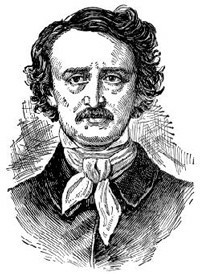
Edgar Allan Poe (1809-1849) was an American writer, celebrated for his dark, gothic tales of horror and suspense. He enjoyed playing games of rationality with his readers. Sometimes he cast himself as a master detective capable of discerning the truth behind any illusion or riddle, a role he expressed through the famous character of Chevalier C. Auguste Dupin. This is also seen in his effort to solve puzzles, such as the mystery of the operation of the Great Chess Automaton.At other times, Poe liked to display his ability to hide the truth from his readers, to force them to play detective. He published six hoaxes during his brief life. Most modern anthologies of his works fail to note that these stories were first presented to readers in the guise of nonfiction. In fact, both detective and hoaxer were two sides of the same coin for Poe. Both roles manifested the power he believed a rational mind could wield over reality. Poe was also fascinated by other hoaxes besides his own. He once referred approvingly to the age in which he lived as the "epoch of the hoax."
Listed below are his six hoaxes.

sub-topics
The Unparalled Adventures of One Hans Pfall (June 1835)
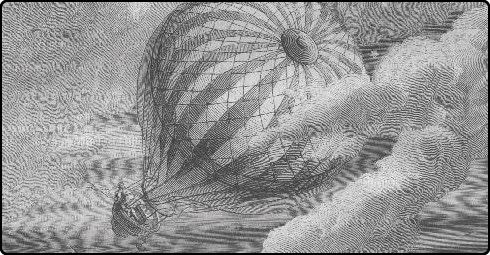
An article titled "The Unparalled Adventures of One Hans Pfall" appeared in the Southern Literary Messenger in late June of 1835. It claimed to be the text of a note dropped from a hot-air balloon that had appeared recently above Rotterdam. The note described Hans Pfall's journey to the moon in order to escape his earth-bound creditors. Pfaall had spent five years living among the inhabitants of the moon before sending one of the lunar inhabitants back to Earth in his balloon in order to deliver a message that he would return to Earth to tell his tale if the citizens of Rotterdam granted him a full pardon for past crimes he had committed; however, the lunarian had been scared by the sight of all the people on the ground and, after throwing Pfall's note down to the crowd, had fled back up into the clouds, thus preventing the residents of Rotterdam from responding to Pfaall's message.The article, though it purported to be factual, was actually a story written by Edgar Allan Poe. It was his first, and somewhat unsuccessful, attempt at a hoax. Few people were fooled, perhaps because, as Poe himself later acknowledged, it was written in a "tone of mere banter."
Poe never finished Pfaall's tale of life on the moon. Shortly after the first installment of his article appeared it was upstaged by a similar hoax about lunar life that appeared in the New York Sun. The success of the New York Sun's hoax dissuaded Poe from continuing with his own tale.
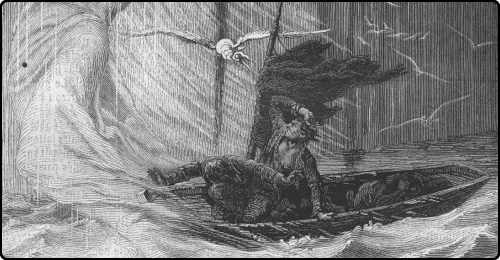
As the Wilkes Expedition, organized by the U.S. Navy, prepared to depart for South America and Antarctica during the late 1830s, polar travel received a great deal of attention in America. This was the context in which a serialized tale authored by Edgar Allan Poe appeared in the Southern Literary Messenger in January and February, 1837. Titled "The Narrative of Arthur Gordon Pym," it presented the story of an explorer, Arthur Gordon Pym, who traveled to the polar latitudes where he suffered a mysterious demise.
The tale first appeared "under the garb of fiction," but when Poe republished it a year later as a novel, he added a preface claiming the work was factual. However, the story is so bizarre that it is certain most readers realized they were being presented with fiction.
The story was a dramatization of the beliefs of John Cleves Symmes, a man who promoted the theory that the earth was hollow and inhabited within. Symmes had long sought funding for a polar expedition (led by himself) so that he could prove his theory. Poe's fictional explorer, Pym, was on a similar quest.
The tale first appeared "under the garb of fiction," but when Poe republished it a year later as a novel, he added a preface claiming the work was factual. However, the story is so bizarre that it is certain most readers realized they were being presented with fiction.
The story was a dramatization of the beliefs of John Cleves Symmes, a man who promoted the theory that the earth was hollow and inhabited within. Symmes had long sought funding for a polar expedition (led by himself) so that he could prove his theory. Poe's fictional explorer, Pym, was on a similar quest.
The Journal of Julius Rodman (1840)
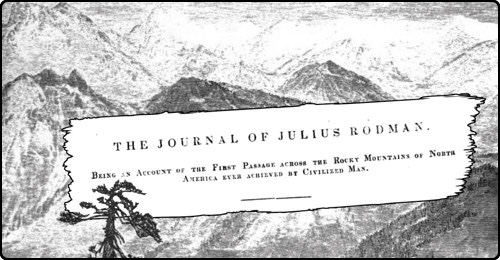
Extracts from the Journal of a "Julius Rodman" appeared in a series of six installments in Burton's Gentlemen's Magazine between January and June 1840. The journal purported to detail a 1792 expedition led by Julius Rodman up the Missouri River toward the Far North. This 1792 expedition, if true, would have made Rodman the first European to cross the Rocky Mountains.Julius Rodman's expedition was subsequently noted by a member of the U.S. Senate, Robert Greenhow, who wrote in a Senate document, "It is proper to notice here an account of an expedition across the American continent, made between 1791 and 1794, by a party of citizens of the United States, under the direction of Julius Rodman, whose journal has been recently discovered in Virginia, and is now in course of publication in a periodical magazine at Philadelphia."
Rodman was actually a fictitious character invented by Edgar Allan Poe. To create this ruse Poe penned the entire journal, relying heavily on sources such as Washington Irving's Astoria and Lewis and Clark's History of the Expedition to give his account a veneer of authenticity. Poe's motive for perpetrating this elaborate hoax is unclear.
The Great Balloon Hoax, 1844 (April 13, 1844)
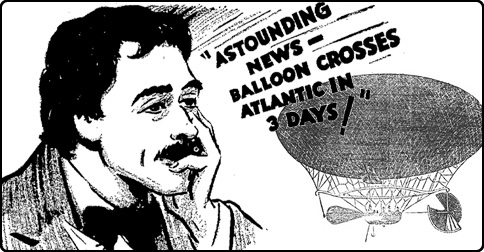
The New York Sun included a broadside, or extra page, in the midday issue of its April 13, 1844 edition, announcing that the famous European balloonist Monck Mason had succeeded in flying across the Atlantic Ocean in 75 hours. This was major news, being the first time the Atlantic had ever been crossed in a balloon.The balloon, named the Victoria, had supposedly taken off from England on a trip to Paris, but had been blown off course due to a propeller accident and ended up floating across the Atlantic and landing on Sullivan's Island, near Charleston, South Carolina.
The story was quickly revealed to be a hoax, authored by Edgar Allan Poe. Monck Mason, however, was a real person who had ballooned from London to Weilburg, Germany in 1836, a journey which he had described in 1837 in a book, Account of the Late Aeronautical Expedition from London to Weilburg.
An illustration of the "Steering Balloon Victoria" accompanied Poe's article. Poe had obtained this image by redrawing it from the frontispiece of an anonymous 1843 pamphlet (the author of which was probably Monck Mason) titled Remarks on the Ellipsoidal Balloon, propelled by the Archimedean Screw, described as the New Aerial Machine.
On the day of the article's publication, Poe stood on the steps of the Sun's building in New York City telling crowds that his own story was a hoax. But apparently, amidst the general excitement, not many people paid attention to him. He later wrote an account in the Columbia Spy of the scene following the publication of the balloon news:
On the morning (Saturday) of its announcement, the whole square surrounding the 'Sun' building was literally besieged, blocked up—ingress and egress being alike impossible, from a period soon after sunrise until about two o'clock P.M.... I never witnessed more intense excitement to get possession of a newspaper. As soon as the few first copies made their way into the streets, they were bought up, at almost any price, from the news-boys, who made a profitable speculation beyond doubt. I saw a half-dollar given, in one instance, for a single paper, and a shilling was a frequent price. I tried, in vain, during the whole day, to get possession of a copy.
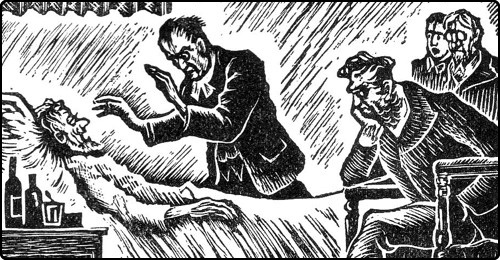
The December 1845 edition of the American Whig Review contained an account of an unusual experiment designed to test whether hypnotism could delay the arrival of death. According to the article, a terminally ill patient, M. Ernest Valdemar, who only had hours left to live, was placed in a trance by a hypnotist. The effect was quite remarkable. Valdemar appeared to go into a state of suspended animation, moving only in response to the hypnotist's commands. He remained in this state for over a day, much to the surprise of his doctors who hadn't given him that long to live. Then Valdemar's pulse stopped and his breathing ceased. He was dead, but his brain remained alive, bound to the will of the hypnotist. Valdemar could gurgle out brief responses to questions.For seven months Valdemar remained in this condition, halfway between death and life, until finally the doctors agreed the trial had gone on long enough. The hypnotist gave the command for the patient to wake from the trance. As he did so the man's body immediately collapsed inwards, disintegrating into a puddle of "detestable putridity."
The account of this experiment was widely reprinted both in America and in Europe. A prominent Boston hypnotist, Robert Collyer, declared that he had no doubt of the truth of the case, since he himself had once brought a man back to life who had died from overdrinking.
However, the article was actually a piece of fiction written by Edgar Allan Poe. When a Scottish correspondent wrote to Poe inquiring about the veracity of the experiment, Poe replied bluntly, "Hoax is precisely the word suited to M. Valdemar's case."
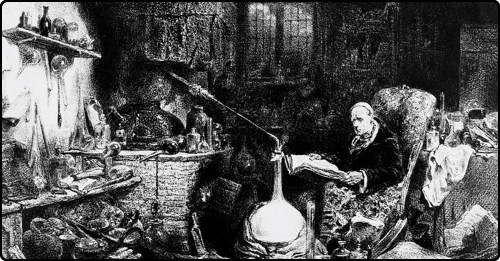
The April 14, 1849 edition of The Flag of Our Union contained an article titled "Von Kempelen and his Discovery." It described the discovery by a German chemist, Baron Von Kempelen, of an alchemical process to transform lead into gold. The account concluded by noting that news of the discovery had already caused a two hundred per cent leap in the price of lead in Europe.
The story was fictional, although this was not indicated anywhere. Its author was Edgar Allan Poe. He had evidently hoped that the tale might deter some of the "forty-niners" who were heading off to California in search of gold that had recently been discovered there.
Poe wrote to Evert A. Duyckinck, "My sincere opinion is that nine persons out of ten (even among the best informed) will believe the quiz (provided the design does not leak out before publication) and that thus, acting as a sudden, although of course a very temporary, check to the gold-fever, it will create a stir to some purpose."
Despite Poe's confidence in his creation, there is no evidence many people were taken in by this hoax.
The story was fictional, although this was not indicated anywhere. Its author was Edgar Allan Poe. He had evidently hoped that the tale might deter some of the "forty-niners" who were heading off to California in search of gold that had recently been discovered there.
Poe wrote to Evert A. Duyckinck, "My sincere opinion is that nine persons out of ten (even among the best informed) will believe the quiz (provided the design does not leak out before publication) and that thus, acting as a sudden, although of course a very temporary, check to the gold-fever, it will create a stir to some purpose."
Despite Poe's confidence in his creation, there is no evidence many people were taken in by this hoax.
| More from the Hoax Museum Archives: | |||
Submit a Comment
Note: Comments by non-members are all checked by a moderator before appearing on the site. This may take a while.
![]()
All text Copyright © 2011 by Alex Boese, except where otherwise indicated. All rights reserved.