The Museum of Hoaxes
HOME   |   ABOUT   |   FORUM   |   CONTACT   |   PINTEREST   |   FACEBOOK   |   TWITTER   |   RSS
The Archive of Hoaxes Before 1700 1700-1799 1800-1868 1869-1913 1914-1949 1950-1976 1977-1989 1990-1999 21st Century
Sub-Archives   Hoax Photo Archive April Fools Archive Tall-Tale Creature Archive
Student Pranks
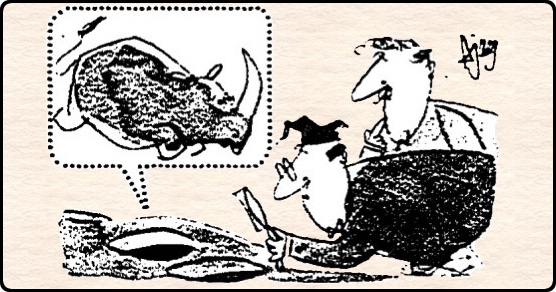
After a heavy snowfall, the footprints of a large animal were found on the campus of Cornell University, leading up to the shore of the frozen Beebe Lake. A hole in the ice indicated that the animal must have fallen in and drowned.

A zoologist examined the tracks and identified them as those of a rhinoceros. Word of the rogue rhinoceros spread around town, and since the University got its water supply from the lake, many students declared they were no longer going to drink the water. Many of those who did drink it, swore they could taste rhinoceros.

The tracks turned out to be the work of Cornell student Hugh Troy. He and a friend had borrowed a rhino-foot wastepaper basket from a professor's house. They had weighted it down with scrap metal then attached it to a clothesline. Holding the clothesline at either end, they made their way across campus, creating a trail of tracks in the snow up to the edge of the lake.

The rhinoceros footprints are one of the most famous pranks in Cornell's history. However, there is no documentation to prove that the prank happened. Therefore, some suggest it may only be a legend.
Hugh Troy (1906-1964)
By trade Hugh Troy (1906-1964) was an artist. He illustrated many children's books, including "Maude for a Day," "The Chippendale Dam," and "Five Golden Wrens." But by nature he was a practical joker, with numerous pranks to his credit. When asked once what advice he would give to aspiring practical jokers, he replied that one should never sit down and try to deliberately think up a practical joke. This was a sure way to arrive at uninspired ideas. Instead, a prankster needs to seize the moment, grabbing opportunities as they arise. More→
Hugo N. Frye (May 1930)
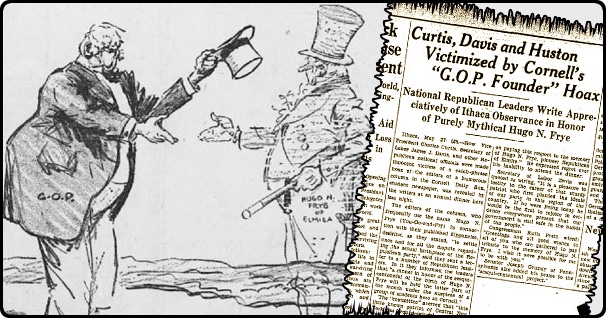
In 1930 Republican leaders throughout the United States received letters inviting them to a May 26 party at Cornell University in honor of the sesquicentennial birthday anniversary of Hugo Norris Frye, aka Hugo N. Frye. The letter explained that Hugo N. Frye had been one of the first organizers of the Republican party in New York State. None of the politicians could make it to the event, but almost all of them replied, expressing sincere admiration for Frye and their regret at not being able to attend.

Unfortunately for the Republican leaders who responded, Hugo N. Frye did not exist. He was the satirical creation of two student editors at the Cornell Sun. Hugo N. Frye was shorthand for "You go and fry!" More→

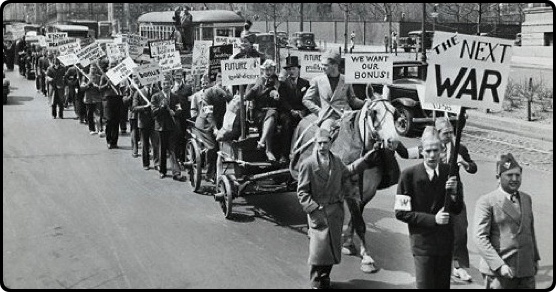
Future veterans march to demand their bonuses
In 1935 veterans of World War One lobbied Congress to pay them their war bonuses ten years early in order to ease the economic hardship they were experiencing during the Great Depression. Congress readily acquiesced and passed the Harrison Bonus Bill in January 1936.

This pre-payment was a source of inspiration for Lewis Gorin, a senior at Princeton University. It seemed logical to him that if present-day veterans could get their war bonuses early, why shouldn't future veterans also receive their money up-front — before they had fought in a war. After all, given the global political situation, it seemed inevitable to Gorin that all the young men in the country would soon have to go off to fight. Why shouldn't these future veterans be given their money now, while they could still enjoy it, instead of having to wait until after the conflict, when they might be dead? More→

Route of the 1956 Olympic torch relay, from Cairns to Melbourne.
In 1956 runners bore the Olympic flame across Australia, on a path from Cairns to Melbourne, where the summer games were to be held. But before the flame even got as far as Sydney, it had to endure a series of setbacks. Torrential rains soaked it. Burning heat almost overwhelmed the runners. The flame even went out a few times. Then in Sydney itself it encountered a situation unique in Olympic history.

Cross-country champion Harry Dillon was scheduled to bear the flame into Sydney, where he would present it to the mayor, Pat Hills. After making a short speech, Hills would pass the flame along to another runner, Bert Button.

Thirty-thousand people lined the streets of Sydney waiting for Dillon to arrive. Reporters stood ready with their cameras to record the historic occasion. Finally the runner appeared, bearing the flame aloft, and everyone began cheering. As the crowd pressed forward a police escort surrounded the runner in order to keep order.

With this escort around him, the runner made his way through the streets all the way to the Sydney Town Hall. He bounded up the steps and handed the torch to the waiting mayor who graciously accepted it and turned to begin his prepared speech.

Then someone whispered in the mayor's ear, "That's not the torch." Suddenly the mayor realized what he was holding. Held proudly in his hand was not the majestic Olympic flame. Instead he was gripping a wooden chair leg topped by a plum pudding can inside of which a pair of kerosene-soaked underwear was burning with a greasy flame. The mayor looked around for the runner, but the man had already disappeared, melting away into the surrounding crowd. More→
The 1959 city council election in Sao Paulo, Brazil had a surprise winner: Cacareco, a five-year-old female rhinoceros at the local zoo. Not only did she win, but she did so by a landslide, garnering 100,000 votes (15% of the total). This was one of the highest totals for a local candidate in Brazil's history to that date. More→

Caltech student Becky Hartsfield shows off the prizes she won.
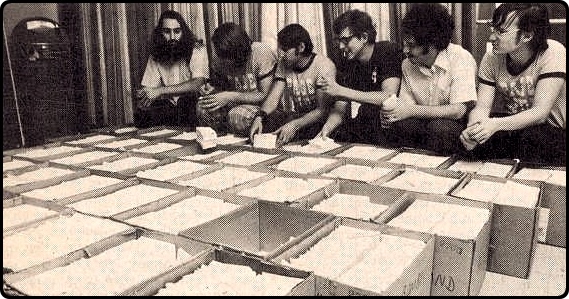
Caltech is known for producing world-class scientists and engineers. But a few of its students have also demonstrated a flair for the law, as a highly controversial 1975 prank that turned on the legalistic reading of a sweepstakes entry form proved.

The sweepstakes in question was held by McDonald's. It ran from March 3rd to March 23rd, 1975, at 187 participating McDonald's restaurants in Southern California. The prizes included a year of groceries, a Datsun Z, McDonald's gift certificates, and cash. But one part of the contest rules caught the attention of three Caltech students who lived in Page House — Steve Klein, Dave Novikoff, and Barry Megdal. The part they noticed was the phrase "Enter as often as you wish." What if, the Caltech students wondered, a person entered the sweepstakes one million times? More→
The Donside Paper Company had for years sponsored an annual contest for graphic design students. In 2000, to spice things up a bit, the company decided to give its contest a slightly different spin. Entrants were challenged to respond to one of three briefs: 1) to promote the Bermuda Triangle as a holiday destination; 2) to design a welcome pack for a shopaholics' association; or 3) to tell a lie convincingly.

The competition seemed to be going well, and many entries had already been received, when the participating colleges received a letter on Donside stationery explaining that the contest had regrettably been cancelled. Obediently, the schools began to turn away new entries. In a panic, Donside called to ask what they were doing, and only then did the schools realize their mistake. The cancellation letter had itself been an entry from a contestant who had taken the challenge to "tell a lie convincingly" to heart. Hundreds of letters and phone calls were required to rectify the situation. However, the colleges took it all in stride. One of them commented, "Isn't it funny — it's the ultimate lie." More→
All text Copyright © 2011 by Alex Boese, except where otherwise indicated. All rights reserved.