The Museum of Hoaxes
HOME   |   ABOUT   |   FORUM   |   CONTACT   |   PINTEREST   |   FACEBOOK   |   TWITTER   |   RSS
Eras: 0-1699 1700s 1800-1868 1869-1913 1914-1949 1950-1976 1977-1989 1990s 2000s
Photography Hoaxes
In 1861 William Mumler was working as a jewelry engraver in Boston and dabbling in photography on the side. One day, after developing a self-portrait, he noticed what appeared to be the shadowy figure of a young girl floating beside his own likeness. Mumler assumed it was an accident, the trace of an earlier negative made with the same plate, but friends told him the figure resembled his dead cousin. Soon the unusual photo came to the attention of the spiritualist community, who proclaimed it to be the first photo ever taken of a spirit. Mumler didn't argue with them. Instead he took advantage of the interest in the photo to go into business as the world's first spirit photographer. He grew wealthy producing spirit photos for grief-stricken clients who had lost relatives in the Civil War. More→
Joseph B. Swan was proud of his potatoes. On his farm outside Loveland, Colorado, in the late nineteenth century, he grew 26,000 pounds of potatoes in one year on a single acre of land. He also claimed to have grown a giant potato that weighed 13lbs 8oz. W.L. Thorndyke, editor of the Loveland Reporter, came up with an idea to help Swan promote his spuds at an 1894 street fair. Thorndyke's idea was to create a hoax photograph of Swan showing off a truly massive potato — one as large as a boulder. He suggested Swan could pass around copies of the photo as a tongue-in-cheek advertisement. To make the photo, Swan and Thorndyke enlisted the services of photographer Adam H. Talbot. Talbot took a photo of a potato and enlarged it to mammoth size. He then cut out a wooden board the size and shape of this enlarged image and he attached the photograph to the board. Finally, he posed Swan holding this giant faux-potato on his shoulder... More→
In 1920 a series of photos of fairies captured the attention of the world. The photos had been taken by two young girls, the cousins Frances Griffith and Elsie Wright, while playing in the garden of Elsie's Cottingley village home. Photographic experts examined the pictures and declared them genuine. Spiritualists promoted them as proof of the existence of supernatural creatures, and despite criticism by skeptics, the pictures became among the most widely recognized photos in the world. It was only decades later, in the late 1970s, that the photos were definitively debunked. More→
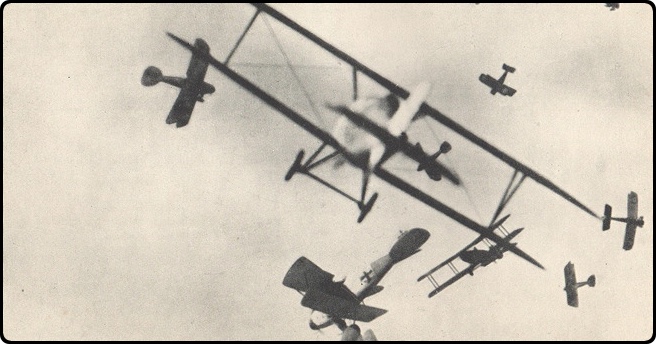
A book called Death in the Air: The War Diary and Photographs of a Flying Corps Pilot was published in 1933. It contained numerous pages of spectacular aerial photographs of World War One dogfights supposedly taken by a pilot in the Royal Air Force. Since very few photos of aerial fighting had been taken by the military, the photographs caused a great sensation. Interest in them grew even greater when they were exhibited at galleries in New York and Philadelphia. It wasn't until 1984 that the photos were discovered to be fake.
In 1933 a picture supposedly showing Adolf Hitler as a baby began circulating throughout England and America. The child in the picture looked positively menacing. Its fat mouth was twisted into a sneer, and it scowled at the camera from dark, squinted eyes. A greasy mop of hair fell over its forehead. More→
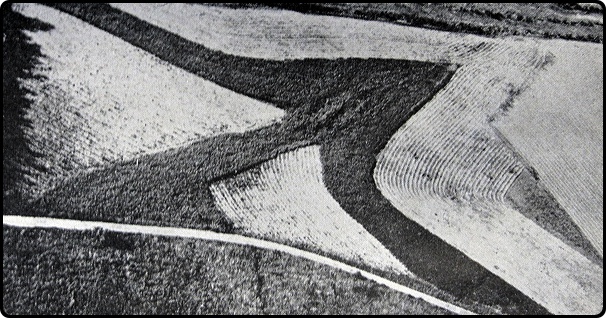
On August 10, 1942 the U.S. Army's public-relations office issued a press release warning the public of "secret markers" that had been found on farm fields throughout the eastern United States. These markers were patterns formed by the arrangement of fertilizer sacks or the way a field had been tilled. From the ground they looked like nothing, but from the air they formed the shape of arrows, apparently created by Nazi sympathizers in order to guide enemy bombers toward military factories and airfields.

The Army simultaneously released three pictures showing these markers. But a few days later it was discovered that the "secret markers" were really just random patterns of no military significance, a fact the Army had known for months. More→
The Stuart Photograph (July 14, 1951)
On July 14, 1951, Forestry Commission employee Lachlan Stuart took a picture of mysterious humps rising from the loch. Over twenty years later researchers visited the spot where he had taken the picture and realized the humps would have been in extremely shallow water close to the shore, meaning that Stuart's monster must have been awfully flat. Confirming their suspicions, author Richard Frere later revealed that Stuart had confessed to him the humps were nothing more than bales of hay covered with tarpaulins.
The MacNab Photograph (July 29, 1955)
July 29, 1955: Bank manager Peter MacNab snapped a photo of something large moving through the water of the loch near Urquhart Castle. But when researcher Roy Mackal studied the photo, he discovered differences between the negative of the image and the print that MacNab had originally shown to the media. Specifically, there was more of the image in the print than there was in the negative (the tree at the bottom left is missing from the negative). This led him to conclude that the "negative" had been created by re-photographing a print. In other words, it was clear that the image had been doctored.
The Flipper Photo (August 7, 1972)
August 7, 1972: An expedition to find Nessie led by Dr. Robert Rines of the Academy of Applied Science struck gold when its underwater camera took a picture of what appeared to be the flipper of a large aquatic animal resembling a plesiosaur. However, the relatively clear image of a flipper shown to the public was not quite what the camera had initially recorded. The initial image was far less distinct. (It basically looked like a shot of a bunch of bubbles or sediment in the water.) This initial picture was then computer enhanced by the NASA Jet Propulsion Laboratories in Pasadena, and apparently the computer-enhanced image was further artistically enhanced by the Academy of Applied Science team (i.e. it was retouched), thereby producing the final flipper photo. Modern image-enhancement software has not been able to conjure anything resembling a flipper from the original image.
May 21, 1977: Anthony 'Doc' Shiels claimed that he took this picture while camping beside Urquhart Castle. Its startling clarity (it's probably the clearest picture of Nessie ever taken) has made it popular with the public. But it's hard to find any expert willing to take it seriously, simply because the creature depicted in it looks so obviously fake. (And it's odd that there are no ripples in the water around the neck.) Skeptics refer to Shiels's monster as "The Loch Ness Muppet." The fact that Shiels was a showman, "wizard," and psychic entertainer who was developing a side business as a professional monster hunter didn't help his credibility. Shiels himself commented that while he definitely took photos of lake monsters, he didn't believe in them.
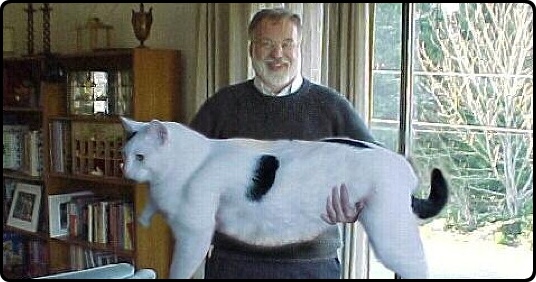
Snowball the Monster Cat, 2000 (Admitted to in May 2001)
Washington-state resident Cordell Hauglie owned a fat family cat named Jumper. As a joke, he created a picture of himself holding a digitally enlarged version of this cat. He emailed the photo to his daughter, and thought nothing more of it. What he didn't realize is that the image then began spreading around the internet, where it became an online sensation. More→
Tourist Guy, 2001 (Week following September 11, 2001)
Soon after September 11, 2001, a sensational photo began circulating via email. It showed a tourist posing for a snapshot on top of the World Trade Center as a hijacked plane approached from behind. An accompanying caption explained that the photo came from a camera found in the rubble of the world trade center. Apparently the photo had been taken just seconds before disaster struck. More→
In March 2004, a photo circulated online showing an American soldier posing with two Iraqi boys. One of the boys was holding a sign that read, "Lcpl Boudreaux killed my Dad, then he knocked up my sister!" The Council on American-Islamic Relations saw the picture and complained to the Pentagon about it. The photo also received coverage in publications such as Islam Online. But it turned out that there were multiple versions of the photo in circulation. In another version the sign read "Lcpl Boudreaux saved my dad then he rescued my sister," and in yet another version the sign read "Lcpl Boudreaux killed my Dad, then all your Base are Belong to us." Obviously the sign was being digitally manipulated, but which was the real version? Eventually the Marine Corps opened an investigation to answer this question. The results of this investigation were not publicly released. Lance Corporal Boudreaux himself insisted that the sign originally read 'Welcome Marines'.
image On May 1, 2004 the British Daily Mirror published pictures of Iraqi prisoners allegedly being tortured by British soldiers. The photos generated immediate controversy, as critics pointed out many features of them that seemed suspicious. First of all, they looked posed. The 'prisoners' did not appear to be injured or even sweating. And the British soldiers were wearing incorrect uniforms and driving vehicles not deployed in Iraq. Two weeks later the Daily Mirror admitted it had been duped and fired its editor, Piers Morgan.
All text Copyright © 2011 by Alex Boese, except where otherwise indicated. All rights reserved.