About This Page
This page is part of the Hoax Archive, a collection of history's most interesting and notorious deceptions categorized by theme and time period.
Hoax Archive Categories
Hoax Museum Archives
Military Hoaxes
![]() |
The Filipino Monkey (January 2008) |
|
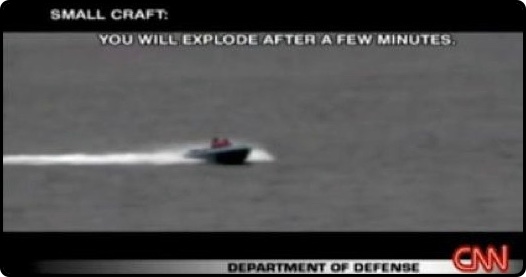
In January 2008 five Iranian speedboats approached three U.S. Warships in the Persian Gulf. The U.S. warships attempted to contact the Iranians: "This is coalition warship. I am engaged in transit passage in accordance with international law. I maintain no harm. Over!" A radio operator on one of the U.S. warships then heard a voice reply, "I am coming to you... You will explode in... minutes." At first the U.S. warships believed this message to be coming from the Iranian speedboats. However, it has since been argued that the mysterious threatening message probably came from a "Filipino Monkey" prankster.
More >>>
| |
![]() |
The Daily Mirror’s Hoax Photos (May 2004) |
On May 1, 2004 the British Daily Mirror published pictures of Iraqi prisoners allegedly being tortured by British soldiers. The photos generated immediate controversy, as critics pointed out many features of them that seemed suspicious. First of all, they looked posed. The 'prisoners' did not appear to be injured or even sweating. And the British soldiers were wearing incorrect uniforms and driving vehicles not deployed in Iraq. Two weeks later the Daily Mirror admitted it had been duped and fired its editor, Piers Morgan.
Categories: Military Hoaxes, Hoaxes in Newspapers and Magazines, Photography Hoaxes, Hoaxes That Fooled Journalists, 2009-2000
| |
![]() |
Lcpl. Boudreaux’s Sign (March 2004) |
In March 2004, a photo circulated online showing an American soldier posing with two Iraqi boys. One of the boys was holding a sign that read, "Lcpl Boudreaux killed my Dad, then he knocked up my sister!" The Council on American-Islamic Relations saw the picture and complained to the Pentagon about it. The photo also received coverage in publications such as Islam Online. But it turned out that there were multiple versions of the photo in circulation. In another version the sign read "Lcpl Boudreaux saved my dad then he rescued my sister," and in yet another version the sign read "Lcpl Boudreaux killed my Dad, then all your Base are Belong to us." Obviously the sign was being digitally manipulated, but which was the real version? Eventually the Marine Corps opened an investigation to answer this question. The results of this investigation were not publicly released. Lance Corporal Boudreaux himself insisted that the sign originally read 'Welcome Marines'.
| |
![]() |
Report From Iron Mountain (October 1967) |
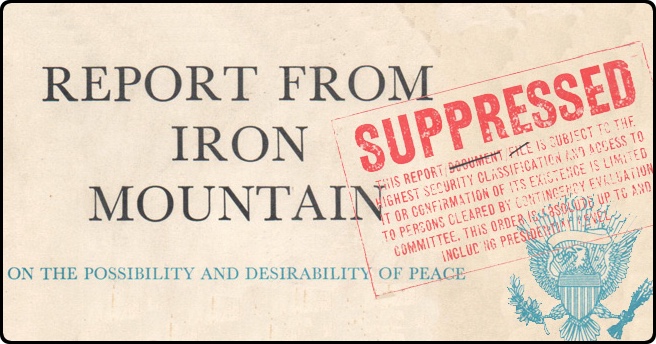
![]() Front cover of Report From Iron Mountain. Leonard C. Lewin, a New York freelance writer, wrote the introduction to the book. He explained that the report had been compiled by 15 experts known as the Special Study Group (SSG) who had been brought together by the U.S. government. The SSG had first met in 1963 at a secret "underground nuclear hideout" called Iron Mountain. They had then held periodic meetings during the next two and a half years to discuss the problems that would confront the United States if it entered into a period of permanent peace. According to Lewin, one of the experts ("John Doe") who was identified as a professor of social science at a 'large Middle Western University,' had decided to release the report to the public. The report, in language full of think-tank jargon, documented the conclusions of the Special Study Group concerning whether peace was possible, given the economic condition of the world. The SSG decided that peace "would almost certainly not be in the best interest of stable society." War, they argued, was simply too important a part of the world economy, and therefore it was necessary to continue a state of war indefinitely... More >>> | |
![]() |
The Flypaper Report (circa 1943) |
During World War II, the illustrator Hugh Troy was given a desk job stateside. He found it excruciatingly boring. So to amuse himself he began preparing Daily Flypaper Reports in the style of standard army regulations. These were counts, printed on official-looking paper, of all the flies trapped on flypaper in the mess hall during the last twenty-four hours. He analyzed the results according to wind direction, nearness to windows, nearness to the kitchen, length of the flypaper, etc. He then would mimeograph the report and slip it in among the other official forms submitted to headquarters each day.After keeping this up for a month, he received a call from an officer in another comapny: "Lieutenant, Can you tell me the proper procedure for filing fly reports? We've been catching hell from the Pentagon for not sending them in." | |
![]() |
Operation Mincemeat (1943) |
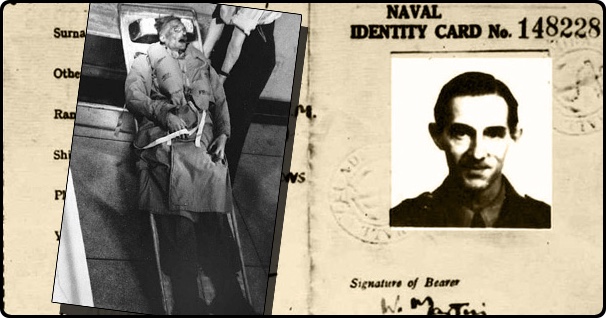
In 1943 the body of a British officer, Major William Martin, was discovered off the coast of Spain, near Huelva. British diplomats strongly requested that all documents found with the body be returned to them, and the Spanish government eventually complied. But upon examination, it was obvious the documents had been opened and read before their return. This was exactly what the British had hoped would happen, because Major Martin did not exist. He was part of a military hoax, codenamed Operation Mincemeat, designed to fool the Germans. The British military had obtained a cadaver, chained a briefcase containing supposedly top-secret papers to its wrist, and dropped it in the sea off the coast of Spain. The plan was that the Germans, via the Spanish, would find the body and read the fake papers. The papers stated that the Allies' planned invasion of southern Europe would begin with an attack on Greece and Sardinia. In reality, the Allies planned to attack Sicily first. The hoax was successful. When the Allies launched their offensive on Sicily, most of the heavy German equipment had been moved to defend these other locations. Ewen Montagu, the British officer who devised the operation, later wrote a book about it titled The Man Who Never Was. The book was subsequently made into a movie. | |
![]() |
The Nazi Air Marker Hoax (August 1942) |
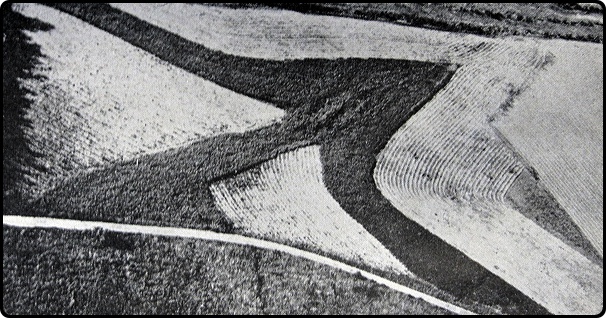
On August 10, 1942 the U.S. Army's public-relations office issued a press release warning the public of "secret markers" that had been found on farm fields throughout the eastern United States. These markers were patterns formed by the arrangement of fertilizer sacks or the way a field had been tilled. From the ground they looked like nothing, but from the air they formed the shape of arrows, apparently created by Nazi sympathizers in order to guide enemy bombers toward military factories and airfields.The Army simultaneously released three pictures showing these markers. But a few days later it was discovered that the "secret markers" were really just random patterns of no military significance, a fact the Army had known for months. More >>> | |
![]() |
The Veterans of Future Wars (1935-1937) |
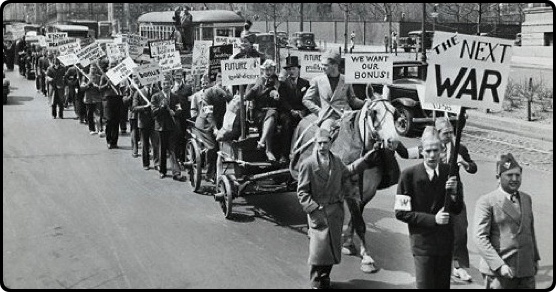
![]() Future veterans march to demand their bonuses This pre-payment was a source of inspiration for Lewis Gorin, a senior at Princeton University. It seemed logical to him that if present-day veterans could get their war bonuses early, why shouldn't future veterans also receive their money up-front before they had fought in a war. After all, given the global political situation, it seemed inevitable to Gorin that all the young men in the country would soon have to go off to fight. Why shouldn't these future veterans be given their money now, while they could still enjoy it, instead of having to wait until after the conflict, when they might be dead? More >>> | |
![]() |
|
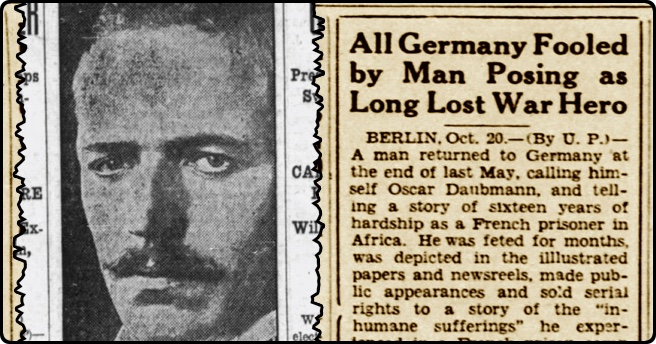
![]() Alfred Hummel as Oscar Daubmann Daubmann told a dramatic tale of imprisonment and escape. He said he had been captured by the French in October 1916 at the Battle of the Somme and was placed in a prison camp. After killing a guard during an unsuccessful escape attempt, he was sentenced to 20 years hard labor and transferred to Algeria. There he was tortured, starved, and kept in solitary confinement. Finally, years later, he was transferred to the prison tailor shop on account of good behavior, and from there was able to make a successful escape. He walked 3000 miles along the coast and was picked up by an Italian steamer that took him to Naples. He then returned to Germany. More >>> Categories: Hoaxes involving false or disguised identity, Imposters, Military Hoaxes, Phony Veterans, 1939-1930
| |
![]() |
The Dreadnought Hoax (February 7, 1910) |
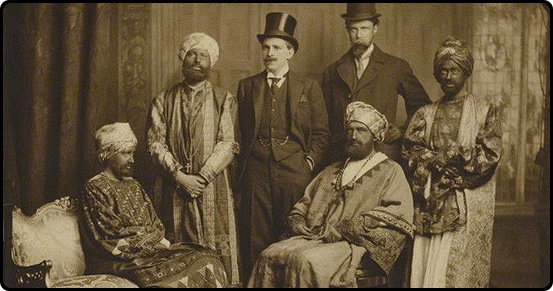
![]() "The Emperor of Abyssinia" and his suite From left to right: Virginia Stephen (Virginia Woolf), Duncan Grant, Horace Cole, Anthony Buxton (seated), Adrian Stephen, Guy Ridley. | |
![]() |
The Captain of Köpenick (October 16, 1906) |
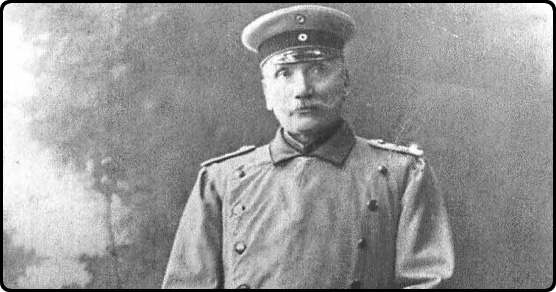
On October 16, 1906, an out-of-work German shoemaker named Wilhelm Voigt donned a second-hand military captain's uniform he had bought in a store, walked out into the street, and assumed control of a company of soldiers marching past. He led them to the town hall of Köpenick, a small suburb of Berlin, arrested the mayor and the treasurer on charges of embezzlement, and took possession of 4,000 marks from the town treasury. He then disappeared with the money. The incident became famous as a symbol of the blind obedience of German soldiers to authority even fake authority.The police tracked him down nine days later, and he was sentenced to four years in jail. But he proved to be such a likable character (and popular hero) that the Kaiser pardoned Voigt after he had served less than two years. Voigt subsequently pursued a career in show business, where he entertained audiences by re-enacting his stunt on the stage. | |
![]() |
Hearst: I’ll Furnish the War (Supposedly said January 1897) |
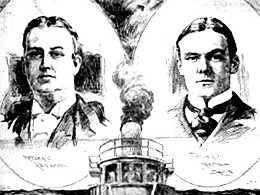
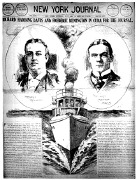
William Randolph Hearst, owner of the New York Journal, had a reputation for never letting truth get in the way of a good story. According to one famous tale, when hostilities broke out between the Spanish and the Cubans, Hearst sent the illustrator Frederic Remington to Cuba to draw pictures of the conflict. Finding that not much was happening, Remington cabled Hearst in January 1897: "Everything is quiet. There is no trouble here. There will be no war. I wish to return."Supposedly Hearst cabled back: "Please remain. You furnish the pictures and I'll furnish the war." It is doubtful Hearst ever sent such a telegram. The first report of it appeared in a 1901 book, On the Great Highway, by journalist James Creelman. Creelman was in Europe at the time the telegram was supposedly sent, so he either heard the story second-hand or invented it himself. Since he was known for exaggeration, the latter is likely. Hearst himself denied having sent such a telegram. Categories: Controversial Hoaxes (maybe they're a hoax, maybe they're not), Media Hoaxes, Hoaxes by Journalists, Military Hoaxes, Hoaxes in Newspapers and Magazines, 1899-1850
| |
![]() |
The Case of the Miraculous Bullet (November 1874) |
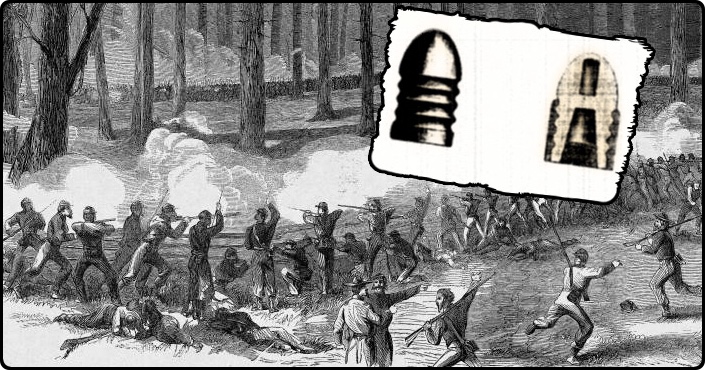
In November 1874 an unusual article appeared in the introductory volume of The American Medical Weekly, a Louisville medical journal. It was written by Dr. LeGrand G. Capers and was titled, "Attention Gynaecologists!Notes from the Diary of a Field and Hospital Surgeon, C.S.A." In the article Dr. Capers recounted an unusual case of artificial insemination he had witnessed on a Civil War battlefield in Mississippi, in which a bullet had passed through a soldier's testicles, and then traveled on before hitting a woman and impregnating her. The event was said to have occurred on May 12, 1863 at around 3 p.m. at the "battle of R." (battle of Raymond), where "Gen. G's brigade" (Brigadier General John Gregg) of the Confederate forces fought Grant's army led by "Gen. L." (Major General John A. Logan).
More >>> | |
![]() |
John Howe, British Spy (1827) |
|
In 1827 a Massachusetts printer named Luther Roby published The Journal Kept by Mr. John Howe while He Was Employed as a British Spy. It told the story of John Howe, a man said to have been a British spy during the Revolutionary war before switching sides to become an American soldier, then a settler, a frontier trader, an Indian preacher, and finally a smuggler.
Howe was long accepted as an actual historical figure. As late as 1976, the historian Robert Gross referred to Howe in The Minutemen and Their World as a "quick-thinking English civilian-spy." The 1983 biographical dictionary American Writers Before 1800 contained an entry about Howe. But the writer of the 1983 biographical entry, Daniel Williams, realized, upon investigation, that Howe was fictitious and exposed the hoax, 165 years after it had been perpetrated. Williams concluded that Roby (or someone he hired to do the writing) had created the character of Howe based on a real figure, Ensign Henry DeBerniere, who had spied for General Gage. Roby essentially Americanized the character of DeBerniere, making him craftier and more representative of the American ideal of the self-made man. Roby's motive was probably financial. He recognized that readers would be more interested in the adventures of a supposedly real Revolutionary war hero than a fictional one. | |
![]() |
|
In 1782 a shocking letter was printed in the Supplement to the Boston Independent Chronicle. It alleged that Indian warriors were sending hundreds of American scalps as war trophies to British royalty and Members of Parliament. The scalps included those of women, as well as young girls and boys.Soon the letter had crossed the Atlantic and began to circulate throughout Europe, where it shocked European public opinion. But in fact, the British had not received scalps from any Indians. The Supplement to the Boston Independent Chronicle was a fake newspaper which Benjamin Franklin had printed and distributed to his friends. Franklin intended his hoax to aid the American war effort by turning European opinion against the British. Categories: Terror and Hate Crime Hoaxes, Military Hoaxes, Hoaxes in Newspapers and Magazines, Outrage Hoaxes, Hoaxes by Journalists, The Hoaxes of Benjamin Franklin, 1799-1700
| |
|
Page 1 of 1 pages
|


On May 1, 2004 the British Daily Mirror published pictures of Iraqi prisoners allegedly being tortured by British soldiers. The photos generated immediate controversy, as critics pointed out many features of them that seemed suspicious. First of all, they looked posed. The 'prisoners' did not appear to be injured or even sweating. And the British soldiers were wearing incorrect uniforms and driving vehicles not deployed in Iraq. Two weeks later the Daily Mirror admitted it had been duped and fired its editor, Piers Morgan.
In March 2004, a photo circulated online showing an American soldier posing with two Iraqi boys. One of the boys was holding a sign that read, "Lcpl Boudreaux killed my Dad, then he knocked up my sister!" The Council on American-Islamic Relations saw the picture and complained to the Pentagon about it. The photo also received coverage in publications such as Islam Online. But it turned out that there were multiple versions of the photo in circulation. In another version the sign read "Lcpl Boudreaux saved my dad then he rescued my sister," and in yet another version the sign read "Lcpl Boudreaux killed my Dad, then all your Base are Belong to us." Obviously the sign was being digitally manipulated, but which was the real version? Eventually the Marine Corps opened an investigation to answer this question. The results of this investigation were not publicly released. Lance Corporal Boudreaux himself insisted that the sign originally read 'Welcome Marines'.

During World War II, the illustrator Hugh Troy was given a desk job stateside. He found it excruciatingly boring. So to amuse himself he began preparing Daily Flypaper Reports in the style of standard army regulations. These were counts, printed on official-looking paper, of all the flies trapped on flypaper in the mess hall during the last twenty-four hours. He analyzed the results according to wind direction, nearness to windows, nearness to the kitchen, length of the flypaper, etc. He then would mimeograph the report and slip it in among the other official forms submitted to headquarters each day.
In 1943 the body of a British officer, Major William Martin, was discovered off the coast of Spain, near Huelva. British diplomats strongly requested that all documents found with the body be returned to them, and the Spanish government eventually complied. But upon examination, it was obvious the documents had been opened and read before their return. This was exactly what the British had hoped would happen, because Major Martin did not exist. He was part of a military hoax, codenamed Operation Mincemeat, designed to fool the Germans.
On August 10, 1942 the U.S. Army's public-relations office issued a press release warning the public of "secret markers" that had been found on farm fields throughout the eastern United States. These markers were patterns formed by the arrangement of fertilizer sacks or the way a field had been tilled. From the ground they looked like nothing, but from the air they formed the shape of arrows, apparently created by Nazi sympathizers in order to guide enemy bombers toward military factories and airfields.


On October 16, 1906, an out-of-work German shoemaker named Wilhelm Voigt donned a second-hand military captain's uniform he had bought in a store, walked out into the street, and assumed control of a company of soldiers marching past. He led them to the town hall of Köpenick, a small suburb of Berlin, arrested the mayor and the treasurer on charges of embezzlement, and took possession of 4,000 marks from the town treasury. He then disappeared with the money. The incident became famous as a symbol of the blind obedience of German soldiers to authority even fake authority.
William Randolph Hearst, owner of the New York Journal, had a reputation for never letting truth get in the way of a good story. According to one famous tale, when hostilities broke out between the Spanish and the Cubans, Hearst sent the illustrator Frederic Remington to Cuba to draw pictures of the conflict. Finding that not much was happening, Remington cabled Hearst in January 1897: "Everything is quiet. There is no trouble here. There will be no war. I wish to return."
In November 1874 an unusual article appeared in the introductory volume of The American Medical Weekly, a Louisville medical journal. It was written by Dr. LeGrand G. Capers and was titled, "Attention Gynaecologists!Notes from the Diary of a Field and Hospital Surgeon, C.S.A." In the article Dr. Capers recounted an unusual case of artificial insemination he had witnessed on a Civil War battlefield in Mississippi, in which a bullet had passed through a soldier's testicles, and then traveled on before hitting a woman and impregnating her. The event was said to have occurred on May 12, 1863 at around 3 p.m. at the "battle of R." (battle of Raymond), where "Gen. G's brigade" (Brigadier General John Gregg) of the Confederate forces fought Grant's army led by "Gen. L." (Major General John A. Logan).
In 1782 a shocking letter was printed in the Supplement to the Boston Independent Chronicle. It alleged that Indian warriors were sending hundreds of American scalps as war trophies to British royalty and Members of Parliament. The scalps included those of women, as well as young girls and boys.