The Museum of Hoaxes
HOME   |   ABOUT   |   FORUM   |   CONTACT   |   PINTEREST   |   FACEBOOK   |   TWITTER   |   RSS
Eras: 0-1699 1700s 1800-1868 1869-1913 1914-1949 1950-1976 1977-1989 1990s 2000s
Hoaxes That Caused Mass Panic
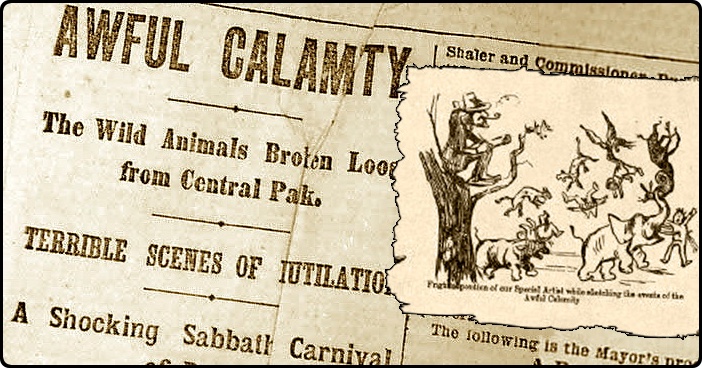
On November 9, 1874 the New York Herald published a front-page article claiming that the animals had escaped from their cages in the Central Park Zoo and were rampaging through the city. A lion had been seen inside a church. A rhinoceros had fallen into a sewer. The police and national guard were heroically battling the beasts, but already forty-nine people were dead and two hundred injured. It was "a bloody and fearful carnival," the article despaired. And the animals were still on the loose!

Many readers panicked when they read the article. However, those who did so hadn't read to the end of the article, where it stated (in rather small print), "the entire story given above is a pure fabrication." More→
rodman law
F. Rodman Law
Frederick Rodman Law (1885-1919) was a well-known daredevil active in the early 20th century. His stunts included parachuting from the top of the Statue of Liberty and jumping off the Brooklyn Bridge. In late April 1912, he requested permission to parachute from the top of the Washington Monument, but he was turned down. However, on May 7, 1912, a pedestrian standing on the corner of Fourteenth and F streets exclaimed that Law appeared to be scaling the monument without permission — and was already a third of the way up.

The pedestrian drew attention to a dark figure on the side of the monument. Soon a huge crowd, numbering in the hundreds, had gathered to watch the feat. For well over an hour people stared and squinted at the figure. Many members of Congress came out of their offices to witness the event, as did officials from the State and Treasury departments and many newspaper reporters. But when the police arrived at the base of the monument to apprehend Law when he came down, they realized that what had resembled a human figure from a distance was actually a damp spot on the side of the monument caused by the previous night's rain. The pedestrian who had originally called attention to the spot had, by that time, disappeared. More→
The BBC Radio Panic, 1926 (January 16, 1926)
On 16 January 1926, BBC Radio interrupted a broadcast of a speech from Edinburgh to give a special announcement: an angry mob of unemployed workers were running amok in London, looting and destroying everything in sight. Listeners were stunned. Anxiously they gathered around their radios to hear the frightening news. They heard that the National Gallery had been sacked and the Savoy Hotel blown up. The alarming reports continued with news that the Houses of Parliament were being attacked with trench mortars. More→
The War of the Worlds, 1938 (October 30, 1938)
On October 30, 1938, thousands of people fled in panic after hearing CBS Radio report that Martian invaders had landed in New Jersey and were marching across the country, using heat rays and poisonous gas to kill Earthlings. But as soon became clear, Martians hadn't really invaded New Jersey. What people had heard (and mistook for a real news broadcast) was a radio version of H.G. Wells's story The War of the Worlds, performed by Orson Welles and the Mercury Theater. More→
The Sibuxiang Beast, 1994 (September 1994)
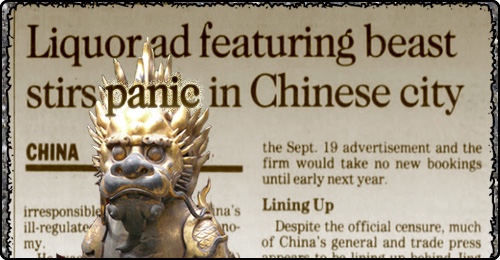
On the evening of September 19, 1994 a stark warning was repeatedly broadcast to TV viewers in Taiyuan, a city in northern China. A message scrolled across an otherwise blank screen warning that the Sibuxiang beast, a mythical creature whose bite was said to be fatal, was not only real, but on the loose and heading towards the city. "It is said that the Sibuxiang is penetrating our area from Yanmenguan Pass and within days will enter thousands of homes," the message read. "Everyone close your windows and doors and be on alert."

The residents of Taiyuan panicked. Many of them barricaded themselves inside their homes, fearing to go out. Others called the local authorities to find out what was happening... More→
All text Copyright © 2011 by Alex Boese, except where otherwise indicated. All rights reserved.