
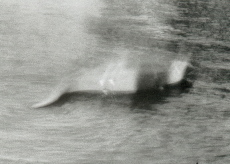
 On November 12, 1933, Hugh Gray was walking back from church along the shore of Loch Ness when, so he later claimed, he saw an "object of considerable dimensions—making a big splash with spray on the surface" of the Loch. Luckily he had his camera with him, so he began snapping pictures. Only one of the pictures showed anything. Nessie believers hailed it as the first photographic evidence of the monster. Skeptics, however, dismissed it as a blurry mess that doesn't show anything at all. Many have suggested that it looks like a distorted image of a dog (perhaps Mr. Gray's own) carrying a stick in its mouth as it swims through water.
More…
On November 12, 1933, Hugh Gray was walking back from church along the shore of Loch Ness when, so he later claimed, he saw an "object of considerable dimensions—making a big splash with spray on the surface" of the Loch. Luckily he had his camera with him, so he began snapping pictures. Only one of the pictures showed anything. Nessie believers hailed it as the first photographic evidence of the monster. Skeptics, however, dismissed it as a blurry mess that doesn't show anything at all. Many have suggested that it looks like a distorted image of a dog (perhaps Mr. Gray's own) carrying a stick in its mouth as it swims through water.
More…
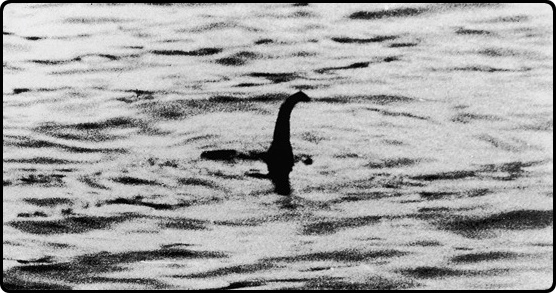
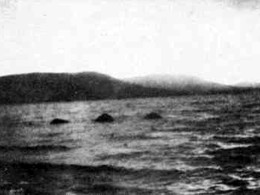
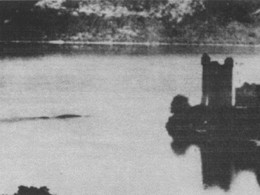
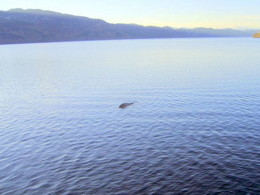
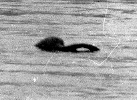 Frank Searle, a former army captain, arrived in Loch Ness to search for the monster during the early 1970s and soon established a reputation as a definite character. He was like a colonial-style adventurer, assisted by a succession of attractive young "monster huntresses." He took an enormous number of photos of Nessie, many of which were published by the media, but all of which have been dismissed by experts as fakes. His early photos, such as the one to the right (taken in October 1972) have been identified as pictures of floating tree trunks. In later photos he progressed to cutting-and-pasting dinosaurs from postcards into his images. Searle left the loch in 1985 and died in 2005.
More…
Frank Searle, a former army captain, arrived in Loch Ness to search for the monster during the early 1970s and soon established a reputation as a definite character. He was like a colonial-style adventurer, assisted by a succession of attractive young "monster huntresses." He took an enormous number of photos of Nessie, many of which were published by the media, but all of which have been dismissed by experts as fakes. His early photos, such as the one to the right (taken in October 1972) have been identified as pictures of floating tree trunks. In later photos he progressed to cutting-and-pasting dinosaurs from postcards into his images. Searle left the loch in 1985 and died in 2005.
More…
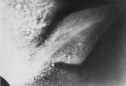 August 7, 1972: An expedition to find Nessie led by Dr. Robert Rines of the Academy of Applied Science struck gold when its underwater camera took a picture of what appeared to be the flipper of a large aquatic animal resembling a plesiosaur. However, the relatively clear image of a flipper shown to the public was not quite what the camera had initially recorded. The initial image was far less distinct. (It basically looked like a shot of a bunch of bubbles or sediment in the water.) This initial picture was then computer enhanced by the NASA Jet Propulsion Laboratories in Pasadena, and apparently the computer-enhanced image was further artistically enhanced by the Academy of Applied Science team (i.e. it was retouched), thereby producing the final flipper photo. Modern image-enhancement software has not been able to conjure anything resembling a flipper from the original image.
More…
August 7, 1972: An expedition to find Nessie led by Dr. Robert Rines of the Academy of Applied Science struck gold when its underwater camera took a picture of what appeared to be the flipper of a large aquatic animal resembling a plesiosaur. However, the relatively clear image of a flipper shown to the public was not quite what the camera had initially recorded. The initial image was far less distinct. (It basically looked like a shot of a bunch of bubbles or sediment in the water.) This initial picture was then computer enhanced by the NASA Jet Propulsion Laboratories in Pasadena, and apparently the computer-enhanced image was further artistically enhanced by the Academy of Applied Science team (i.e. it was retouched), thereby producing the final flipper photo. Modern image-enhancement software has not been able to conjure anything resembling a flipper from the original image.
More…
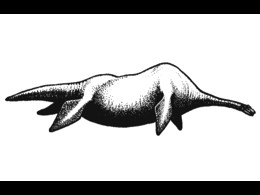
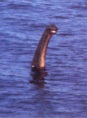 May 21, 1977: Anthony 'Doc' Shiels claimed that he took this picture while camping beside Urquhart Castle. Its startling clarity (it's probably the clearest picture of Nessie ever taken) has made it popular with the public. But it's hard to find any expert willing to take it seriously, simply because the creature depicted in it looks so obviously fake. (And it's odd that there are no ripples in the water around the neck.) Skeptics refer to Shiels's monster as "The Loch Ness Muppet." The fact that Shiels was a showman, "wizard," and psychic entertainer who was developing a side business as a professional monster hunter didn't help his credibility. Shiels himself commented that while he definitely took photos of lake monsters, he didn't believe in them.
More…
May 21, 1977: Anthony 'Doc' Shiels claimed that he took this picture while camping beside Urquhart Castle. Its startling clarity (it's probably the clearest picture of Nessie ever taken) has made it popular with the public. But it's hard to find any expert willing to take it seriously, simply because the creature depicted in it looks so obviously fake. (And it's odd that there are no ripples in the water around the neck.) Skeptics refer to Shiels's monster as "The Loch Ness Muppet." The fact that Shiels was a showman, "wizard," and psychic entertainer who was developing a side business as a professional monster hunter didn't help his credibility. Shiels himself commented that while he definitely took photos of lake monsters, he didn't believe in them.
More…



Loch Ness Monster Hoaxes