Site Map
Hoax Archive: Categories
Literary Forgery
The Donation of Constantine, 756 AD (circa 750 ad)
The Donation of Constantine was a letter supposedly written by the Roman emperor Constantine (285-337 A.D.) to Pope Sylvester I, granting the Catholic Church ownership of vast territories within the western Roman Empire. For centuries, Popes used the Donation to legitimate the Church’s possession of the papal lands in Italy. The truth was that the Church only officially acquired the papal lands in 756 ad when King Pepin of the Frankish Empire gave them to the Church as a gift. But for almost 700 years, until 1440, the Donation was considered to be authentic.
More→ | Categories: Forgers, History Hoaxes, Historical Forgeries, Religious Hoaxes, Literary Forgery, Before 1700 |
The Letter of Prester John, c.1150 (circa 1165)
In the mid-twelfth century, at a time when European rulers felt threatened by the growing power of Muslim nations on their borders, a letter suddenly appeared from Prester John, who described himself as a Christian king of great wealth living in the far east. The letter was addressed to the Byzantine emperor Manuel Comnenus.Prester John claimed to be a descendant of one of the Three Magi. He wrote that his kingdom stretched from India to the land where the sun rises, and that it was inhabited by fantastic creatures such as seven-horned bulls, birds so large they could lift and kill an armored man, and horned men with three eyes in the back of their heads. He even claimed there was a fountain of perpetual youth in his kingdom.
The letter circulated throughout all the European courts. In 1177, Pope Alexander III instructed his personal envoy to travel east, search for Prester John, and deliver a reply to his letter. It was hoped Prester John would come to the aid of the Christian nations in Europe, but no response ever came. Nevertheless, European explorers continued to search for the mythical king for centuries.
The true author of the letter remains unknown. Whoever it was, he was familiar with old legends, which he borrowed heavily from legends such as the tales of Alexander the Great’s adventures in the East. Linguistic evidence suggests the letter originated in Italy. The author probably intended to offer hope to the Christian armies fighting the crusades, and in this respect he succeeded, even though the hope was a false one.
| Categories: Travel and Exploration Hoaxes, Forgers, Literary Forgery, Before 1700 |

Crowland Abbey
| Categories: Forgers, History Hoaxes, Historical Forgeries, Legal Hoaxes, Religious Hoaxes, Literary Forgery, Before 1700 |
Count d’Armagnac’s Forged Papal Bull, c.1455 (circa 1455)
Count Jean V d'Armagnac (1420-1473) was described by a contemporary as "short and stocky of stature, even pot-bellied, but gifted with great bodily strength. His neck was short, surmounted with an acne-pocked visage, with squinty eyes, crowned by a shock of red hair."
The Count fell in love with his younger sister, Isabelle, whom he affectionately called ma mia costa (my own rib). She was said to be one of the great beauties of her time. He had two sons with her, after which he sought approval from the Pope to marry her. The Pope refused.
Undeterred, the Count bribed a papal official, Antoine d'Alet, Bishop of Cambrai, to forge a papal bull allowing the marriage. A few months later, the Count and his sister had a third child together, a daughter. The three children were known as the Bastards of Armagnac. Isabelle referred to them in public as her niece and nephews, which technically they were.
When the Pope learned of what the Count had done, he excommunicated him. Eventually the Count married another woman (not related to him).
Later the Count rebelled against King Charles VII of France, who sent an army to crush him. The army killed the Count and dragged his body through the streets. They locked his wife, seven months pregnant, in a cell with her husband's dead body. Her child (the Count's one legitimate heir) was stillborn, thus ensuring the end of the House of Armagnac.
The Count fell in love with his younger sister, Isabelle, whom he affectionately called ma mia costa (my own rib). She was said to be one of the great beauties of her time. He had two sons with her, after which he sought approval from the Pope to marry her. The Pope refused.
Undeterred, the Count bribed a papal official, Antoine d'Alet, Bishop of Cambrai, to forge a papal bull allowing the marriage. A few months later, the Count and his sister had a third child together, a daughter. The three children were known as the Bastards of Armagnac. Isabelle referred to them in public as her niece and nephews, which technically they were.
When the Pope learned of what the Count had done, he excommunicated him. Eventually the Count married another woman (not related to him).
Later the Count rebelled against King Charles VII of France, who sent an army to crush him. The army killed the Count and dragged his body through the streets. They locked his wife, seven months pregnant, in a cell with her husband's dead body. Her child (the Count's one legitimate heir) was stillborn, thus ensuring the end of the House of Armagnac.
| Categories: Forgers, Legal Hoaxes, Religious Hoaxes, Romance Hoaxes, Literary Forgery, Before 1700 |
Cicero’s Consolatio (1583)
Carlo Sigonio was a highly respected Italian scholar who specialized in the history of Rome. Around 1583 he claimed that he had discovered a new complete work by the great Roman orator Cicero. It was titled De Consolatione or the Consolation. In it Cicero grieved for his daughter's death. Only small fragments of this work had ever been found before. The discovery of this manuscript caused great excitement. But when other scholars read it, the general consensus was that it had to be a fake. It contained numerous anachronistic phrases and Italian mannerisms that Cicero would never have used.
Sigonio stubbornly defended the work, but today it is still regarded as being a forgery. Sigonio might have written the book himself, perhaps to display his mastery of Ciceronian scholarship.
| Categories: Forgers, Literary Hoaxes, Literary Forgery, Before 1700 |
Jean Hardouin’s Theory of Universal Forgery, 1693 (circa 1693)
Jean Hardouin (1646-1729) was not himself a forger, but he was the author of an unusual theory about forgery. As librarian of the Lycee Louis-le-Grand in Paris, he came to the conclusion that virtually all classical texts, and most ancient works of art, coins and inscriptions, had been forged by a group of thirteenth-century monks led by a mysterious figure whom he called Severus Archontius. The goal of this group was supposedly to "establish Atheism amongst men, by paganising all the facts of Christianity". The name Severus Archontius was probably a veiled reference to the Holy Roman Emperor Frederick II of Hohenstaufen.Hardouin was, at the time he first proposed his theory in 1693, a highly regarded scholar. Other learned men tried to take him seriously and argued the merits of his theory with him, but as he persisted in his views, he gradually came to be seen as a pariah in the scholarly community. One contemporary described him as "very confident, arrogant, and violently addicted to hypothesis and paradox." His critics referred to his theory dismissively as "Harduinismus".
Hardouin claimed he "detected the whole fraud" by spotting a series of clues embedded in classical works, clues that included instances of poor writing as well as apparent anachronisms. He believed the thirteenth-century forgers had not only forged the core classical texts, but also a range of later references to these texts, thereby creating a vast web of mutually reinforcing deception.
A nineteenth-century historian remarked that, "The legitimate inference from his theory is that he wished to establish Romanism on the ruins of universal learning, and to reduce mankind to an implicit submission to the Popedom: for, to the obvious question, which he states himself, 'If we must not believe the Fathers, whom can we believe?' he boldly replies: 'Not the Fathers, I say, but our Holy Mother the Church of Rome.'"
Viewed in a broader context, Hardouin's theory can be seen as an extreme expression of a growing awareness amongst seventeenth-century scholars of the number of errors, exaggerations, and inventions in the historical record.
| Categories: Conspiracy Theories, Forgers, Historical Forgeries, Literary Forgery, Before 1700 |
De Situ Brittaniae, 1747 (1747)

De Situ Brittaniae
The material caused a buzz of excitement amongst antiquarians because it revealed numerous Roman landmarks whose existence had not been previously known and suggested the existence of an entire unknown Roman province. But in fact, the map and manuscript turned out to be one of the greatest forgeries of the century. More→
| Categories: Forgers, History Hoaxes, Historical Forgeries, Literary Forgery, 1700-1799 |
As literacy rates rose during the eighteenth century, a kind of cult-like reverence for the work of William Shakespeare emerged. Theaters staged his plays repeatedly, and collectors eagerly sought out any relics related to his life.The bookseller Samuel Ireland was one of the most passionate of these Shakespeare-worshiping relic hunters. He devoted his life to the pursuit of Shakespeariana, in the process neglecting his talented young son, William Henry Ireland (1777-1835). That is, until his son brought home from the law office where he worked a mortgage document apparently signed by Shakespeare himself. More→
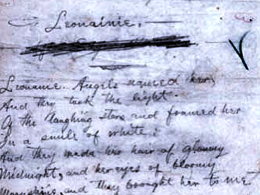
Leonainie, 1877 (August 1877)
Under the heading "Posthumous Poetry," Indiana's Kokomo Dispatch published a poem titled "Leonainie" on August 3, 1877. It was an unremarkable poem except in one way. The editor of the Dispatch, John Henderson, claimed it was a previously unpublished poem by Edgar Allan Poe. (Click here to read the poem.)The publication of this poem generated excitement among fans and scholars of Poe, and within a few weeks it had been reprinted in major papers throughout the United States. But in reality it was not a poem by Poe. Its true author was a struggling young Indiana poet, James Whitcomb Riley. More→

The Protocols of the Elders of Zion, 1903 (First published 1903)
The Protocols of the Elders of Zion was first published in Russia in 1903. It was said to be the text of a speech given by a Zionist leader outlining a secret Jewish plan to achieve world power by controlling international finance and subverting the power of the Christian church. The manuscript was used to justify hate campaigns against the Jewish people throughout the twentieth century, including the Russian pogroms of the early twentieth century and the Nazi persecutions of the 1930s and '40s. Many copies of the Protocols are still in circulation today throughout the world.
However, the Protocols are a hoax. Journalists discovered in 1921 that the text had been plagiarized from an 1864 work, Dialogue in Hell Between Machiavelli and Montesquieu, by Maurice Joly. Joly's book was an attack upon Emperor Napoleon III that didn't mention the Jewish people at all. But when Joly's work resurfaced in Russia at the turn of the century, it was transformed into pseudo-evidence of a vast Jewish conspiracy.
The Hitler Diaries, 1983 (April 1983)

Gerd Heidemann (right) and Wolf Hess (left), son of Nazi leader Rudolf Hess, pose with a volume of the Hitler diaries. April, 1983.
Stern's announcement generated a media frenzy. Magazines and news agencies bid for the right to serialize the diary. Journalists, historians, and World War II buffs eagerly anticipated what revelations it would contain. Skeptics, however, insisted it had to be a fake.
The skeptics turned out to be right. Less than two weeks after Stern's initial announcement, forensics experts at the West German Bundesarchiv issued a press release of their own, denouncing the diaries as a "crude forgery." More→
All text Copyright © 2011 by Alex Boese, except where otherwise indicated. All rights reserved.