About This Page
This page is part of the Hoax Archive, a collection of history's most interesting and notorious deceptions categorized by theme and time period.
Hoax Archive Categories
Hoax Museum Archives
Literary Hoaxes
![]() |
Angel at the Fence (Exposed December 2008) |
The story of how Herman Rosenblat first met his wife, Roma, was remarkable. Rosenblat was imprisoned as a child in the Buchenwald concentration camp. He claimed that Roma, a Jewish girl disguised as a Christian who lived in the nearby town, used to throw apples over the fence for him. Twelve years later, the two met in Coney Island and realized where they had previously seen each other. They fell in love and got married. Rosenblat first shared this story in the mid-1990s, when he submitted it as an entry for a newspaper contest about "best love stories". He said he had been told to share the story, which he had kept secret for so many years, by his dead mother who appeared to him in a vision while he was lying in a hospital bed after being shot during a robbery.
More >>> | |
![]() |
JT LeRoy (Exposed in Oct 2005) |
In 1994 a teenage boy called JT (or Jeremy "Terminator") LeRoy began to attract attention in the literary community. He published a few short stories, but he also aggressively reached out to other, older writers, communicating with them by phone, email, and fax. He was a sympathetic character a transgendered, homosexual, drug-addicted, pathologically shy teenager who had been living on the streets, forced into a life of truck-stop prostitution by his mother. Writing seemed to offer a means for him to escape that life, and other writers strongly supported his efforts. In 1999 he published his first novel, Sarah, which was a critical success. More books followed, as well as celebrity friendships. By 2005, when he was in his mid-twenties, his stature as a literary star appeared to be secure. His books were selling well, and one of them, The Heart Is Deceitful Above All Things, was being made into a movie. But this stature was shaken when, in October 2005, author Stephen Beachy published an article in New York Magazine that asked a simple question: Was JT LeRoy a real person?
More >>> Categories: Hoaxes involving false or disguised identity, Imposters, Gender Fakers, Literary Hoaxes, 2009-2000
| |
![]() |
Norma Khouri’s Forbidden Love (Exposed in July 2004.) |
Norma Khouri's bestseller Honor Lost (published in Australia, Khouri's home, as Forbidden Love) told the story of a Jordanian 'honor killing.' Dalia, a young woman living in Jordan, falls in love with a Christian man and is murdered for this transgression by her father in order to defend the 'honor' of the family. Khouri claimed the story was nonfiction, based on the life (and death) of a woman she met while growing up in Jordan. But the Sydney Morning Herald discovered that Khouri did not grow up in Jordan. She actually grew up in a suburb of Chicago. And no person matching the Dalia character appears to have existed. Khouri's book was revealed to be fiction. The Australian publisher of the book withdrew it from sale.
| |
![]() |
Gabriel Garcia Marquez’s Final Farewell (May 2000) |
![]() Gabriel Garcia Marquez On May 29, 2000 these rumors appeared to be confirmed when a poem signed with his name appeared in the Peruvian daily La Republica. The poem, titled "La Marioneta" or "The Puppet," was said to be a farewell poem Garcia Marquez had written and sent out to his closest friends on account of his worsening condition... More >>> | |
![]() |
The Claire Chazal Experiment (2000) |
![]() Claire Chazal In 2000, the editors of Voici magazine, a weekly tabloid, decided to use her novel to prove that the success of novels by celebrities has little to do with the literary merit of the novels themselves and everything to do with the fame of their authors. They changed the title of her novel to Maitresse d'Ecole, altered the names of some of the characters, and changed the two opening sentences. They then submitted the manuscript to numerous publishing houses, claiming it was a work by an unknown author. Every publisher rejected it, including Chazal's own publisher, Plon. To add insult to injury, Plon not only didn't recognize the book, but also suggested that the author should send a self-addressed/stamped envelope if she wanted the manuscript back. Jacques Colin, editor of Voici, commented: "publishers open their doors wide to novels by celebrity authors ... which would never have been published if they had been signed by an obscure writer." Chazal did not comment on the hoax. | |
![]() |
Jane Somers (aka Doris Lessing) (Exposed in September 1984) |
|
In 1983 the novel The Diary of a Good Neighbor was published in Great Britain and the United States. It told the story of a successful middle-aged magazine editor who befriends a lonely old woman. The cover identified the author as Jane Somers, a name that was said to be the pseudonym of a "well-known English woman journalist." The book received little critical attention, and had only modest sales. Approximately 1500 copies sold in the UK and 3000 in the United States.
A year later a sequel appeared, If the Old Could. But upon its publication, Doris Lessing revealed herself to be the author of both works. More >>> Categories: Hoaxes involving false or disguised identity, Fictitious Persons, Literary Hoaxes, Literary Bait-and-Switch Hoaxes, 1989-1980
| |
![]() |
Casablanca Rejected (1982) |
![]() Too much dialogue, not enough exposition, weak story line Casablanca is arguably the most famous movie in the history of film. It won the Academy Award for Best Picture in 1943, and was voted as one of the top three American films ever made by the American Film Institute. It's a movie that everyone in the film industry should instantly be able to recognize. But in 1982 freelance writer Chuck Ross asked himself this question: Would contemporary Hollywood movie agents actually be able to recognize Casablanca if it was submitted to them as a script? Or failing that, would they at least be able to recognize it as great writing? To find out, Ross devised an experiment. He retyped the script of Casablanca, changed its title to "Everybody Comes to Rick's" (the title of the original play by Murray Burnett and Joan Alison), changed the name of Rick's sidekick from Sam to Dooley (after Dooley Wilson, the actor who played that character), and submitted it to 217 agencies as a script supposedly by an unknown writer, "Erik Demos." More >>> | |
![]() |
The Steps Experiment (1975 & 1979) |
![]() Artwork accompanying Ross's 1979 article describing the Steps Experiment. Categories: Hoaxes involving false or disguised identity, Literary Hoaxes, Literary Bait-and-Switch Hoaxes, 1979-1970
| |
![]() |
|
|
Throughout history there have numerous cases of forgers faking diaries and biographies of people who are already dead. But, for obvious reasons, it is far less common for a forger to fake the biography of a person who is still alive. But this is exactly what happened when writer Clifford Irving forged the "autobiography" of the eccentric billionaire Howard Hughes, while Hughes was still alive. In 1971 Irving told his publisher, McGraw-Hill, that Hughes had contacted him after reading and enjoying one of his earlier books. Hughes, he said, wanted to write an autobiography in order to set straight all the lies and rumors that were circulating about his life, and he wanted Irving to ghostwrite the work. Irving produced letters from Hughes (all forged) to prove the offer was real. McGraw-Hill completely fell for Irving’s story. They eventually gave him almost $1,000,000 in order to secure the rights to the work, and in return Irving handed them Hughes’s “autobiography” a few months later.
More >>>
| |
![]() |
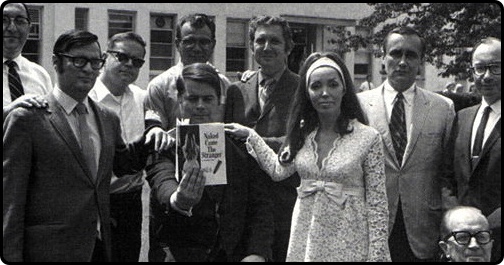
Naked Came the Stranger (Revealed in August 1969) |
![]() | |
![]() |
|
In 1968 Carlos Castaneda, a graduate student in anthropology at the University of California at Los Angeles (UCLA), published The Teachings of Don Juan: A Yaqui Way of Knowledge. It described his encounters with Don Juan Matus, a Yaqui shaman from Mexico. Don Juan supposedly trained Castaneda in ancient forms of knowledge, such as how to use drugs to communicate with animals (or even to become an animal). Castaneda's book became a bestseller and was an important influence on the New Age movement. Castaneda was awarded a doctorate by UCLA in 1972.Castaneda insisted Don Juan was a real person, but this is widely doubted by scholars. Skeptics point to the fact that Castaneda never describes Don Juan speaking in his native language, nor does Don Juan use local names to describe any plants or animals. Castaneda never showed his field notes to anyone. And many of the experiences Castaneda describes, such as hiking for days through the Sonoran desert in the middle of the summer, border on the impossible. Castaneda also falsified details of his own biography. Castaneda claimed he was born in Brazil in 1935, but an investigation by Time magazine revealed he was actually born in Peru in 1925. | |
![]() |
Report From Iron Mountain (October 1967) |
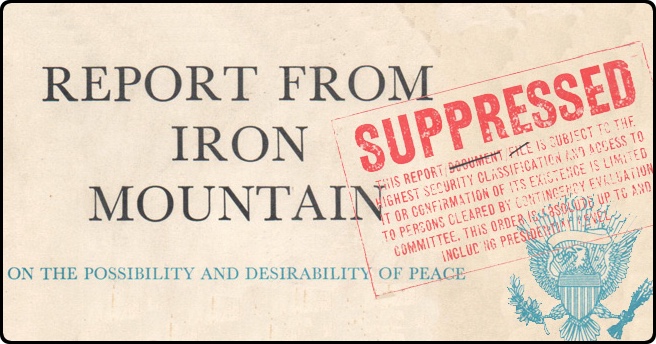
![]() Front cover of Report From Iron Mountain. Leonard C. Lewin, a New York freelance writer, wrote the introduction to the book. He explained that the report had been compiled by 15 experts known as the Special Study Group (SSG) who had been brought together by the U.S. government. The SSG had first met in 1963 at a secret "underground nuclear hideout" called Iron Mountain. They had then held periodic meetings during the next two and a half years to discuss the problems that would confront the United States if it entered into a period of permanent peace. According to Lewin, one of the experts ("John Doe") who was identified as a professor of social science at a 'large Middle Western University,' had decided to release the report to the public. The report, in language full of think-tank jargon, documented the conclusions of the Special Study Group concerning whether peace was possible, given the economic condition of the world. The SSG decided that peace "would almost certainly not be in the best interest of stable society." War, they argued, was simply too important a part of the world economy, and therefore it was necessary to continue a state of war indefinitely... More >>> | |
![]() |
I, Libertine (Conceived of in April 1955) |
On September 20, 1956 Ballantine Books published I, Libertine, a novel by Frederick R. Ewing. It was advertised as a "turbulent, turgid, tempestuous" tale of eighteenth-century court life in London. However, Ewing didn't actually exist. Both he and the book were the creation of nighttime deejay Jean Shepherd, devised as an elaborate hoax upon "day people."
More >>> | |
![]() |
Ern Malley (1944) |
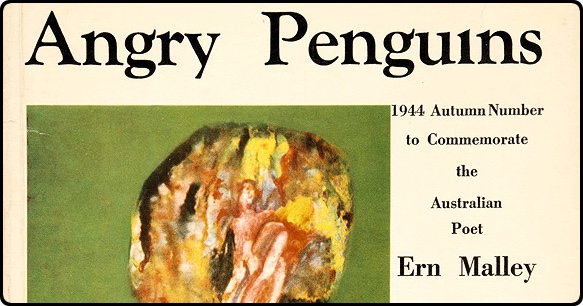
![]() The 1944 cover of Angry Penguins devoted to the work of Ern Malley | |
![]() |
Spectric Poetry (1916) |
|
In 1916 a slender volume of poetry titled Spectra: A Book of Poetic Experiments introduced the Spectric school of poetry to the world. It joined many other experimental schools of poetry then currently in vogue, such as the Imagists, the Futurists, and the Idealists.
The Spectric poems were rather bizarre and nonsensical, but were also fun, full of life, and decked out with colorful (albeit illogical) imagery. More >>> Categories: Literary Hoaxes, 1919-1900
| |


The story of how Herman Rosenblat first met his wife, Roma, was remarkable. Rosenblat was imprisoned as a child in the Buchenwald concentration camp. He claimed that Roma, a Jewish girl disguised as a Christian who lived in the nearby town, used to throw apples over the fence for him. Twelve years later, the two met in Coney Island and realized where they had previously seen each other. They fell in love and got married. Rosenblat first shared this story in the mid-1990s, when he submitted it as an entry for a newspaper contest about "best love stories". He said he had been told to share the story, which he had kept secret for so many years, by his dead mother who appeared to him in a vision while he was lying in a hospital bed after being shot during a robbery.
In 1994 a teenage boy called JT (or Jeremy "Terminator") LeRoy began to attract attention in the literary community. He published a few short stories, but he also aggressively reached out to other, older writers, communicating with them by phone, email, and fax. He was a sympathetic character a transgendered, homosexual, drug-addicted, pathologically shy teenager who had been living on the streets, forced into a life of truck-stop prostitution by his mother. Writing seemed to offer a means for him to escape that life, and other writers strongly supported his efforts. In 1999 he published his first novel, Sarah, which was a critical success. More books followed, as well as celebrity friendships. By 2005, when he was in his mid-twenties, his stature as a literary star appeared to be secure. His books were selling well, and one of them, The Heart Is Deceitful Above All Things, was being made into a movie. But this stature was shaken when, in October 2005, author Stephen Beachy published an article in New York Magazine that asked a simple question: Was JT LeRoy a real person?
Norma Khouri's bestseller 


In 1968 Carlos Castaneda, a graduate student in anthropology at the University of California at Los Angeles (UCLA), published 
On September 20, 1956 Ballantine Books published I, Libertine, a novel by Frederick R. Ewing. It was advertised as a "turbulent, turgid, tempestuous" tale of eighteenth-century court life in London. However, Ewing didn't actually exist. Both he and the book were the creation of nighttime deejay Jean Shepherd, devised as an elaborate hoax upon "day people."