Site Map
Hoax Archive: Categories
Literary Hoaxes
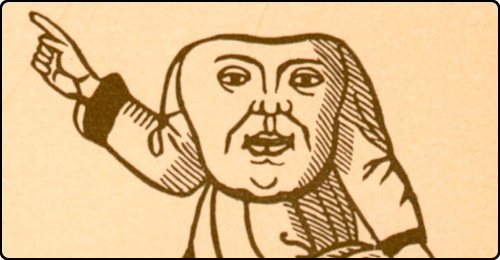
The Travels of Sir John Mandeville, 1371 (circa 1371)
The Travels of Sir John Mandeville, which first appeared in print around 1371, purported to document the travels of an English knight throughout Egypt, Ethiopia, India, Persia, and Turkey. The book was very popular, and was regarded as being factual by medieval scholars, but modern readers can easily spot that the majority of it is fiction. For instance, it describes islands whose inhabitants have the bodies of humans but the heads of dogs, a tribe whose only source of nourishment is the smell of apples, people the size of pygmies whose mouths are so small that they have to suck all their food through reeds, and a race of one-eyed giants who eat only raw fish and raw meat.
More→ | Categories: Travel and Exploration Hoaxes, Literary Hoaxes, Before 1700 |
The Voynich Manuscript, c.1500 (circa 1500)
The Voynich manuscript is a mysterious book consisting of approximately 240 pages of hand-written text and crudely drawn illustrations that depict plants, astrological diagrams, and naked women. The text is written in an unknown alphabet that has defied all attempts at translation. It is not certain exactly how old the manuscript is, but it appears to date to around the late fifteenth century. It is named after Wilfrid Voynich, who acquired it in 1912 from the library of Villa Mondragone, a Jesuit college in Frascati, Italy.
More→ | Categories: Linguistic Hoaxes, Literary Hoaxes, Before 1700 |
Cicero’s Consolatio (1583)
Carlo Sigonio was a highly respected Italian scholar who specialized in the history of Rome. Around 1583 he claimed that he had discovered a new complete work by the great Roman orator Cicero. It was titled De Consolatione or the Consolation. In it Cicero grieved for his daughter's death. Only small fragments of this work had ever been found before. The discovery of this manuscript caused great excitement. But when other scholars read it, the general consensus was that it had to be a fake. It contained numerous anachronistic phrases and Italian mannerisms that Cicero would never have used.
Sigonio stubbornly defended the work, but today it is still regarded as being a forgery. Sigonio might have written the book himself, perhaps to display his mastery of Ciceronian scholarship.
| Categories: Forgers, Literary Hoaxes, Literary Forgery, Before 1700 |
A book titled Madagascar; or Robert Drury’s Journal, during fifteen years captivity on that Island was published in England in 1729. In it, Robert Drury described how, almost forty years earlier, he had been shipwrecked off the coast of Madagascar, survived the slaughter of his shipmates by hostile islanders, and then spent the next fifteen years living as a slave, fighting in local wars, taking a wife, and eventually escaping on a slave ship back to England.
The story was accepted as true during the eighteenth century. In fact, it served as one of Europe’s main sources of information about the faraway island of Madagascar. But during the nineteenth century scholars started to question almost everything about it. In particular, there were suspicions that the book was actually a fictional account written by Daniel Defoe, author of Robinsin Crusoe, and that Robert Drury didn't even exist.
However, the controversy has come full circle, because modern scholars suspect the work may not be a hoax after all. In 1996, Mike Parker Pearson, an archaeologist at Sheffield University, published evidence suggesting not only that Drury had lived, but that his description of early 18th century Madagascar was highly accurate... far too accurate to have been invented by Defoe.
Therefore, while it's impossible to say for sure, Robert Drury's Journal may be a case of a factual narrative mistaken for a hoax.
The story was accepted as true during the eighteenth century. In fact, it served as one of Europe’s main sources of information about the faraway island of Madagascar. But during the nineteenth century scholars started to question almost everything about it. In particular, there were suspicions that the book was actually a fictional account written by Daniel Defoe, author of Robinsin Crusoe, and that Robert Drury didn't even exist.
However, the controversy has come full circle, because modern scholars suspect the work may not be a hoax after all. In 1996, Mike Parker Pearson, an archaeologist at Sheffield University, published evidence suggesting not only that Drury had lived, but that his description of early 18th century Madagascar was highly accurate... far too accurate to have been invented by Defoe.
Therefore, while it's impossible to say for sure, Robert Drury's Journal may be a case of a factual narrative mistaken for a hoax.
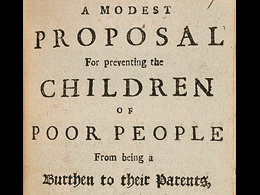
A Modest Proposal (1729)
In 1729 Jonathan Swift anonymously published a short work titled A Modest Proposal for Preventing the Children of Poor People in Ireland From Being a Burden to their Parents or the Country, and For Making Them Beneficial to the Public. The essay began innocuously by discussing the problem of numerous starving beggars and homeless children in Ireland. But then it proposed a radical solution: Ireland's large, impoverished population could be turned to its advantage by feeding the unwanted babies of the poor to the rich. Swift noted, "A young healthy child well nursed, is, at a year old, a most delicious nourishing and wholesome food, whether stewed, roasted, baked, or boiled; and I make no doubt that it will equally serve in a fricassee, or a ragout."
Swift did not actually intend to promote class-based cannibalism. His point was to use satire in order to dramatize how the rich exploit and dehumanize the poor. However, many readers failed to recognize this.
Swift's short work is one of the most celebrated examples of satire in the English language. It has subsequently lent its name to a genre of satirical hoaxing that uses the same method. The satirist pretends to advocate an idea that people find shocking or disgusting. But the true goal of the satire (at least, according to the satirist) is to raise awareness of a social problem.
Swift did not actually intend to promote class-based cannibalism. His point was to use satire in order to dramatize how the rich exploit and dehumanize the poor. However, many readers failed to recognize this.
Swift's short work is one of the most celebrated examples of satire in the English language. It has subsequently lent its name to a genre of satirical hoaxing that uses the same method. The satirist pretends to advocate an idea that people find shocking or disgusting. But the true goal of the satire (at least, according to the satirist) is to raise awareness of a social problem.
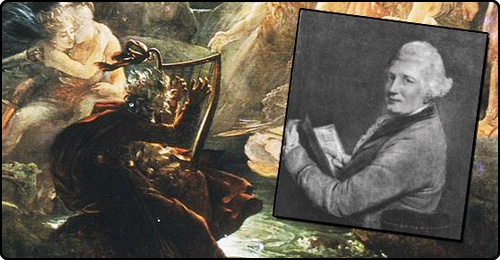
Scottish schoolmaster James Macpherson claimed that during his travels through remote areas of Scotland he had discovered the text of an ancient epic poem written by a third-century bard named Ossian.In 1761 Macpherson published a translation of this poem, titled Fingal. Two years later he translated a second epic poem, Temora. The works became international successes and propelled Macpherson to fame and riches. But other scholars, particulary Samuel Johnson, accused Macpherson of having written the works himself. A bitter controversy ensued until Macpherson's death, at which point scholars got a chance to examine his sources. It then became clear that the poems were principally written by Macpherson himself, not by a third-century Scottish bard.
| Categories: Literary Hoaxes, 1700-1799 |
Thomas Chatterton and the Rowley Poems, 1767 (Late 1760s)
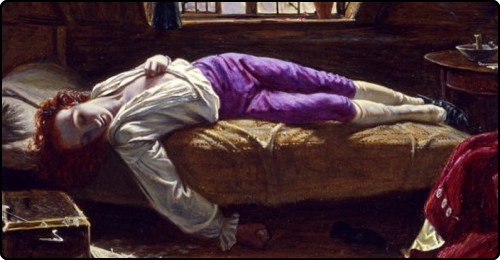
At the age of twelve, Thomas Chatterton (1752-1770) began writing poems in the style of the old manuscripts he came across in his uncle's church. Eventually he turned out a group of poems that he claimed were the work of a 15th century priest named Thomas Rowley. The poems attracted attention and praise.Encouraged, Chatterton left for London at the age of 17, hoping to make it as a writer on his own terms. But four months later, unable to find work, he committed suicide by poisoning himself with arsenic. The Rowley poems were only recognized as forgeries when they were republished after Chatterton's death. More→
| Categories: Forgers, Literary Hoaxes, 1700-1799 |
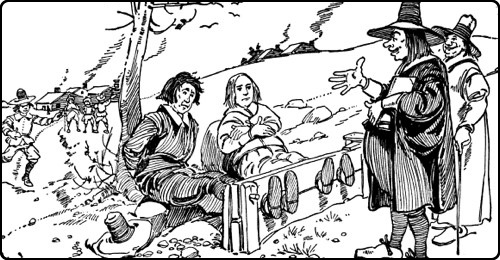
In 1781 the Reverend Samuel Peters published a book titled A General History of Connecticut. The book included sensational details about "blue laws" that had supposedly once existed in Connecticut. In fact, there was no evidence such laws had ever existed.
More→
| Categories: Legal Hoaxes, Literary Hoaxes, 1700-1799 |
As literacy rates rose during the eighteenth century, a kind of cult-like reverence for the work of William Shakespeare emerged. Theaters staged his plays repeatedly, and collectors eagerly sought out any relics related to his life.The bookseller Samuel Ireland was one of the most passionate of these Shakespeare-worshiping relic hunters. He devoted his life to the pursuit of Shakespeariana, in the process neglecting his talented young son, William Henry Ireland (1777-1835). That is, until his son brought home from the law office where he worked a mortgage document apparently signed by Shakespeare himself. More→
Grimm’s Fairy Tales (1812)
The Grimm's Fairy Tales, first published in German in 1812 as Kinder- und Hausmärchen, is considered to be one of the major works of 19th-century culture. Popular myth holds that the tales came from simple, peasant folk interviewed by the brothers, Jakob and Wilhelm. In reality, the bulk of the tales came from a handful of middle- and upper-class women. Some of the tales were French in origin, not German. Furthermore, the tales were heavily revised and rewritten by the Grimm brothers before publication.In his 1983 book One Fairy Story Too Many: The Brothers Grimm and their Tales John Ellis argued that the Grimm Brothers engaged in a kind of literary fraud. As Ellis put it, "the Grimms deliberately made false claims for their tales and suppressed the evidence of their actual origin."
Most scholars, however, are more kind to the Grimms. They agree that the tales did not come from peasant folk, but argue that the Grimms did not try to hide or misrepresent their sources. They attribute the Grimm's revision of the tales to their attempt to synthesize different versions of the tales together.
| Categories: Literary Hoaxes, Anthropology Hoaxes, 1800-1868 |
In 1812 a Boston printer published a journal, said to have been written by the French trader Charles Le Raye, describing his capture in 1801 by a band of Teton Sioux and subsequent travels through the Upper Missouri and Yellowstone regions. If the account is true, Le Raye would have been the first European to travel through that region and write about it, preceding the Lewis and Clark expedition by three years. But scholars now believe the journal was a hoax. They cite its gross geographical inaccuracies, inaccurate portrayal of Indian life, and the lack of any other evidence suggesting that Le Raye existed. However, a few parts of the journal are accurate. This indicates that its author had access to a source of information about the Upper Missouri region. This source might have been a journal by Lewis and Clark member Sergeant Nathaniel Pryor, although it was not previously known that Pryor kept a journal. More→
| Categories: Travel and Exploration Hoaxes, Literary Hoaxes, Anthropology Hoaxes, 1800-1868 |
John Howe, British Spy (1827)
In 1827 a Massachusetts printer named Luther Roby published The Journal Kept by Mr. John Howe while He Was Employed as a British Spy. It told the story of John Howe, a man said to have been a British spy during the Revolutionary war before switching sides to become an American soldier, then a settler, a frontier trader, an Indian preacher, and finally a smuggler.
Howe was long accepted as an actual historical figure. As late as 1976, the historian Robert Gross referred to Howe in The Minutemen and Their World as a "quick-thinking English civilian-spy." The 1983 biographical dictionary American Writers Before 1800 contained an entry about Howe. But the writer of the 1983 biographical entry, Daniel Williams, realized, upon investigation, that Howe was fictitious and exposed the hoax, 165 years after it had been perpetrated.
Williams concluded that Roby (or someone he hired to do the writing) had created the character of Howe based on a real figure, Ensign Henry DeBerniere, who had spied for General Gage. Roby essentially Americanized the character of DeBerniere, making him craftier and more representative of the American ideal of the self-made man. Roby's motive was probably financial. He recognized that readers would be more interested in the adventures of a supposedly real Revolutionary war hero than a fictional one.
Howe was long accepted as an actual historical figure. As late as 1976, the historian Robert Gross referred to Howe in The Minutemen and Their World as a "quick-thinking English civilian-spy." The 1983 biographical dictionary American Writers Before 1800 contained an entry about Howe. But the writer of the 1983 biographical entry, Daniel Williams, realized, upon investigation, that Howe was fictitious and exposed the hoax, 165 years after it had been perpetrated.
Williams concluded that Roby (or someone he hired to do the writing) had created the character of Howe based on a real figure, Ensign Henry DeBerniere, who had spied for General Gage. Roby essentially Americanized the character of DeBerniere, making him craftier and more representative of the American ideal of the self-made man. Roby's motive was probably financial. He recognized that readers would be more interested in the adventures of a supposedly real Revolutionary war hero than a fictional one.
| Categories: History Hoaxes, Literary Hoaxes, Military Hoaxes, 1800-1868 |
Hoaxes of Edgar Allan Poe (1809-1849)
Edgar Allan Poe (1809-1849) was an American writer, celebrated for his dark, gothic tales of horror and suspense. He enjoyed playing games of rationality with his readers. Sometimes he cast himself as a master detective capable of discerning the truth behind any illusion or riddle, a role he expressed through the famous character of Chevalier C. Auguste Dupin. This is also seen in his effort to solve puzzles, such as the mystery of the operation of the Great Chess Automaton.At other times, Poe liked to display his ability to hide the truth from his readers, to force them to play detective. He published six hoaxes during his brief life. Most modern anthologies of his works fail to note that these stories were first presented to readers in the guise of nonfiction. In fact, both detective and hoaxer were two sides of the same coin for Poe. Both roles manifested the power he believed a rational mind could wield over reality. Poe was also fascinated by other hoaxes besides his own. He once referred approvingly to the age in which he lived as the "epoch of the hoax."
Listed below are his six hoaxes.
- The Great Balloon Hoax, 1844 (April 13, 1844)
| Categories: Literary Hoaxes, Serial Pranksters, 1800-1868 |
The Unparalled Adventures of One Hans Pfall (June 1835)
An article titled "The Unparalled Adventures of One Hans Pfall" appeared in the Southern Literary Messenger in late June of 1835. It claimed to be the text of a note dropped from a hot-air balloon that had appeared recently above Rotterdam. The note described Hans Pfall's journey to the moon in order to escape his earth-bound creditors. Pfaall had spent five years living among the inhabitants of the moon before sending one of the lunar inhabitants back to Earth in his balloon in order to deliver a message that he would return to Earth to tell his tale if the citizens of Rotterdam granted him a full pardon for past crimes he had committed; however, the lunarian had been scared by the sight of all the people on the ground and, after throwing Pfall's note down to the crowd, had fled back up into the clouds, thus preventing the residents of Rotterdam from responding to Pfaall's message.
The article, though it purported to be factual, was actually a story written by Edgar Allan Poe. It was his first, and somewhat unsuccessful, attempt at a hoax. Few people were fooled, perhaps because, as Poe himself later acknowledged, it was written in a "tone of mere banter."
Poe never finished Pfaall's tale of life on the moon. Shortly after the first installment of his article appeared it was upstaged by a similar hoax about lunar life that appeared in the New York Sun. The success of the New York Sun's hoax dissuaded Poe from continuing with his own tale.
The article, though it purported to be factual, was actually a story written by Edgar Allan Poe. It was his first, and somewhat unsuccessful, attempt at a hoax. Few people were fooled, perhaps because, as Poe himself later acknowledged, it was written in a "tone of mere banter."
Poe never finished Pfaall's tale of life on the moon. Shortly after the first installment of his article appeared it was upstaged by a similar hoax about lunar life that appeared in the New York Sun. The success of the New York Sun's hoax dissuaded Poe from continuing with his own tale.
Maria Monk's Awful Disclosures was first published in January, 1836. In it, Monk exposed various scandalous events that, according to her, had occurred at the Hotel Dieu convent in Montreal. She claimed convent nuns were having sexual relations with priests from the neighboring seminary who supposedly entered the convent through a secret tunnel. All babies born of these illicit encounters, Monk claimed, were baptized before being strangled and dumped in a lime pit in the basement of the convent. Maria Monk said she had lived in the convent for a total of seven years before becoming pregnant by a priest. Unable to bear the thought of having her child killed and dumped in the basement, she finally fled.The publication of Maria Monk's Awful Disclosures caused an enormous public outcry that fed on the widespread anti-Catholic sentiment of the era. Leading protestants in New York and Montreal demanded an investigation of the convent, to which demand the Bishop of Montreal eventually acquiesced. It turned up no evidence to support Maria Monk's claims, but American Protestants refused to accept these results, claiming the investigation was biased because it had supposedly been conducted by Jesuits disguised as Protestants.
A New York City newspaper editor, Col. William Leete Stone, asked the Bishop for permission to investigate with a team of protestants. The bishop granted his request, and in October 1836 Stone led a team around the convent. With Maria Monk's book in hand, he compared her description of the convent's interior with the convent itself. He found very little correspondence between the two. However he was not allowed to see the nun's rooms or the basement area and had to return to New York City, his investigation unfinished.
Col. Stone later obtained permission to see the entire convent and, on the basis of this fuller investigation, concluded there was no evidence Maria Monk "had ever been within the walls of the cloister."
With her claims discredited, Maria Monk fell from public view. A rumor emerged that she had actually been a prostitute in Montreal, and that the years she claimed to have spent in a convent were spent in the Magdalen Asylum for Wayward Girls. She was later arrested for picking the pocket of a man who had paid her for sex. She died in prison on Welfare Island, New York City, in 1849. Her Awful Disclosures, despite having been shown to be false, remained in print until well into the twentieth century.
All text Copyright © 2011 by Alex Boese, except where otherwise indicated. All rights reserved.