About This Page
This page is part of the Hoax Archive, a collection of history's most interesting and notorious deceptions categorized by theme and time period.
Hoax Archive Categories
Hoax Museum Archives
The Hoaxes of Hugh Troy

Hugh Troy posing in front of one of his murals. New York City, Rockefeller Center, 1940.
Campus Pranks
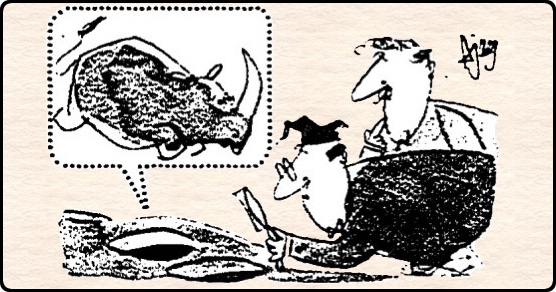
Hugh Troy got his start as a prankster while a student at Cornell University. His most famous prank there involved creating a trail of rhinoceros footprints in the snow using a hollowed-out rhino-foot wastepaper basket.
Another of his campus pranks involved a professor who used to leave his black rubber boots out to dry by the classroom door while he was lecturing. One day Troy secretly spirited the boots away, painted them to look like feet, hid his artwork with black soot, then placed them back by the door. When the professor put the boots back on and walked outside, the soot washed away, making it look like the professor was walking around barefoot.
While working as the student sports reporter at Cornell, Troy invented a character named "Johnny Tsal". Tsal was a poor wretch who would inevitably finish last in whatever race that Troy was assigned to cover. ('Tsal' was 'last' spelt backwards.) Troy said he invented this perpetual loser so that he wouldn't have to feel bad about reporting someone's defeat.
One of his pranks eventually got Troy in trouble. He printed a fake newspaper, the Cornell Globe and Square Dealer, with the headline, "President breaks wind for new aeronautical college." The headline so annoyed the administration that they suspended Troy for a term.
The New York City Years
After graduating from Cornell in 1927, Troy moved to New York City to find work as an artist. One day he went down to Central Park and sat for a while reading on a park bench. When he was done, he nonchalantly picked up the bench and began to carry it away. He didn't get very far before a policeman stopped him, hauled him into the police station, and charged him with stealing public property. At which point, much to the confusion of the police officers, Troy whipped out a sales receipt. It turned out that he owned the bench. He had purchased it at a store the day before and left it in the park, just so that he could 'steal' it later.
Another time, Troy and a friend dressed up as city workers, placed 'men at work' signs on a busy street, and started to dig a hole. The police eventually arrived and, believing they were real city workers, obligingly began to divert traffic around them. Once they had dug a good-sized hole, Troy and his friend gathered up their tools and left. The puzzled police officers continued to stand there diverting traffic.
In a similar prank, Troy and an accomplice dressed in workmen's clothes, took ladders into the lobby of the Waldorf-Astoria Hotel, and calmly began to remove all the light bulbs. They proceeded to remove every single bulb, and then they left. No one ever asked them what they were doing or tried to stop them.
To get even with the manager of a Greenwich village movie theater who had annoyed him, Troy took a jar of moths with him into the opening night premiere of a Greta Garbo film. Troy waited until the moment when Garbo was kissing Melvyn Douglas, then he opened the jar. All the moths immediately flew toward the light of the projector, obscuring the film.
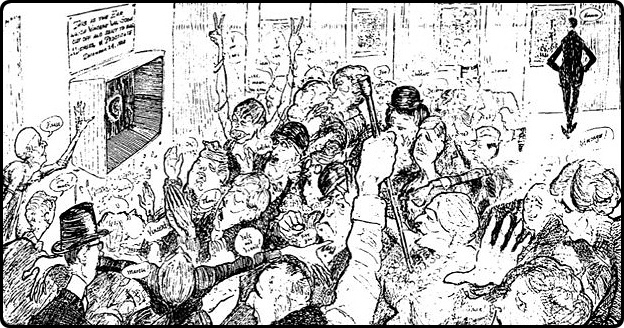
Troy's most famous New York City prank occurred in 1935, when he fashioned an ear out of dried beef and placed it in the Museum of Modern Art's Van Gogh exhibit, beside a sign describing it as the ear Van Gogh cut off and sent to his mistress.
The War Years
During World War II, Troy served as a captain in Army Intelligence, participating in the Guam campaign. But he was initially posted to an officers' training camp in the South. Tiring of the endless paperwork, he started submitting Flypaper Reports to the Pentagon, detailing the number of flies caught by flypaper in the mess hall. Reportedly, the Pentagon soon was requesting that all officers submit similar reports.
While in the South Pacific, he was asked to help a folklorist who had arrived to document native tales. Thinking it was a frivolous activity during a bombing campaign, Troy persuaded a local boy to invent tales to tell the folklorist. The folklorist eagerly transcribed the tales and returned home thinking he had stumbled upon the find of his career.
The Washington Years
Troy moved to Washington DC in 1951 where he worked for the Central Intelligence Agency. A year after moving there, he placed a small ad in the Washington Post promoting the services of a company of "Ghost Artists." Their motto was "We paint it, you sign it!" He received numerous inquiries from prospective clients.
Troy died in 1964, at the age of 58, after a long illness.
His most famous pranks are described in more detail below.
![]() |
Ghost Artists (February 1952) |
On February 5, 1952, a small ad ran on the theatrical page of the Washington Post offering the services of a company of "ghost artists": "Too busy to paint? Call on the Ghost Artists? We paint it, you sign it."The idea of ghost artists caught the interest of the media, and a report about the company went out over the wire services and appeared in newspapers nationwide. The ghost artists were said to be earning lucrative fees from executives who wanted to impress their friends. Satisfied clients included military men, government officials, doctors, businessmen, and a Wall Street broker who commissioned an entire exhibition in order to break into "arty circles." More >>> Categories: Advertising Hoaxes, Art Hoaxes, Satirical Art Hoaxes, Hoaxes That Fooled Journalists, The Hoaxes of Hugh Troy, 1959-1950
| |
![]() |
The Flypaper Report (circa 1943) |
During World War II, the illustrator Hugh Troy was given a desk job stateside. He found it excruciatingly boring. So to amuse himself he began preparing Daily Flypaper Reports in the style of standard army regulations. These were counts, printed on official-looking paper, of all the flies trapped on flypaper in the mess hall during the last twenty-four hours. He analyzed the results according to wind direction, nearness to windows, nearness to the kitchen, length of the flypaper, etc. He then would mimeograph the report and slip it in among the other official forms submitted to headquarters each day.After keeping this up for a month, he received a call from an officer in another comapny: "Lieutenant, Can you tell me the proper procedure for filing fly reports? We've been catching hell from the Pentagon for not sending them in." | |
![]() |
Van Gogh’s Ear Exhibited (November 1935) |
The illustrator Hugh Troy was frustrated by the crowds at New York's Van Gogh exhibit, which made it hard for art lovers such as himself to view the works. He was also convinced that most of the people were there out of lurid interest in the man who had cut off his ear, not out of a true appreciation for the art. To prove his point, he fashioned a fake ear out of a piece of dried beef and mounted it in a velvet-lined shadow box. He snuck this into the museum and stood it on a table in the Van Gogh exhibit. Beside the box he placed a sign: "This is the ear which Vincent Van Gogh cut off and sent to his mistress, a French prostitute, Dec. 24, 1888."
More >>> | |
![]() |
The Cornell Rhinoceros (circa 1925) |
After a heavy snowfall, the footprints of a large animal were found on the campus of Cornell University, leading up to the shore of the frozen Beebe Lake. A hole in the ice indicated that the animal must have fallen in and drowned.A zoologist examined the tracks and identified them as those of a rhinoceros. Word of the rogue rhinoceros spread around town, and since the University got its water supply from the lake, many students declared they were no longer going to drink the water. Many of those who did drink it, swore they could taste rhinoceros. The tracks turned out to be the work of Cornell student Hugh Troy. He and a friend had borrowed a rhino-foot wastepaper basket from a professor's house. They had weighted it down with scrap metal then attached it to a clothesline. Holding the clothesline at either end, they made their way across campus, creating a trail of tracks in the snow up to the edge of the lake. The rhinoceros footprints are one of the most famous pranks in Cornell's history. However, there is no documentation to prove that the prank happened. Therefore, some suggest it may only be a legend. | |
|
Page 1 of 1 pages
|


On February 5, 1952, a small ad ran on the theatrical page of the Washington Post offering the services of a company of "ghost artists": "Too busy to paint? Call on the Ghost Artists? We paint it, you sign it."
During World War II, the illustrator Hugh Troy was given a desk job stateside. He found it excruciatingly boring. So to amuse himself he began preparing Daily Flypaper Reports in the style of standard army regulations. These were counts, printed on official-looking paper, of all the flies trapped on flypaper in the mess hall during the last twenty-four hours. He analyzed the results according to wind direction, nearness to windows, nearness to the kitchen, length of the flypaper, etc. He then would mimeograph the report and slip it in among the other official forms submitted to headquarters each day.
The illustrator Hugh Troy was frustrated by the crowds at New York's Van Gogh exhibit, which made it hard for art lovers such as himself to view the works. He was also convinced that most of the people were there out of lurid interest in the man who had cut off his ear, not out of a true appreciation for the art. To prove his point, he fashioned a fake ear out of a piece of dried beef and mounted it in a velvet-lined shadow box. He snuck this into the museum and stood it on a table in the Van Gogh exhibit. Beside the box he placed a sign: "This is the ear which Vincent Van Gogh cut off and sent to his mistress, a French prostitute, Dec. 24, 1888."
After a heavy snowfall, the footprints of a large animal were found on the campus of Cornell University, leading up to the shore of the frozen Beebe Lake. A hole in the ice indicated that the animal must have fallen in and drowned.