About This Page
This page is part of the Hoax Archive, a collection of history's most interesting and notorious deceptions categorized by theme and time period.
Hoax Archive Categories
Hoax Museum Archives
Hoaxes involving false or disguised identity
![]() |
JT LeRoy (Exposed in Oct 2005) |
In 1994 a teenage boy called JT (or Jeremy "Terminator") LeRoy began to attract attention in the literary community. He published a few short stories, but he also aggressively reached out to other, older writers, communicating with them by phone, email, and fax. He was a sympathetic character a transgendered, homosexual, drug-addicted, pathologically shy teenager who had been living on the streets, forced into a life of truck-stop prostitution by his mother. Writing seemed to offer a means for him to escape that life, and other writers strongly supported his efforts. In 1999 he published his first novel, Sarah, which was a critical success. More books followed, as well as celebrity friendships. By 2005, when he was in his mid-twenties, his stature as a literary star appeared to be secure. His books were selling well, and one of them, The Heart Is Deceitful Above All Things, was being made into a movie. But this stature was shaken when, in October 2005, author Stephen Beachy published an article in New York Magazine that asked a simple question: Was JT LeRoy a real person?
More >>> Categories: Hoaxes involving false or disguised identity, Imposters, Gender Fakers, Literary Hoaxes, 2009-2000
| |
![]() |
Samukeliso Sithole (Exposed January 2005) |
![]() Samukeliso Sithole Categories: Hoaxes involving false or disguised identity, Imposters, Gender Fakers, Sports Hoaxes, 2009-2000
| |
![]() |
The Yes Men’s Bhopal Hoax (December 3, 2004) |
On December 3, 2004 the BBC broadcast an interview with Jude Finisterra, who claimed to be a representative of Dow Chemical. The date was the 20th anniversary of the chemical disaster in Bhopal, and the BBC had sought out a representative from Dow to speak about the tragedy since Dow had inherited responsibility for the disaster via a corporate acquisition. During the interview, Mr. Finisterra shocked the BBC's audience when he said that not only had Dow decided to accept full responsibility for the incident, but that it was going to pay $12 billion in compensation to the victims. In response to the news, Dow's stock value promptly dropped.
More >>> Categories: Hoaxes involving false or disguised identity, Hoaxes as Social Activism, Hoax Websites, Hoaxes That Fooled Journalists, 2009-2000
| |
![]() |
Phony 9/11 Deaths (The months following Sept. 11, 2001) |
|
As estimates of the death toll rose in the days following the 9/11 attacks, enormous amounts of sympathy and media attention flowed out towards those who had lost loved ones in the attack. Those who had participated in rescue efforts were hailed as national heroes. But simultaneously, many people (motivated, perhaps, by a desire for sympathy or attention) fabricated tales of phony heroics and lost loved ones in the weeks and months following 9/11. Listed are a few of the more notable cases of these phony 9/11 tales:
More >>>
Categories: Death Hoaxes, Hoaxes involving false or disguised identity, Financial Scams, Terror-Related Hoaxes, Hoaxes Inspired by September 11, 2001,
| |
![]() |
Gorgeous Guy (May 2001) |
![]() 'Gorgeous Guy' On May 11, 2001 Dan's picture had been posted on a local internet portal, San Francisco's craigslist.org, in the 'Missed Connections' forum. The picture's caption read, "Gorgeous Guy @ 4th and Market at the MUNI/Amtrak Bus Stop (Mon-Fri)." The person who had posted the message talked about how she wanted to meet this guy, but she didn't know his name. She was hoping he would see her message and contact her. More >>> Categories: Hoaxes involving false or disguised identity, Internet Hoaxes, Craigslist Hoaxes, Romance Hoaxes, 2009-2000
| |
![]() |
Allegra Coleman (November 1996) |
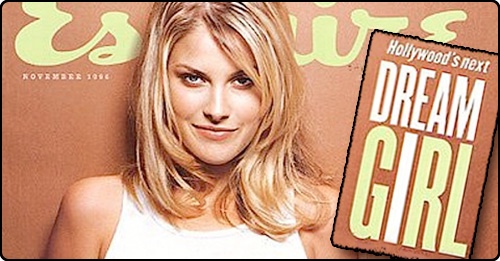
Esquire magazine's November 1996 cover featured Allegra Coleman, said to be a hot new star taking Hollywood by storm. "Forget Gwyneth, Forget Mira," the cover declared. "Here's Hollywood's next Dream Girl."The feature article inside described the buzz building around her. David Schwimmer, star of Friends, was said to be her on-again, off-again boyfriend, although he was getting some competition from Quentin Tarantino who had apparently dumped Mira Sorvino to go out with her. It was even rumored that Woody Allen had completely overhauled his next movie so that she could star in it. "The real thing," the article gushed. "She has it." More >>> Categories: Hoaxes involving false or disguised identity, Fictitious Persons, Hoaxes in Newspapers and Magazines, Entertainment and Show Business Hoaxes, Hoaxes by Journalists, 1999-1990
| |
![]() |
The Buckwheat Imposter (October 1990) |
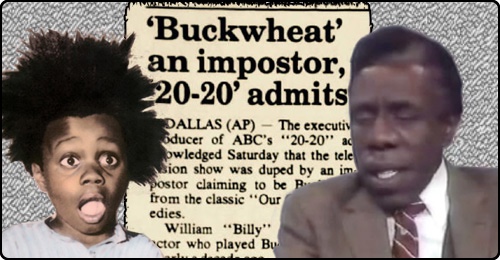
![]() Buckwheat, as seen on Our Gang Buckwheat was the wide-eyed, African-American character played for almost ten years by William Thomas. He was famous for his signature phrase, "O-Tay!" After leaving the show, Thomas dropped from the public eye. 20/20 claimed that it had tracked him down to Tempe, Arizona where he was working at a low-paying job as a grocery bagger. It aired an interview with him in which he talked about the cruel twists and turns his life had taken. Unfortunately for 20/20, the man they interviewed was not William Thomas. Thomas had worked as a film lab technician before dying in 1980 at the age of 49. The man 20/20 interviewed was an imposter named Bill English who had been claiming to be Buckwheat for the past 30 years. The week after it aired the segment, 20/20 admitted its mistake. In the ensuing scandal, a producer was fired and 20/20 was sued for negligence by the son of the real William Thomas. Categories: Hoaxes involving false or disguised identity, Imposters, Television Hoaxes, Hoaxes That Fooled Journalists, 1999-1990
| |
![]() |
Jane Somers (aka Doris Lessing) (Exposed in September 1984) |
|
In 1983 the novel The Diary of a Good Neighbor was published in Great Britain and the United States. It told the story of a successful middle-aged magazine editor who befriends a lonely old woman. The cover identified the author as Jane Somers, a name that was said to be the pseudonym of a "well-known English woman journalist." The book received little critical attention, and had only modest sales. Approximately 1500 copies sold in the UK and 3000 in the United States.
A year later a sequel appeared, If the Old Could. But upon its publication, Doris Lessing revealed herself to be the author of both works. More >>> Categories: Hoaxes involving false or disguised identity, Fictitious Persons, Literary Hoaxes, Literary Bait-and-Switch Hoaxes, 1989-1980
| |
![]() |
The Steps Experiment (1975 & 1979) |
![]() Artwork accompanying Ross's 1979 article describing the Steps Experiment. Categories: Hoaxes involving false or disguised identity, Literary Hoaxes, Literary Bait-and-Switch Hoaxes, 1979-1970
| |
![]() |
Black Like Me (1959) |
John Howard Griffin was a white native Texan novelist and journalist with a strange idea that he couldn't get out of his head. What if a white man became a black man for six weeks and traveled through Deep South states such as Georgia, Alabama, Louisiana, and Mississippi?
More >>> Categories: Hoaxes involving false or disguised identity, Hoaxes as Social Activism, Racial Hoaxes, 1959-1950
| |
![]() |
Baby Adolf (1933) |
![]() Categories: Hoaxes involving false or disguised identity, Photography Hoaxes, Political Hoaxes, 1939-1930
| |
![]() |
|
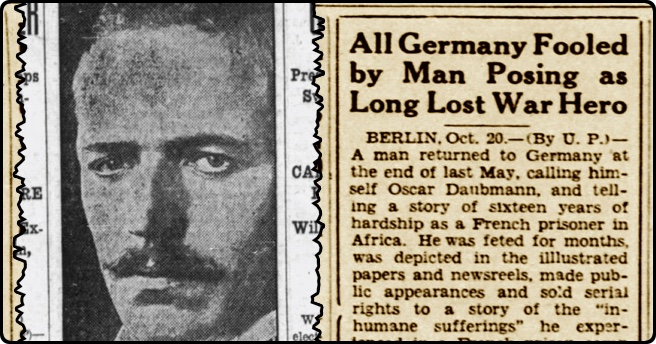
![]() Alfred Hummel as Oscar Daubmann Daubmann told a dramatic tale of imprisonment and escape. He said he had been captured by the French in October 1916 at the Battle of the Somme and was placed in a prison camp. After killing a guard during an unsuccessful escape attempt, he was sentenced to 20 years hard labor and transferred to Algeria. There he was tortured, starved, and kept in solitary confinement. Finally, years later, he was transferred to the prison tailor shop on account of good behavior, and from there was able to make a successful escape. He walked 3000 miles along the coast and was picked up by an Italian steamer that took him to Naples. He then returned to Germany. More >>> Categories: Hoaxes involving false or disguised identity, Imposters, Military Hoaxes, Phony Veterans, 1939-1930
| |
![]() |
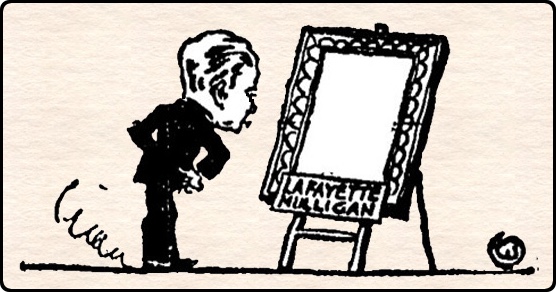
Lafayette Mulligan (1924) |
|
In 1924 a man calling himself Lafayette Mulligan presented the Prince of Wales with the key to the City of Boston, while the Prince was vacationing in Massachusetts. However, the Mayor of Boston had no idea who Lafayette Mulligan was. In fact, Lafayette Mulligan was not a real person at all.
More >>>
Categories: Hoaxes involving false or disguised identity, Fictitious Persons, Political Hoaxes, Pranks, 1929-1920
| |
![]() |
The Dreadnought Hoax (February 7, 1910) |
![]() "The Emperor of Abyssinia" and his suite From left to right: Virginia Stephen (Virginia Woolf), Duncan Grant, Horace Cole, Anthony Buxton (seated), Adrian Stephen, Guy Ridley. | |
![]() |
Tom Thumb’s Baby (circa 1865) |
|
On February 10, 1863 Tom married Lavinia Warren, a woman equally small in size. The two then toured together through Europe as husband and wife. To complete the scene of domestic bliss, Barnum often had Lavinia pose holding a baby. It was claimed that this was the child of Lavinia and Tom, but in fact it was simply an orphaned baby Barnum had provided them with. Because of her size, Lavinia was incapable of having a baby of her own. Unfortunately, as the baby grew it soon began to overshadow Lavinia. Therefore Barnum switched the infant with a smaller one. He repeated this practice whenever each successive baby grew too large for its 'parents.' Categories: Birth Hoaxes, Hoaxes involving false or disguised identity, Entertainment and Show Business Hoaxes, The Hoaxes of P.T. Barnum, 1899-1850
| |
|
Page 1 of 1 pages
|


In 1994 a teenage boy called JT (or Jeremy "Terminator") LeRoy began to attract attention in the literary community. He published a few short stories, but he also aggressively reached out to other, older writers, communicating with them by phone, email, and fax. He was a sympathetic character a transgendered, homosexual, drug-addicted, pathologically shy teenager who had been living on the streets, forced into a life of truck-stop prostitution by his mother. Writing seemed to offer a means for him to escape that life, and other writers strongly supported his efforts. In 1999 he published his first novel, Sarah, which was a critical success. More books followed, as well as celebrity friendships. By 2005, when he was in his mid-twenties, his stature as a literary star appeared to be secure. His books were selling well, and one of them, The Heart Is Deceitful Above All Things, was being made into a movie. But this stature was shaken when, in October 2005, author Stephen Beachy published an article in New York Magazine that asked a simple question: Was JT LeRoy a real person?

On December 3, 2004 the BBC broadcast an interview with Jude Finisterra, who claimed to be a representative of Dow Chemical. The date was the 20th anniversary of the chemical disaster in Bhopal, and the BBC had sought out a representative from Dow to speak about the tragedy since Dow had inherited responsibility for the disaster via a corporate acquisition. During the interview, Mr. Finisterra shocked the BBC's audience when he said that not only had Dow decided to accept full responsibility for the incident, but that it was going to pay $12 billion in compensation to the victims. In response to the news, Dow's stock value promptly dropped.

Esquire magazine's November 1996 cover featured Allegra Coleman, said to be a hot new star taking Hollywood by storm. "Forget Gwyneth, Forget Mira," the cover declared. "Here's Hollywood's next Dream Girl."

John Howard Griffin was a white native Texan novelist and journalist with a strange idea that he couldn't get out of his head. What if a white man became a black man for six weeks and traveled through Deep South states such as Georgia, Alabama, Louisiana, and Mississippi?