Site Map
Hoax Archive: Categories
Cryptozoology Hoaxes
Jacko (July 4, 1884)
The British Columbia Daily Colonist reported that a gorilla-type creature had been captured by railway workers and was being held in a local jail. It was given the nickname "Jacko." However, the entire thing turned out to be a hoax, as the hundreds of people who visited the jail and tried to view Jacko discovered, since Jacko was nonexistent. This story languished in obscurity until the 1950s when a reporter came across a reference to it (unaware it had turned out to be a newspaper hoax) and publicized it as an early example of a Sasquatch sighting.
| Categories: Cryptozoology Hoaxes, Bigfoot Hoaxes, 1869-1913 |
The Loch Ness Monster (1933-Present)
Ancient Scottish legend told of a "beast" that lived in the waters of Loch Ness. St. Columba, for instance, was supposed to have encountered a large serpent in the River Ness over 1400 years ago. But the modern history of Nessie began in 1933 when a new road was completed along the northern shore of the Loch, providing easy access to unobstructed views of the water. Soon after this, a couple spotted an "enormous animal" in the Loch. The Inverness Courier wrote up their sighting, describing what they saw as a "monster;" intense media interest followed; and thus was born the modern Loch Ness Monster.
More→
| Categories: Pseudoscience Hoaxes, Cryptozoology Hoaxes, Zoology Hoaxes, 1914-1949 | Haiku |
The Spray Photograph (November 12, 1933)
On November 12, 1933, Hugh Gray was walking back from church along the shore of Loch Ness when, so he later claimed, he saw an "object of considerable dimensions—making a big splash with spray on the surface" of the Loch. Luckily he had his camera with him, so he began snapping pictures. Only one of the pictures showed anything. Nessie believers hailed it as the first photographic evidence of the monster. Skeptics, however, dismissed it as a blurry mess that doesn't show anything at all. Many have suggested that it looks like a distorted image of a dog (perhaps Mr. Gray's own) carrying a stick in its mouth as it swims through water.
| Categories: Cryptozoology Hoaxes, Loch Ness Monster Hoaxes, 1914-1949 |
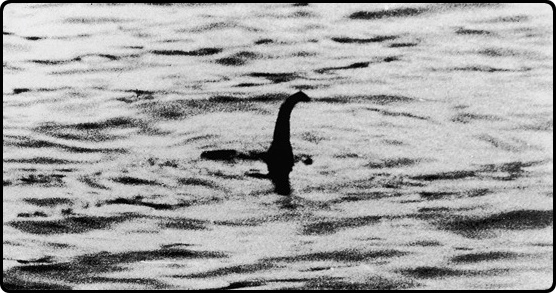
The Surgeon’s Photo, 1934 (April 1934)
In April 1934, Colonel Robert Wilson, a respected British surgeon, came forward with a picture that appeared to show a sea serpent rising out of the water of Loch Ness. Wilson claimed he took the photograph early in the morning on April 19, 1934, while driving along the northern shore of the Loch. He said he noticed something moving in the water and stopped his car to take a photo. For decades this photo was considered to be the best evidence of the existence of a sea monster in the Loch. But Wilson himself refused to have his name associated with it. Therefore it came to be known simply as "The Surgeon's Photo."
More→
| Categories: Cryptozoology Hoaxes, Loch Ness Monster Hoaxes, 1914-1949 |
The Stuart Photograph (July 14, 1951)
| Categories: Photography Hoaxes, Cryptozoology Hoaxes, Loch Ness Monster Hoaxes, 1950-1976 |
The MacNab Photograph (July 29, 1955)
| Categories: Photography Hoaxes, Cryptozoology Hoaxes, Loch Ness Monster Hoaxes, 1950-1976 |
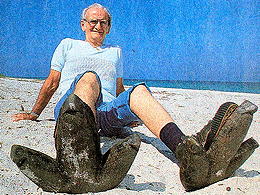
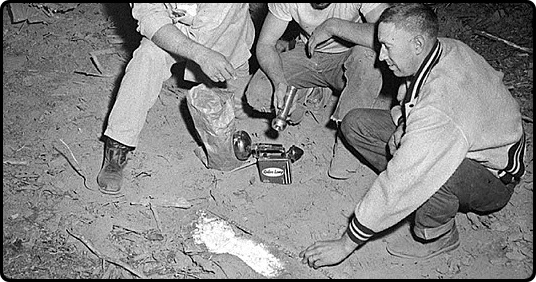
The Birth of Bigfoot, 1958 (August 27, 1958)

Jerry Crew
| Categories: Cryptozoology Hoaxes, Bigfoot Hoaxes, 1950-1976 |
The Patterson-Gimlin Bigfoot Film (October 20, 1967)
October 20, 1967: Roger Patterson and Bob Gimlin travelled on horseback into the Six Rivers National Forest of northern California, carrying with them a 16mm camera, determined to get some footage of Bigfoot. Near Bluff Creek they spotted what appeared to be a female Bigfoot (shown in the thumbnail) striding along a riverbank. Patterson managed to record 952 frames of film before the creature disappeared into the forest. The footage he took remains, by far, the most famous evidence of Bigfoot's existence. But rumors abound that Patterson and Gimlin were either victims of a hoax, or perpetrators of one. One theory is that the creature filmed by Patterson/Gimlin was the creation of John Chambers, lead make-up artist on the Planet of the Apes (filmed in 1967). More recently, a man named Bob Heironimus has come forward who claims he was hired by Gimlin to wear an ape suit and pretend to be Bigfoot for their film.
More→
| Categories: Cryptozoology Hoaxes, Bigfoot Hoaxes, 1950-1976 |
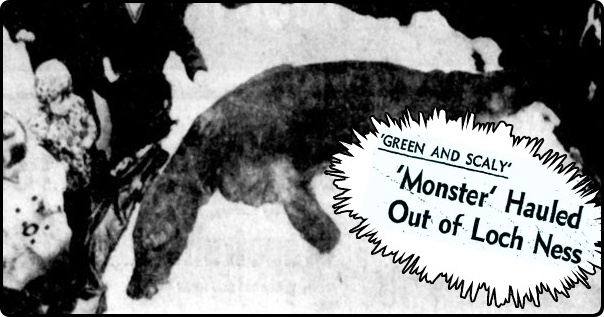
Body of Nessie Found, 1972 (March 31, 1972)
On the day before April Fool's Day, 1972, a team of British zoologists from the Flamingo Park Zoo found a mysterious carcass floating in Loch Ness. Initial reports claimed it weighed a ton and a half and was 15 ½ feet long.
More→
| Categories: Cryptozoology Hoaxes, Loch Ness Monster Hoaxes, 1950-1976 |
Frank Searle, Monster Hunter (early 1970s to mid 1980s)
Frank Searle, a former army captain, arrived in Loch Ness to search for the monster during the early 1970s and soon established a reputation as a definite character. He was like a colonial-style adventurer, assisted by a succession of attractive young "monster huntresses." He took an enormous number of photos of Nessie, many of which were published by the media, but all of which have been dismissed by experts as fakes. His early photos, such as the one to the right (taken in October 1972) have been identified as pictures of floating tree trunks. In later photos he progressed to cutting-and-pasting dinosaurs from postcards into his images. Searle left the loch in 1985 and died in 2005.
The Flipper Photo (August 7, 1972)
Nessiteras Rhombopteryx (1975)
Sir Peter Scott of the Loch Ness Phenomena Investigation Bureau participated in the 1972 expedition that produced the flipper photo. Feeling that the photo provided proof that some kind of large creature existed in the loch, he decided to give the animal a scientific name: Nessiteras Rhombopteryx (which meant "the Ness wonder with a diamond fin"). But London newspapers soon pointed out that if you juggled around the letters in this name, you got the phrase "monster hoax by Sir Peter S." Was this evidence that the flipper photo had been a deliberate hoax? Scott denied it. Dr. Rines came to his rescue by pointing out that if you juggled the letters around a bit more, you could spell "Yes, both pix are monsters. R."
| Categories: Zoology Hoaxes, Cryptozoology Hoaxes, Loch Ness Monster Hoaxes, 1950-1976 |
Bride of Bigfoot (May 1976)
Cherie Darvell was a member of a film crew searching for Bigfoot in the woods outside Eureka, California. Unfortunately for her, she found Bigfoot and he abducted her. Or so she claimed. Humboldt County organized a search party to find her, but without success. (Total cost for the search: $11,613. Humboldt County tried to sue Shasta County to make them pay a portion of the cost, but a judge struck down their suit, ruling that the search for Bigfoot had been an "exercise in futility.") A few days later, Darvell walked into a nearby resort, looking none the worse for wear, despite her experience as a Bride of Bigfoot. When reporters tried to ask her questions about her ordeal, her only response was to scream. Her fellow filmmakers, Ed Bush and Terry Gaston, later released a movie showing her being carried away by Bigfoot. It crossed the minds of a few people that the "abduction" had been simply an elaborate publicity stunt.
| Categories: Cryptozoology Hoaxes, Bigfoot Hoaxes, Abduction Hoaxes, 1950-1976 |
The Loch Ness Muppet, 1977 (May 21, 1977)
| Categories: Photography Hoaxes, Cryptozoology Hoaxes, Loch Ness Monster Hoaxes, 1977-1989 |
Loch Ness Conger Eels (May 2, 2001)
May 2, 2001: Two large, serpent-like conger eels were found on the shore of the loch. Since the eels were saltwater creatures and the loch is freshwater, they evidently had been placed there. The leading theory was that a hoaxer, hoping the eels would be mistaken for mini-Nessies, had dumped them there.
| Categories: Cryptozoology Hoaxes, Loch Ness Monster Hoaxes, 2000-Present |
All text Copyright © 2011 by Alex Boese, except where otherwise indicated. All rights reserved.