The Museum of Hoaxes
HOME   |   ABOUT   |   FORUM   |   CONTACT   |   PINTEREST   |   FACEBOOK   |   TWITTER   |   RSS
Eras: 0-1699 1700s 1800-1868 1869-1913 1914-1949 1950-1976 1977-1989 1990s 2000s
The Hoaxes of Alan Abel
During the early 1950s, Alan Abel headed to New York City, hoping to establish himself as a comedian. Unfortunately, he had little luck getting work, so he had to take a desk job at the American Automobile Association. Bored to tears, he soon found himself playing pranks on unsuspecting customers by giving them bizarre driving instructions.

It was around this time that he began to realize he was more suited to a career as a full-time prankster than anything else. Still frustrated from trying to break into comedy by traditional routes, he also realized that hoaxing offered a great way to take matters into his own hands and gain media exposure that was otherwise being denied to him. His big breakthrough was the "Society for Indecency to Naked Animals" hoax in 1959 that launched him onto his career as a hoaxer.

By the mid-1970s he had become a well-known public figure, and he continued to practice his brand of irreverent humor during the following decades. Ideas for new hoaxes seemed to flow continually from his brain. He even managed to establish himself as something of a professional hoaxer by appearing for a fee at business conventions. He would pretend to be a serious speaker whose presentation would gradually grow stranger and stranger.

His stunts succeeded in amusing many and angering others, but they almost always commanded attention.
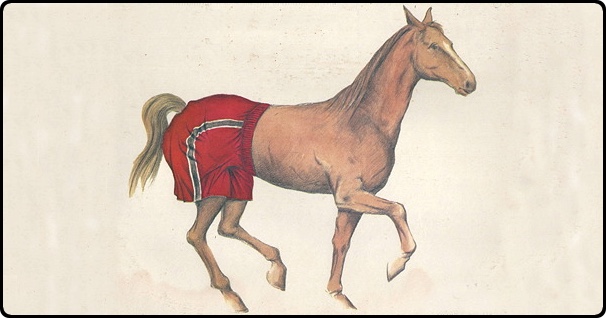
G. Clifford Prout was a man with a mission, and that mission was to put clothes on all the millions of naked animals throughout the world. To realize his dream, Prout founded an organization, the Society for Indecency to Naked Animals (abbreviated as SINA). It was left unexplained why the society was 'for indecency' not 'against indecency'. More→
Yetta Bronstein, a 48-year-old Bronx housewife, ran for President in 1964 and again in 1968 as the candidate for the Best Party. Her slogans were "Vote for Yetta and watch things get better" and "Put a mother in the White House."

Her proposals included national bingo, self-fluoridation, placing a suggestion box on the White House fence, and printing a nude picture of Jane Fonda on postage stamps "to ease the post office deficit and also give a little pleasure for six cents to those who can't afford Playboy magazine."

She promised she would staff her cabinet with "people who have failed in life and learned to live with it." More→
On January 2, 1980 the New York Times announced the death of Alan Abel on its obituary page. It provided a flattering account of his career. The obituary read, in part:

Alan Abel, a writer, musician and film producer who specialized in satire and lampoons, died of a heart attack yesterday at Sundance, a ski resort near Orem, Utah, while investigating a location for a new film. He was 50 years old and lived in Manhattan and Westport, Conn.

Mr. Abel, a graduate of Ohio State University with majors in music and speech, made a point in his work of challenging the obvious and uttering the outrageous. He gained national recognition several years ago when he mounted a campaign for animal decency, demanding that horses and dogs, for example, be fitted with underwear.

Unfortunately for the Times, Abel was not dead. The Times learned this when Abel held a press conference the next day in which he revealed that the news of his death was a hoax engineered by himself and a team of twelve accomplices. It is reported that the editor of the Times was so mad at the deception, that he vowed to never print Abel's name again. This was a vow the editor was unable to keep.
FAINT, 1985 (January 21, 1985)
On January 21, 1985, the daily broadcast of the Donahue show was devoted to a typically unusual subject — gay senior citizens. But few people would later remember the topic of that day's show, because as the live broadcast progressed seven members of the audience proceeded to faint. Concerned by the bizarre outbreak of swooning, Donahue cancelled the rest of the show and sent everyone home.

The producers theorized that the hot temperature inside the studio might have caused the people to collapse, but a few days later Deborah Harmon, one of the fainters, admitted she had been paid to do so by the well-known prankster Alan Abel. He had also paid the six other audience members who had fainted.

Abel later explained that the stunt was designed as a protest against the deteriorating quality of daytime talk shows. He claimed that a group called FAINT (Fight Against Idiotic Neurotic TV) had spearheaded the protest. "We want to raise the consciousness of the public by going unconscious," he said.

The stunt attracted more censure than any of Abel's other pranks because critics charged that it could have inspired panic at a time when there was public concern over the possible spread of Legionnaire's disease. More→
All text Copyright © 2011 by Alex Boese, except where otherwise indicated. All rights reserved.