About This Page
This page is part of the Hoax Archive, a collection of history's most interesting and notorious deceptions categorized by theme and time period.
Hoax Archive Categories
Hoax Museum Archives
Advertising Hoaxes
![]() |
Wine Spectator Hoaxed (Revealed August 2008) |
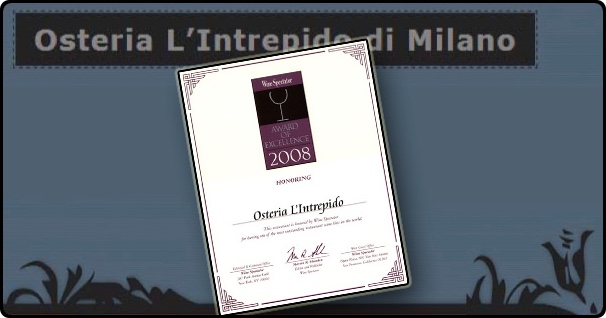
Since 1981 the magazine Wine Spectator has given "Awards of Excellence" to restaurants that it deems to have exceptional wine lists. To win an award a restaurant must submit their wine list to the magazine and pay a $250 application fee. Over two-thirds of the restaurants who submit an application win an award, and the contest earns Wine Spectator over $1 million a year in fees. In 2008 the magazine gave an award to Osteria L’Intrepido, a restaurant in Milan, Italy. It was later embarrassed to discover that this restaurant did not exist.
More >>> | |
![]() |
The Loch Ness Tooth (March 2005) |
March 2005: Two American students visiting Scotland claimed to have found an enormous tooth (possibly belonging to Nessie) lodged in the carcass of a deer along the shore of the loch. However, (so they said) a game warden who happened to be passing by almost immediately confiscated the tooth from them, though not before they got a few pictures of it. The students subsequently created a website to publicize their find and lobby for the return of the tooth. But animal experts identified the "tooth" from its picture as the antler of a roe muntjac deer. The website and accompanying story then turned out to be a publicity stunt for a horror novel by Steve Alten titled The Loch.
| |
![]() |
|
The website of Colin Mayhew offered details on how this eccentric, but apparently brilliant, engineer had built an "autonomous crash-preventing robot" from the body of a BMW Mini Cooper r50. Video showed the humanoid robot in action, stopping a car from crashing into a wall. The Mini Cooper Autonomous Robot was eventually revealed to be an elaborate viral marketing campaign designed to promote the new Mini Cooper.
More >>> Categories: Advertising Hoaxes, Viral (hoax) Marketing Campaigns, Internet Hoaxes, Hoax Websites, Technology Hoaxes, Robot Hoaxes, 2009-2000
| |
![]() |
Hunting for Bambi (July 2003) |
In July 2003, Las Vegas TV station KLAS-TV reported that a local company was selling “Bambi Hunts.” These were games in which men with paintball guns hunted naked women in the Nevada desert. Anyone could sign up to join in a "hunt", although it could cost as much as $10,000 per game. An international media frenzy ensued. Numerous critics denounced the hunts, pointing out that a paintball hitting a naked woman could seriously hurt her. Many questioned how such a thing could be legal.Only after a week did it become widely apparent that there was no evidence the company had conducted any Bambi hunts. The company wasn’t currently accepting customers (it said there was too much negative publicity), and everyone who claimed to have participated in previous hunts was highly unreliable. Further research revealed that the company was only licensed to sell videos. If it had run commercial paintball games, it had done so illegally. When the Las Vegas authorities threatened to bring charges against the company, its president, Michael Burdick, admitted that no real Bambi hunts had taken place. The story about the hunts had, he said, just been a “hook” to boost sales of a soft-porn video about a fictional Bambi Hunt. The hook worked. Though their stunt almost got them run out of Las Vegas, Burdick’s company sold thousands of copies of the video. Categories: Advertising Hoaxes, Outrage Hoaxes, Sex Hoaxes, Sports Hoaxes, Hoaxes That Fooled Journalists, 2009-2000
| |
![]() |
The Cesky Sen Hypermarket (May 2003) |
|
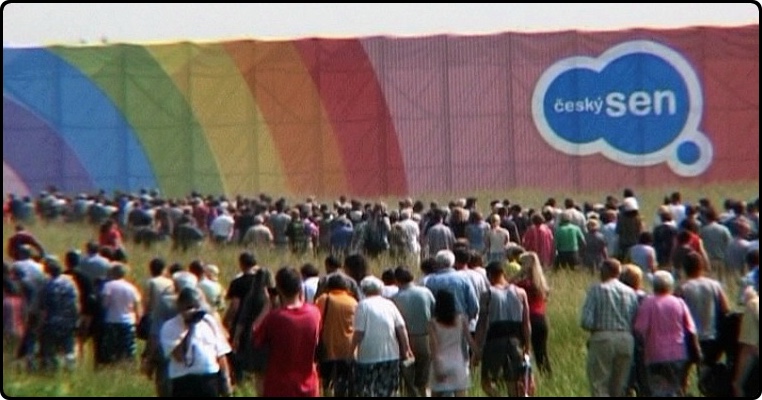
In early 2003 advertisements began to appear throughout Prague promoting a new hypermarket called Cesky Sen (or "Czech Dream") opening soon in the Lethany Fairgrounds. The ads appeared on billboards, at bus stops, in newspapers, and on TV. The store promised ultra-low prices, such as TVs for $19 and mineral water for pennies, and a special surprise for anyone who came to the grand opening on May 31, 2003.
On the day of the grand opening, hundreds of eager consumers parked their cars at the Lethany Fairgrounds and approached the store. They could see its bright colors in the distance. Shopping bags in hand, they ran across the fairgrounds, only to find... nothing but a 26x260 foot Cesky-Sen banner fluttering in the wind. This was the special surprise. More >>> Categories: Advertising Hoaxes, 2009-2000
| |
![]() |
The Microsoft iLoo (April 30, 2003) |
![]() The iLoo, the press release promised, would include a wireless keyboard, a height-adjustable flat plasma screen, a six-channel surround-sound speaker system installed under the sink, broadband internet access, toilet paper conveniently printed with url suggestions, and (last but not least) a toilet outfitted with vacuum suction to guarantee maximum hygiene. More >>> | |
![]() |
David Manning (Exposed in June 2001) |
|
No matter how bad the movies of Columbia Pictures were, there was always one reviewer sure to heap praise on them David Manning of the Ridgefield Press. For instance, while other reviewers skewered Hollow Man, Manning declared it, "One helluva scary ride! The summer's best special effects." The sophomoric comedy The Animal impressed him as "another winner," and he singled out Heath Ledger of A Knight's Tale as "this year's hottest new star." These comments all appeared prominently in print ads for these films.
David Manning's rave reviews might have gone forever unnoticed. After all, few people pay much attention to the hyperbolic comments that grace most movie ads. However, during the course of investigating the journalistic subworld of movie junkets, Newsweek Reporter John Horn uncovered the curious truth behind David Manning. The Ridgefield Press, a small weekly newspaper based in Connecticut, had never heard of the man. Nor was Manning known by any of the other reporters who frequented the junket circuit. In fact, Manning didn't exist at all. He was, Horn discovered, the fictional creation of a young marketing executive at Sony, the parent company of Columbia Pictures. More >>> | |
![]() |
Ron’s Angels (Exposed in October 1999) |
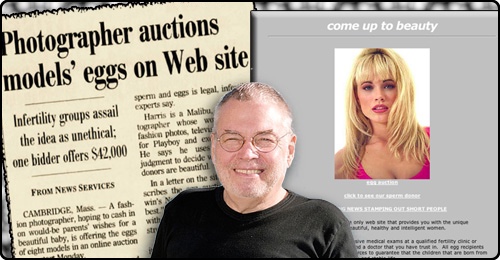
It is legal to sell donor eggs to infertile couples. However, Ron Harris, an erotic photographer, proposed taking this process one step further. He established a website, Ronsangels.com, at which nubile supermodels auctioned off their eggs to the highest bidders. The concept outraged other members of the infertility industry.
More >>> Categories: Advertising Hoaxes, Birth Hoaxes, Internet Hoaxes, Hoax Websites, Sex Hoaxes, Hoaxes That Fooled Journalists, 1999-1990
| |
![]() |
The Blair Witch Project (1999) |
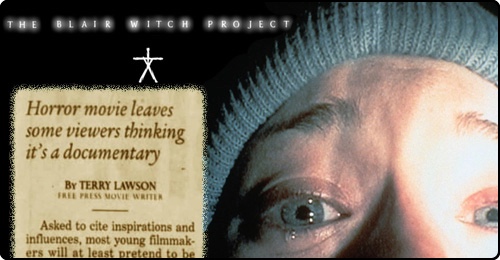
In 1999 The Blair Witch Project became a multimillion-dollar box-office sensation. Much of this success owed to a clever marketing scheme centering around a website, blairwitch.com. The premise of the site (and the movie) was that in 1994 three student filmmakers had disappeared in the woods near Burkitsville, Maryland while shooting a documentary about the local legend of the Blair Witch. Supposedly the Blair Witch was Elly Kedward, a woman who had been accused of witchcraft and child murder back in 1785 and had been banished from the town, left to die of cold in the woods. Her spirit was said to still haunt the area. Visitors to blairwitch.com could view detailed historical information about the legend of the Blair Witch, including old photographs, police reports, letters, and interviews with officials. It was all so convincing that many people were fooled into believing that Elly Kedward was a real historical figure, and that there really was a legend of a Blair Witch. There wasn't. The entire tale was fictitious. The site revolutionized internet marketing. Movie studios started churning out hoax websites to accompany their movies, in the hope of generating the same kind of buzz that the Blair Witch Project enjoyed. But none of these efforts has yet matched the success of BlairWitch.com. | |
![]() |
The Sneaker Pimps Crop Circle (July 1997) |
In July 1997 a crop circle resembling the logo of a popular band, the Sneaker Pimps, appeared in Warwickshire, England. This band was playing in the nearby Phoenix music festival. No one ever took credit for the formation. Cerealogists Andy Thomas and Mike Leigh have suggested that "the thought patterns of those at the festival had somehow coalesced to create it in ways which experiments had shown possible." An alternative (more plausible) explanation is that it was created either by a fan, or by a public-relations agent trying to publicize the band.
| |
![]() |
The Sibuxiang Beast (September 1994) |
|
On the evening of September 19, 1994 a stark warning was repeatedly broadcast to TV viewers in Taiyuan, a city in northern China. A message scrolled across an otherwise blank screen warning that the Sibuxiang beast, a mythical creature whose bite was said to be fatal, was not only real, but on the loose and heading towards the city. "It is said that the Sibuxiang is penetrating our area from Yanmenguan Pass and within days will enter thousands of homes," the message read. "Everyone close your windows and doors and be on alert."
The residents of Taiyuan panicked. Many of them barricaded themselves inside their homes, fearing to go out. Others called the local authorities to find out what was happening... More >>> | |
![]() |
The BMW Crop Circle (February 1993) |
A crop circle appeared in a field of rye located outside of Johannesburg, South Africa during the first week of February 1993.The South African media speculated excitedly about whether it was the work of a UFO. Many newspapers and TV and radio shows discussed it, fanning interest in the incident. Popular curiosity grew until February 14, when a small detail was pointed out that had previously escaped almost everyone's notice: the circle formed a BMW logo. The circle turned out to be the work of the Hunt Lascaris ad agency, working on behalf of BMW. TV commercials soon followed, showing aerial views of the circle accompanied by the tag-line, "Perhaps there is intelligent life out there after all." Hunt Lascaris estimated that it received over $1 million worth of free publicity from the stunt. | |
![]() |
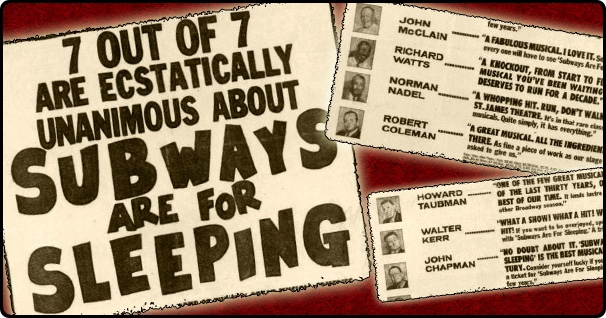
Subways Are For Sleeping (1961) |
![]() Advertisement for Subways Are For Sleeping that ran in the New York Herald-Tribune The ad would have appeared in all the leading New York City papers, but an editor at one paper noticed something puzzling about it before he gave the okay to publish it. Small pictures of the theatre critics accompanied their quotations. However, the picture of Richard Watts showed a black man, and the editor knew that Richard Watts, the theater critic, was white... More >>> | |
![]() |
Ghost Artists (February 1952) |
On February 5, 1952, a small ad ran on the theatrical page of the Washington Post offering the services of a company of "ghost artists": "Too busy to paint? Call on the Ghost Artists? We paint it, you sign it."The idea of ghost artists caught the interest of the media, and a report about the company went out over the wire services and appeared in newspapers nationwide. The ghost artists were said to be earning lucrative fees from executives who wanted to impress their friends. Satisfied clients included military men, government officials, doctors, businessmen, and a Wall Street broker who commissioned an entire exhibition in order to break into "arty circles." More >>> Categories: Advertising Hoaxes, Art Hoaxes, Satirical Art Hoaxes, Hoaxes That Fooled Journalists, The Hoaxes of Hugh Troy, 1959-1950
| |
![]() |
The Kidnapping of Nicole Riche (March 29, 1950) |
![]() Nicole Riche Categories: Advertising Hoaxes, April Fool's Day Hoaxes, Entertainment and Show Business Hoaxes, Abduction Hoaxes, 1959-1950
| |


Since 1981 the magazine Wine Spectator has given "Awards of Excellence" to restaurants that it deems to have exceptional wine lists. To win an award a restaurant must submit their wine list to the magazine and pay a $250 application fee. Over two-thirds of the restaurants who submit an application win an award, and the contest earns Wine Spectator over $1 million a year in fees. In 2008 the magazine gave an award to Osteria L’Intrepido, a restaurant in Milan, Italy. It was later embarrassed to discover that this restaurant did not exist.
March 2005: Two American students visiting Scotland claimed to have found an enormous tooth (possibly belonging to Nessie) lodged in the carcass of a deer along the shore of the loch. However, (so they said) a game warden who happened to be passing by almost immediately confiscated the tooth from them, though not before they got a few pictures of it. The students subsequently created a website to publicize their find and lobby for the return of the tooth. But animal experts identified the "tooth" from its picture as the antler of a roe muntjac deer. The website and accompanying story then turned out to be a publicity stunt for a horror novel by Steve Alten titled The Loch.
The website of Colin Mayhew offered details on how this eccentric, but apparently brilliant, engineer had built an "autonomous crash-preventing robot" from the body of a BMW Mini Cooper r50. Video showed the humanoid robot in action, stopping a car from crashing into a wall. The Mini Cooper Autonomous Robot was eventually revealed to be an elaborate viral marketing campaign designed to promote the new Mini Cooper.
In July 2003, Las Vegas TV station KLAS-TV reported that a local company was selling “Bambi Hunts.” These were games in which men with paintball guns hunted naked women in the Nevada desert. Anyone could sign up to join in a "hunt", although it could cost as much as $10,000 per game. An international media frenzy ensued. Numerous critics denounced the hunts, pointing out that a paintball hitting a naked woman could seriously hurt her. Many questioned how such a thing could be legal.
It is legal to sell donor eggs to infertile couples. However, Ron Harris, an erotic photographer, proposed taking this process one step further. He established a website, Ronsangels.com, at which nubile supermodels auctioned off their eggs to the highest bidders. The concept outraged other members of the infertility industry.
In 1999 The Blair Witch Project became a multimillion-dollar box-office sensation. Much of this success owed to a clever marketing scheme centering around a website,
In July 1997 a crop circle resembling the logo of a popular band, the Sneaker Pimps, appeared in Warwickshire, England. This band was playing in the nearby Phoenix music festival. No one ever took credit for the formation. Cerealogists Andy Thomas and Mike Leigh have suggested that "the thought patterns of those at the festival had somehow coalesced to create it in ways which experiments had shown possible." An alternative (more plausible) explanation is that it was created either by a fan, or by a public-relations agent trying to publicize the band.
A crop circle appeared in a field of rye located outside of Johannesburg, South Africa during the first week of February 1993.
On February 5, 1952, a small ad ran on the theatrical page of the Washington Post offering the services of a company of "ghost artists": "Too busy to paint? Call on the Ghost Artists? We paint it, you sign it."