Site Map
Hoax Archive: Categories
Advertising Hoaxes
The Hoaxes of P.T. Barnum (1810-1891)
Phineas Taylor Barnum (1810-1891) described himself as the "Prince of Humbug," an epithet he more than earned during his long career as a showman. Barnum is best remembered today for the circus that still bears his name (and for the animal crackers named after him), but before the circus he was the proprietor of a New York museum, and it was this museum that initially made him rich and famous.Barnum's career as a showman was marked by a variety of sensational publicity stunts, hoaxes, and plain-old false advertising which he used to attract visitors to his bizarre exhibits. His promotional techniques often tested the boundaries of what the emerging nineteenth-century middle class was willing to accept, but he was somehow able to convince audiences that he was selling them entertainment, not fraud. An indication that people viewed him as a kind of lovable con-artist is the fact that the phrase, "There's a sucker born every minute," will forever be attributed to him, even though he was not the one who said it.
His money-making schemes included a series of relatively small-scale humbugs. For instance, he boasted that one of the attractions at his museum was the "Great Model of Niagara Falls with Real Water." What his visitors found, however, was just an 18-inch miniature model through which a trickle of water recirculated.
Then there was his so-called "Captain Cook Club." It was supposedly the actual club that killed Captain Cook, though it looked suspiciously like a mislabeled Indian war club.
Perhaps his most famous leg-pull was his "This Way to the Egress" sign. Curiosity seekers, thinking the 'egress' was some kind of unusual exhibit, followed the signs to it until they came, eventually, to a door that led them outside. Then they had to pay admission to get back in.
- Joice Heth, 1835 (1835)
- The Feejee Mermaid, 1842 (July 1842)
The Free Grand Buffalo Hunt (August 31, 1843)
Posters that appeared around New York City in the summer of 1843 advertised a "Grand Buffalo Hunt" that would take place across the river in Hoboken on August 31, 1843. For the entertainment of the crowd, which would be protected behind thick double-rail fencing, cowboys would pretend to hunt and lasso a herd of wild buffalo imported from New Mexico. Best of all, the event would take place free of charge.The organizer of this event was the showman P.T. Barnum, and naturally he had a scheme to make money from it. He had secretly cut a deal with the operators of the Hoboken ferry, so that he would receive half of their net receipts. The more people he could entice to make the trip to Hoboken, the more cash he would pocket. He expected around 16,000 to make the trip, but 24,000 people showed up, unable to resist the lure of a "free" show. Barnum ended up pocketing a profit of $3500 for the day.
However, the show proved to be not quite what it had been advertised. Instead of a herd of wild, dangerous buffalo, the crowd was greeted by a ragtag group of scrawny, malnourished creatures that Barnum had bought from a local merchant for $700. When the crowd started hooting and hollering, the buffalo became frightened and broke through the "thick double-rail fencing" (which was really just a flimsy barrier) and escaped into the surrounding swampland.

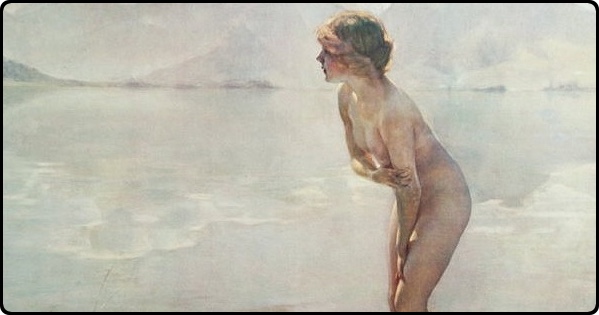
| Categories: Advertising Hoaxes, Art Hoaxes, Satirical Art Hoaxes, Outrage Hoaxes, Sex Hoaxes, 1869-1913 |
Stotham: The Town That Didn’t Exist, 1920 (April 1920)
The quaint Massachusetts town of Stotham, described in an advertising monograph as an example of an unspoiled New England village, didn't actually exist.
| Categories: Advertising Hoaxes, Fictitious Places, 1914-1949 |
The Brazilian Invisible Fish (circa 1928)
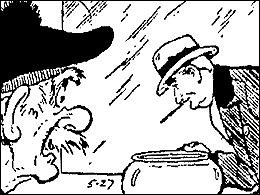
Harry Reichenbach (1882-1931) was a publicist whose career spanned the early twentieth century. He was responsible for promoting many movies and show business personalities. In his autobiography, Phantom Fame (written with the help of David Freedman), Reichenbach described a publicity stunt he devised early in his career that has since become a classic example of inventive (though misleading) low-budget promotion. It involved a creature called the "Brazilian Invisible Fish."
More→
| Categories: Advertising Hoaxes, Hoaxes Involving Animals, 1914-1949 |
Hoaxes & Stunts of Jim Moran (1907-1999)
Jim Moran (1907-1999) was called, at various times, "super salesman number one," "America's No. 1 prankster," and "the last great bunco artist in the profession of publicity." He became famous during the 1930s and 40s for devising outrageous stunts on behalf of his clients. His favorite technique was to test the validity of popular sayings. For instance, he sold an icebox to an eskimo, found a needle in a haystack, and walked a bull through a china shop.
More→ | Categories: Advertising Hoaxes, Pranks, Serial Pranksters, 1914-1949 |
The Kidnapping of Nicole Riche, 1950 (March 29, 1950)
At 3 a.m. on the morning of Saturday, April 1, 1950 the 22-year-old French actress Nicole Riche walked into a Paris police station dressed in a flimsy white negligee. She had been missing for over two days. When the police questioned her about where she had been, she spilled forth a bizarre tale about being kidnapped by "Puritans" who kept her in a room without food while they lectured her about the immorality of her life. Finally, she said, her captors abandoned her in the Fontainebleau Forest, where she was found and helped to safety by kindly gypsies. The police believed none of her tale, and rightly so. Her "kidnapping" turned out to have been an elaborate publicity stunt designed to promote Paris's infamous Grand Guignol theater.
More→
Ghost Artists, 1952 (February 1952)
On February 5, 1952, a small ad ran on the theatrical page of the Washington Post offering the services of a company of "ghost artists": "Too busy to paint? Call on the Ghost Artists? We paint it, you sign it."The idea of ghost artists caught the interest of the media, and a report about the company went out over the wire services and appeared in newspapers nationwide. The ghost artists were said to be earning lucrative fees from executives who wanted to impress their friends. Satisfied clients included military men, government officials, doctors, businessmen, and a Wall Street broker who commissioned an entire exhibition in order to break into "arty circles." More→
The Sandpaper Test, 1959 (1960)
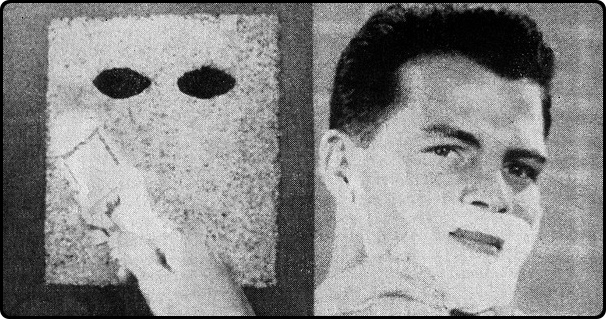
In 1959, the Colgate-Palmolive company began airing three TV ads in America for its Palmolive Rapid-Shave shaving cream. All three commercials included a "sandpaper test" designed to demonstrate that Rapid-Shave's "moisturizing" action was so powerful it would not only soften up even the heaviest beard in seconds, but also make sandpaper shaveable. But what viewers were led to believe was a piece of sandpaper being shaved was actually plexiglass covered with sand.
More→
| Categories: Advertising Hoaxes, 1950-1976 |
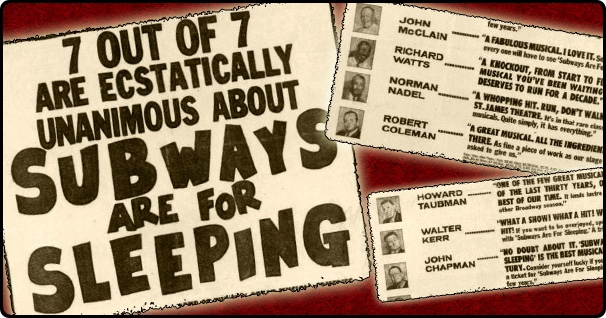
Subways Are For Sleeping, 1962 (January 4, 1962)
San Serriffe, 1977 (April 1, 1977)
The BMW Crop Circle, 1993 (February 1993)
A crop circle appeared in a field of rye located outside of Johannesburg, South Africa during the first week of February 1993.The South African media speculated excitedly about whether it was the work of a UFO. Many newspapers and TV and radio shows discussed it, fanning interest in the incident. Popular curiosity grew until February 14, when a small detail was pointed out that had previously escaped almost everyone's notice: the circle formed a BMW logo.
The circle turned out to be the work of the Hunt Lascaris ad agency, working on behalf of BMW. TV commercials soon followed, showing aerial views of the circle accompanied by the tag-line, "Perhaps there is intelligent life out there after all." Hunt Lascaris estimated that it received over $1 million worth of free publicity from the stunt. More→
| Categories: Advertising Hoaxes, Paranormal Hoaxes, Crop Circle Hoaxes, 1990-1999 |
The Sibuxiang Beast, 1994 (September 1994)
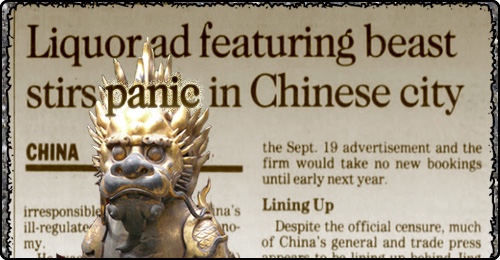
On the evening of September 19, 1994 a stark warning was repeatedly broadcast to TV viewers in Taiyuan, a city in northern China. A message scrolled across an otherwise blank screen warning that the Sibuxiang beast, a mythical creature whose bite was said to be fatal, was not only real, but on the loose and heading towards the city. "It is said that the Sibuxiang is penetrating our area from Yanmenguan Pass and within days will enter thousands of homes," the message read. "Everyone close your windows and doors and be on alert."
The residents of Taiyuan panicked. Many of them barricaded themselves inside their homes, fearing to go out. Others called the local authorities to find out what was happening... More→
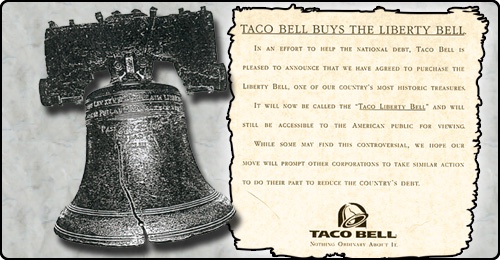
The Taco Liberty Bell, 1996 (April 1, 1996)

| Categories: Advertising Hoaxes, April Fool's Day Hoaxes, 1990-1999 | Haiku |
The Sneaker Pimps Crop Circle (July 1997)
In July 1997 a crop circle resembling the logo of a popular band, the Sneaker Pimps, appeared in Warwickshire, England. This band was playing in the nearby Phoenix music festival. No one ever took credit for the formation. Cerealogists Andy Thomas and Mike Leigh have suggested that "the thought patterns of those at the festival had somehow coalesced to create it in ways which experiments had shown possible." An alternative (more plausible) explanation is that it was created either by a fan, or by a public-relations agent trying to publicize the band.
| Categories: Advertising Hoaxes, Paranormal Hoaxes, Crop Circle Hoaxes, 1990-1999 |
All text Copyright © 2011 by Alex Boese, except where otherwise indicated. All rights reserved.