The Museum of Hoaxes
HOME   |   ABOUT   |   FORUM   |   CONTACT   |   FACEBOOK   |   TWITTER   |   RSS
The Archive of Hoaxes Before 1700 1700-1799 1800-1868 1869-1913 1914-1949 1950-1976 1977-1989 1990-1999 21st Century
Sub-Archives   Hoax Photo Archive April Fools Archive Tall-Tale Creature Archive
The Hoax Archive
A collection of the most notorious deceptions throughout history
1990-1999
LIST OF TITLES
The Cross-Dressing Ken Doll July 1990Operation Blackbird July 1990The Buckwheat Imposter October 1990Milli Vanilli Exposed in November 1990Russia Sells Lenin’s Body November 1991The Wingdings Prophecies 1992Ghostwatch October 31, 1992Grunge Speak November 1992The BMW Crop Circle February 1993Arm the Homeless December 1993The Sibuxiang Beast September 1994Microsoft Buys the Catholic Church Late 1994Alien Autopsy 1995The Taco Liberty Bell April 1, 1996The Sokal Hoax May 1996Allegra Coleman November 1996The Sneaker Pimps Crop Circle July 1997Stephen Glass 1998Our First Time Exposed in July 1998The Blair Witch Project 1999The Piltdown Chicken October 1999Ron’s Angels Exposed in October 1999
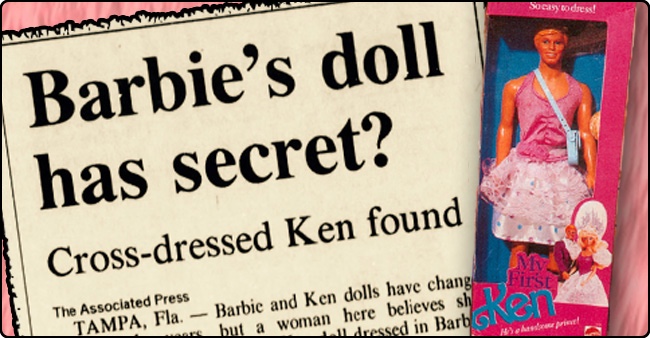
In July 1990 Carina Guillot and her 12-year-old daughter, Jocelyn, were visiting relatives in Florida when they wandered into a Toys 'R' Us store and spotted something very unusual. Standing inside a sealed cardboard package among the ranks of Ken dolls dressed in their standard-issue outfits was a Ken decked out in a purple tank top and sporting a lace apron on top of a polka-dotted skirt. Mrs. Guillot immediately thought, "Oh my God, now we have a crossed-dressed Ken." More→
Categories: Pranks,Gender Fakers

Colin Andrews confers with military personnel during Operation Blackbird
By the summer of 1990 the phenomenon of crop circles was attracting large amounts of media attention. A group of researchers, who described themselves as 'cerealogists,' set out to solve the mystery of the circles' formation once and for all. They camped out on a hillside in Wiltshire with an array of heat, light and sound detectors, in the hope of recording the creation of a crop circle.

On the second night, July 25, the Operation appeared to meet with success. The monitoring equipment recorded flashing orange lights in the adjacent field. The next morning the lead researcher excitedly told the waiting media that two large circles with parallel lines running through them had formed during the night... More→

Buckwheat, as seen on Our Gang
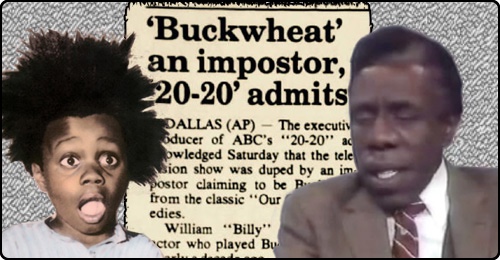
Many child stars achieve success and stability as adults, but some child stars go from stardom to the opposite extreme of anonymity and failure, as if dragged down by the weight of their early fame. According to a segment that aired on ABC News's 20/20 in October 1990, this appeared to be the fate of the actor who had played Buckwheat in the 'Our Gang' comedies of the 1930s and '40s.

Buckwheat was the wide-eyed, African-American character played for almost ten years by William Thomas. He was famous for his signature phrase, "O-Tay!" After leaving the show, Thomas dropped from the public eye. 20/20 claimed that it had tracked him down to Tempe, Arizona where he was working at a low-paying job as a grocery bagger. It aired an interview with him in which he talked about the cruel twists and turns his life had taken.

Unfortunately for 20/20, the man they interviewed was not William Thomas. Thomas had worked as a film lab technician before dying in 1980 at the age of 49. The man 20/20 interviewed was an imposter named Bill English who had been claiming to be Buckwheat for the past 30 years. The week after it aired the segment, 20/20 admitted its mistake. In the ensuing scandal, a producer was fired and 20/20 was sued for negligence by the son of the real William Thomas.

Milli Vanilli accepting a Grammy Award
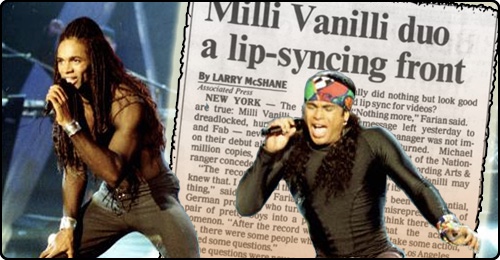
In 1988 the German record producer Frank Farian discovered Robert Pilatus and Fabrice Morvan (Rob and Fab) while they were living in Munich. Impressed by their charisma and chiselled good looks, Farian formed them into a pop group that he dubbed 'Milli Vanilli.'

Their success was almost instantaneous. They rocketed to stardom on the strength of their hit singles, Girl You Know It's True and Blame It on the Rain. Their debut album sold over seven million copies, and they won a 1989 grammy as best new artist.

But there was an ugly truth lurking behind the attractive façade presented by Rob and Fab: they possessed absolutely no musical abilities whatsoever. They couldn't play instruments, write music, or sing. All of their songs had been created in a studio by professional musicians. Whenever Rob and Fab performed on stage, they simply lip-synched the words... More→
Categories: Music Hoaxes
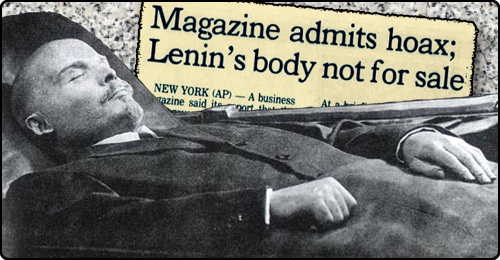
Following the collapse of the Soviet Union in 1989, the Russian government struggled to mend its ailing economy, but the nation's financial situation remained dire. In November 1991, Forbes FYI, an American business magazine, revealed just how hopeless the Russian economic situation had become. It reported that the Russian government, desperate for foreign currency, had decided to sell the embalmed body of Vladimir Lenin to the highest bidder. The body had been on public display in a Red Square mausoleum for decades. The bidding would start at $15 million.

ABC News and USA Today both repeated the story. Subsequently the editor of Forbes FYI revealed that it was a hoax. Russian Interior Minister Viktor Barrannikov denounced the joke as "an impudent lie."
Wingdings are a series of so-called "dingbat fonts" in Microsoft Word. They display symbols and pictures instead of letters, with each symbol corresponding to a different letter. In 1992, soon after the release of Windows 3.1, a rumor began to circulate alleging that anti-semitic messages had been coded into wingdings. The cause of this rumor was the (true) fact that if you typed the letters NYC using wingdings, you got a skull and crossbones, a star of David, and a thumbs up symbol. More→
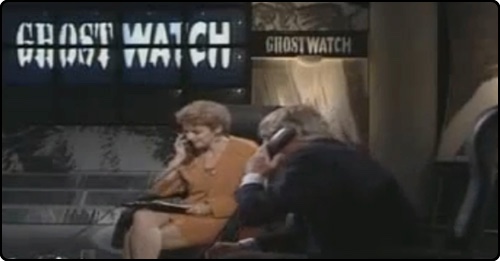
On 31 October 1992, Britain's BBC TV aired a 90-minute documentary called Ghostwatch. The program was advertised as a live investigation into reports of supernatural activity at a council house in North London. The show was anchored by a group of well-known television reporters: Michael Parkinson, Sarah Greene, Mike Smith and Craig Charles.

Michael Parkinson and Mike Smith both reported from a TV studio, where calls were being taken from the public. Experts on supernatural activity were interviewed via a satellite hook-up. Sarah Greene and Craig Charles reported live on location from the house itself.

However, events quickly took a sinister turn. A wet patch appeared in the middle of the carpet. The noise of cats was heard emanating from the walls, and scratches appeared all over body of a young girl... More→
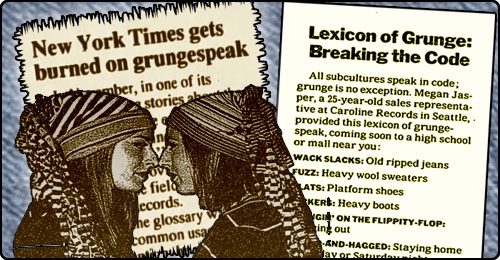
In the early 1990s, Grunge emerged as a popular new hard rock musical style. Its characteristic image was of greasy-haired, lumberjack-shirted garage bands playing punk-metal guitar rock. Groups such as Nirvana, Soundgarden, and Mudhoney epitomized this new Seattle-based sound.

On November 15, 1992 the New York Times published an article analyzing the roots and evolution of the grunge movement. It theorized that Grungers had embraced greasy hair and lumberjack shirts as a way to rebel against the vanity and flashy style of the eighties. The Times also reported that, just like any self-respecting subculture, the Grungers had developed their own lexicon of "grunge speak." More→
A crop circle appeared in a field of rye located outside of Johannesburg, South Africa during the first week of February 1993.

The South African media speculated excitedly about whether it was the work of a UFO. Many newspapers and TV and radio shows discussed it, fanning interest in the incident. Popular curiosity grew until February 14, when a small detail was pointed out that had previously escaped almost everyone's notice: the circle formed a BMW logo.

The circle turned out to be the work of the Hunt Lascaris ad agency, working on behalf of BMW. TV commercials soon followed, showing aerial views of the circle accompanied by the tag-line, "Perhaps there is intelligent life out there after all." Hunt Lascaris estimated that it received over $1 million worth of free publicity from the stunt.
A press release distributed to the media in Columbus, Ohio announced the formation of a new charity that would benefit the homeless by providing them with guns and ammunition. It was called the "Arm the Homeless Coalition." News of this charity was soon picked up by the national media and generated enormous controversy. But when an Ohio reporter tried to track down the Director of the Arm the Homeless Coalition, his investigation led him instead to a group of Ohio State University students who admitted the entire thing was a joke. More→
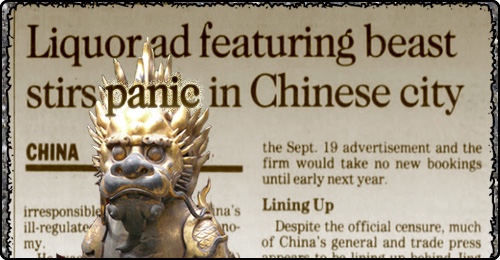
On the evening of September 19, 1994 a stark warning was repeatedly broadcast to TV viewers in Taiyuan, a city in northern China. A message scrolled across an otherwise blank screen warning that the Sibuxiang beast, a mythical creature whose bite was said to be fatal, was not only real, but on the loose and heading towards the city. "It is said that the Sibuxiang is penetrating our area from Yanmenguan Pass and within days will enter thousands of homes," the message read. "Everyone close your windows and doors and be on alert."

The residents of Taiyuan panicked. Many of them barricaded themselves inside their homes, fearing to go out. Others called the local authorities to find out what was happening... More→
In 1994 a press release began circulating online, primarily via email, claiming that Microsoft had bought the Catholic church. (Click here to read the press release.) The announcement, which bore a Vatican City dateline, noted that this was "the first time a computer software company has acquired a major world religion." The release then quoted Microsoft Chairman Bill Gates as saying that he considered religion to be a growth market and that, "The combined resources of Microsoft and the Catholic Church will allow us to make religion easier and more fun for a broader range of people." Under the terms of the deal, Microsoft would acquire exclusive electronic rights to the Bible and would make the sacraments available online. More→
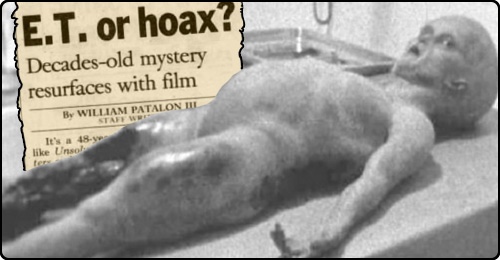
Ever since the rumored crash of a flying saucer near Roswell, New Mexico in the summer of 1947, UFO theorists had speculated that the body of an extraterrestrial had been collected from the wreckage and autopsied. In May 1995, British music and video producer Ray Santilli announced he had acquired footage of such an autopsy. A broad coalition of expert ridiculed the footage as an obvious hoax. Physicians pointed out that the surgeons shown in the film were holding their instruments incorrectly, indicating they were not real surgeons. Special-effects artists noted that the body being dissected appeared to be made of rubber. In 2006 Santilli confessed that the footage was indeed a hoax. He had filmed the footage inside a London apartment. The body of the alien had been created by sculptor John Humphreys. More→
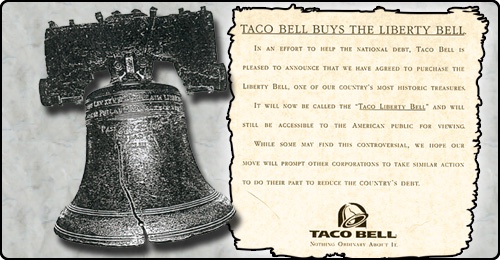
On April 1, 1996, the Taco Bell Corporation announced it had bought the Liberty Bell and was renaming it the Taco Liberty Bell. Hundreds of outraged citizens called the National Historic Park in Philadelphia where the bell was housed to express their anger. Their nerves were only calmed when Taco Bell revealed, a few hours later, that it was all a practical joke. The best line of the day came when White House press secretary Mike McCurry was asked about the sale. Thinking on his feet, he responded that the Lincoln Memorial had also been sold. It would now be known, he said, as the Ford Lincoln Mercury Memorial. More→

Alan Sokal
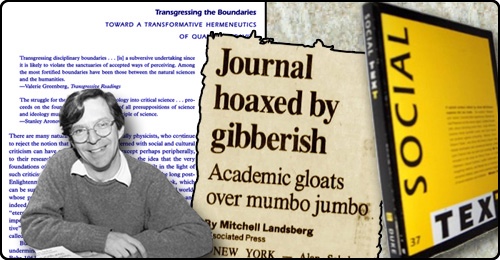
An article that appeared in the Spring 1996 issue of the cultural studies journal Social Text bore the portentous title "Transgressing the Boundaries: Toward a Transformative Hermeneutics of Quantum Gravity." At first glance the article appeared to be an unlikely candidate for controversy. It was written in the typical style of academic articles, slightly overbearing and verbose, and it came armored with a bristling flank of footnotes (more footnotes than actual text). But on the day that the Spring issue of Social Text appeared in print, the author of the article, New York University physics professor Alan Sokal, published a letter in the academic trade publication Lingua Franca revealing his article was intended as a parody, a fact which the editorial board of Social Text had apparently failed to recognize.

"Any competent physicist or mathematician (or undergraduate physics or math major) would realize that it is a spoof," Sokal asserted. He suggested that his article's acceptance by the journal pointed to "an apparent decline in the standards of rigor in certan precincts of the academic humanities." He also fumed over "how readily they [Social Text] accepted my implication that the search for truth in science must be subordinated to a political agenda."

The New York Times ran the story of Sokal's revelation on its front page on May 18, and from there the controversy grew. More→
Page 1 of 2 pages  1 2 > 
All text Copyright © 2011 by Alex Boese, except where otherwise indicated. All rights reserved.