| HOME | FORUM | REGISTER | LOGIN | HOAXIPEDIA | COLLEGE PRANKS | ABOUT THE CURATOR | CONTACT |
| A HISTORY OF HOAXES | HOAX WEBSITES | HOAX PHOTOS | HOAX PHOTO TESTS | GULLIBILITY TESTS | TALL-TALE CREATURES |
Additional
April Fool's Day Content
- The April Fool's Day Database (a catalog of April Fool's Day hoaxes throughout history)
- The Origin of April Fools Day
- Top 10 Worst April Fool's Day Hoaxes
Search the Museum
A Note About the Spelling of April Fool's Day
There is disagreement about the correct placement of the apostrophe within the phrase "April Fool's Day." The three options are: April Fool's Day, April Fools' Day, or (no apostrophe at all) April Fools Day.
The phrase does not actually have a definitively correct spelling. Historically, April Fool's Day has been, by far, the most popular choice. This is probably because it looks less awkward than the alternatives. But a more logical argument for this spelling is that The April Fool is a singular, iconic character to whom the day is dedicated. Numerous illustrations of The Fool dressed in his robes and horned hat support this view.
However, a small but vocal group believes that April Fools' Day is the correct spelling. Proponents of this belief point to the parallel term All Fools' Day, which indicates that the day is dedicated to All Fools (plural) in general. Though some etymologists have speculated that All Fools' Day is a corruption of Auld Fool's Day or Old Fool's Day.
The third option, to drop the apostrophe entirely, would be correct if you consider the phrase to be a form of exclamation: "April Fools" being neither singular nor plural, but rather what you yell out when you've tricked someone. This spelling is rarely seen.
This site uses the historical standard, April Fool's Day.
The phrase does not actually have a definitively correct spelling. Historically, April Fool's Day has been, by far, the most popular choice. This is probably because it looks less awkward than the alternatives. But a more logical argument for this spelling is that The April Fool is a singular, iconic character to whom the day is dedicated. Numerous illustrations of The Fool dressed in his robes and horned hat support this view.
However, a small but vocal group believes that April Fools' Day is the correct spelling. Proponents of this belief point to the parallel term All Fools' Day, which indicates that the day is dedicated to All Fools (plural) in general. Though some etymologists have speculated that All Fools' Day is a corruption of Auld Fool's Day or Old Fool's Day.
The third option, to drop the apostrophe entirely, would be correct if you consider the phrase to be a form of exclamation: "April Fools" being neither singular nor plural, but rather what you yell out when you've tricked someone. This spelling is rarely seen.
This site uses the historical standard, April Fool's Day.
REMOTE CONTROL FART MACHINE
Embarrass your boss, friends, and family! Press the remote button and set off one of 15 different fart sounds!
THE TOILET MONSTER
As the unsuspecting victim goes to use the bathroom, they'll scream as they lift the lid and are greeted by the Toilet Monster!
Embarrass your boss, friends, and family! Press the remote button and set off one of 15 different fart sounds!
THE TOILET MONSTERAs the unsuspecting victim goes to use the bathroom, they'll scream as they lift the lid and are greeted by the Toilet Monster!
The Top 100 April Fool's Day Hoaxes of All TimeAs judged by notoriety, creativity, and number of people duped
Click here for a list of some of this year's hoaxes.
#11: UFO Lands in London
1989: On March 31, 1989 thousands of motorists driving on the highway outside London looked up in the air to see a glowing flying saucer descending on their city. Many of them pulled to the side of the road to watch the bizarre craft float through the air. The saucer finally landed in a field on the outskirts of London where local residents immediately called the police to warn them of an alien invasion. Soon the police arrived on the scene, and one brave officer approached the craft with his truncheon extended before him. When a door in the craft popped open, and a small, silver-suited figure emerged, the policeman ran in the opposite direction. The saucer turned out to be a hot-air balloon that had been specially built to look like a UFO by Richard Branson, the 36-year-old chairman of Virgin Records. The stunt combined his passion for ballooning with his love of pranks. His plan was to land the craft in London's Hyde Park on April 1. Unfortunately, the wind blew him off course, and he was forced to land a day early in the wrong location.
#12: Flying Penguins
2008: The BBC announced that camera crews filming near the Antarctic for its natural history series Miracles of Evolution had captured footage of Adélie penguins taking to the air. It even offered a video clip of these flying penguins, which became one of the most viewed videos on the internet. Presenter Terry Jones explained that, instead of huddling together to endure the Antarctic winter, these penguins took to the air and flew thousands of miles to the rainforests of South America where they "spend the winter basking in the tropical sun." A follow-up video explained how the BBC created the special effects of the flying penguins.
#13: Kremvax
1984: A message distributed to the members of Usenet (the online messaging community that was one of the first forms the internet took) announced that the Soviet Union was joining Usenet. This generated enormous excitement, since most Usenet members had assumed that cold war security concerns would prevent such a link-up. The message purported to come from Konstantin Chernenko (from the address chernenko@kremvax.UUCP) who explained that the Soviet Union wanted to join the network in order to "have a means of having an open discussion forum with the American and European people." The message created a flood of responses. Two weeks later its true author, a European man named Piet Beertema, revealed it was a hoax. This is believed to be the first hoax on the internet. Six years later, when Moscow really did link up to the internet, it adopted the domain name 'kremvax' in honor of the hoax.
#14: The Body of Nessie Found
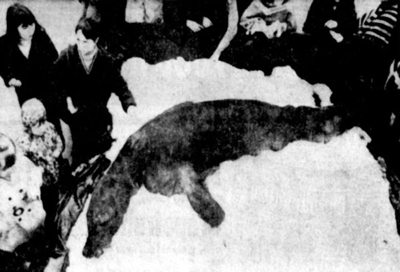
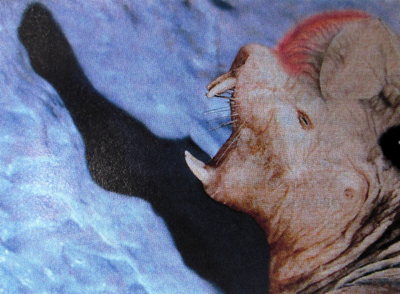
1972: On March 31 1972, a team of zoologists from Yorkshire's Flamingo Park Zoo, who were at Loch Ness searching for proof of Nessie's existence, found a mysterious carcass floating in the Loch. Initial reports claimed it weighed a ton and a half and was 15 ½ feet long. The zoologists placed the body in a van and began to transport it back to the zoo. However, the police chased down their truck and stopped it under a 1933 act of Parliament prohibiting the removal of "unidentified creatures" from Loch Ness. The body was then taken to nearby Dunfermline for examination. The discovery of the carcass received worldwide media attention. The British press dubbed it "Son of Nessie." But upon examination, Edinburgh scientists identified the creature as a bull elephant seal from the South Atlantic. The next day John Shields, Flamingo Park's education officer, confessed he had been responsible for the body. The bull elephant seal had died the week before at Dudley Zoo. He had shaved off its whiskers, padded its cheeks with stones, and kept it frozen for a week, before dumping it in the Loch and then phoning in a tip to make sure his colleagues found it. He had meant to play an April Fool's prank on his colleagues, but admitted the joke got out of hand when the police chased down their van.
#15: Metric Time
1975:
Australia's This Day Tonight news program revealed that the country would soon be converting to "metric time." Under the new system there would be 100 seconds to the minute, 100 minutes to the hour, and 20-hour days. Furthermore, seconds would become millidays, minutes become centidays, and hours become decidays. The report included an interview with Deputy Premier Des Corcoran who praised the new time system. The Adelaide townhall was even shown sporting a new 10-hour metric clock face. The thumbnail (found at TelevisionAU.com) shows TDT Adelaide reporter Nigel Starck posing with a smaller metric clock. TDT received numerous calls from viewers who fell for the hoax. One frustrated viewer wanted to know how he could convert his newly purchased digital clock to metric time.
FAKE TATTOO SLEEVESGet "inked" by night and still keep your day job with "tattoo sleeves". The tattoo is printed directly on stretchable fabric sleeves fabric which is a machine washable nylon. They come in pairs; wear one or both.
#16: The Eruption of Mount Edgecumbe
1974: Residents of Sitka, Alaska were alarmed when the long-dormant volcano neighboring them, Mount Edgecumbe, suddenly began to belch out billows of black smoke. People spilled out of their homes onto the streets to gaze up at the volcano, terrified that it was active again and might soon erupt. Luckily it turned out that man, not nature, was responsible for the smoke. A local practical joker named Porky Bickar had flown hundreds of old tires into the volcano's crater and then lit them on fire, all in a (successful) attempt to fool the city dwellers into believing that the volcano was stirring to life. According to local legend, when Mount St. Helens erupted six years later, a Sitka resident wrote to Bickar to tell him, "This time you've gone too far!" (photo via sitka.com)
#17: The Case of the Interfering Brassieres
1982: The Daily Mail reported that a local manufacturer had sold 10,000 "rogue bras" that were causing a unique and unprecedented problem, not to the wearers but to the public at large. Apparently the support wire in these bras had been made out of a kind of copper originally designed for use in fire alarms. When this copper came into contact with nylon and body heat, it produced static electricity which, in turn, was interfering with local television and radio broadcasts. The chief engineer of British Telecom, upon reading the article, immediately ordered that all his female laboratory employees disclose what type of bra they were wearing.
#18: Man Flies By Own Lung Power
1934: In April 1934 many American newspapers, including The New York Times, printed a photograph of a man flying through the air by means of a device powered only by the breath from his lungs. Accompanying articles excitedly described this miraculous new invention. The man, identified as German pilot Erich Kocher, blew into a box on his chest. This activated rotors that created a powerful suction effect, lifting him aloft. Skis on his feet served as landing gear, and a tail fin allowed him to steer. What the American papers didn't realize was that the "lung-power motor" was a joke. The photo had first appeared in the April Fool's Day edition of the Berliner Illustrirte Zeitung. It made its way to America thanks to Hearst's International News Photo agency which not only fell for the hoax but also distributed it to all its U.S. subscribers. In the original Berliner Illustrirte Zeitung article, the pilot's name was spelled "Erich Koycher," which was a pun on the German word "keuchen," meaning to puff or wheeze.
#19: The Sydney Iceberg
1978: A barge appeared in Sydney Harbor towing a giant iceberg. Sydneysiders were expecting it. Dick Smith, a local adventurer and millionaire businessman (owner of Dick Smith's Foods), had been loudly promoting his scheme to tow an iceberg from Antarctica for quite some time. Now he had apparently succeeded. He said that he was going to carve the berg into small ice cubes, which he would sell to the public for ten cents each. These well-traveled cubes, fresh from the pure waters of Antarctica, were promised to improve the flavor of any drink they cooled. Slowly the iceberg made its way into the harbor. Local radio stations provided excited blow-by-blow coverage of the scene. Only when the berg was well into the harbor was its secret revealed. It started to rain, and the firefighting foam and shaving cream that the berg was really made of washed away, uncovering the white plastic sheets beneath.
#20: The 26-Day Marathon
1981: The Daily Mail ran a story about an unfortunate Japanese long-distance runner, Kimo Nakajimi, who had entered the London Marathon but, on account of a translation error, thought that he had to run for 26 days, not 26 miles. Reportedly Nakajimi was now somewhere out on the roads of England, still running, determined to finish the race. Various people had spotted him, though they were unable to flag him down. The translation error was attributed to Timothy Bryant, an import director, who said, "I translated the rules and sent them off to him. But I have only been learning Japanese for two years, and I must have made a mistake. He seems to be taking this marathon to be something like the very long races they have over there."
All text copyright © of Alex Boese, except where otherwise indicated.