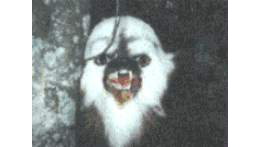
 The abbagoochie (pronounced abba-GOO-cheez) is a fierce little creature resembling a cross between an owl, fox, and deer.
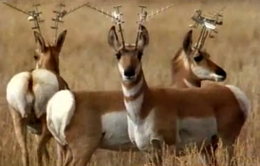 Antennalope are a stunning example of cross-species symbiosis. These North-American antelopes have evolved to have metal antennas on top of their heads, instead of the traditional antlers.
  The bare-fronted hoodwink is an extremely shy species of bird. To date it has never been fully observed. In fact, its existence has only been surmised thanks to the efforts of ornithologist M.F. Meiklejohn who conducted a careful study of birds "partially seen or indeterminately heard." Meiklejohn advised that bird watchers in the field could recognize the species by its "blurred appearance and extremely rapid flight away from the observer."
More…
The bare-fronted hoodwink is an extremely shy species of bird. To date it has never been fully observed. In fact, its existence has only been surmised thanks to the efforts of ornithologist M.F. Meiklejohn who conducted a careful study of birds "partially seen or indeterminately heard." Meiklejohn advised that bird watchers in the field could recognize the species by its "blurred appearance and extremely rapid flight away from the observer."
More…
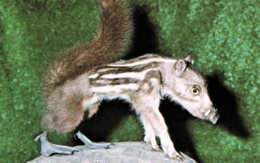 In Sweden, its native land, the Belarussian Shore Muddler is known as the "Vitrysk Strandmuddlare." It is found in the region of Zscicvzoskaija. The creature is remarkable because it appears to combine the head of a baby pig, the tail of a squirrel, and the feet of a water fowl.
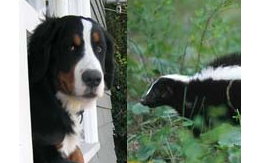 Burmese Mountain Dogs are a rare dog breed that live in the mountains of Myanmar. They have been bred to hunt skunks and protect livestock. Their abilities as skunk hunters are remarkable. Their skunk-like markings can fool a skunk into believing the dog is another skunk, until too late. Despite their size, they can climb trees over 50-feet high in pursuit of the arboreal Burmese Skunk. In the event that a skunk sprays them, they can shed the scent with a mere rinsing. Burmese Mountain Dogs make great pets. Their major drawback is their excessive shedding. They should not be confused with Bernese Mountain Dogs, which are Swiss farm dogs.
More…
Burmese Mountain Dogs are a rare dog breed that live in the mountains of Myanmar. They have been bred to hunt skunks and protect livestock. Their abilities as skunk hunters are remarkable. Their skunk-like markings can fool a skunk into believing the dog is another skunk, until too late. Despite their size, they can climb trees over 50-feet high in pursuit of the arboreal Burmese Skunk. In the event that a skunk sprays them, they can shed the scent with a mere rinsing. Burmese Mountain Dogs make great pets. Their major drawback is their excessive shedding. They should not be confused with Bernese Mountain Dogs, which are Swiss farm dogs.
More…
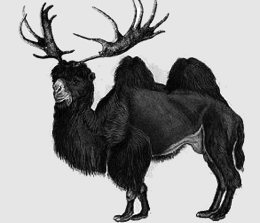 The Camelce is a curious hybrid of the American elk and the Asiatic camel, created when camels imported by the U.S. government for use as pack animals in the Arizona desert got loose and mated with elks in the wild. The existence of this creature was first reported in an 1875 New York Herald article about the Newton-Jenney expedition to the Black Hills of South Dakota. However, the reporter didn't actually see such a creature. He got all his information from local "experts".
More…
The Camelce is a curious hybrid of the American elk and the Asiatic camel, created when camels imported by the U.S. government for use as pack animals in the Arizona desert got loose and mated with elks in the wild. The existence of this creature was first reported in an 1875 New York Herald article about the Newton-Jenney expedition to the Black Hills of South Dakota. However, the reporter didn't actually see such a creature. He got all his information from local "experts".
More…
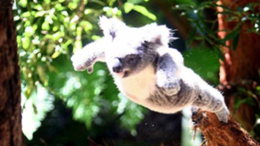 Drop bears are carnivorous, tree-dwelling marsupials found throughout Australia. Their preferred dwelling is eucalyptus trees or gum trees. They are related to koala bears, though larger and equipped with sharp teeth and razor-like claws. Sometimes people refer to them as the koala bear's evil twin.
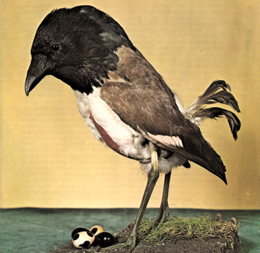
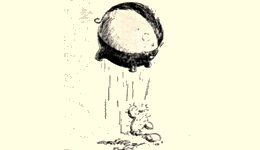
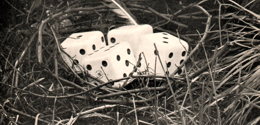 The Fatu-Liva bird, found in the South Pacific Filbert Islands (discovered by the American explorer Walter E. Traprock during the early twentieth century), has one remarkable trait — it lays square, spotted eggs (shown above). If threatened, Fatu-Livas are capable of laying these eggs while aloft. The eggs then drop with great force, inflicting serious damage on anything unfortunate enough to be down below.
 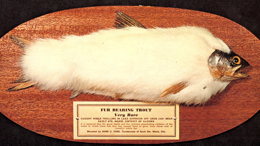 Fur-Bearing Trout (also known as Beaver Trout) possess thick coats of fur that help to keep them warm in the cold northern waters where they live.
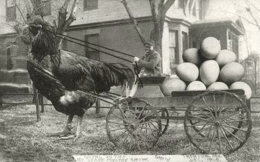 Giant roosters are not a distinct species, but rather a mutant, oversized version of the common rooster. It's not clear what makes them so big. Maybe it's the food they eat, or something in the air. Maybe it's radiation. Whatever the reason, giant roosters have been a frequent subject of photographs from the beginning of the twentieth century onwards. Many of these photographs have been sent as postcards. During the drought years of the Great Depression midwestern farmers seemed to enjoy sending postcards of giant roosters (and other giant-sized livestock and produce) to their friends and relatives back east. These postcards were frequently captioned: "They grow 'em big here!"
More…
Giant roosters are not a distinct species, but rather a mutant, oversized version of the common rooster. It's not clear what makes them so big. Maybe it's the food they eat, or something in the air. Maybe it's radiation. Whatever the reason, giant roosters have been a frequent subject of photographs from the beginning of the twentieth century onwards. Many of these photographs have been sent as postcards. During the drought years of the Great Depression midwestern farmers seemed to enjoy sending postcards of giant roosters (and other giant-sized livestock and produce) to their friends and relatives back east. These postcards were frequently captioned: "They grow 'em big here!"
More…
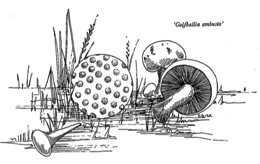 The rare mushroom known as Golfballia ambusta prefers to grow in fields of partially mown grass. It can be found throughout the world, but is said to have originated in Scotland.
  The wild Haggis (plural: Haggi) lives in the highlands of Scotland. It is round, four-legged, fur-covered, and usually less than a foot in length (comparable in size to a grouse). It is a shy creature, rarely seen, and for this reason there is some disagreement about its exact morphology and habits.
 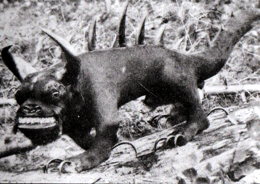 The Hodag (also known as the Bovine Spiritualis) is native to Wisconsin. In fact, it is the official symbol of Rhinelander, Wisconsin where the first one was captured by Eugene Shepard in 1896. Its name comes from combining the words "horse" and "dog."
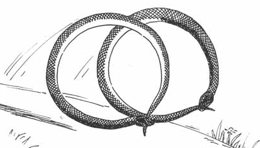 Sightings of hoop snakes have been reported since colonial times in North America and for at least the past century in Australia. This snake grasps its tail in its mouth and rolls after its prey, thereby achieving great speed, especially when going downhill. Hoop snakes have been clocked going over 60 m.p.h.
 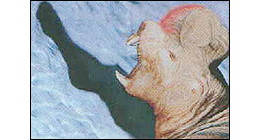 Hotheaded naked ice borers are a small, molelike species that is unusually adapted to life in the Antarctic. Bony plates on their head fed by numerous blood vessels radiate large amounts of heat, allowing these creatures to burrow through solid ice at high speeds. They feed on penguins whom they attack by rapidly melting the ice beneath them, causing the hapless birds to fall down into the slush. The ice borers then kill their prey by ripping it apart with their sharp teeth.
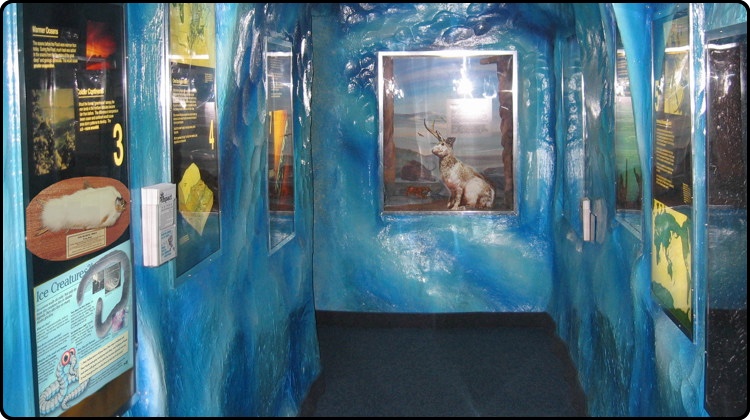
 Ice worms are cold-loving creatures that live inside glaciers. If it is cold enough outside they will crawl out of their holes in order to bask in the frigidity. As they bask they make a chirping sound that is loud enough to keep awake anyone trying to sleep nearby.
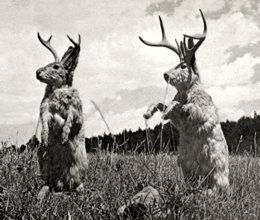 The jackalope is an antlered species of rabbit found throughout the western United States. The jackalope is highly aggressive and is willing to use its antlers to fight. It also has an uncanny ability to mimic human voices. In the old West, when cowboys gathered by their campfires to sing, jackalopes would frequently be heard singing back, mimicking the voices of the cowboys. When chased, jackalopes use their vocal abilities to elude capture by calling out phrases such as, "There he goes, over there," to throw pursuers off their track.
More…
The jackalope is an antlered species of rabbit found throughout the western United States. The jackalope is highly aggressive and is willing to use its antlers to fight. It also has an uncanny ability to mimic human voices. In the old West, when cowboys gathered by their campfires to sing, jackalopes would frequently be heard singing back, mimicking the voices of the cowboys. When chased, jackalopes use their vocal abilities to elude capture by calling out phrases such as, "There he goes, over there," to throw pursuers off their track.
More…
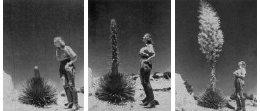 "Jumpin' Yuccy" is the popular name given to Schuss-Yucca, a variety of chaparral yucca found throughout the southwestern United States. "Schuss-yucca" derives from the German word "schuss," meaning to shoot up, a reference to this plant's amazing ability to grow a stalk ten to twenty feet high, blossom, and then die, all within a matter of minutes or even seconds.
 The Manchurian Miniature Water Buffalo is a dwarf species of buffalo that only stands a few inches tall, fully grown. It is recorded that Emperor Hi Lee Sung kept one in his garden for 47 years.
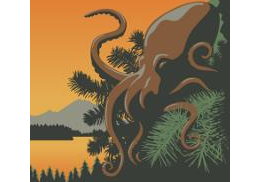 You find the Pacific Northwest Tree Octopus high in the trees of Washington State's Olympic National Forest. They spend their early lives in the water of Puget Sound, but as they mature they move upwards, adopting an arboreal existence.
 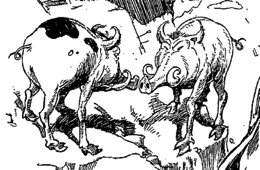 The Rackabore is a kind of wild boar that, like the Sidehill Gouger, is adapted for walking on steep slopes because the legs on one side of its body are longer than on the other. The drawback is that it can only move in one direction depending on whether it is a right-handed or left-handed Rackabore. They cannot turn around.
 The rubberado, also known as the bouncing porcupine, has an unusual form of locomotion. It bounces from place to place. This is made possible by its rubbery flesh. Every time it bounces, it laughs.
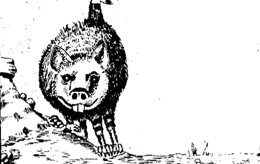 Sidehill gougers are herbivores adapted to living on steep hillsides. The legs on one side of their body are longer than the legs on the other, allowing them to stand comfortably on sloped terrain. Gougers come in two varieties: left-handed and right-handed (also known as counter-clockwise and clockwise). The legs of a left-handed gouger are shorter on the left. As a result, it can only travel around a hill counter-clockwise. Right-handed gougers are just the opposite. The constant movement in the same direction is the source of the gouger's name, because they gouge a path in the side of a hill as they circle it. If gougers try to reverse direction, they topple over.
More…
Sidehill gougers are herbivores adapted to living on steep hillsides. The legs on one side of their body are longer than the legs on the other, allowing them to stand comfortably on sloped terrain. Gougers come in two varieties: left-handed and right-handed (also known as counter-clockwise and clockwise). The legs of a left-handed gouger are shorter on the left. As a result, it can only travel around a hill counter-clockwise. Right-handed gougers are just the opposite. The constant movement in the same direction is the source of the gouger's name, because they gouge a path in the side of a hill as they circle it. If gougers try to reverse direction, they topple over.
More…
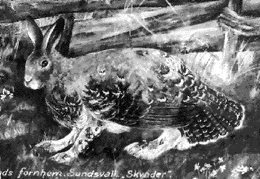 The skvader is a species of winged hare indigenous to Sweden. According to legend, this unusual animal was first discovered by a hunter named Håkan Dahlmark in 1874. Eventually a stuffed specimen of the creature was put on display in the Historical Preservation Society in Sundsvall where it remains to this day.
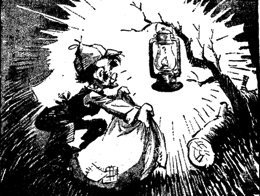 The exact nature of the Snipe is shrouded in mystery, as it is very rare to observe one up close. It is thought to be an extremely shy, flightless bird. Some reports give it glowing red eyes.
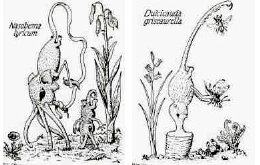 Snouters are a class of animals once found on the Hi-yi-yi Islands in the Pacific. They had evolved to use their noses for virtually every imaginable function. For instance, the Sniffling Snouter caught fish with the long threads that emerged from its nostrils, while the perfumed Honeytail Snouter stood upright on its nose and caught insects with its sticky tail.
  The Tasmanian Mock Walrus (TMW) is a whiskered, four-inch long creature that purrs like a cat, has the temperament of a hamster, and resembles a walrus. It never needs to be walked or bathed, can be trained to use a litter box, and eats cockroaches. A single TMW can rid a house of roaches. However, it will also eat cheese and Vegemite. For this reason it is highly sought after as a pet.
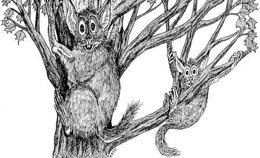 These little squirrel-like creatures inhabit the trees of New England, living on berries and fruit. Since their skin is bark-colored, they're almost impossible to see. In addition, they wrap themselves tightly around tree-trunks, concealing themselves further. But they're quite easy to hear. Walk around in the woods and it's almost impossible not to notice their high-pitched cries. When a strong wind is blowing they get especially excited and squeak at each other even more loudly. Tree Squeaks are usually quite placid and pose no threat to humans. However, after extended dry spells they have been known to become aggressive.
More…
These little squirrel-like creatures inhabit the trees of New England, living on berries and fruit. Since their skin is bark-colored, they're almost impossible to see. In addition, they wrap themselves tightly around tree-trunks, concealing themselves further. But they're quite easy to hear. Walk around in the woods and it's almost impossible not to notice their high-pitched cries. When a strong wind is blowing they get especially excited and squeak at each other even more loudly. Tree Squeaks are usually quite placid and pose no threat to humans. However, after extended dry spells they have been known to become aggressive.
More…
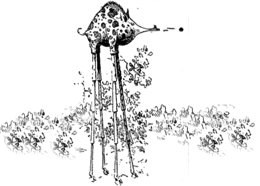 The Tripodero lives in areas of dense undergrowth, hunting for birds and other small animals that are its main source of food. When it sees some prey, the tripodero extends its legs, just as the legs of a photographer's tripod can be extended, thereby raising its body above the brush. When it has a clear line of sight, the tripodero shoots a mud pellet (a supply of which it stores in its left cheek) out of its blowgun-like snout. It rarely misses. Once the prey is stunned, the tripodero can consume it at its leisure. When its legs are not extended, the Tripodero can move quite rapidly through the brush.
More…
The Tripodero lives in areas of dense undergrowth, hunting for birds and other small animals that are its main source of food. When it sees some prey, the tripodero extends its legs, just as the legs of a photographer's tripod can be extended, thereby raising its body above the brush. When it has a clear line of sight, the tripodero shoots a mud pellet (a supply of which it stores in its left cheek) out of its blowgun-like snout. It rarely misses. Once the prey is stunned, the tripodero can consume it at its leisure. When its legs are not extended, the Tripodero can move quite rapidly through the brush.
More…
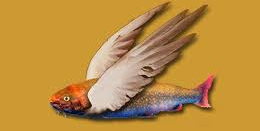 The upland trout is a species of flying fish that is scared of water and lives on land, preferring to build its nests high in trees. When cooked, it has a delicious flavor. Therefore it is prized as a delicacy by experienced campers. Often such campers will send their less experienced companions out into the woods to search for Upland Trout nests.
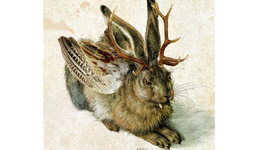 Wolpertingers are small mammals with a body resembling that of a rabbit or squirrel, but also having antlers, fangs, and feathered wings. Occasionally they have the webbed feet of a duck.
Wolpertingers are usually found in the forests of Bavaria. The best way to catch a Wolpertinger, according to legend, is to be a beautiful young woman (or be in the company of one), since Wolpertingers have a weakness for female beauty. The woman should go out into a forest at night while the moon is full and find a secluded nook where a Wolpertinger is likely to be. Hopefully, the creature will soon reveal itself. When it does the woman should expose her breasts. This will cause the Wolpertinger to instantly fall into a stupor, allowing it to easily be bagged.
More…
Wolpertingers are small mammals with a body resembling that of a rabbit or squirrel, but also having antlers, fangs, and feathered wings. Occasionally they have the webbed feet of a duck.
Wolpertingers are usually found in the forests of Bavaria. The best way to catch a Wolpertinger, according to legend, is to be a beautiful young woman (or be in the company of one), since Wolpertingers have a weakness for female beauty. The woman should go out into a forest at night while the moon is full and find a secluded nook where a Wolpertinger is likely to be. Hopefully, the creature will soon reveal itself. When it does the woman should expose her breasts. This will cause the Wolpertinger to instantly fall into a stupor, allowing it to easily be bagged.
More…
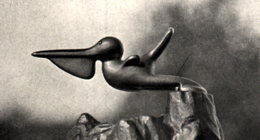 Woofen-poofs, which are native to the Gobi Desert, are approximately 17 centimeters in length, have a long beak below which hangs a pendulous pouch, and possess extremely short, semi-circular wings. Their rapid wing-beat produces a distinctive musical sound as they fly, "three octaves above middle C." Small, sandy-brown feathers help to disguise them in the desert.