The
Geneva Tribune reported that on April 1 a French aviator flying over a German camp dropped what appeared to be a huge bomb. The German soldiers immediately scattered in all directions, but no explosion followed. After some time, the soldiers crept back and gingerly approached the bomb. They discovered that it was actually a large football with a note tied to it that read, "April Fool!" [
The Atlanta Constitution, Aug 2, 1915.]
More…
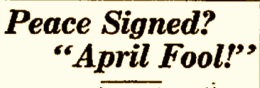
A prankster started a rumor alleging that a peace treaty ending World War I had been signed. According to the Associated Press: "The report rapidly spread over all Paris and the telephone wires to the American headquarters in the hotel de Crillon became hot with inquiries as to the truth of the rumor. It did not take long however, for inquiries to realize the character of the report when they were reminded that today was April 1st." The Treaty of Versailles, which marked the formal end of the war, was signed on June 28, 1919. [
Daily Northwestern, Apr 1, 1919.]
More…
The
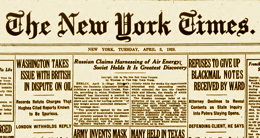
Deutsche Allgemeine Zeitung reported that a Russian scientist, Professor Figu Posakoff, had discovered a method of "harnessing the latent energy of the atmosphere," the energy displayed in thunderstorms and other atmospheric catastrophes. Harnessing this energy would allow the Soviets to hurl objects "of any weight almost unlimited distances."
The Soviets were said to have promised to use this discovery only for peaceful purposes. However the
Allgemeine Zeitung noted that it would certainly give the nation a powerful advantage in warfare.
The New York Times ran the story on its front page on April 3, having failed to realize that it was a joke.
More…
The
Honolulu Star-Bulletin reported that Norwegian scientist Thorkel Gellison (fellow of the King Haakon Loof Lirpa Society) had invented wings that allowed men to fly. He had recently demonstrated his invention in Hawaii. He had also supplied these wings to the Finnish army, leading the Russians to decide to move for a truce with Finland.
More…
The
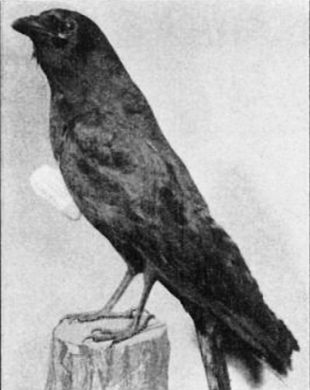
Elkhart Daily Truth detailed a plan to create a protective air fleet for Indiana at low cost by attaching miniature, eight-ounce bombs to 25,000 crows, which would be trained to release the bombs on the enemy. The report included a photograph of one of the "Black Bombers." The "bomb" in the picture was really a salt shaker, and the crow was stuffed.
Although the crow bombers were an April Fool's day joke, there really was a plan developed and tested by the U.S. military during World War II to create
"bat bombs" by strapping incendiary devices to bats, and then dropping the bats on Japanese cities.
More…
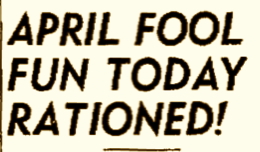
The Associated Press reported that the Society for the Preservation of Practical Jokers had issued an advisory to its members warning them that "in view of the war's restrictions on what some fools consider fun" practical jokers should proceed with caution "otherwise, there might be casualties."
For instance, it would be considered sabotage to put a brick under an old hat on the sidewalk for passing pedestrians to kick, because shoes were now rationed. It would be similarly unwise to put salt in the sugar bowl, since one cup of coffee ruined is considered "grounds for justifiable homicide." The end of the article revealed, "April Fool! There's no such thing as a Society for the Preservation of Practical Jokers."
More…
The European edition of the army newspaper
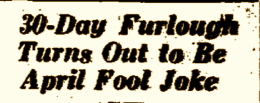
Stars and Stripes announced that plans had been completed to give 30-day furloughs at home to all officers and men who had served in Europe for a year.
The editorial went on to say that the men would be transported back to the States on the Normandie, which had been salvaged, newly outfitted, and would be manned by a crew of WAACS. Onboard entertainers would include Gypsy Rose Lee and Betty Grable.
More…
"The army wants men, but in this atomic age it doesn't believe its recruits must be so ferocious looking they'll scare the foe to death. Cpl. Donald Barnes (left), Batavia, Ill., received a telegram Sunday that 'Joe Buschmann' would be 18 Monday, so Barnes was on hand early to enlist Joe for the Chicago army recruiting station. When he got to the address he found himself at the Lincoln park zoo, and Joe turned out to be Bushman, 550 pound gorilla, who celebrates his eighteenth birthday on April Fool's day." [Associated Press]
More…
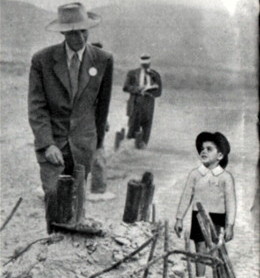
Pageant magazine ran an illustrated inside feature about Garson Inconnu, a four-year-old boy genius who had worked on the Manhattan Project, helping to build the atom bomb. The article explained that the U.S. government had concealed the boy's existence, fearing he might "fall prey to alien agents."
More…
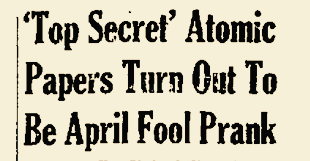
Two teenage boys walked into a London police station and handed over a folder that appeared to contain designs for an atomic weapon. They said they had found it lying on the pavement at a bus stop. Word of the disturbing discovery soon went public, causing widespread alarm. The apparent security breach was even discussed in the House of Commons. But when atomic experts got around to examining the formulae and blueprints, they concluded they were meaningless.
The mystery was solved when a friend of the two boys confessed he had created the "top secret" documents himself out of Norwegian billhead receipts and pieces of an old blueprint he had taken from the office where he worked. He wrote "a lot of gibberish" on the papers, put them in a folder, and showed it to his friends, claiming he had found it lying in the street.
More…
The Light of San Antonio, Texas reported that a huge army missile had accidentally escaped from Kelly Air Force Base during testing, "screamed over San Antonio," and crashed into a water tank near Trinity University. An accompanying picture showed the missile embedded in the ground as water from the tank poured over it. An Airforce Colonel was quoted as saying, "We're spending a great deal of money and much of this nation's international diplomacy is based on the armed strength this and other units like it achieve. So I hope you'll understand why I have no more time for this damned April Fool gag."
More…
The Pennsylvania
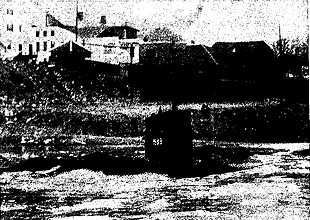
Bedford Express ran a photograph on its front page of an atomic submarine floating in the Raystown River. The paper was subsequently flooded with calls from its readers: "Was there really a sub in the river? Where is it now? Has it left yet?" The image was created by a Gazette photographer who superimposed a picture of the sub onto a picture of the river. The Raystown River is only three feet deep in the Bedford area. [
Syracuse Herald-Journal, Apr 2, 1960.]
More…
The
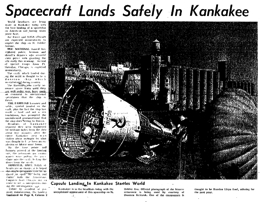
Daily Journal, based in Kankakee, Illinois, reported that a Soviet space capsule had landed just outside of the city. Apparently the cosmonauts had seriously miscalculated their trajectory during reentry. The Soviet government was said to be keeping its silence about the capsule. An accompanying photograph showed a space capsule with a hammer and sickle displayed on its side. The article said that one of the cosmonauts, Lirpa Loof, had been missing for over a year. Many people drove to the supposed site of the landing to see the capsule.
More…
Larry McCormick took to the streets of downtown St. Louis selling an April Fool newspaper announcing that the war in Vietnam was ending. "Our Boys Come Home -- All GIs Out of Vietnam." Other headlines in the paper included, "I was wrong says Nixon," and "Gen. Westmoreland indicted for war crimes."
More…
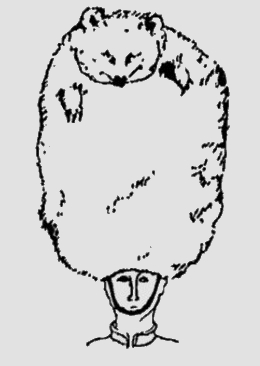
Soldier, the magazine of the British Army, revealed that the fur on the bearskin helmets worn by the Irish guards while on duty at Buckingham Palace keeps growing and needs to be regularly trimmed:
The most hair-raising fact about the bearskins has been discovered by scientists recently. The skins retain an original hormone, which lives on after the animal has been skinned. Scientists call it otiose and it is hoped it can be put to use in medical research — especially into baldness.
The article quoted Maj. Ursa who noted, "Bears hibernate in the winter and the amazing thing is that in the spring the skins really start to sprout." An accompanying photo showed Guardsmen sitting in an army barbershop having their helmets trimmed. The story was picked up by the London Daily Express and run as a straight story.
More…
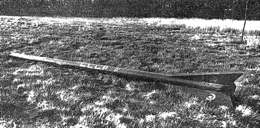
An unknown prankster planted a 16-foot missile decorated with the hammer and sickle symbol of the Soviet Union outside of Andrews Air Force Base near Washington, DC. The missile was point-down in the ground, as if it had landed nose-first and become embedded in the ground. It was clearly visible to commuters on their morning drive into work. A sign near the missile read "April Fools... Courtesy of Mothers Against Missiles." Park police quickly cleared the missile away.
More…
Israel Radio broadcast that Nabih Berri, leader of the Shi'ite Amal movement, had been assassinated. The news caused an immediate flaring of tensions in the region. However, Israeli officials quickly denounced the report as a hoax. The false report was traced back to an army intelligence officer who had planted the news item in the broadcasts of the Israeli Army's intelligence monitoring unit, from which it had been picked up by Israel Radio. Israel's Defence Minister, Yitzhak Rabin, announced that the unnamed officer would be court-martialed. Most commentators found the hoax to be in poor taste. "Berri Berri funny," one foreign correspondent commented.
More…
The
Daily Telegraph reported that Margaret Thatcher was considering privatizing the Army and selling off the Brigade of Guards. According to the article, "Strict flotation terms would prevent hostile foreign interests gaining majority control over the brigade."
More…
Russia's
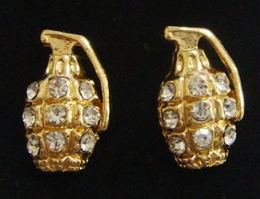
Itar-Tass news agency reported that a military factory had begun manufacturing diamond-encrusted grenades, which it was selling to Russian gangsters who might be concerned that they could not only live glamorously but also "die luxuriously as well." The article noted, "The use of such a grenade will leave your one-time rival in a sea of beautiful sparkling gems rather than in a pool of blood."
More…
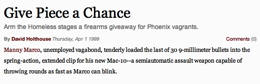
The
Phoenix New Times ran a story announcing the formation of an unusual new charity to benefit the homeless. Instead of providing the homeless with food and shelter, this charity would provide them with guns and ammunition. It was named 'The Arm the Homeless Coalition.' The story received coverage from
60 Minutes II, the Associated Press, and numerous local radio stations before the media realized the article was a hoax. The
Phoenix New Times's joke was actually a reprise of a
1993 prank perpetrated by students at Ohio State University.
More…
Tanzania's
Sunday Observer reported there was panic in the town of Tabora when former Ugandan dictator Idi Amin was seen walking down the main street of the town dressed in a kilt. Accompanying him were an entourage of armed, semi-naked warriors, 37 of his children, and a member of the Saudi royal family. The Observer noted: "Unfortunately, because of the presence of the Saudi prince, nobody was allowed to photograph this unique whistle-stop visit." At the time, Amin was actually living in exile in Saudi Arabia. He had been deposed from power in 1979 by rebels backed by Tanzanian forces.
More…
The
Tokyo Shimbun reported that the Japanese government was planning to send robots modelled on the 1960s cartoon character Astro Boy to assist with post-war reconstruction in Iraq. They noted: "It is partly aimed at showing the world the right way to use science technology following the loss of confidence in US high-tech weapons."
More…
Kenya's
East African Standard reported that the US forces in Iraq were actively recruiting reinforcements from Kenya, Ethiopia, and Sudan. Troops from these regions were supposedly better adapted to desert conditions which were giving the US forces a "rough time."
More…
South Africa's Afrikaans-language
Beeld newspaper scooped its rivals by reporting that, in a last minute deal to avoid war, Iraqi President Saddam Hussein had accepted an offer of exile in South Africa. In exchange he would run South Africa's oil industry. Details of the arrangement included: Hussein would be given a game farm on which to live, and he would travel in a jet outfitted with a missile defense system. The US was said to be happy about the deal because it would make Hussein "somebody else's problem."
More…
The Register announced that, in a surprise move, the Bush twins had announced their decision to enroll in the military and serve in Iraq. Jenna Bush was quoted as saying:
"We all understood that my sister and I had been called to set this example of hope and optimism for all of America and the world beyond. And we knew as well that it would be a disgrace and a scandal for us not to accept freely the consequences of our father's decision to go to war on behalf of freedom and liberty. How could my sister and I, in good conscience, allow other Americans to shoulder this burden if we were not just as willing?... How could our parents allow it? What a terrible message to send! Well, fortunately, that's not the way we Bushes are made. We have a long history of public service and personal sacrifice."
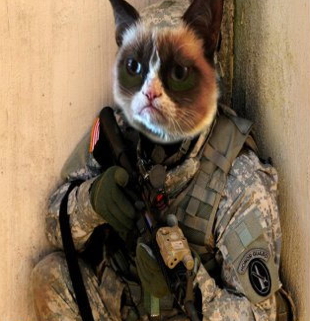
The
U.S. Army announced the launch of a "Military Working Cat Program" at the Old Guard in Virginia. Cats would work alongside military police, assisting them with narcotics detection, tracking criminals, and taking down criminals.
The program sought to take advantage of the olfactory and hearing prowess of cats, which is superior to that of both humans and dogs. Unfortunately the program had gotten off to a rocky start, with a lot of soldiers "scratched up pretty badly." However, one cat, Gino, had already successfully graduated from the program.
More…