A popular legend holds that April Fool's Day began in 1564 when the 14-year-old King Charles IX of France passed the
Edict of Roussillon, decreeing that henceforth the year would begin on January 1, instead of April 1. Supposedly some people failed to hear about the change and continued to celebrate the new year on April 1, causing people to make fun of them and play pranks on them. In this way, they became the first April fools.
The existence of references to April Fool's Day before 1564 suggests that this cannot have been the origin of the celebration. But also, the story is incorrect in that April 1 was not considered the start of the year in any part of France before 1564. The year began on different days in different parts of the country (March 25, March 1, Easter, or January 1). One of the reasons for the reform was to impose a single calendrical system throughout the entire country.
More…
Australia's
This Day Tonight revealed that the country would soon be converting to "metric time." Under the new system there would be 100 seconds to the minute, 100 minutes to the hour, and 20-hour days. Furthermore, seconds would become millidays, minutes become centidays, and hours become decidays. The report included an interview with Deputy Premier Des Corcoran who (participating in the prank) praised the new time system. The Adelaide townhall was shown sporting a new 10-hour metric clock face. The show received numerous calls from viewers who fell for the hoax. One caller wanted to know how he could convert his newly purchased digital clock to metric time.
More…
London's Capital Radio station announced that
Operation Parallax would soon go into effect. This was a government plan to resynchronize the British calendar with the rest of the world. Ever since 1945, the station explained, Britain had gradually become 48 hours ahead of all other countries because of the constant switching back and forth from British Summer Time. To remedy this situation, the British government had decided to cancel April 5 and 12 that year. Capital Radio received numerous calls as a result of this announcement. One employer wanted to know if she had to pay her employees for the missing days. Another woman was curious about what would happen to her birthday, which fell on one of the cancelled days.
More…
The BBC's overseas service reported that Big Ben was going to be given a digital readout. The news elicited a huge response from listeners shocked and angry about the change. "Surprisingly, few people thought it was funny," admitted Tony Lightley of the overseas service.
The same news report also claimed that the clock hands would be given away to the first four listeners to contact the station. One Japanese seaman in the mid-Atlantic immediately radioed in, hoping to be among the lucky callers.
The
Eldorado Daily Journal, an Illinois paper, announced a contest to see who could save the most daylight for daylight savings time. The rules of the contest were simple: beginning with the first day of daylight savings time, contestants would be required to save daylight. Whoever succeeded in saving the most daylight would win. Only pure daylight would be allowed—no dawn or twilight light, though light from cloudy days would be allowed. Moonlight was strictly forbidden. Light could be stored in any container. The contest received a huge, nationwide response, with the paper's editor interviewed by correspondents from CBS and NBC and featured in papers throughout the country.
More…
On March 30, Guinness issued a press release announcing it had reached an agreement with the Old Royal Observatory in Greenwich, England to be the official beer sponsor of the Observatory's millennium celebration. According to this agreement, Greenwich Mean Time would be renamed Guinness Mean Time until the end of 1999. In addition, where the Observatory traditionally counted seconds in "pips," it would now count them in "pint drips." Finally, a Guinness bar would open in the astronomy dome and the Observatory's official millennium countdown would feature a Guinness clock counting "pint settling time" with a two-minute stopwatch.
Guinness issued the announcement as an embargoed release, meaning that reporters who received the release weren't supposed to write about it until the day it was issued to the public on April 1. However, the
Financial Times broke the embargo (not realizing that the release was a joke) and discussed the announcement a day early in an article titled "Guinness to sponsor the Old Royal Observatory." It criticized Guinness for exploiting the millennium excitement to promote its brand name, declaring that Guinness, with its Greenwich tie-in, was setting a "brash tone for the millennium."
When the
Financial Times learned it had fallen for a joke, it printed a curt retraction, stating that the news it had disclosed "was apparently intended as part of an April 1 spoof." Guinness spokesman Roy Mantle said, "The best thing to say is that they pipped everybody to the post and we were very pleased to see that actually in such an august organ as the
Financial Times." In a separate statement Guinness took a more charitable tone, explaining that "The
Financial Times was running a perfectly serious business piece and Guinness faxed over the spoof among other information. It wasn't really his [the reporter's] fault."
More…
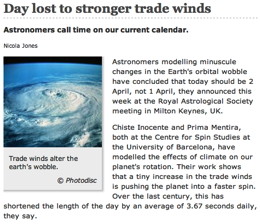
Nature.com reported a
startling discovery made by astronomers. The increasing force of trade winds had slightly accelerated the spin of the Earth. As a consequence the length of the day had decreased over the past century, meaning that the calendar was now inaccurate: "Just as February has an extra day in leap years, we conclude that March ought to have 30 days once every 100 years, not 31… If we start the adjustments this year we should be back on track." In other words, "today should be 2 April, not 1 April."
More…
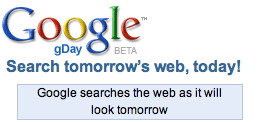
Google Australia debuted
gDay technology "enabling you to search content on the internet before it is created":
"The core technology that powers gDay™ is MATE™ (Machine Automated Temporal Extrapolation). Using MATE's™ machine learning and artificial intelligence techniques developed in Google's Sydney offices, we can construct elements of the future. Google spiders crawl publicly available web information and our index of historic, cached web content. Using a mashup of numerous factors such as recurrence plots, fuzzy measure analysis, online betting odds and the weather forecast from the iGoogle weather gadget, we can create a sophisticated model of what the internet will look like 24 hours from now."
More…
The Democracy Center
posted on its website that Bolivian President Evo Morales had accused the United States of engaging in a clandestine effort to force Bolivia to adopt Daylight Savings Time. The article quoted Morales as saying, "We have seen the government of the U.S. try to undermine our democracy, block us from the lawful export of coca products, and smuggle in munitions. But now we see that these conspirators also have their sights set on changing our clocks. We denounce this before the world community." The news was reposted as fact by a few blogs, including the
Huffington Post, before it was identified as a joke.
More…