On March 31, 1940 the Franklin Institute issued a press release warning that the world would end the next day. The release was picked up by radio station KYW which announced, "Scientists predict that the world will end at 3 P.M. Eastern Standard Time tomorrow. This is no April Fool joke. Confirmation can be obtained from Wagner Schlesinger, director of the Fels Planetarium of this city."
The public reaction was immediate. Local authorities were flooded with frantic phone calls. The panic only subsided after the Franklin Institute assured people that it had made no such prediction. The prankster responsible for the press release turned out to be William Castellini, the Institute's press agent. He had intended to use the fake release to publicize an April 1st lecture at the institute titled "How Will the World End?" Soon afterwards, the Institute dismissed Castellini.
More…
New York City's
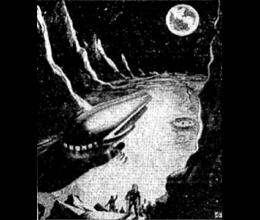
Hayden Planetarium advertised that at 2 o'clock on April 1st the "first non-stop rocket ship flight to the moon" would take place, leaving from the planetarium. The announcement was accompanied by an illustration by artist Tom Voter.
Before the actual "flight," the Planetarium offered a clarification: "The only April Fool element in this miracle flight is that the 240,000 miles of space between the earth and the moon will be spanned in the comfort of the imagination, aided by trick photography, weird lighting effects and a realistic reproduction of the fantastic lunar landscapes."
More…
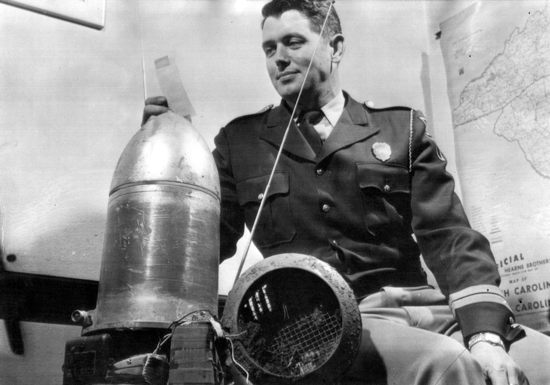
W.D. Loy of Charlotte, North Carolina first heard a loud bang, then a series of beeps coming from his front yard. He went out to investigate and found on his lawn a silvery cylinder shaped like a missile with an antenna protruding from the top. Suspecting it was some kind of Soviet satellite, similar to Sputnik, Loy sent his family into the basement to hide, then called the police.
When they arrived, they unscrewed the bolts holding the object together and found inside a beeping electric bicycle horn, as well as a note that read, "All work and no play makes Jack a dull boy. April fool!" The photo shows Officer K.K. Scott reading the note.
More…
The April 1959 edition of the
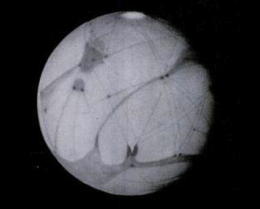
Great Plains Observer astronomical newsletter included a spoof report alleging that the moons of Mars had been discovered to be artificial satellites flung into orbit by some ancient civilization that had once inhabited the red planet.
American astronomers were shocked when this story was apparently taken seriously by a well-regarded Soviet scientist, Dr. Iosip Shklovsky, who repeated the claim in an interview with
Komsomol Pravda. Dr. Gerald Kuiper of the Yerkes Observatory later said, "He is much too brilliant to believe such nonsense."
More…
The
Lawrence Daily Journal-World reported that a group of science students had launched Kansas University's World War II Memorial Tower into orbit:
"A group of Kansas University science students Tuesday night sneaked up on Mt. Oread, equipped the Memorial Campanile with rockets and as APRIL 1 dawned today they ran their count-down and sent the famed 'singing silo' of Lawrence zooming toward orbit. There was some question today, however, as to whether Ronald Barnes, KU carilloneur, was allowed to get out of the tower before it was launched from its Jayhawk pad."
More…
An hour-long Swiss Radio broadcast announced that U.S. astronauts had just landed on the moon. The announcement generated enormous excitement. Telephone exchanges became jammed as people tried to phone friends to share the news. Even U.S. authorities in Switzerland initially weren't sure if the news was true or false.
The broadcast concluded with the report that the moonship would take off from the moon at 7 p.m. Listeners were urged to climb to a high vantage point, away from the city lights, to watch it return to Earth. As a result, there was a huge rush of people who tried to leave Zurich and get to the top of Mt. Uetliberg, overlooking the city. The railroad up the mountain had to add additional trains to handle the number of passengers.
More…
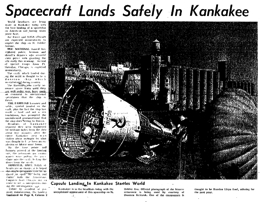
The
Daily Journal, based in Kankakee, Illinois, reported that a Soviet space capsule had landed just outside of the city. Apparently the cosmonauts had seriously miscalculated their trajectory during reentry. The Soviet government was said to be keeping its silence about the capsule. An accompanying photograph showed a space capsule with a hammer and sickle displayed on its side. The article said that one of the cosmonauts, Lirpa Loof, had been missing for over a year. Many people drove to the supposed site of the landing to see the capsule.
More…
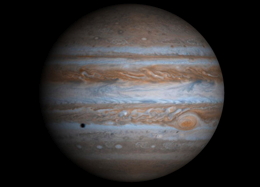
During an interview on BBC Radio 2, astronomer Patrick Moore revealed that at exactly 9:47 a.m. Pluto would pass behind Jupiter, and that this alignment would result in a stronger gravitational pull from Jupiter, counteracting the Earth's own gravity and making people momentarily weigh less. He told listeners that if they jumped up and down while this was happening, they would experience a strange floating sensation.
When 9:47 a.m. arrived, BBC2 began to receive hundreds of calls from listeners who claimed to have felt the sensation. One woman insisted that she and her friends had floated around the room. Another caller complained that he ascended so rapidly that he hit his head on the ceiling.
More…
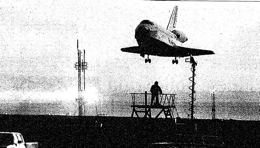
Dave Rickards, a deejay at San Diego's KGB-FM, announced that the space shuttle Discovery had been diverted from Edwards Air Force Base and would land instead at Montgomery Field just outside the city at 8:30 am. Thousands of commuters immediately headed there, causing enormous traffic jams that lasted for almost an hour.
Of course, the shuttle never landed. Montgomery Field is far too small for the shuttle to have even considered landing there, and there wasn't a shuttle in orbit at the time. The police weren't amused. They announced they would be billing the radio station for the cost of forcing officers to direct the traffic. In its defense, the radio station said, "It was a joke... We're just trying to have some fun."
More…
When America Online subscribers logged in to the service on April 1st, they were greeted with a news flash: "Government source reveals signs of life on Jupiter." This headline was backed up by statements from a planetary biologist and an assertion by Ted Leonsis, AOL's president, that his company possessed documents that proved the government was hiding the existence of life on the massive planet. The story generated over 1300 messages on AOL, and hundreds of people called the Jet Propulsion Laboratory in Pasadena, California trying to obtain more details about the discovery.
More…
Novoye Pokoleniye, a Kazakh newspaper, reported on Friday, March 30 that Dariga Nazarbayeva, the daughter of President Nursultan Nazarbayev, would become the first Kazakh woman to fly into space. Accompanying her would be her one-year-old daughter who was receiving special training to become the world's first child astronaut. Nazarbayeva was already something of a Kazakh celebrity because of her presidency of Khabar TV. Her mission in space would be to launch a new satellite TV channel, Khabar-3, which would transmit to "the most remote areas of the world where the Kazakh diaspora lives: in the USA, Mongolia, France, New Zealand and so on."
The paper also reported that only Kazakh cuisine would be served on the flight. In addition, "The research programme also envisages making several feminine space experiments such as wet cleaning in zero-gravity conditions, cleaning of portholes in open space, nail-varnishing and hair-dyeing in a vacuum. The time of narrow specialist-orientated research is gone and the epoch of space exploration for everyday-life purposes is coming. So, who else, if not a woman and housewife, is to make laboratory experiments here?"
More…
Google announced they were accepting applications for positions at Copernicus Center, their new "lunar hosting and research center." Applicants, Google noted, must be "capable of surviving with limited access to such modern conveniences as soy low-fat lattes, The Sopranos and a steady supply of oxygen." Google went on to say that the facility, set to open in Spring 2007, would house 35 engineers, 27,000 low cost Web servers, two massage therapists and a sushi chef.
More…
CBBC (Children's BBC)
announced that astronomers had decided to rename the planets in the Solar System after characters from the Lord of the Rings. The Earth would henceforth be known as Gandalf. Mars would become Frodo. Pluto would be known as Sauron, and even the Moon would receive a new name: Gollum.
More…
Nature.com reported that images of the Moon taken by the Floating Optical Orbital Lens (F.O.O.L.) revealed that bacteria left behind by the Apollo lunar mission was causing the moon to disintegrate.
"Images of the lunar surface reveal deep cracks and holes that are slowly but surely releasing gas and dust into space. 'This is serious,' says Brad Kawalkowizc, an astrogeologist from the Sprodj Atomic Research Centre in Belgium, who has analysed the pictures. 'There really is less Moon up there than there used to be.' If the process continues, he adds, the Moon could eventually crumble away to nothing."
More…
NASA's
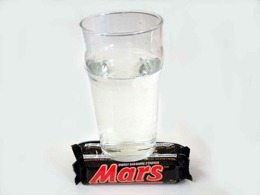
Astronomy Picture of the Day site published photographic evidence of the discovery of water on Mars.
More…
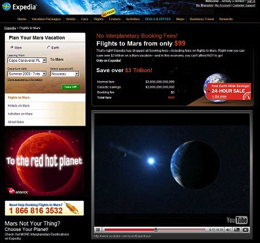
Internet-based travel site Expedia.com announced it was offering flights to Mars for only $99, which it calculated to be a savings of $3 trillion for travelers. "In this economy, you can't afford NOT to go!" it declared.
Richard Branson
announced that he had bought Pluto "for an undisclosed sum." His intent was to have it reinstated as a planet, which he planned to do by constructing a deep space vehicle that would drag asteroids and space debris to Pluto, thereby increasing its mass until it had reached the requisite size to be considered a planet.
He hoped that Pluto's return to planet status would "set an example for struggling entrepreneurs facing setbacks."
More…