A German garden journal,
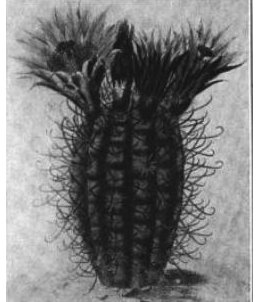
Möllers Deutsche Gärtner Zeitung (15:148), printed details about a fictitious species of cactus,
Echinocereus dahliaeflorus, in its April edition. The editor of the journal apparently forgot his own joke because he indexed the cactus name at the end of the year. [
The Cactaceae]
More…
Rear Admiral Tully Shelley, managing director of a company of oil refinery and construction engineers, designed a match striking machine as an April Fool's Day joke. He called it his "Yonghy Bonghy Bo" (an allusion to Edward Lear's poem, "The Courtship of the Yonghy-Bonghy-Bo"). The machine actually did work and could be used to light a cigarette.
More…
The April 1959 edition of the
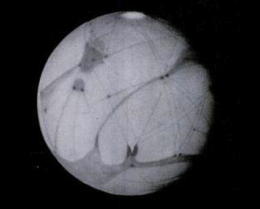
Great Plains Observer astronomical newsletter included a spoof report alleging that the moons of Mars had been discovered to be artificial satellites flung into orbit by some ancient civilization that had once inhabited the red planet.
American astronomers were shocked when this story was apparently taken seriously by a well-regarded Soviet scientist, Dr. Iosip Shklovsky, who repeated the claim in an interview with
Komsomol Pravda. Dr. Gerald Kuiper of the Yerkes Observatory later said, "He is much too brilliant to believe such nonsense."
More…
The April 1972 issue of the British
Veterinary Record contained an article about the diseases of
Brunus edwardii (aka Teddy Bear), which was described as a species "commonly kept in homes in the United Kingdom and other countries in Europe and North America." The article warned:
"63.8 percent of households are inhabited by one or more of these animals... The public health implications of this fact are obvious, and it is imperative that more be known about their diseases."
For months afterwards the correspondence section of the journal was dominated by letters about
Brunus edwardii.
More…
The naturalist David Attenborough gave a report on BBC Radio 3 about a group of islands in the Pacific known as the Sheba Islands. He played sound recordings of the island’s fauna, including a recording of a night-singing, yodelling tree mouse called the Musendrophilus. He also described a web-footed species whose webs were prized by inhabitants of the island as reeds for musical instruments.
During an interview on BBC Radio 2, astronomer Patrick Moore revealed that at exactly 9:47 a.m. Pluto would pass behind Jupiter, and that this alignment would result in a stronger gravitational pull from Jupiter, counteracting the Earth's own gravity and making people momentarily weigh less. He told listeners that if they jumped up and down while this was happening, they would experience a strange floating sensation.
When 9:47 a.m. arrived, BBC2 began to receive hundreds of calls from listeners who claimed to have felt the sensation. One woman insisted that she and her friends had floated around the room. Another caller complained that he ascended so rapidly that he hit his head on the ceiling.
More…
Discover magazine revealed the discovery by wildlife biologist Dr. Aprile Pazzo of a fascinating new species, the hotheaded naked ice borer, which she had encountered while studying penguins in Antarctica. They were about half a foot long, very light, and had a bony plate on their head that could become burning hot, allowing them to bore tunnels through the ice at high speeds, "much faster than a penguin can waddle." Packs of them would rapidly melt the ice beneath a penguin, causing it to sink into the slush, at which point they would surround the creature and consume it.
More…
Discover Magazine reported that physicists had discovered a new fundamental particle of matter, dubbed the Bigon. It could only be coaxed into existence for mere millionths of a second, but amazingly, when it did materialize it was the size of a bowling ball. It was theorized that the Bigon might be responsible for a host of unexplained phenomena such as ball lightning, sinking souffles, and spontaneous human combustion.
More…
The April 1998 issue of the
New Mexicans for Science and Reason newsletter contained an article claiming that the Alabama state legislature had voted to change the value of the mathematical constant pi from 3.14159 to the 'Biblical value' of 3.0. Before long the article had made its way onto the internet, and then it rapidly made its way around the world, forwarded by people in their email. It only became apparent how far the article had spread when the Alabama legislature began receiving hundreds of calls from people protesting the legislation. The original article, which was intended as a parody of legislative attempts to circumscribe the teaching of evolution, was written by physicist Mark Boslough.
More…
The scientific journal
Nature, in its online edition, revealed the discovery of "a near-complete skeleton of a theropod dinosaur in North Dakota." The discovery was referred to in an article by Henry Gee discussing the palaeontological debate over the origin of birds. The dinosaur skeleton had reportedly been discovered by Randy Sepulchrave of the Museum of the University of Southern North Dakota.
The exciting part of the discovery, according to the article, was that "The researchers believe that the dinosaur, now named as
Smaugia volans, could have flown."
More…
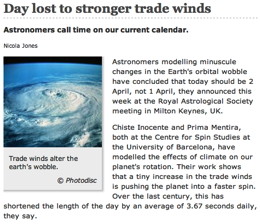
Nature.com reported a
startling discovery made by astronomers. The increasing force of trade winds had slightly accelerated the spin of the Earth. As a consequence the length of the day had decreased over the past century, meaning that the calendar was now inaccurate: "Just as February has an extra day in leap years, we conclude that March ought to have 30 days once every 100 years, not 31… If we start the adjustments this year we should be back on track." In other words, "today should be 2 April, not 1 April."
More…
RealClimate.org detailed the work of Dr. Ewe Noh-Watt of the New Zealand Institute of Veterinary Climatology, who had discovered that global warming was caused not by a buildup of carbon dioxide in the atmosphere, but rather by the decline of New Zealand's sheep population. The reasoning was that sheep are white, and therefore large numbers of sheep increased the planet's albedo (the amount of sunlight reflected back into space). As the sheep population declined, the ground absorbed more solar radiation, thus warming the planet: "It can be seen that the recent warming can be explained entirely by the decline in the New Zealand sheep population, without any need to bring in any mysterious so-called 'radiative forcing' from carbon dioxide, which doesn't affect the sunlight (hardly) anyway — unlike Sheep Albedo."
More…
The University of Michigan College of Engineering released a video revealing that their researchers had created a teleportation machine. Materials Science Prof. Xavier Vlad demonstrated how he could teleport a small key from one end of the machine to the other. He further explained that the process was discovered by accident — just like the discovery of Post-It notes.
More…