The
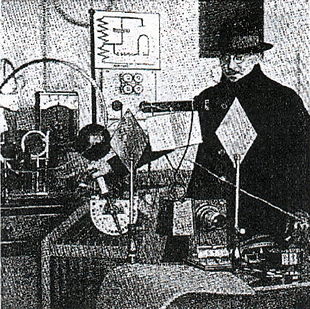
German Gardener's News, edited by Herr Möller, issued an April Fool's Day edition that discussed various botanical discoveries, such as varieties of flowers that were so phosphorescent they gave sufficient light to read by. "Under proper conditions the flowers of the clematis glow like stars, while sunflowers, if correctly nurtured, make it quite possible to read a newspaper by their unaided light." A photograph showed Herr Möller reading by the light of sunflower lamps in his garden at 10 o'clock at night.
More…
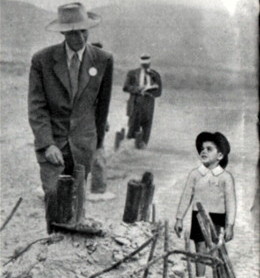
The mayor of Santa Fe, New Mexico announced that the perfectly preserved bones of a prehistoric boy and girl had been found in the badlands near San Rafael. The bones were located in a white stone house that was partially buried in lava. The prehistoric couple had apparently been overwhelmed by a volcanic eruption. Their skeletons were covered with a thick yellow plaster. Even the reddish-brown hair of the girl had been preserved. The girl had been wearing two turquoise earrings, that now rested beside her head. The find generated great interest among scientists. However, a few days later the mayor was forced to admit that there were no skeletons. He had been the victim of an April Fool's Day hoax. [
The Washington Post, Apr 11, 1920.]
More…
The
Deutsche Allgemeine Zeitung reported that a Russian scientist, Professor Figu Posakoff, had discovered a method of "harnessing the latent energy of the atmosphere," the energy displayed in thunderstorms and other atmospheric catastrophes. Harnessing this energy would allow the Soviets to hurl objects "of any weight almost unlimited distances."
The Soviets were said to have promised to use this discovery only for peaceful purposes. However the
Allgemeine Zeitung noted that it would certainly give the nation a powerful advantage in warfare.
The New York Times ran the story on its front page on April 3, having failed to realize that it was a joke.
More…
Radio Umschau, a German weekly journal about radio technology, revealed that two Polish researchers had discovered a way to overcome the force of gravity. When they aimed high-frequency FM waves at a small quartz crystal and increased the output to several kilowatts, the crystal transformed into an opaque cube and rose into the air, lifting the entire apparatus of the experiment with it. Tests showed that the cube could support a weight of 25 kilograms. The cube had not only become weightless, but had actually achieved a negative weight.
More…
On March 31, 1940 the Franklin Institute issued a press release warning that the world would end the next day. The release was picked up by radio station KYW which announced, "Scientists predict that the world will end at 3 P.M. Eastern Standard Time tomorrow. This is no April Fool joke. Confirmation can be obtained from Wagner Schlesinger, director of the Fels Planetarium of this city."
The public reaction was immediate. Local authorities were flooded with frantic phone calls. The panic only subsided after the Franklin Institute assured people that it had made no such prediction. The prankster responsible for the press release turned out to be William Castellini, the Institute's press agent. He had intended to use the fake release to publicize an April 1st lecture at the institute titled "How Will the World End?" Soon afterwards, the Institute dismissed Castellini.
More…
Pageant magazine ran an illustrated inside feature about Garson Inconnu, a four-year-old boy genius who had worked on the Manhattan Project, helping to build the atom bomb. The article explained that the U.S. government had concealed the boy's existence, fearing he might "fall prey to alien agents."
More…
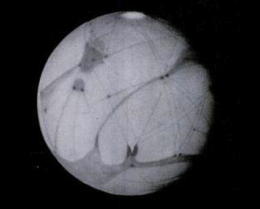
The April 1959 edition of the
Great Plains Observer astronomical newsletter included a spoof report alleging that the moons of Mars had been discovered to be artificial satellites flung into orbit by some ancient civilization that had once inhabited the red planet.
American astronomers were shocked when this story was apparently taken seriously by a well-regarded Soviet scientist, Dr. Iosip Shklovsky, who repeated the claim in an interview with
Komsomol Pravda. Dr. Gerald Kuiper of the Yerkes Observatory later said, "He is much too brilliant to believe such nonsense."
More…
BBC TV interviewed a London University professor who had perfected a technology he called "smellovision," allowing viewers to smell aromas produced in the television studio in their homes. The professor explained that his machine broke scents down into their component molecules which were then transmitted through the screen.
The professor demonstrated by placing some coffee beans and onions into the smellovision machine. He asked viewers to report by noon whether they had smelled anything. Numerous viewers called in from across the country to confirm that they had distinctly experienced these scents. Some claimed the onions made their eyes water.
More…
Newspapers around the world announced that the dead body of the Loch Ness Monster had been found. A team of zoologists from Yorkshire's Flamingo Park Zoo, who were at Loch Ness searching for proof of Nessie's existence, had discovered the carcass floating in the water the day before. Initial reports claimed it weighed a ton and a half and was 15½ feet long. The zoologists placed the body in their van and began transporting it back to the zoo, but the local police chased them down and stopped them, citing a 1933 act of Parliament prohibiting the removal of "unidentified creatures" from Loch Ness.
The police took the body to Dunfermline for examination, where scientists soon threw cold water on the theory that the creature was the Loch Ness Monster. It turned out to be a bull elephant seal from the South Atlantic. The next day, the Flamingo Park's education officer, John Shields, confessed he had been responsible for placing the body in the Loch. The seal had died the week before at Dudley Zoo. He had shaved off its whiskers, padded its cheeks with stones, and kept it frozen for a week, before dumping it in the Loch. Then he phoned in a tip to make sure his colleagues found it. He had meant to play an April Fool's prank on his colleagues, but admitted the joke got out of hand when the police chased down their van. The seal's body was displayed at the Flamingo Park Zoo for a few days before being properly disposed of.
More…
The April 1972 issue of the British
Veterinary Record contained an article about the diseases of
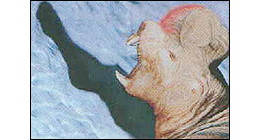
Brunus edwardii (aka Teddy Bear), which was described as a species "commonly kept in homes in the United Kingdom and other countries in Europe and North America." The article warned:
"63.8 percent of households are inhabited by one or more of these animals... The public health implications of this fact are obvious, and it is imperative that more be known about their diseases."
For months afterwards the correspondence section of the journal was dominated by letters about
Brunus edwardii.
More…
The naturalist David Attenborough gave a report on BBC Radio 3 about a group of islands in the Pacific known as the Sheba Islands. He played sound recordings of the island’s fauna, including a recording of a night-singing, yodelling tree mouse called the Musendrophilus. He also described a web-footed species whose webs were prized by inhabitants of the island as reeds for musical instruments.
During an interview on BBC Radio 2, astronomer Patrick Moore revealed that at exactly 9:47 a.m. Pluto would pass behind Jupiter, and that this alignment would result in a stronger gravitational pull from Jupiter, counteracting the Earth's own gravity and making people momentarily weigh less. He told listeners that if they jumped up and down while this was happening, they would experience a strange floating sensation.
When 9:47 a.m. arrived, BBC2 began to receive hundreds of calls from listeners who claimed to have felt the sensation. One woman insisted that she and her friends had floated around the room. Another caller complained that he ascended so rapidly that he hit his head on the ceiling.
More…
The Kansas
Hutchinson News reported that the Kansas Botanical Research Laboratory had made a breakthrough in plant communication by creating a device that allowed plants to "talk" in near-human terms.
The scientists realized they could converse with plants by translating their own voices through a computer into the form of "vibration waves" which the plants could respond to. "I'm not saying that it's possible to have any great philosophical discussion with the ferms or any nonsense like that," the chief scientist admitted, "but we do have some form of two-way communication."
More…
The
Guardian reported that scientists at Britain's research labs in Pershore had "developed a machine to control the weather." A series of articles explained that, "Britain will gain the immediate benefit of long summers, with rainfall only at night, and the Continent will have whatever Pershore decides to send it." Readers were also assured that Pershore scientists would make sure that it snowed every Christmas in Britain. A photograph showed a scruffy-looking scientist surrounded by scientific equipment, with the caption, "Dr. Chisholm-Downright expresses quiet satisfaction as a computer printout announces sunshine in Pershore and a forthcoming blizzard over Marseilles."
More…
The
Herald-News in Roscommon, Michigan reported that 3 lakes in northern Michigan had been selected to host "an in-depth study into the breeding and habits of several species of fresh-water sharks." Two thousand sharks were to be released into the lakes including blue sharks, hammerheads, and a few great whites. The experiment was designed to determine whether the sharks could survive in the cold climate of Michigan, and apparently the federal government was spending $1.3 million to determine this. A representative from the National Biological Foundation was quoted as saying that there would probably be a noticeable decline in the populations of other fish in the lake because "the sharks will eat about 20 pounds of fish each per day, more as they get older."
County officials were said to have protested the experiment, afraid of the hazard it would pose to fishermen and swimmers, but their complaints had been ignored by the federal government. Furthermore, fishermen had been forbidden from catching the sharks. The report concluded by again quoting the National Biological Foundation representative, who said that "We can't be responsible for people if they are attacked. Besides, anyone foolish enough to believe all this deserves to be eaten."
More…
MIT's
Technology Review published an article titled "Retrobreeding the Woolly Mammoth" that described an effort by Soviet scientists, led by Dr. Sverbighooze Yasmilov, to insert DNA from woolly mammoths found frozen in Siberian ice into elephant cells. The cells would then be brought to term inside elephant surrogate mothers. Many members of the media believed the report to be real.
More…
Lloyd Stallkamp, electronics instructor at South Dakota's National College, announced that Albert Einstein was wrong about light being made up of photons that travel at the speed of light. Stallkamp had discovered that, in reality, it was darkness that was composed of "darkons" that were gradually filling up the universe:
"All the caves are filled with dark already. Outer space is filled with dark already. Once the sun gets filled up, that's it. There's no other place to put it... We can see inside the sunspots that the sun is black inside. So my theory is that the sun is going to fill up with black and become a black hole."
Stallkamp also had concluded that darkness was heavier than light: "Just look in a pool of water. You'll see all the dark has settled to the bottom."
More…
Garden News magazine revealed that a prehistoric plant had been discovered growing out of a fossilised stegosaurus dropping found preserved within a Mojave Desert cave. The plant, dubbed the dinosaur vine, was being studied by Professor Adge Ufult.
More…
Discover magazine reported that an archaeologist digging in Jerusalem had uncovered the legendary Holy Grail. The archaeologist, Leon Decoeur, found the grail on Christmas eve when, for no particular reason, he had decided to work late at the dig. The discovery had sparked intense excitement and controversy in the scientific community, although some doubted Decoeur's findings, remembering that 15 years earlier he had claimed to have found the Sermon on the Mount. Most exciting of all, blood had been found at the bottom of the cup. Decoeur hypothesized that the DNA of Jesus might reveal, once and for all, "that we're closer to chimpanzees than to the deity."
More…
Discover magazine revealed the discovery by wildlife biologist Dr. Aprile Pazzo of a fascinating new species, the hotheaded naked ice borer, which she had encountered while studying penguins in Antarctica. They were about half a foot long, very light, and had a bony plate on their head that could become burning hot, allowing them to bore tunnels through the ice at high speeds, "much faster than a penguin can waddle." Packs of them would rapidly melt the ice beneath a penguin, causing it to sink into the slush, at which point they would surround the creature and consume it.
More…
The Glasgow Herald described the recent arrival in Britain of a new energy-saving miracle: heat-generating plants. These plants, known by the scientific name Solar complexus americanus, were imports from Venezuela. One plant alone, fed by nothing more than three pints of water a day, generated as much heat as a 2kw electric fire. A few of these horticultural wonders placed around a house could entirely eliminate the need for a central-heating system, and when submerged in water, the plants created a constant supply of hot water. The Scandinavian botanist responsible for discovering these hot-air producers was Professor Olaf Lipro.
Discover Magazine reported that physicists had discovered a new fundamental particle of matter, dubbed the Bigon. It could only be coaxed into existence for mere millionths of a second, but amazingly, when it did materialize it was the size of a bowling ball. It was theorized that the Bigon might be responsible for a host of unexplained phenomena such as ball lightning, sinking souffles, and spontaneous human combustion.
More…
The April 1998 issue of the
New Mexicans for Science and Reason newsletter contained an article claiming that the Alabama state legislature had voted to change the value of the mathematical constant pi from 3.14159 to the 'Biblical value' of 3.0. Before long the article had made its way onto the internet, and then it rapidly made its way around the world, forwarded by people in their email. It only became apparent how far the article had spread when the Alabama legislature began receiving hundreds of calls from people protesting the legislation. The original article, which was intended as a parody of legislative attempts to circumscribe the teaching of evolution, was written by physicist Mark Boslough.
More…
The scientific journal
Nature, in its online edition, revealed the discovery of "a near-complete skeleton of a theropod dinosaur in North Dakota." The discovery was referred to in an article by Henry Gee discussing the palaeontological debate over the origin of birds. The dinosaur skeleton had reportedly been discovered by Randy Sepulchrave of the Museum of the University of Southern North Dakota.
The exciting part of the discovery, according to the article, was that "The researchers believe that the dinosaur, now named as
Smaugia volans, could have flown."
More…
The British supermarket chain Tesco published an advertisement in
The Sun announcing the successful development of a genetically modified 'whistling carrot.' The ad explained that the carrots had been engineered to grow with tapered airholes in their side. When fully cooked, these airholes caused the vegetable to whistle.
More…
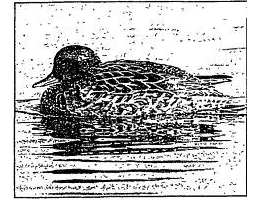
British Waterways released a study claiming that a study conducted by Dr. Olaf Priol had found that ducks who lived on canals weighed, on average, a pound more than ducks who lived on rivers. The slow-moving canal water apparently provided the ducks with less opportunity for exercise, and so they gained weight.
The study had an embargo date of April 1st (meaning the media was not supposed to make it public until then), but reporter Declan Curry of BBC Business News, not recognizing the study as a joke, broke the embargo and discussed it on-air on March 30th.
More…
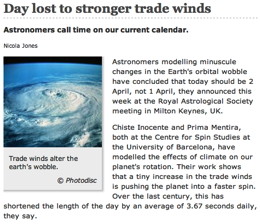
Nature.com reported a
startling discovery made by astronomers. The increasing force of trade winds had slightly accelerated the spin of the Earth. As a consequence the length of the day had decreased over the past century, meaning that the calendar was now inaccurate: "Just as February has an extra day in leap years, we conclude that March ought to have 30 days once every 100 years, not 31… If we start the adjustments this year we should be back on track." In other words, "today should be 2 April, not 1 April."
More…
An Oslo Township announced that city workers had discovered the remains of a 15,000-year-old body while digging part of a tunnel for the local subway system. As a result, work on the subway had been halted indefinitely. The skeleton was going to be named “Homo Metro” because of where it had been found.
More…
Scientific American ran an editorial, titled "Okay, we give up," revealing that the magazine would henceforward give equal space to the views of Creationists:
"This magazine's coverage of so-called evolution has been hideously one-sided. For decades, we published articles in every issue that endorsed the ideas of Charles Darwin and his cronies… Where were the answering articles presenting the powerful case for scientific creationism? Why were we so unwilling to suggest that dinosaurs lived 6,000 years ago or that a cataclysmic flood carved the Grand Canyon? Blame the scientists."
More…
RealClimate.org detailed the work of Dr. Ewe Noh-Watt of the New Zealand Institute of Veterinary Climatology, who had discovered that global warming was caused not by a buildup of carbon dioxide in the atmosphere, but rather by the decline of New Zealand's sheep population. The reasoning was that sheep are white, and therefore large numbers of sheep increased the planet's albedo (the amount of sunlight reflected back into space). As the sheep population declined, the ground absorbed more solar radiation, thus warming the planet: "It can be seen that the recent warming can be explained entirely by the decline in the New Zealand sheep population, without any need to bring in any mysterious so-called 'radiative forcing' from carbon dioxide, which doesn't affect the sunlight (hardly) anyway — unlike Sheep Albedo."
More…
The Bristol Zoo Gardens
announced it was conducting an experiment to gauge the sensory sensitivity of gorillas, hoping to find out "whether the scent of humans in a gorilla's environment can be picked up even after the humans have gone." The humans, however, would need to be naked in order to leave the strongest scent behind.
Christoph Schwitzer, Head of Research, explained: "We are monitoring the gorillas' behaviour following gardeners carrying out work on Gorilla Island – once fully clothed, as a control group, and again without clothes, to see if there is a significant difference."
The zoo later admitted that the experiment never took place, although it noted, "it is true that gorillas have a good sense of smell and are able to detect strong odours in their environment such as human sweat or the musk of an unknown gorilla."
More…
The University of Michigan College of Engineering released a video revealing that their researchers had created a teleportation machine. Materials Science Prof. Xavier Vlad demonstrated how he could teleport a small key from one end of the machine to the other. He further explained that the process was discovered by accident — just like the discovery of Post-It notes.
More…
CERN, the Geneva-based organization that operates the world's largest particle physics laboratory, announced that henceforth all its webpages would be written in Comic Sans. CERN Head of Communications James Gillies noted, "We thought the most effective way to communicate our research into the fundamental structure of matter at the very boundaries of technology was by changing the font." He added, "This is a serious laboratory, with a serious research agenda... And it makes the letters look all round and squishy."
CERN added that all especially important physics results would be accompanied online by animations of little clappy hands.
More…
In response to customer demand, globemaker MOVA debuted a Flat Earth Globe. The company boasted, "The Flat Earth MOVA Globe removes science and facts from the conversation to better represent the world we all live on. Behold an Earth that does not spin and is not spherical. Matter of fact, it’s flat as a pancake." The new globe also featured no latitude and longitude lines "for a clean, no-nonsense look," as well as an "Ice Wall edge so we don’t fall off."
More…