The
Los Angeles Times ran a front-page "exclusive" reporting that Hamburg scientist Dr. Eugene Lirpa had discovered good health to be caused by a bacteria, "Bacillus sanitatis." Sick people were lacking this "germ of health," but they could be cured simply by breathing in the same air as healthy people.
This story appears to be the only time the
LA Times ever perpetrated an April Fool hoax.
More…
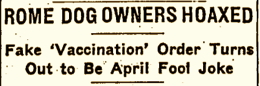
Over 200 dog owners gathered with their pets near the Porta San Lorenzo in Rome after reading in the
Ricostruzione newspaper that the municipal veterinary authority had demanded that all dogs be brought in for "vaccination against a sudden outbreak of typhus" that was easily communicable to humans.
"While Allied medical officers expressed astonishment, those who took the notice in good faith learned that even the address given in the story was nonexistent."
The
Ricostruzione paper was itself a victim of the hoax, having fallen for a fake April Fool announcement. [
New York Times - Apr 2, 1945]
More…
The April 1972 issue of the British
Veterinary Record contained an article about the diseases of
Brunus edwardii (aka Teddy Bear), which was described as a species "commonly kept in homes in the United Kingdom and other countries in Europe and North America." The article warned:
"63.8 percent of households are inhabited by one or more of these animals... The public health implications of this fact are obvious, and it is imperative that more be known about their diseases."
For months afterwards the correspondence section of the journal was dominated by letters about
Brunus edwardii.
More…
BBC Radio interviewed a "Dr. Clothier" about the government's efforts to stop the spread of Dutch Elm Disease. Dr. Clothier described some recent discoveries, such as the research of Dr. Emily Lang who had found that exposure to Dutch Elm Disease immunized people to the common cold.
Unfortunately, there was a side effect. Exposure to the disease also caused red hair to turn yellow. This was attributed to a similarity between the blood count of redheads and the soil conditions in which affected trees grew. Therefore, redheads were advised to stay away from forests for the foreseeable future. Dr. Clothier was actually the comedian Spike Milligan disguising his voice.
BBC TV's Nationwide news program ran a segment about a well located on the farm of James Coatsworth in Rothbury, Northumberland. This well supposedly had the power to make hair grow on bald men’s heads.
The Russian newspaper Moskovsky Komsomolets reported that Mikhail Gorbachev had volunteered to test a revolutionary new anti-baldness spray. As a result he had sprouted a new head of hair, covering his famous birthmark. Accompanying the article was a picture of Gorbachev on a trip to South Korea sporting his new, curly-locked look.
Russian Public TV reported that a spring had been discovered in the Caucasus mountains with the ability to cure male baldness. "According to the latest statistics, the number of bald men in Adygeya has plummeted," the report noted. The news program showed "before" and "after" pictures of the man who had made the discovery. (The BBC perpetrated a
similar April Fool's Day hoax in 1977.)
More…
The website BetterHumans.com posted news of the first case of a human catching a computer virus:
"A software developer from Houston, Texas has become the first human to contract a computer virus, microbiologists have confirmed. John Newman, an employee of vTouch Systems, came into contact with the virus through the use of a neural interface that his company is developing. Avril DuChamps, a spokesperson for vTouch Systems, confirmed yesterday at a press conference that Newman had come down with the virus. All activities at vTouch have been suspended until further notice."
More…
Norway's
Aftenposten reported a plan by government health authorities to implant electronic id chips under patient's skin in order to better monitor their medical needs. Health workers would be able to monitor their movements and know when they entered a hospital.
Aftenposten later noted that over 2,000 people clicked on a link that accompanied the internet version of the story for people who wanted to participate in the project.
More…
NPR also ran a story about the
growing use of performance-enhancing drugs (steroids) in the world of music. It stated that: "Something is happening in the world of music. Musicians are playing faster, louder, and stronger than they ever have before… Rumors have been circulating for some time that just like in the world of sports performance enhancing drugs may be the cause."
More…
National Public Radio's Weekend Edition Sunday
reported that New York City Democratic councilman David Yassky had called for a ban on obnoxious ring tones. The councilman claimed that objectionable ring tones were costing the economy upwards of $1.2 billion and were the cause of numerous fights induced by "ring-tone rage." As of April 1, 2008, NPR reported, cell phone users would be restricted to four city-approved ring tones.
More…
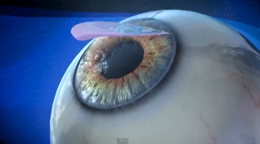
Jen Sands-Windsor reported for NPR's
Morning Edition about a new surgical procedure that made people's eyes "act like 3D glasses," eliminating the need to wear special glasses when watching 3D movies or TV.
One recipient of the surgery raved, "Seeing 'Gnomeo & Juliet' without those horrible glasses was life-changing."
Unfortunately, a side-effect of the surgery was blurred vision when not looking at a 3D screen, but the developer of the procedure was working on corrective lenses "that will allow our patients to see real life normally."
More…