Google unveiled
"MentalPlex" search technology that read the user's mind to determine what the user wanted to search for, thus eliminating the need for typing. Users were invited to peer intently at an animated spinning circle while projecting a mental image of their search request.
If the MentalPlex circle was clicked, search results for "April Fools" appeared, as well as a notice that MentalPlex was "unclear on whether your search is about money or monkeys."
More…
Google revealed the secret at the heart of its search technology:
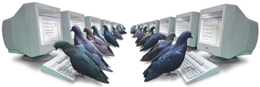
PigeonRank. Clusters of pigeons had been trained to compute the relative values of web pages:
PigeonRank's success relies primarily on the superior trainability of the domestic pigeon (Columba livia) and its unique capacity to recognize objects regardless of spatial orientation… By collecting flocks of pigeons in dense clusters, Google is able to process search queries at speeds superior to traditional search engines, which typically rely on birds of prey, brooding hens or slow-moving waterfowl to do their relevance rankings. When a search query is submitted to Google, it is routed to a data coop where monitors flash result pages at blazing speeds. When a relevant result is observed by one of the pigeons in the cluster, it strikes a rubber-coated steel bar with its beak, which assigns the page a PigeonRank value of one. For each peck, the PigeonRank increases.
More…
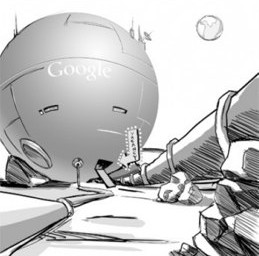
Google announced they were accepting applications for positions at Copernicus Center, their new "lunar hosting and research center." Applicants, Google noted, must be "capable of surviving with limited access to such modern conveniences as soy low-fat lattes, The Sopranos and a steady supply of oxygen." Google went on to say that the facility, set to open in Spring 2007, would house 35 engineers, 27,000 low cost Web servers, two massage therapists and a sushi chef.
More…
Google branched out into a new product area with the announcement of
Google Gulp, a high-tech "smart drink" that featured a DNA scanner embedded in the lip of the bottle that would read "all 3 gigabytes of your base pair genetic data in a fraction of a second, fine-tuning your individual hormonal cocktail in real time using our patented Auto-Drink™ technology, and slamming a truckload of electrolytic neurotransmitter smart-drug stimulants past the blood-brain barrier to achieve maximum optimization of your soon-to-be-grateful cerebral cortex."
Plus, the company added, "it's low in carbs!"
More…
Google announced a new technology called
TiSP (Toilet Internet Service Provider) that would allow it to provide free in-home wireless broadband service. Users would connect to the internet via their bathroom's plumbing system. Installation involved dropping a weighted fiber-optic cable down the toilet and then activating the "patented GFlush™ system" which would send the cable "surfing through the plumbing system to one of the thousands of TiSP Access Nodes." Google promised that it would provide a higher-performance version of the service for businesses which would include "24-hour, on-site technical support in the event of backup problems, brownouts and data wipes."
More…
Google Australia debuted
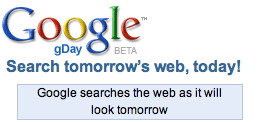
gDay technology "enabling you to search content on the internet before it is created":
"The core technology that powers gDay™ is MATE™ (Machine Automated Temporal Extrapolation). Using MATE's™ machine learning and artificial intelligence techniques developed in Google's Sydney offices, we can construct elements of the future. Google spiders crawl publicly available web information and our index of historic, cached web content. Using a mashup of numerous factors such as recurrence plots, fuzzy measure analysis, online betting odds and the weather forecast from the iGoogle weather gadget, we can create a sophisticated model of what the internet will look like 24 hours from now."
More…
Google unveiled
Gmail Autopilot, a feature that automatically reads and responds to your email, saving you the time of doing this. It boasted that Autopilot could mirror any communication style, could also work for Gmail chat, and would work even if both sender and recipient had Autopilot on:
"Two Gmail accounts can happily converse with each other for up to three messages each. Beyond that, our experiments have shown a significant decline in the quality ranking of Autopilot's responses and further messages may commit you to dinner parties or baby namings in which you have no interest."
More…
Google Australia announced it had partnered with the Australian rules football league to develop the
gBall.
This was a rugby ball with "inbuilt GPS and motion sensor systems to monitor the location, force and torque of each kick." Google could then provide users with "detailed online kicking tips, style suggestions and tutorials based on their gBall kicking data." As an added bonus, "Kicking data is also sent to national talent scouts and player agents. The gBall will vibrate if talent scouts or player agents want to make contact with the user."
More…
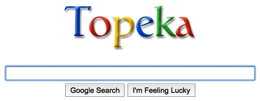
Google announced that it was officially changing its name to Topeka. The name change was a response to the recent decision by the mayor of Topeka, Kansas to change the name of his city to Google.
Google remarked: "We didn't reach this decision lightly; after all, we had a fair amount of brand equity tied up in our old name. But the more we surfed around (the former) Topeka's municipal website, the more kinship we felt with this fine city at the edge of the Great Plains."
Google cautioned that its new product names might take some getting used to. For instance, the former Google Maps would now be called Topeka Maps. But it assured everyone that its services would continue to offer information from across the globe, not just from Topeka.
More…
Google debuted
Gmail Motion, designed to allow people to write emails using only gestures, which Gmail would track using your computer webcam and a "spatial tracking algorithm." Command gestures included:
open a message by making a motion with your hands as if you're opening an envelope,
reply by pointing backward over your shoulder with your thumb, and
reply all by pointing backward with both thumbs.
More…
Gmail introduced "Gmail Tap". This app replaced the QWERTY keyboard on mobile phones with two keys, a dot and a dash, allowing users to communicate using morse code. This not only simplified the act of typing on a phone, but also allowed it to be done without looking at the screen, making it "ideal for situations where you need to discreetly send emails, such as when you're on a date or in a meeting with your boss."
More…
Recognizing the continuing popularity of retro gaming systems,
Google Maps announced that it would soon be offering a version of Google Maps for the Nintendo Entertainment System, featuring low-res, 8-bit maps and "a timeless soundtrack". It would be the first time an NES cartridge had been sold in 18 years. Though until the cartridges were available in stores, the public was invited to experience a trial version of the 8-bit maps online.
In case of technical difficulties, users were directed to "blow on the cartridge to fix bugs."
More…
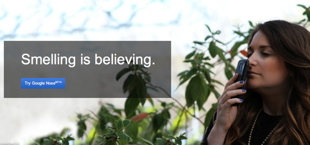
Google announced
Google Nose Beta — allowing people to smell what they searched for online. The company explained that they had leveraged "new and existing technologies to offer the sharpest olfactory experience available," with their "street sense vehicles" roaming far and wide to index millions of different scents, thereby creating the "Google Aromabase" of 15M+ "scentibytes."
The scents were smellable by people at their computers because Google had figured out how to manipulate the photons coming out of the screen, causing them to intersect with "infrasound waves," thereby temporarily aligning molecules to emulate particular scents.
More…
Google Netherlands revealed that its researchers, working in collaboration with Wageningen University, had developed a cutting-edge technology that allowed them to communicate with plants — specifically with tulips, which had been the initial focus of the research due to the Netherlands historical relationship with this plant. The result was a new product, Google Tulip, which let users around the world communicate with any tulip. "Talk to your tulip today," promised the company.
More…