Places that exist only on April 1st
"The equator was recently photographed for the first time in history. It turned out to be a broad white line which this schooner had difficulty in hurdling." [
Life - Apr 4, 1938]
More…
Westward Television, a British TV studio, produced a documentary feature about the village of Spiggot whose residents were refusing to accept the new decimal currency recently adopted by the British government. The feature included interviews with local officials from Spiggot. The documentary prompted an outpouring of support for this rebellious village from the British public, and many people expressed a willingness to join it in its anti-decimal crusade. Unfortunately for this burgeoning rebellion, the village of Spiggot did not exist.
More…
John Lennon and Yoko Ono issued a statement announcing the birth of a new "conceptual country," Nutopia, which consisted of "no land, no boundaries, no passports, only people."
Claiming to be ambassadors of Nutopia, and therefore eligible for diplomatic immunity, Lennon and Ono waved white handkerchiefs at a press conference, saying, "This is the flag of Nutopia; we surrender" (referring to Lennon's immigration problems, as he and Ono tried to remain in the United States).
The official seal of Nutopia showed a picture of a seal (the marine animal).
More…
BBC Radio 4’s Today Show also reported about a controversy involving the Island of Foley, located between Sheppey and the Kent Coast. Apparently the island was the cause of numerous shipwrecks. Therefore, authorities had decided to destroy it. However, because this decision had been protested by conservationists, authorities had decided to tow it somewhere safer instead. Towing islands has been a source of jokes as far back as 1824, when a hoaxer supposedly had the residents of Manhattan believing that their island was going to be towed out to sea.
The naturalist David Attenborough gave a report on BBC Radio 3 about a group of islands in the Pacific known as the Sheba Islands. He played sound recordings of the island’s fauna, including a recording of a night-singing, yodelling tree mouse called the Musendrophilus. He also described a web-footed species whose webs were prized by inhabitants of the island as reeds for musical instruments.
The Guardian published a seven-page "special report" about San Serriffe, a small republic located in the Indian Ocean consisting of several semi-colon-shaped islands. A series of articles described the geography and culture of this obscure nation. The report generated a huge response. The Guardian's phones rang all day as readers sought more information about the idyllic holiday spot. However, San Serriffe did not actually exist. The report was an elaborate joke — one with a typographical twist, since numerous details about the island (such as its name) alluded to printer's terminology.The success of the hoax is widely credited with inspiring the British media's enthusiasm for April Foolery in subsequent years.
More…
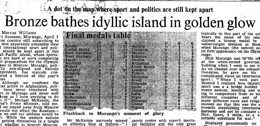
The
London Times reported on a small, Pacific island state named Murango whose inhabitants (most of whom seemed to be of British descent) were busy preparing to send a delegation to the Moscow Olympics, despite the western boycott of the games. The Murango islanders were said to enjoy two things most in life: their local drink, ourakino, and sports. In 1972 the small island state had supposedly achieved a brief moment of glory on the international stage by winning a bronze medal in boxing during the 1972 Munich Olympics. The winner of the medal had been named Dick T. Murango. However, Dick T. Murango and the island of Murango were entirely fictitious, though in 1972 a man named Dick T. Murunga
had won a bronze medal for boxing. Mr. Murunga, however, was from Kenya.
More…
NPR's
All Things Considered ran a segment about the threat of extinction facing the Vince Lombardi Fondue Springs, the "last surviving spring of natural fondue cheese in the United States," located in the fondue country of northern Wisconsin.
For years the fondue springs had been a "point of pilgrimage for cheese communicants." But now, the Cheese Watch Society warned, the Fondue Pocket was reducing. The society recommended "a highly trained force of cheese rangers to control visitors to the fondue pocket using sniffer dogs." If steps weren't taken, the society warned, the cheese would soon be gone.
More…
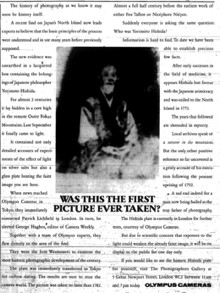
The camera manufacturer Olympus ran an ad in
The Guardian announcing the discovery of "the first picture ever taken." The picture had been discovered "in a cave high in the remote Outer Fokus Mountains." It had been taken by Yorimoto Hishida around 1782, "almost a full half century before the earliest work of either Fox Talbot or Nicéphore Niépce."
More…
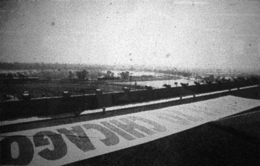
Airline passengers descending into Los Angeles Airport saw an 85-foot-long yellow banner on the ground that spelled out, in 20-foot-high red letters, "Welcome to Chicago." It was raised above the Hollywood Park race track, about three miles from the airport. Park spokesman Brock Sheridan explained, "It was something we always wanted to do. We thought it would be kind of funny and our new management... thought it would be a great practical joke." The sign remained up for two days.
More…
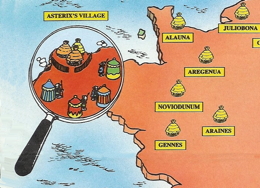
The Independent announced the discovery by archaeologists of the 3000-year-old village of the cartoon hero Asterix — found at Le Yaudet, near Lannion, France, in almost precisely the location where Rene Goscinny, Asterix's creator, had placed it in his books. The expedition was led by Professor Barry Cunliffe, of Oxford University, and Dr. Patrick Galliou, of the University of Brest. The team found evidence that the small village had never been occupied by Roman forces. They also discovered Celtic coins printed with an image of a wild boar (the favorite food of Asterix's friend Obelix), as well as a large collection of rare Iron Age menhirs (standing stones) "of the precise size favoured by the indomitable Obelix whose job as a menhir delivery man has added a certain academic weight to the books."
More…
The
Moscow Tribune went out onto the streets of Moscow to ask people what they thought about the ethnic cleansing in Brutistan. They received a variety of concerned replies. The joke was that Brutistan does not exist.
More…
NPR's
All Things Considered reported that the U.S. Post Office was introducing a new
portable zip codes program that would allow individuals to take their zip code with them when they moved. The program was inspired by a recent FCC ruling that allowed people to retain the same phone number wherever they moved or whatever service they switched to.
Supporters of the program noted, "A modern, mobile society… can no longer afford to remain grounded in locale-specific zip codes… a zip code is a badge of honor, an emblem symbolizing a citizen's place in the demographic, rather than geographic, landscape."
More…
Dutch entrepreneur Merijn Everaarts unveiled a plan to create a floating island made entirely out of plastic. His idea was that he would use a machine called a "Sea Duster" to collect plastic waste floating in the ocean — the so-called "plastic soup" of marine debris.
The machine would then process this waste into buoyant plastic blocks, using algae as a binder resin to attach them together. Slowly the island would form, like Lego blocks being put together.
The new plastic landmass, which he planned to call "Dobber Island," would be constructed off the coast of Zandvoort, a popular Dutch beach town.
More…